



How to Spot Fake Antique Buddhist Statues
How to Spot Fake Antique Buddhist Statues
Table of Contents
- Why Forgery Is Common in the Buddhist Statue Market
- Signs of Artificial Patina on Bronze Statues
- Characteristics of Authentic Buddhist Iconography
- Tools for Examining Antique Sculptures
- Material Composition and Workmanship: Reading the Surface
- Scientific Testing and Digital Provenance: New Verification Methods
- Legal and Ethical Considerations When Buying Antique Buddhist Statues
- Conclusion
- Frequently Asked Questions
Why Forgery Is Common in the Buddhist Statue Market
Learning how to spot fake antique Buddhist statues starts with understanding why they exist. Demand for antique Buddhist and Hindu sculpture has grown faster than the supply of genuine pieces, and that gap invites reproduction. A workshop can cast a new bronze, bury it in acidic soil for a few months, and produce something that fools a casual buyer. The result: a market where forgeries sit beside authentic works, sometimes in the same shop.
Provenance is a claim. Patina, tool marks, and iconography are evidence. This guide shows you how to read that evidence, step by step, so you can tell a genuine piece from a clever fake before you commit.
Signs of Artificial Patina on Bronze Statues
Patina is the surface layer that forms on bronze over decades of exposure to air, moisture, and human touch. Artificial patina is applied in hours, and it almost always leaves clues.
Real patina builds unevenly. It pools in crevices, thins on high points, and shows a range of colors from brown to green to near-black. Fake patina tends to look flat and uniform, or it flakes off in chips. Rub a hidden spot with a soft cloth. If green color transfers easily, the finish is painted on.
Chemical Versus Natural Oxidation
Natural oxidation is slow. It develops in layers and bonds with the metal. Chemical oxidation, often done with acids or sulfur compounds, sits on top of the surface. Under a bright light, chemical patina looks slightly waxy or powdery.
Look for these tells:
- Uniform color across the whole statue, with no wear on raised areas
- Bright green residue in the deepest recesses, where real patina is usually darkest
- A sharp smell of vinegar or sulfur when you get close
- Fresh metal visible where the patina has chipped
Genuine pieces show wear where hands would touch them: the face, the base, the edges of robes. A statue with pristine patina everywhere has probably never been handled, which is odd for something supposedly centuries old.
Characteristics of Authentic Buddhist Iconography
Authentic Buddhist iconography follows strict rules that have changed little across centuries, but those rules differ by region and era. A forger working from photos often gets the small details wrong, and those details are your best test.
Every element carries meaning. The mudra (hand gesture) must match the figure's role. The urna (the mark between the eyebrows) and the ushnisha (the cranial bump) appear on Buddha figures but not on most bodhisattvas. The number of lotus petals on a base often follows regional conventions, not random choice.
Mudras, Urna, and Ushnisha: Getting the Details Right
Check these features against a reliable reference:
- Mudra: Fingers should be relaxed and natural, not stiff or fused. The Dhyana mudra rests in the lap with palms up.
- Urna: Usually a small raised dot. On fakes, it is often painted on or missing entirely.
- Ushnisha: Should flow into the hairline. A seam or a sharp step between the head and the bump signals a mold.
- Hands and ears: Ears on authentic pieces are long and detailed. Fakes often have thick, simplified lobes.
Hand-carved pieces show slight asymmetry. Mold-made reproductions come out too perfect, then get "aged" to hide it. A figure that is perfectly symmetrical in every detail deserves a closer look.
Regional Stylistic Checklists
Most guides stop at "know the iconography." The real edge is knowing how the same figure looks different depending on where and when it was made. Use these checklists as a first-pass filter.
Gandhara (roughly 1st-5th century, northwest region):
- Hellenistic influence is the tell: wavy hair, sharp nose bridge, heavy drapery folds that look almost like a toga.
- Schist and stucco dominate; bronze is rarer.
- The ushnisha is often a smooth, rounded bun rather than a tight curl pattern.
- Halo, when present, is plain and disc-like, not perforated.
Pala (roughly 8th-12th century, northeast India and Bengal):
- Black basalt or dark schist with a high polish that survives centuries.
- Slim waist, broad shoulders, and a body that reads as almost fluid.
- Jewelry is dense and finely chased, especially on bodhisattvas.
- The lotus base has wide, fleshy petals with a pronounced double rim.
Ming and Qing (roughly 14th-20th century):
- Gilt bronze dominates; look for a thick, warm gold rather than a thin yellow wash.
- The ushnisha is often a distinct, jewel-topped mound.
- Robes fall in flat, stylized folds rather than naturalistic drapery.
- Sealed bases are common; a genuine seal is soldered flush, not glued.
Southeast Asian (Khmer, Thai, Burmese):
- Khmer bronzes favor broad faces, thick lips, and a continuous browline.
- Thai pieces often show a flame finial on the ushnisha and very smooth, almost glassy surfaces.
- Burmese wood and lacquer figures are light for their size; if it feels heavy, question the material.
When Iconography and Style Disagree
The strongest signal is a mismatch between iconography and style. A figure with correct Pala jewelry but Gandhara drapery is not a rare hybrid; it is usually a modern copy assembled from reference photos. Genuine pieces are internally consistent because the artist worked inside one tradition. When the parts do not agree, treat the piece as suspect until documentation proves otherwise.
Tools for Examining Antique Sculptures
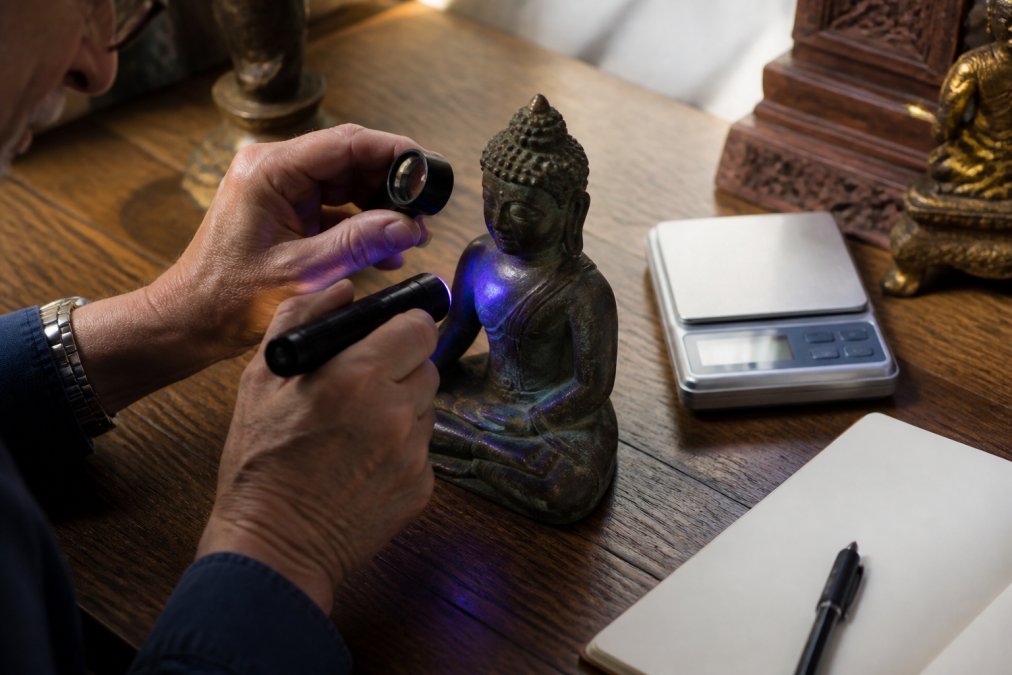
You do not need a lab to inspect a statue. A few simple tools reveal most fakes.
A magnifying loupe (10x is enough) shows tool marks, casting seams, and paint layers. A UV flashlight makes modern repairs and repaints glow under black light. A soft cloth and a notebook let you test and record what you find.
Bring these to any viewing:
- 10x jeweler's loupe
- UV blacklight
- Soft cotton cloth
- Measuring tape
Look for casting seams along the sides and back.
Material Composition and Workmanship: Reading the Surface
Material and workmanship tell you how a statue was made, and that tells you when. Bronze, wood, and stone each age in their own way.
Wood Aging, Insect Activity, and Structural Clues
Wood statues age from the inside out. Look for wood aging signs: fine cracks along the grain, darker color near the base, and a dry, light weight. Fresh wood feels heavy and smells like sawdust.
Scientific Testing and Digital Provenance: New Verification Methods
Science and digital records now back up what your eyes see. This is where most buyer guides stop, and where the real answers often begin.
What Each Test Actually Measures
X-ray fluorescence (XRF) reads the elemental composition of a metal surface without damaging the piece. It tells you whether a bronze is a true tin-bronze alloy or a modern brass with zinc added for cheap casting. It does not date the object. A forger can pour an old-style alloy tomorrow. Use XRF to rule out material anachronisms, not to confirm age.
Reading a Lab Report
Ask for the full report, not a summary. A credible report names the lab, the method, the sample location, the instrument, and the margin of error. Look for these red flags:
- No sample location listed (where was the drill taken?)
- A date range so wide it covers both antique and modern
- No margin of error or confidence interval
- A lab name you cannot verify independently
Digital Provenance in Practice
Digital provenance uses secure records to track an object's history. Some dealers now log ownership, photos, and test results in tamper-resistant databases. This does not replace paperwork, but it makes a documented chain harder to fake.
Ask sellers for:
- Any prior test reports, with the lab's name and sample locations
- A written ownership history with dates
- High-resolution photos of marks, seams, and repairs
- A clear statement of what is antique and what is not
The Cost-and-Time Trade-Off
Testing is not free and not fast. XRF is the quickest and least invasive, often done on-site. TL requires drilling and weeks of lab time. Carbon dating is slower still. For a low-value piece, testing may cost more than the statue is worth. For a high-value purchase, budget for at least two independent tests and treat the expense as part of the price.
Legal and Ethical Considerations When Buying Antique Buddhist Statues
The law matters as much as the art. Buying the wrong piece can mean losing it, or worse.
Conclusion
The hardest part of buying antique Buddhist sculpture is trusting the object when the seller's story sounds perfect. Slow down, use your tools, and let the patina, iconography, and paperwork speak for themselves.
Frequently Asked Questions
How can I tell if the patina on a Buddhist statue is artificial?
Artificial patina often looks uniform and sits only on the surface, while genuine oxidation builds up unevenly in crevices and recesses over decades. Try wiping a small area with a soft cloth: real patina stays put, while applied finishes may rub off or feel waxy. Under UV light, artificial coatings can fluoresce. Also check for a chemical smell, which suggests a recently applied finish rather than natural aging.
What physical characteristics indicate a modern reproduction of a Buddhist statue?
Modern reproductions often show mold seams, perfectly symmetrical features, and sharp, machine-cut edges that hand-carved pieces lack. Look for uniform thickness in the base, identical facial expressions across supposedly unique pieces, and fresh tool marks that cut through the patina rather than sitting beneath it. Genuine antiques show slight asymmetries and wear patterns consistent with age and handling.
What tools do I need to examine an antique sculpture before buying?
A 10x jeweler's loupe for surface detail and a UV flashlight to spot modern coatings are useful.
How do I distinguish between hand-cast and mass-produced sculptures?
Hand-cast pieces made with the lost-wax method show subtle variations in thickness and surface texture, and may retain faint casting investment residue in recesses. Mass-produced statues are often slip-cast or die-stamped, producing identical copies with uniform walls, visible seam lines, and a hollow, tinny sound when tapped. Checking the base interior usually reveals the difference quickly.
