



Identifying Authentic Buddhist Bronze Statues: A Collector's Guide
Identifying Authentic Buddhist Bronze Statues: A Collector's Guide
Table of Contents
Visual Authentication: What Authentic Buddhist Bronze Statues Look Like
The surface of an authentic Buddhist bronze statue tells a story written in texture, light, and time. Hand-cast pieces display subtle irregularities from human craftsmanship, while machine-made reproductions betray themselves through uniformity that feels too perfect. Experienced collectors immediately notice whether the surface invites touch or repels it.
Surface Texture and Casting Quality
Run your fingers across an authentic piece and you'll sense the difference immediately. Hand-cast bronze contains micro-variations that no modern machine can replicate without looking artificial. These variations come from the mold itself, the clay or plaster used in lost-wax casting leaves its own texture signature.
Genuine pieces show "flow lines," subtle directional marks where molten bronze moved through the mold during pouring. These are not defects but evidence of the casting process. Machine-made reproductions often sand away these marks, creating an unnaturally uniform surface that catches light in a flat, lifeless way. The finish should be consistent with the intended age, an 18th-century Burmese statue should not have the polished gleam of a recently cast piece.
Hand-Cast vs Machine-Made: The Craftsmanship Difference
Hand-cast pieces, created using the lost-wax method, show evidence of human decision-making at every stage. Machine-made pieces prioritize efficiency and consistency, using rubber molds or centrifugal casting that produce identical copies with minimal variation.
Look at the base of the statue. Hand-cast pieces show subtle marks where sprues (channels for molten bronze) have been ground down. Machine-made pieces tend to have cleaner, more symmetrical bases. Every detail should reflect careful craftsmanship, hand positions (mudras), facial expression, and proportional relationships serve the spiritual purpose the statue was created to fulfill.
Patina Analysis for Bronze Antiques: Reading the Age
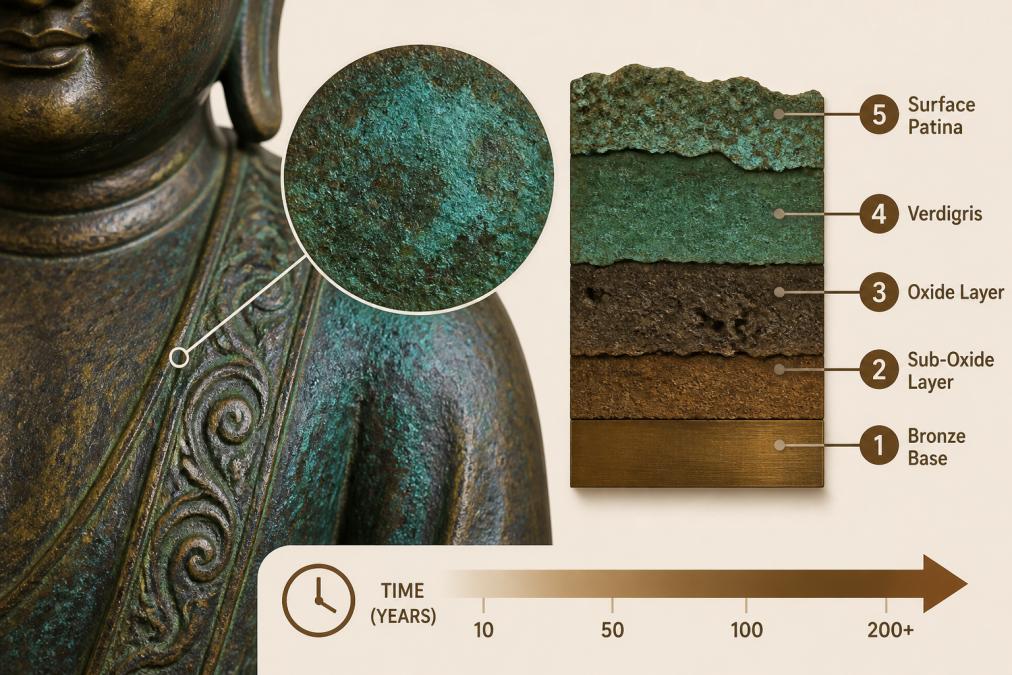
The patina of a bronze statue is its biography. This colored surface layer, ranging from deep blue-green verdigris to rich brown oxidation, develops over years and decades as the bronze reacts with oxygen, moisture, and atmospheric compounds. Understanding patina is essential for distinguishing authentic antique bronzes from modern reproductions artificially aged to deceive.
Verdigris and Oxidation Patterns
Verdigris, the distinctive blue-green patina that forms on bronze, develops through a specific chemical process. Copper in the bronze oxidizes when exposed to oxygen and moisture, creating a protective layer of copper carbonate and copper sulfate. Genuine verdigris requires years or decades to develop fully, and the pattern it creates is highly individual.
Authentic verdigris appears in layers, with variations in color and thickness reflecting the statue's exposure history. A piece kept indoors in a dry climate develops different patina than one exposed to salt air or humid conditions. These environmental signatures are nearly impossible to fake. In dry environments, verdigris tends toward darker blue-green; in humid climates near saltwater, it becomes more golden or reddish-brown. Different colored patches on a single statue suggest the piece has experienced varied environmental conditions over time, exactly what an authentic antique would show.
Artificial patination tends toward uniformity. The color is often too consistent, applied as if with a brush rather than developing naturally through oxidation. Artificial patinas also lack the crystalline structure of genuine verdigris and flake or chip in ways that reveal the underlying metal too easily.
Natural Aging vs Artificial Patination
Natural patina bonds chemically with the bronze beneath it, becoming part of the metal itself. Artificial patinas sit on the surface like paint, applied using chemical solutions that create the appearance of age without the depth.
Under magnification, genuine patina shows natural cracking patterns called crazing that follow the grain structure of the bronze. These cracks are random and organic. Artificial patinas either lack crazing or show uniform, geometric cracking patterns that look unnatural. Another indicator is "active patina", verdigris that continues to develop and change slightly over time. If you examine a statue you've owned for several years and notice the patina has changed subtly, deepened, or developed new color variations, that's a strong sign of authenticity.
Signs of a Fake Bronze Buddha: Red Flags Every Collector Should Know
Modern reproduction techniques have become sophisticated, but they leave traces that expert collectors recognize. Understanding these red flags protects you from purchasing expensive fakes marketed as authentic antiques.
Common Reproduction Techniques
The most common method for creating fake antique bronzes is rubber-mold casting. This technique is fast and cheap but introduces subtle changes that compound with each generation of copying. Details become slightly softer and less crisp, sharp edges round slightly, fine lines become less defined. This "degradation of detail" is visible under magnification.
Chemical aging is applied to create false patina. The most obvious sign is patina that's too uniform, too thick, or too perfectly distributed. Real patina develops unevenly based on environmental exposure.
Weight, Density, and Material Composition
Bronze is dense. A solid bronze statue of a given size has a specific weight range based on alloy composition. Reproductions often use cheaper alloys or hollow casting techniques that produce lighter pieces than authentic examples. Serious collectors always weigh pieces and compare the weight to documented examples of similar size and origin.
Authentic Buddhist bronzes from different regions and periods used different alloy compositions. Burmese bronzes from the 18th and 19th centuries typically contain higher tin content, making them harder than later Thai or Cambodian bronzes. Chinese bronzes often contain lead, a characteristic modern reproductions sometimes omit for safety reasons.
Hold two pieces of similar size, one known authentic and one suspect. The authentic piece should feel noticeably heavier. Genuine bronzes also show characteristic wear patterns. Areas that have been handled, the base, the lap, show thinner patina or bare bronze. The back of the head, rarely touched, retains thicker patina. Reproductions artificially aged to look uniform throughout lack these authentic wear patterns.
Mold Marks, Casting Seams, and Chasing: Technical Indicators of Authenticity
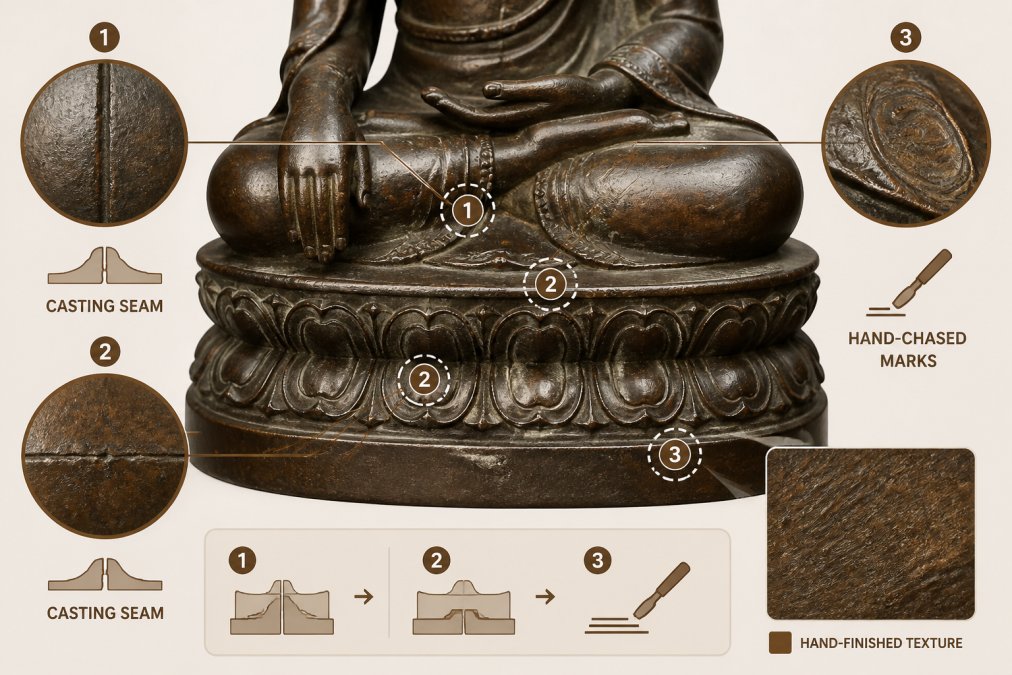
The technical evidence of how a statue was cast and finished provides reliable authentication clues. Casting seams are the lines where two halves of a mold met during casting. In hand-cast bronzes, these seams are typically ground down but remain visible as faint lines, usually running vertically down the sides or around the base. The seam lines should be straight and consistent, a signature of careful mold-making.
Mold marks appear as small depressions or raised areas where the mold had imperfections. Authentic pieces show random, organic mold marks that vary in size and distribution. Reproductions either lack mold marks entirely or show them in suspiciously regular patterns.
Chasing refers to hand-finishing work done after casting. The artist uses specialized hammers and chisels to refine details, sharpen edges, and correct imperfections. Authentic chasing shows variation in tool marks, indicating deliberate work by a skilled artisan. The chasing follows the sculpture's form logically, enhancing anatomical detail and spiritual iconography. Fake chasing added to reproductions often appears random or poorly executed, with tool marks inconsistent in depth or direction.
Antique Bronze Statue Appraisal: Provenance and Documentation
Provenance, the documented history of an object's ownership and location, is the gold standard of authentication. A statue with a clear provenance trail, especially one that includes museum documentation, auction records, or scholarly publication, carries far greater credibility than an undocumented piece.
Authentic provenance includes specific information: where the piece was acquired, when, from whom, and ideally why it was sold. The best provenance includes photographs of the piece in its previous locations or correspondence between buyers and sellers. Documentation might include certificates of authenticity from reputable dealers or auction houses. A certificate from a major international auction house like Christie's or Sotheby's carries weight because these institutions employ expert authenticators and stake their reputation on accuracy.
Historical Dating and Regional Stylistic Variations
Buddhist bronze statues from different regions and periods show distinct stylistic characteristics. A Burmese Shan Buddha from the 18th century looks different from a Thai Sukhothai Buddha or a Cambodian Khmer piece. These stylistic variations reflect regional artistic traditions, available materials, and spiritual iconographic requirements.
Burmese bronzes tend toward more angular features and elaborate ornamentation. Thai pieces often show smoother proportions and simpler decoration. Cambodian bronzes frequently display Khmer artistic influences with specific mudra positions and facial characteristics. An authentic piece should display stylistic consistency with its claimed origin and period. Modern reproductions often mix stylistic elements from different regions or periods, creating pieces that look "generically Buddhist" rather than authentically regional.
Scientific Testing Methods for Collectors
While visual inspection and provenance research form the foundation of authentication, scientific testing provides objective data that supports or contradicts preliminary conclusions.
Thermoluminescence (TL) testing measures radiation trapped in ceramic materials. If a bronze statue contains a ceramic core (used in lost-wax casting), TL testing can determine when that ceramic was last fired. X-ray fluorescence (XRF) testing analyzes the elemental composition of the bronze without damaging the piece, revealing the ratio of copper, tin, lead, and other metals in the alloy. Authentic pieces from specific regions and periods show characteristic alloy compositions. Patina analysis under scanning electron microscopy (SEM) reveals the crystalline structure and layering of the patina. Genuine verdigris shows characteristic crystal formations that artificial patinas cannot replicate.
These scientific tests are expensive, typically ranging from several hundred to several thousand dollars, and are most justified for high-value pieces or when visual authentication remains inconclusive.
Building Your Authentication Checklist
Systematic authentication requires evaluating multiple factors rather than relying on any single indicator. Create a personal checklist based on the following criteria:
Surface and Patina Assessment:
- Patina shows natural color variation and depth (strong indicator)
- Surface texture shows micro-variations consistent with hand-casting (strong indicator)
- Patina is uniform and surface-level (strong indicator of fake)
- Verdigris shows crystalline structure under magnification (strong indicator)
Casting and Finishing Evidence:
- Visible casting seams that are straight and consistent (strong indicator)
- Chasing marks show variation and follow the sculpture's form (strong indicator)
- Mold marks are random and organic (moderate indicator)
- Details are crisp and well-defined (moderate indicator)
Physical Properties:
- Weight and density match documented examples (strong indicator)
- Piece feels substantial and properly balanced (moderate indicator)
- Bronze alloy composition matches regional/period expectations (strong indicator if tested)
Provenance and Documentation:
- Clear ownership history with specific dates and sources (strong indicator)
- Documentation from reputable institutions or dealers (strong indicator)
- Publication in scholarly catalogs (strong indicator)
Stylistic Consistency:
- Style matches claimed region and period (strong indicator)
- Iconography is consistent with spiritual tradition (moderate indicator)
- Stylistic elements appear mixed or inconsistent (strong indicator of fake)
Authentic pieces typically score strongly across multiple categories. A statue with excellent patina, clear casting evidence, documented provenance, and stylistic consistency is almost certainly authentic. Conversely, a piece with uniform artificial patina, no visible casting evidence, missing provenance, and stylistic inconsistencies is almost certainly a modern reproduction.
Identifying authentic Buddhist bronze statues requires patience, knowledge, and honest skepticism. By understanding the technical evidence of hand-casting, the natural development of patina, regional stylistic variations, and the importance of provenance, you develop the expertise to make confident purchases.
At HD Asian Art, our carefully curated selection represents pieces that have passed rigorous authentication and carry the documentation that serious collectors require. Browse our collection to see authenticated pieces with complete provenance records.
| Authentication Factor | What to Look For | Confidence Level |
|---|---|---|
| Patina depth and variation | Natural color variation, crystalline structure, environmental wear patterns | Strong |
| Casting seams and marks | Straight seams, organic mold marks, visible evidence of hand-finishing | Strong |
| Weight and density | Substantial feel, appropriate weight for size and alloy type | Strong |
| Provenance documentation | Specific ownership history, institutional records, scholarly publication | Strong |
| Stylistic consistency | Regional and period-appropriate style, coherent iconography | Moderate to Strong |
| Surface uniformity | Wear patterns on high-contact areas, varied patina thickness | Moderate |
| Alloy composition | Regional and period-appropriate metal content | Strong (if tested) |
Frequently Asked Questions
How can I tell if a bronze Buddha statue is real or a modern reproduction?
Real bronze Buddhist statues show consistent patina, natural oxidation, and weight appropriate to their size. Reproductions often have uniform, artificially applied patinas, lightweight construction, or visible casting defects. Check for casting seams, hand-chasing marks, and examine the base for mold marks. Weight is critical: authentic bronze statues feel substantially heavier than resin or hollow modern casts of similar dimensions.
What role does patina analysis for bronze Buddha antiques play in authentication?
Patina tells the statue's age story. Genuine antique bronze develops layered verdigris and oxidation over decades or centuries. The patina should be uneven, with deeper accumulation in recessed areas. Artificial patinas look uniform and surface-level. Collectors should examine patina consistency across all surfaces, test adhesion by gentle rubbing, and look for patina inside seams and under loose areas that would be difficult to fake convincingly.
What are the most common signs of a fake bronze Buddha statue?
Watch for uniform, glossy patinas applied to hide poor casting quality. Reproductions often have sharp, identical details across multiple pieces, whereas hand-cast originals show variation. Lightweight construction, visible parting lines that weren't hand-finished, and inconsistent iconography are red flags. Machine-made copies frequently lack the subtle irregularities and craftsmanship hallmarks of authentic hand-cast pieces.
How important is provenance when appraising an antique bronze Buddha statue?
Provenance is essential for valuation and authenticity. Documentation showing ownership history, acquisition dates, and previous collections significantly increases value and credibility. Look for certificates of authenticity, estate records, or museum exhibition history. Pieces with clear provenance chains command higher prices and offer greater confidence in authentication than statues with vague or missing historical records.
