



How to Spot Fake Antique Buddha Statues Online
How to Spot Fake Antique Buddha Statues Online
How to Spot Fake Antique Buddha Statues Online
Table of Contents
- Why Fake Antique Buddha Statues Are Everywhere Online
- Start with the Material: Bronze, Stone, and Wood
- Signs of Age in Bronze Statues: Patina and Wear Patterns
- Identifying Cast vs Hand-Carved Statues
- The Macro-Photography Checklist for Surface Texture
- Provenance and Documentation: What Proof Actually Looks Like
- When to Seek Buddha Statue Appraisal Services
- Conclusion: Buy the Piece, Not the Story
- Frequently Asked Questions
Why Fake Antique Buddha Statues Are Everywhere Online
The online antique market has a dirty secret: convincing replicas far outnumber genuine artifacts. Identifying fakes demands a systematic approach to material analysis, craftsmanship evaluation, and documentation review.
Modern forgery has become increasingly sophisticated. The trade in counterfeit antiquities affects serious collectors, spiritual practitioners, and interior designers alike.
Fakes share predictable weaknesses. Below are the exact inspection methods that separate genuine antiques from clever reproductions.
Start with the Material: Bronze, Stone, and Wood
Material analysis is the first and most reliable filter when examining any antique statue. Each material ages in distinct ways that are difficult to replicate convincingly.
Genuine bronze patina forms in irregular, organic layers that penetrate the surface. Artificial aging often produces a uniform green coating that sits on top of the metal, pooling unevenly or appearing in impossible locations.
Stone sculptures show wear patterns that follow the natural grain of the material, with softened edges from centuries of handling and ritual use. Aging wood develops deep cracks and insect channels that are nearly impossible to fake convincingly without leaving tool marks.
Signs of Age in Bronze Statues: Patina and Wear Patterns
Patina is the single most important indicator of age in bronze statues, and it is also the most frequently faked feature.
Genuine bronze patina develops in layers over many years, transitioning through subtle color variations from deep browns to greens and blues, creating a surface texture integrated with the metal rather than painted on top.
Conservation guidelines from the Smithsonian Institution describe how bronze disease and stable patina differ, which is useful knowledge when evaluating whether surface changes indicate genuine age or chemical treatment. Artificial aging techniques often employ acids or burial in reactive soil to accelerate oxidation, but the results lack the depth and variation of natural patina.
Genuine antiques show wear on areas that were touched, rubbed, or exposed to ritual offerings. Raised details like hands, faces, and ornaments exhibit softened contours, while replicas often retain sharp edges that betray recent manufacture.
Identifying Cast vs Hand-Carved Statues
The manufacturing method leaves forensic evidence that distinguishes genuine antiques from modern reproductions. Bronze statues are produced through sand-casting or the lost-wax method, while stone and wood pieces are hand-carved. Each technique leaves characteristic traces.
Lost-wax casting, the traditional method used for centuries across Asia, leaves subtle irregularities like seam lines, slight asymmetries, and small air pockets. Modern sand-casting often produces sharper, more uniform results with visible mold seams.
Examine the interior and underside. Genuine hand-carved stone and wood pieces show tool marks that follow the natural contours of the material. Cast bronze statues reveal their method through wall thickness, casting cores, and the texture of unpolished interior surfaces.
Traditional chasing leaves distinctive tool marks that modern workshops rarely replicate. Gilding on genuine antiques shows wear patterns consistent with centuries of ritual use, while modern gilding appears too uniform and intact.
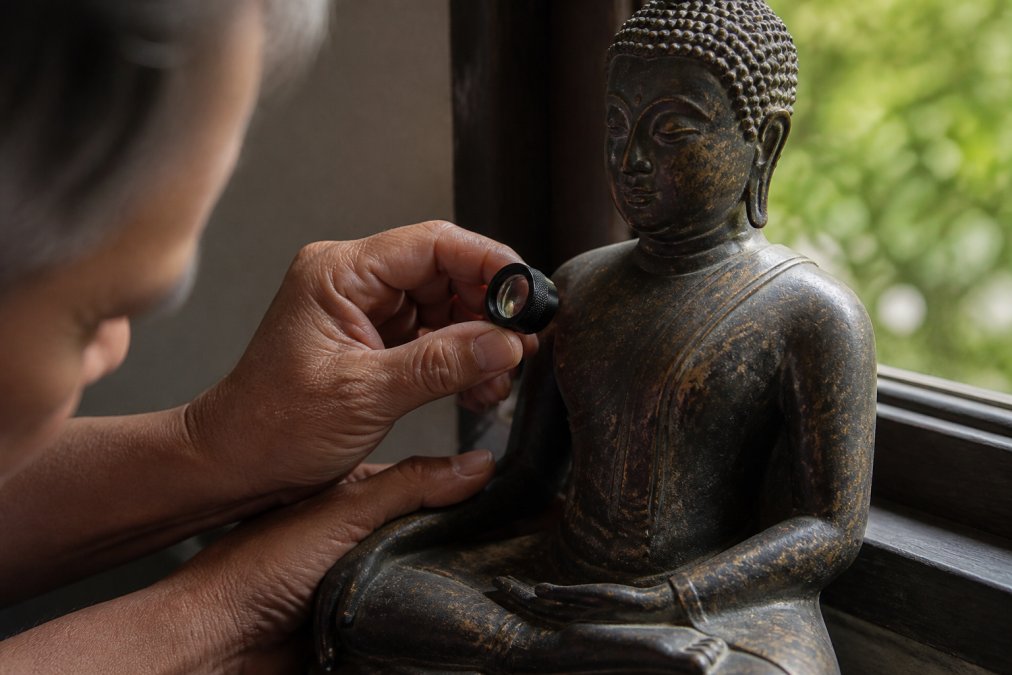
The Macro-Photography Checklist for Surface Texture
Macro-photography reveals what the naked eye cannot see, making it an essential tool for identifying fake antique buddha statues online. High-resolution images of specific surface areas provide the evidence needed to evaluate authenticity.
Request or capture macro images of these five areas:
- The patina surface at 10x magnification, looking for natural variation versus uniform artificial coloring
- The interior of the base or hollow areas, examining for casting cores, tool marks, or modern materials
- The fine details of the face, hands, and ornaments, checking for softened edges versus sharp modern finishing
- The underside and any hidden surfaces, which often reveal the true age and manufacturing method
- The transition zones where patina meets exposed metal, verifying that oxidation penetrates the surface
Genuine antiques show a surface texture that varies across the piece, with casting porosity, tiny pitting, and irregular crystalline structures. Modern replicas often display uniform surfaces with repetitive patterns betraying machine finishing or chemical treatment.
Provenance and Documentation: What Proof Actually Looks Like
Provenance is the documented history of ownership, and it is the strongest evidence of authenticity available to collectors. A genuine antique should have a paper trail tracing its journey from origin to current ownership, and establishing that it entered the country legally.
The Legal Framework You Cannot Ignore
The United States enforces import restrictions on cultural property through bilateral agreements under the Convention on Cultural Property Implementation Act (CPIA) of 1983. Cultural property import restrictions from the U.S. State Department maintain a list of countries with which the U.S. has signed agreements, including Cambodia, China, and Thailand, all major sources of Buddhist sculpture.
Under these agreements, certain artifacts cannot be imported without an export permit from the country of origin. For example, the U.S.-Cambodia memorandum of understanding restricts the import of Khmer stone and bronze sculptures dating from the 6th through 15th centuries, requiring documentation of legal export or a pre-1970 export date.
What Legitimate Documentation Looks Like
Real provenance documents include:
- Export permits from the country of origin. These are government-issued documents that authorize the export of cultural property. They are rare for genuinely old pieces because many were exported before such permits existed.
- Pre-1970 documentation. The 1970 UNESCO Convention on the Means of Prohibiting and Preventing the Illicit Import, Export and Transfer of Ownership of Cultural Property established the international standard for cultural property protection. Pieces exported before 1970 are generally considered to have left their country of origin before the convention took effect. Auction houses and dealers often use "pre-1970" as the benchmark for legitimate trade.
- Auction house receipts. Records from major auction houses like Christie's, Sotheby's, or regional houses provide a verifiable chain of ownership. These records include lot numbers, sale dates, and descriptions that can be cross-referenced.
- Museum exhibition records. If a piece was exhibited in a museum, the exhibition catalog serves as documented proof of its existence and location at a specific time.
- Published references. Scholarly books and academic journals that illustrate or describe the piece provide additional verification.
Red Flags in Documentation
Vague statements about pieces being "from an old European collection" without supporting documentation should raise immediate concerns. Legitimate dealers maintain detailed records and can produce documentation upon request. Common red flags include:
- "From a private collection" with no name. If the collector is not named, the provenance cannot be verified.
- "Acquired in the 1960s" with no supporting evidence. This claim is often used to suggest a pre-1970 export date without providing actual proof.
- A chain of ownership with gaps. Legitimate provenance is continuous. Gaps of decades without explanation suggest the piece may have been looted or illegally exported during that period.
- Reluctance to provide documentation in writing. A dealer who will discuss provenance verbally but will not put it in writing is hiding something.
The Unique Angle: Ethical Collecting as Risk Management
Beyond the legal requirement, provenance matters for ethical reasons. Looted antiquities fuel the destruction of cultural heritage sites across Southeast Asia. When you purchase a statue without verifiable provenance, you may be funding the continued looting of temples and archaeological sites.
Collectors who demand proper provenance create market pressure that discourages the trade in looted artifacts. A dealer who cannot or will not provide documentation is either selling a fake or a looted artifact, neither is a safe purchase.
Ask the seller directly about export and import documentation. A legitimate dealer will provide details about how the piece legally entered the country. Evasive answers about documentation often indicate either a fake or an illegally exported artifact. Additionally, request a written guarantee of authenticity and legal provenance as part of the sales contract. This gives you legal recourse if the documentation later proves to be fraudulent.
How to Verify Documentation Independently
Do not rely solely on the seller's claims. Verify provenance documents by:
- Contacting the auction house listed in the provenance to confirm the sale record.
- Checking the U.S. State Department's cultural property list to determine whether the piece's country of origin has an active import restriction agreement with the United States.
- Consulting the Art Loss Register to check whether the piece has been reported as stolen.
- Requesting a copy of the export permit and verifying its authenticity with the issuing government agency, if possible.
This level of verification is standard practice for serious collectors and dealers. It takes time, but it is the only way to ensure your purchase is both authentic and legal.
When to Seek Buddha Statue Appraisal Services
Professional buddha statue appraisal services provide independent verification that protects both your investment and your peace of mind. Subtle forgeries can fool even experienced collectors, so knowing when to escalate and how to choose the right expert is critical.
When to Escalate Beyond Visual Inspection
Consider professional appraisal in these specific scenarios:
- The purchase price exceeds $2,000. At this threshold, the cost of appraisal (typically $150-$500 per piece, depending on the specialist and the complexity of the analysis) is a reasonable insurance premium against a much larger loss.
- The piece comes with a dramatic provenance story but no verifiable documentation. Forgers often invent temple discoveries or colonial-era collections to explain gaps in history. An expert can test the physical evidence to see if the story holds.
- You plan to resell or insure the statue. Insurance companies and auction houses require documented appraisals from recognized specialists before they will underwrite or list high-value items.
- The statue shows a mix of authentic and suspicious features. For example, a bronze with a convincing patina but casting seams that suggest modern manufacture warrants scientific testing to determine whether the body is old and the patina is new, or vice versa.
What a Professional Appraisal Actually Involves
Professional appraisers combine scientific testing with art historical knowledge. Common methods include:
- X-ray fluorescence (XRF) analysis to determine the elemental composition of the metal. This non-destructive test can identify modern alloys or trace elements that reveal the smelting technology used. For example, the presence of high levels of zinc in a piece claimed to be ancient Southeast Asian bronze would be a red flag, as traditional alloys were primarily copper-tin with trace arsenic or lead.
- Thermoluminescence (TL) testing for ceramic pieces. This method measures the accumulated radiation dose since the object was last fired. A small sample is drilled from the base and analyzed in a laboratory. TL testing is destructive to a small degree but is the gold standard for ceramic authenticity.
- Radiocarbon dating for organic materials like wood or lacquer. This method can date the material itself, but it requires a sample to be sent to a lab and can take several weeks.
These methods detect fakes that visual inspection cannot, such as statues cast from period-authentic bronze but manufactured in modern workshops, which will pass a visual patina check but fail a stylistic review by a trained art historian.
How to Choose a Qualified Appraiser
Not all appraisers are equal. Look for specialists with the following credentials:
- Membership in the American Society of Appraisers (ASA) or the International Society of Appraisers (ISA). These organizations require adherence to ethical standards and continuing education.
- A specialty in Asian art or Buddhist sculpture. A generalist appraiser may not know the regional differences between Thai, Burmese, Tibetan, and Chinese casting traditions.
- Independence from the seller. Never use an appraiser recommended by the dealer selling the piece. A conflict of interest undermines the entire purpose of the appraisal.
Appraisal standards and ethics guidelines from the American Society of Appraisers outline what collectors should expect from qualified professionals, including written reports, methodology disclosure, and independence from the seller.
The Cost-Benefit Calculation
For pieces under $1,000, a full professional appraisal may cost more than the statue is worth; rely on the visual inspection techniques in this guide and purchase only from dealers offering written guarantees and return policies. For pieces above $5,000, appraisal is non-negotiable.
Professional appraisals also establish value for insurance and resale purposes. When purchasing high-value pieces, factor the cost of appraisal into your budget, a $400 appraisal on a $10,000 statue is a 4% cost that protects your investment.
Conclusion: Buy the Piece, Not the Story
The most expensive mistake collectors make is falling in love with a narrative rather than examining the object itself. Forgers craft compelling stories to distract from the physical evidence, which tells the truth about material, craftsmanship, and age.
Focus your inspection on what you can verify: patina depth and variation, manufacturing marks, wear patterns, and the documentation trail. When a piece fails inspection, walk away regardless of how beautiful it is or how convincing the story sounds.
For collectors seeking authentic pieces with verifiable provenance, working with a reputable dealer removes much of the risk. HD Asian Art offers a carefully curated collection of Buddhist and Hindu statues, alongside exquisite Khmer and Southeast Asian sculptures. Our selection is designed to enhance altars, meditation spaces, and refined spiritual home interiors.
Browse our selection and find a piece that carries authentic history, not a fabricated story
.
Frequently Asked Questions
How can you tell if a Buddha statue is truly antique?
Look for signs of age in bronze statues that are difficult to fake, such as a natural patina that has formed unevenly over decades, consistent wear patterns on raised areas, and oxidation in recessed details. Check the casting method for irregularities typical of old sand-casting or lost-wax techniques. Most importantly, demand verifiable provenance documentation. A reputable seller should provide a history of ownership and an honest assessment of the piece's age, not just a confident claim.
Does patina always prove a Buddha statue is old?
No. Patina is one of the most commonly faked features on replica statues. Sellers often apply chemical treatments, pigments, or waxes to create a convincing verdigris or dark oxidation layer. Examine the patina closely: natural patina develops in micro-layers and is slightly translucent, while artificial aging often looks flat, chalky, or uniformly applied. Authentic wear patterns are also key. Look for rubbed highlights on the highest points, like the crown or hands, which indicate decades of handling and cleaning.
What should I look for in the casting process of an antique statue?
The casting process leaves distinct clues. Antique pieces made using the lost-wax method often show slight asymmetries, irregular wall thickness, and unique tool marks from the finishing process. Sand-casting leaves a characteristic grainy texture. Mass-produced modern fakes are often made using centrifugal casting, which results in a perfectly uniform, hollow interior and crisp details that lack the hand-chased quality of an original. Compare the detailing, especially in the face and robes, for stiffness that betrays a modern mold.
Where can I find reliable buddha statue appraisal services?
Seek out an independent appraiser who specializes in Asian art and is accredited by a professional organization like the Appraisers Association of America. Auction houses with dedicated Asian art departments also offer formal appraisal services for a fee, which can be invaluable for high-value pieces. During an appraisal, expect a thorough examination of material composition, casting techniques, stylistic features, and a detailed report on provenance. This documentation is essential for insurance and resale.
