



Ethical Sourcing of Antique Buddhist Art: A Buyer's Guide
Ethical Sourcing of Antique Buddhist Art: A Buyer's Guide
Table of Contents
- Why Ethical Sourcing Matters for Antique Buddhist Art
- Understanding Buddhist Art Provenance and Ownership History
- Questions to Ask an Antique Art Dealer Before You Buy
- Cultural Property Laws and Import Considerations
- Responsible Antique Buying: A Framework for Collectors
- Verifying Authenticity and Condition of Buddhist Statues
- Building Trust: Finding Reputable Sources for Antique Buddhist Art
- Frequently Asked Questions
Why Ethical Sourcing Matters for Antique Buddhist Art
Bringing an antique Buddhist statue into your home means valuing cultural heritage and spiritual integrity. At HD Asian Art, we believe that ethical sourcing of antique Buddhist art is fundamental to responsible collecting.
Buddhist art carries profound spiritual and cultural significance for practitioners and communities. Purchasing without understanding origins can unknowingly support looting, trafficking, or disrespect toward sacred traditions. The difference between a thoughtful purchase and a problematic one comes down to asking the right questions before you buy.
Understanding Buddhist Art Provenance and Ownership History
Provenance is the documented ownership history of an object. For antique Buddhist art, it answers: Where did this piece originate? How did it leave its country of origin? Who has owned it since?
Strong provenance protects you as a buyer. It establishes legitimacy and increases value. Weak or missing provenance raises red flags. According to research on responsible collecting practices, provenance verification means matching an object against independent records rather than relying on the seller's summary, this approach separates ethical dealers from those cutting corners.
What Provenance Documents Should Accompany Your Purchase
Legitimate antique Buddhist art should come with clear documentation. Look for:
- Original purchase receipts or auction house catalogs
- Export permits from the country of origin (if applicable)
- Import documentation showing legal entry into the current country
- Photographs showing the piece's condition at various points in its history
- Written statements from previous owners or institutions
- Conservation reports from recognized experts
These documents create a chain of custody that strengthens confidence in authenticity and legal status. If a dealer cannot provide documentation, ask why, a reputable source will have answers.
Red Flags in Provenance Claims
Watch for these provenance red flags:
- Vague origin stories: "It came from an old collection" or "It's been in a family for generations" without specifics
- Missing middle history: Jumps from ancient creation directly to recent acquisition, skipping centuries
- Convenient gaps: Claims that records were lost, destroyed, or unavailable
- Seller reluctance: Unwillingness to provide written documentation or connect you with previous owners
- Too-good-to-be-true pricing: Significantly underpriced compared to similar authenticated pieces
- Unverifiable claims: Stories that cannot be cross-checked with museum databases, auction records, or expert registries
We recommend requesting independent verification of any major claim about a piece's history before committing to a purchase.
Questions to Ask an Antique Art Dealer Before You Buy
Direct conversation with a dealer reveals their knowledge and integrity. Ask these specific questions:
- Where exactly did this piece originate geographically and culturally?
- When and how did it leave its country of origin?
- Do you have export permits or legal documentation proving lawful removal?
- Who owned this piece before you, and can you provide contact information for verification?
- Has this piece been professionally authenticated? By whom?
- What condition issues exist, and has it been restored or conserved?
- Can you provide written documentation of all provenance claims?
- Are you affiliated with any professional organizations that verify ethical sourcing?
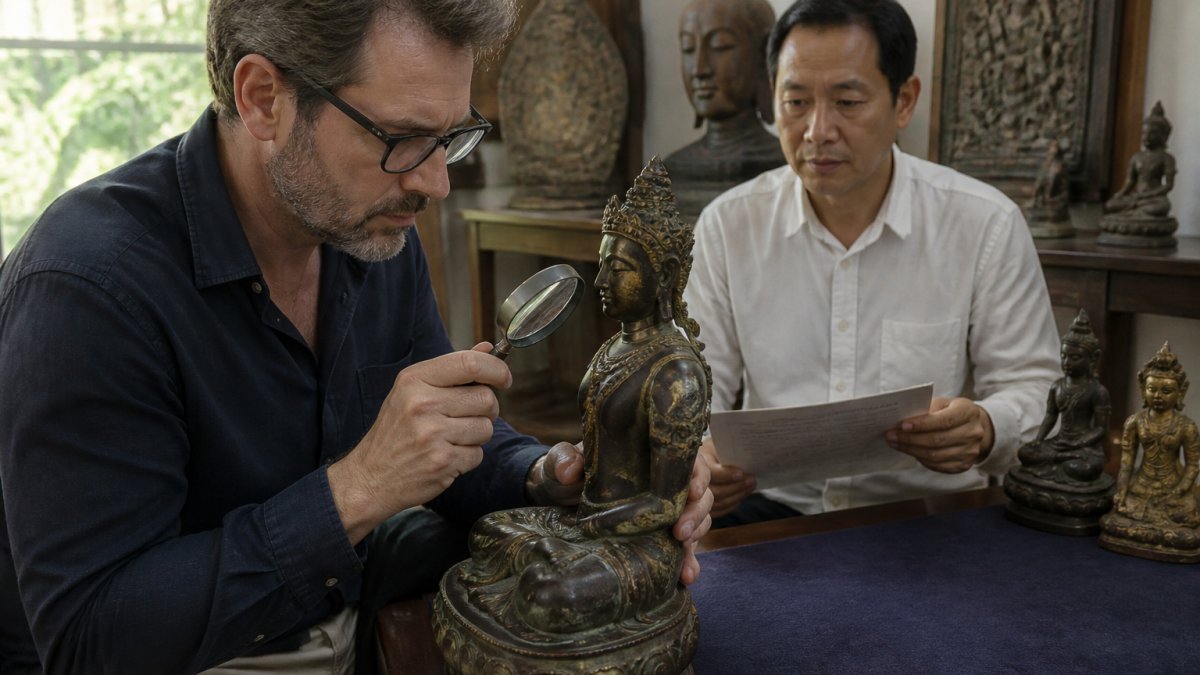
Thorough written responses demonstrate professionalism; deflection or vagueness suggests caution.
Assessing Dealer Transparency and Expertise
Reputable dealers explain iconography, materials, historical context, regional variations, and conservation ethics.
Listen for specific knowledge about casting techniques, regional stylistic differences, or historical contexts. Generic descriptions suggest limited expertise.
Honest dealers acknowledge uncertainty, provide written documentation without resistance, and encourage independent verification.
Cultural Property Laws and Import Considerations
Many countries restrict export of cultural artifacts. The United States has import restrictions on cultural property from source countries. Importing without proper documentation can result in seizure by U.S. Customs and Border Protection, civil penalties, and criminal liability.
U.S. Import Restrictions and the Archaeological Resources Protection Act
The Archaeological Resources Protection Act (ARPA) prohibits importation of archaeological artifacts removed without legal authorization, including Buddhist statues and temple carvings from archaeological contexts.
Objects removed before 1970 (when the UNESCO Convention on Cultural Property was enacted) may have been legal then but are now considered problematic.
For Buddhist art specifically:
- Cambodia restricts export of pre-Angkorian and Angkorian period sculptures. Pieces from this era require an export permit from Cambodia's Ministry of Culture and Fine Arts. Without documentation, U.S. Customs will seize the object.
- Thailand prohibits export of Buddhist images and statues without a permit from the Thai Fine Arts Department. This restriction applies regardless of age. Many Thai pieces offered for sale internationally lack proper export documentation.
- Myanmar (Burma) restricts export of antique Buddhist statues and temple art. Export permits are rarely granted for pieces considered national cultural property.
- Nepal restricts export of Hindu and Buddhist religious art, particularly bronzes and stone sculptures. Pieces must have an export certificate from Nepal's Department of Archaeology.
- Tibet and China have strict regulations on Tibetan Buddhist art, thangka paintings, and bronze statues. Export requires approval from Chinese cultural authorities and is frequently denied.
Request an export permit or certificate of legal export before purchase. A legitimate dealer will have this documentation or explain why it wasn't required.
Documentation You Must Request Before Purchase
Before purchase, obtain and review:
Export permits or certificates: The original document from the source country's cultural ministry, including object description, export date, exporting institution, destination country, and official seal.
Import documentation: U.S. Customs entry records or historical bills of lading confirming legal entry.
Chain of custody documentation: Written records of ownership at each stage. Gaps exceeding five years should be explained.
Statements from previous owners or institutions: Contact museums, auction houses, or known collectors to verify history and condition.
Professional appraisals or condition reports: These establish authenticity and verify the object matches documentation.
What Happens If You Import Without Proper Documentation
U.S. Customs screens shipments for cultural property violations. Without proper documentation, the piece may be seized, returned to its country of origin without refund, subject to civil penalties, or result in criminal charges including fines and imprisonment.
How to Verify Legal Compliance Before Purchase
Step 1: Identify the source country and its export laws.
Step 2: Research cultural property restrictions by contacting the country's embassy or cultural ministry.
Step 3: Request documentation from the dealer, export permits, import records, and ownership history.
Step 4: Verify independently by contacting the source country's cultural ministry to confirm authenticity.
Step 5: Consult a cultural property attorney for high-value purchases or incomplete provenance.
Recent Changes in U.S. Import Policy
The U.S. has increased enforcement of cultural property restrictions and expanded screening of online sales and international shipping. Import violations are increasingly detected.
Source countries increasingly request repatriation of cultural property. Understanding legal and ethical status protects you from future complications.
Responsible Antique Buying: A Framework for Collectors
Ethical sourcing of antique Buddhist art follows a practical decision-making process. Before purchasing any piece, work through these steps systematically.
Screening for Looted or Trafficked Objects
Looted objects are removed without permission from sites, temples, or communities. Trafficked pieces are illegally transported across borders. Both carry legal risk.
Screen purchases by checking museum databases and repatriation registries, verifying export documentation aligns with claimed age and origin, researching source-country restrictions, and asking dealers about trafficking due diligence.
Reputable dealers conduct these checks routinely.
Religious Respect and Ethical Display
Buddhist art is sacred to many practitioners. Objects created for altars, temples, or meditation spaces carry spiritual significance. Ethical display means treating pieces with appropriate respect.
Display the statue at or above eye level, keep it clean, avoid placing sacred imagery in bathrooms or alongside secular decor, understand its purpose, and consider community perspectives on your ownership.
Ethical discussion of Buddhist objects includes conservation choices as well as acquisition. How you care for a piece reflects your commitment to responsible collecting.
Verifying Authenticity and Condition of Buddhist Statues
Authenticity verification requires examining multiple factors: materials, casting or carving technique, wear patterns, stylistic elements, and historical context.
Materials tell stories. Bronze statues should show appropriate patina for their claimed age. Wood pieces exhibit specific grain patterns and aging characteristics.
Casting techniques varied by region and period. Sand casting produces different surface characteristics than lost-wax casting. Regional workshops developed distinctive styles.
Restoration and conservation are normal for antique pieces. However, extensive rebuilding, replacement of missing parts, or heavy repainting can diminish authenticity and value.
Building Trust: Finding Reputable Sources for Antique Buddhist Art
Trust develops through consistency, transparency, and expertise. Reputable sources demonstrate these qualities across every interaction.
Established dealers maintain professional credentials and affiliations. They participate in industry organizations focused on ethical practices. They publish detailed descriptions with photographs showing condition clearly. They welcome questions and provide written responses.
HD Asian Art specializes in carefully curated Buddhist and Hindu statues, handpicked antique and contemporary pieces from Southeast Asia. Our selection process emphasizes provenance verification and ethical sourcing. We provide temple-inspired decor designed for meaningful use in meditation spaces and spiritual home interiors.
Look for dealers who:
- Provide detailed provenance documentation without resistance
- Offer professional conservation and condition assessments
- Welcome independent expert verification
- Maintain transparent pricing and clear return policies
- Educate customers about cultural significance and respectful display
- Build long-term relationships rather than pursuing one-time sales
| Dealer Quality Indicator | What It Means |
|---|---|
| Detailed provenance documentation | Transparency about object's history and legal status |
| Professional authentication | Third-party verification of authenticity and age |
| Conservation expertise | Understanding of proper care and restoration ethics |
| Community engagement | Respect for cultural significance and source communities |
| Return and guarantee policies | Confidence in authenticity and willingness to stand behind pieces |
Ethical sourcing of antique Buddhist art requires diligence, but the reward is ownership of pieces with genuine integrity. When you work with HD Asian Art, you gain access to carefully authenticated pieces with documented provenance and professional conservation standards. Finding Reputable Antique Buddhist Art Dealers emphasizes provenance verification as the foundation of responsible collecting.
Frequently Asked Questions
What does ethical sourcing mean when buying antique Buddhist art?
Ethical sourcing of antique Buddhist art means verifying that an object was legally acquired, respecting its cultural and religious significance, and ensuring it was not looted or illicitly trafficked. It involves checking provenance, understanding the object's archaeological or historical context, and purchasing from dealers who practice transparency about ownership history. Responsible collectors also consider how the artwork will be displayed and treated with the reverence appropriate to its sacred origins.
What provenance documents should accompany an antique Buddhist sculpture?
Reputable provenance includes documented ownership history, acquisition receipts, export permits, and expert authentication certificates. Provenance verification means matching an object against independent records rather than relying solely on the seller's summary. Look for clear chains of custody, museum exhibition records, scholarly publications, or archaeological documentation. Vague claims without supporting paperwork are a significant red flag.
How can I screen for looted or trafficked Buddhist art before purchasing?
Research the object's country of origin and check whether that nation has cultural property laws restricting export of antiquities. Verify the seller's claims against museum databases, auction records, and expert networks. Ask for detailed documentation of how the piece left its origin country and entered the current market. Be cautious of objects with incomplete histories or sellers unwilling to disclose acquisition details. Independent experts can help assess whether an object's style and condition align with legitimate archaeological finds.
What should I ask a dealer about an artwork's origin and condition?
Ask specifically where and when the object was excavated or created, who owned it before the current seller, and what documentation supports those claims. Inquire about any repairs, restoration, or conservation work performed. Ask whether the piece has been examined by independent experts and request contact information for those professionals. A transparent dealer will provide detailed answers and encourage you to verify information independently. Hesitation or vague responses suggest the dealer may not have fully vetted the object themselves.
