



Finding Reputable Antique Buddhist Art Dealers: 2026 Guide
Finding Reputable Antique Buddhist Art Dealers: 2026 Guide
Table of Contents
- Why Dealer Vetting Matters More Than Ever
- Essential Questions to Ask Art Dealers Before You Buy
- How to Verify Authentic Buddhist Sculpture Provenance
- Buddhist Art Collector Best Practices for Due Diligence
- Red Flags of Fraudulent Dealers and How to Spot Them
- Understanding Cultural Heritage Laws and Ethical Acquisition
- Building Long-Term Relationships with Reputable Antique Buddhist Art Dealers
- Frequently Asked Questions
Why Dealer Vetting Matters More Than Ever
Finding reputable antique Buddhist art dealers starts with accepting an uncomfortable truth: the market rewards patience, not enthusiasm. This guide from HD Asian Art walks through the vetting process serious collectors use before money changes hands.
Essential Questions to Ask Art Dealers Before You Buy
Questions to ask art dealers should cover three areas: where the piece came from, what paperwork supports that claim, and what happens if the claim turns out to be false. Get all three answered in writing before you commit.
- What is the full ownership history, and can you document each transfer?
- Which country did this piece leave, and under what export authorization?
- Do you provide a written authenticity guarantee, and for how long?
- What is your return policy if an independent expert disputes the attribution?
- Can you name the conservator or lab that examined the piece, if any?
Provenance and Documentation
Provenance is the documented chain of ownership of an object, from its place of origin to the present seller. A complete provenance file typically includes purchase receipts, auction records, export permits, and prior catalog listings.
Authenticity Guarantees and Return Policies
A written authenticity guarantee should state, in plain terms, that the dealer will refund your purchase if a qualified expert determines the piece is not as described. The guarantee should specify the time window and who counts as a qualified expert.
How to Verify Authentic Buddhist Sculpture Provenance
Authentic Buddhist sculpture provenance verification means matching the object against independent records, not trusting the seller's summary. The dealers who survive scrutiny expect this process; the ones who resist it are telling you something.
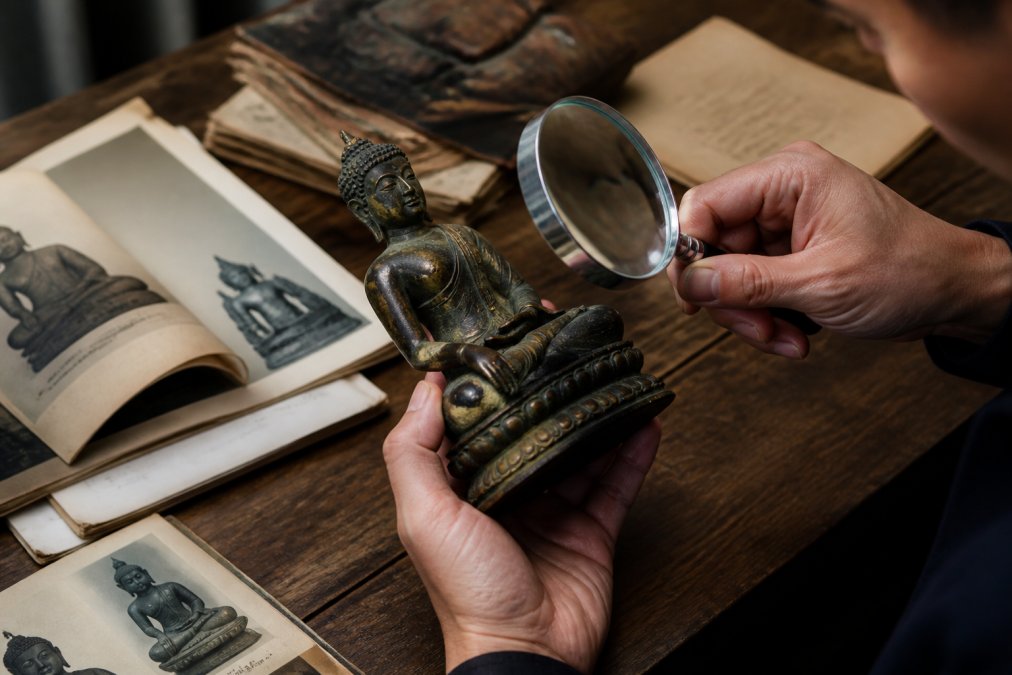
The Four-Source Verification Protocol
Run every piece through the same four sources. Each one either corroborates the dealer's story or exposes a gap.
- Auction archives. Search the major houses' online archives for the piece or a close match. Look for the same iconography, dimensions, and base type. A match that appears in a 1990s catalog with a different owner than the dealer claims is a discrepancy worth pressing on.
- Museum comparanda. Compare casting details, drapery folds, and base construction against published museum collections. Museums publish catalog entries with period, region, and material attributions you can cite back to the dealer.
- Export documentation. Request the export permit and verify the issuing authority directly. A permit number that cannot be confirmed with the named authority is not documentation; it is decoration.
- Physical examination. Have an independent conservator examine patina, casting seams, and tool marks. This is the step buyers skip most often, and it is the one that catches modern castings dressed as antiques.
What Each Source Actually Tells You
Auction archives establish market history, not authenticity. A piece can appear at auction and still be a later casting. Treat archives as one data point, not a verdict.
The Documentation Checklist
- Signed bill of sale with the dealer's legal name and business address
- Written provenance statement covering each prior transfer
- Copies of prior receipts, auction records, or catalog listings
- Export permit or written confirmation that none was required
- Written authenticity guarantee with defined terms and time window
- Return policy in writing, including who pays return freight
- Conservator's report or the dealer's written refusal to permit one
For legal context on what counts as protected cultural property, consult UNESCO's guidance on illicit trafficking of cultural property, which explains how source countries classify sacred objects.
Buddhist Art Collector Best Practices for Due Diligence
Buddhist art collector best practices come down to one habit: verify before you fall in love. Experienced collectors build a checklist and apply it to every purchase, regardless of how trustworthy the dealer seems.
| Step | What to Do | Why It Matters |
|---|---|---|
| 1. Screen the dealer | Check references and trade history | Filters out bad actors early |
| 2. Request documents | Ask for provenance file in writing | Creates a paper trail |
| 3. Verify independently | Cross-check auction and museum records | Catches false claims |
| 4. Get expert review | Hire a conservator or appraiser | Confirms material and age |
| 5. Confirm terms | Read guarantee and return policy | Protects your money |
Red Flags of Fraudulent Dealers and How to Spot Them
Fraudulent dealers share recognizable habits. The most common is pressure: artificial urgency, limited-time offers, and reluctance to let you seek a second opinion.
Watch for these warning signs:
- Refusal to provide provenance documents before payment
- Vague answers about country of origin or export history
- No written authenticity guarantee or a guarantee with no defined terms
- Prices far below comparable pieces, framed as a "once-in-a-lifetime" find
- Reluctance to let an independent expert examine the piece
- Stock photos instead of images of the actual object
Understanding Cultural Heritage Laws and Ethical Acquisition
Ethical acquisition means confirming a piece left its country of origin legally and that its export was properly authorized. In the United States, this is not just an ethical preference; it is a legal requirement, and the mechanisms are specific enough that a serious buyer should know them by name.
The U.S. Legal Framework
Three layers of law govern the import and ownership of antique Buddhist art in the United States:
- The Cultural Property Implementation Act (CPIA), 19 U.S.C. §§ 2601-2613. This statute implements the 1970 UNESCO Convention in U.S. law. It allows the United States to enter bilateral agreements with source countries restricting import of specified archaeological and ethnological materials. If a piece falls within an active agreement, import without a valid export permit from the source country is prohibited.
- The National Stolen Property Act, 18 U.S.C. § 2314. This statute criminalizes the interstate or foreign transport of stolen goods, including cultural property that a foreign court has declared stolen. U.S. courts have applied it to antiquities in several high-profile cases.
- Executive Order 13967 and related sanctions authorities. These restrict dealings in cultural property from certain jurisdictions and can apply even when the CPIA does not.
What This Means for a Buyer
Before you wire funds, confirm four things:
- The source country. Identify it precisely. "Southeast Asia" is not a jurisdiction.
- Whether an active bilateral agreement covers that country. The State Department publishes the current list of memoranda of understanding. Check it.
- Whether the piece falls within the covered categories. Agreements typically specify archaeological materials and ethnological objects by type and age. A piece outside the covered categories may move freely; one inside them requires documentation.
- Whether the dealer can produce the export permit. If the piece left the source country after the relevant agreement took effect, the permit is the document that matters.
The Ethical Dimension
Legal compliance is the floor, not the ceiling. Many Buddhist sculptures remain objects of active veneration, and their removal from temples, shrines, and monastic collections is a live concern for the communities of origin. A dealer who can explain how a piece left its original context, and who is comfortable discussing that history, is a better long-term partner than one who treats the question as an inconvenience.
Buying responsibly protects you in three ways:
- It reduces the risk of seizure or forfeiture.
- It preserves the piece's resale and insurance value.
- It respects the living communities for whom these objects remain sacred.
Building Long-Term Relationships with Reputable Antique Buddhist Art Dealers
The best dealers become long-term partners, not one-off vendors. Once you find someone who answers hard questions honestly, that relationship pays off through early access to well-documented pieces.
A few habits build trust on both sides:
- Pay promptly and communicate clearly.
- Share your collecting focus so the dealer knows what to flag.
- Ask for provenance files at purchase, not months later.
- Follow up after delivery with honest feedback.
Frequently Asked Questions
What should I look for when buying antique Buddhist art?
Look for documented provenance, signs of age like patina and wear, and a dealer who provides a written authenticity guarantee. Ask about the piece's history, including any auction records or previous owners. Reputable antique Buddhist art dealers will welcome these questions and provide clear answers. Also check for restoration work, as undisclosed repairs can affect both value and integrity.
How do I verify the provenance of an antique Buddhist statue?
Request a complete provenance history including auction house records, export documents, and any certificates of authenticity. Cross-check the documentation with the dealer's claims. Authentic Buddhist sculpture provenance should trace the piece's ownership back through verifiable sources. If a dealer cannot provide clear documentation, treat that as a warning sign and consider other options.
What are the signs of a reputable art dealer?
Reputable dealers offer transparent provenance, provide written guarantees, and have verifiable references. They welcome questions about authenticity and are willing to connect you with previous clients. They also stay informed about cultural heritage laws and ethical acquisition practices. A dealer who pressures you to buy quickly or avoids documentation questions is not someone to trust.
How can I distinguish between antique and contemporary Buddhist art?
Antique pieces show natural patina, subtle wear patterns, and age-related changes in materials. Contemporary works often have uniform finishes and lack the depth of aged surfaces. Ask the dealer about dating techniques used and request any material analysis reports. Understanding historical periods and styles also helps you recognize period-specific craftsmanship and iconography.
The hardest part of collecting is not finding beautiful sculpture; it is finding a dealer who will prove where it came from.
HD Asian Art offers a carefully curated selection of Buddhist and Hindu statues with free shipping, so you can build a meditation space or sanctuary with pieces chosen for authenticity and craftsmanship. Browse the collection and find sculpture worthy of the practice it serves.
