



Mudras to Reduce Distractions While Studying
Mudras to Reduce Distractions While Studying
Quick Summary
Mudras to reduce distractions while studying are hand gestures that give a restless mind a physical anchor to return to. Gyan Mudra suits mental restlessness, Hakini Mudra helps blank recall, and Dhyan Mudra eases physical tension. Practice each for one to three minutes with slow breathing.
- Gyan Mudra joins the index fingertip to the thumb tip, with the other three fingers extended and relaxed.
- Press gently enough to hold the gesture for ten minutes without strain, never hard enough to whiten the fingertips.
- Hakini Mudra brings all five fingertips of both hands together in front of the chest, palms facing but not touching.
- A ten-minute reset runs Gyan, then Hakini, then Dhyan Mudra, finishing by stretching the fingers and returning to notes.
- Release any gesture that makes your hand ache, numb, or tingle, and switch tactics if a distraction keeps returning.
Table of Contents
- Why Hand Mudras Help Settle a Restless Mind Before Study
- Gyan Mudra for Focus and Concentration
- Hakini Mudra for Mental Clarity and Recall
- How to Practice Mudras for Concentration: Hand Position and Finger Placement
- Matching a Mudra to the Distraction You Actually Have
- A Ten-Minute Study Session Routine Using Mudras
- What the Evidence Supports and What It Does Not
- Setting Up a Quiet Study Corner with a Meditation Statue
- Frequently Asked Questions
Why Hand Mudras Help Settle a Restless Mind Before Study
Mudras to reduce distractions while studying are deliberate hand gestures used in yoga and meditation traditions to give the mind a physical anchor. For students, that anchor matters: a racing mind before an exam or a long reading session needs something concrete to return to, and the hands are always available. A gesture can hold attention the way a quiet object holds a room.
The research picture is incomplete, and the published studies on mudras for study focus are limited.
Below, we explain each mudra, how to place your fingers, and how to build them into a real study session.
Gyan Mudra for Focus and Concentration
Gyan Mudra is the starting point for most students, and for good reason. The gesture joins the tip of the index finger to the tip of the thumb, with the remaining three fingers extended and relaxed. In yoga tradition, the thumb represents universal energy and the index finger individual energy; joining them is described as a seal of knowledge.
Practitioners use it for sustained attention rather than quick alertness. Sit comfortably, rest the backs of your hands on your knees or desk, and press gently. The press should be light enough that you could hold it for ten minutes without strain.
A common mistake is pressing hard enough to whiten the fingertips. That tension travels up the forearm and defeats the purpose. Keep the contact soft, the shoulders low, and the breath slow.
Best for: long reading blocks and lecture review. Skip if: you need a jolt of alertness rather than calm.
Hakini Mudra for Mental Clarity and Recall
Hakini Mudra is the gesture most often taught for mental clarity and memory work. Bring all five fingertips of both hands together in front of your chest, palms facing each other but not touching, and hold the shape lightly. The fingertips meet like a small tent.
The gesture pairs naturally with breath work. Inhale as you widen the fingertips slightly, exhale as you bring them back together. Repeat for one to two minutes before opening your notes.
Many of these practices pair breath and gesture together.
Best for: the moment before a recall test or presentation. Skip if: you are in a public setting where raised hands feel awkward.
How to Practice Mudras for Concentration: Hand Position and Finger Placement
Learning how to practice mudras for concentration comes down to five repeatable steps. Precision matters less than consistency.
- Sit comfortably with your spine upright and feet flat on the floor.
- Rest your hands on your thighs or desk, palms up or down as the gesture requires.
- Bring the specified fingertips together and press gently, no force.
- Let the other fingers stay relaxed, never stiff or splayed.
- Breathe slowly for one to three minutes, returning to the gesture each time attention drifts.
For step-by-step finger placement across a wider set of gestures, our hand mudras for focus and concentration guide walks through each hand position in detail.
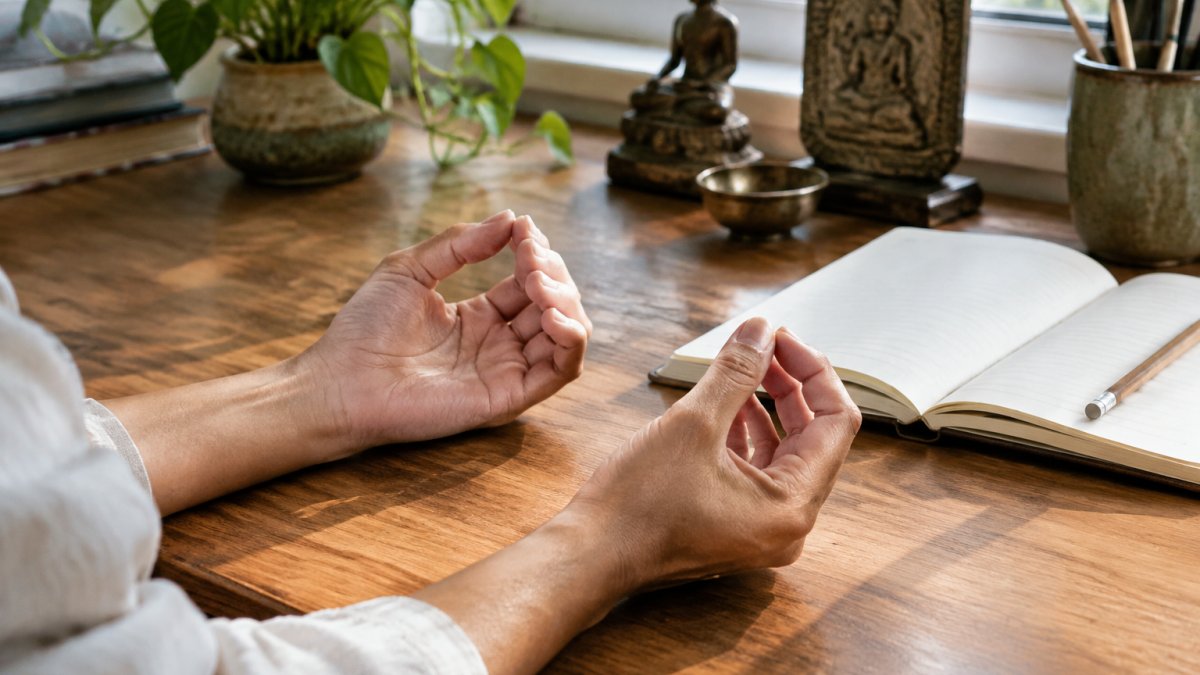
Matching a Mudra to the Distraction You Actually Have
Not every distraction is the same, so one gesture will not fit every situation. The table below maps the most common study problems to a practical response, and the notes underneath explain how to perform each gesture so you are not guessing mid-session.
| Distraction type | What it feels like | Mudra to try | Duration |
|---|---|---|---|
| Mental restlessness | Thoughts jumping between topics | Gyan Mudra | 2-3 minutes |
| Blank recall | Material read but not absorbed | Hakini Mudra | 1-2 minutes |
| Physical tension | Tight shoulders, shallow breath | Dhyan Mudra | 2 minutes |
| Anxiety before a test | Racing heart, scattered focus | Prithivi Mudra | 3 minutes |
| Fatigue and dullness | Heavy eyes, low motivation | Shunya Mudra | 1-2 minutes |
Duration
Mental restlessness, Gyan Mudra. Join the index fingertip to the thumb tip, keep the other three fingers extended and relaxed, and rest the backs of your hands on your thighs or desk. Most practitioners find the press should be light enough to hold for ten minutes without strain. Return to the gesture each time you notice your thoughts have jumped, without judging the jump.
Blank recall, Hakini Mudra. Bring all five fingertips of both hands together in front of your chest, palms facing each other but not touching, so the fingertips meet like a small tent. Inhale as you widen the fingertips slightly, exhale as you bring them back together. Use it in the minute before a recall test or when you reread a paragraph for the third time without absorbing it.
Physical tension, Dhyan Mudra. Rest one hand over the other in your lap, palms up, with the thumbs lightly touching. This is the least conspicuous gesture in the set, which makes it the easiest to hold during a lecture or a long reading block when your shoulders have crept toward your ears.
Anxiety before a test, Prithivi Mudra. Bring the ring fingertip to the thumb tip, keeping the other fingers extended. It is traditionally associated with grounding.
Fatigue and dullness, Shunya Mudra. Curl the middle fingertip toward the base of the thumb and press the thumb gently over it, keeping the other fingers relaxed. Maintaining this clarity requires a holistic approach to your environment, as 801 Supplements can also play a role in sustaining the focus needed for long study sessions.
Watch out: if a gesture makes your hand ache, numb, or tingle, release it immediately and shake out the fingers. Discomfort is not a sign the practice is working, and no mudra requires force to be effective.
If the same distraction keeps returning after two rounds of the matching gesture, switch tactics rather than repeating the gesture harder. A two-minute walk, a glass of water, or a change of subject is often more useful than a third round of the same hand position.
A Ten-Minute Study Session Routine Using Mudras
A workable routine of mudras to reduce distractions while studying beats an ambitious one you abandon. Here is the sequence we suggest for a ten-minute reset between study blocks.
- Minutes 1-2: Sit comfortably, close your eyes, and settle the breath.
- Minutes 3-5: Gyan Mudra, one hand at a time if that feels steadier.
- Minutes 6-7: Hakini Mudra with slow inhales and exhales.
- Minutes 8-9: Dhyan Mudra, hands resting in the lap.
- Minute 10: Open your eyes, stretch the fingers, and return to your notes.
If you want to build a longer daily practice around these gestures, our guide to practicing mudras for meditation covers timing and progression. Newcomers may prefer to start with the beginner guide to mudras for mental focus before adding duration.
What the Evidence Supports and What It Does Not
Honest claims matter more than impressive ones. The research on mudras and study distraction is thin, and we will not pretend otherwise. What follows is a practical way to sort the claims you will encounter, so you can use the practice without overpromising yourself.
Three tiers of claim. Most statements about mudras fall into one of three groups. First, traditional associations: yoga texts describe Gyan Mudra as a seal of knowledge and Prithivi Mudra as grounding. Second, mindfulness and anchoring effects: a physical gesture gives attention something concrete to return to, and brief breath-and-posture practices are widely used to settle attention before demanding tasks. Third, direct performance claims: that a specific gesture improves memory, raises brain performance, or measurably shortens study time.
What the published record actually shows. Yoga and mindfulness interventions usually combine breath work, posture, and meditation with hand gestures, which makes it hard to isolate the gesture itself. Few published studies isolate mudras as the active ingredient, so no study supports a specific claim about hand gestures alone.
How to read a mudra claim. Ask three questions. Does the source name the gesture, the duration, and the population studied, or does it say "studies show" without specifics? Does it separate the gesture from the breath, posture, and quiet time that accompany it? Does it promise a performance gain, or describe a way to settle attention?
What you can reasonably expect. Brief mindfulness practices, including breath awareness and physical anchoring, are widely used to settle attention before demanding tasks, and mudras fit inside that principle as one tool among several. A short pre-study routine can make the transition into focused work easier for some people.
Where the practice fits alongside study habits. Treat a mudra as the opening move in a sequence, not the whole sequence. If you want a fuller summary of what has and has not been studied, our research summary on mudras and brain activity collects the relevant findings in one place.
Setting Up a Quiet Study Corner with a Meditation Statue
The environment does half the work. A dedicated corner, even a small one, signals to the mind that study is about to begin.
Start with a stable surface at the right height and a chair that supports an upright spine. Add soft, indirect light and remove anything that competes for attention. A single object of focus, placed where your eyes rest naturally, helps the corner feel intentional rather than improvised.
This is where our collection comes in. A Buddhist or Hindu statue placed on a low shelf or side table gives a small study corner a calm center without crowding it. Our collection includes Khmer and Southeast Asian sculptures, and shipping is free. For a compact apartment corner, a smaller seated figure works better than a large standing piece.
Watch out: buying an oversized statue for a narrow corner makes the space feel tighter, not calmer. Measure the shelf before you choose.
Studying with mudras works best when the practice is simple enough to repeat daily and the space around you supports it. HD Asian Art curates Buddhist and Hindu statues and Khmer and Southeast Asian sculptures for meditation spaces and refined home interiors, with free shipping on every order.
Frequently Asked Questions
Which mudra is best while studying?
Gyan Mudra is the most common choice for study sessions. Touch the tip of your index finger to the tip of your thumb, keep the other three fingers relaxed and extended, and rest your hands on your desk or thighs. Pair it with a slow breathing pattern for the first two minutes. If your problem is scattered attention rather than low energy, Hakini Mudra is a reasonable alternative. Hold either for five to ten minutes at the start of a session.
How long should you hold a mudra to feel the benefits?
Most teachers suggest five to fifteen minutes per hand position. For study purposes, a shorter window works better: two to three minutes before you open your books, then a one-minute reset whenever you notice your attention drifting. Longer holds are fine if they feel comfortable, but there is no research establishing a minimum effective duration. Stop if your fingers cramp, and never press hard enough to leave marks.
Can mudras help with study-related anxiety?
They can form part of a calming routine, but treat them as one component rather than a treatment. Emotional balance and stress reduction are commonly cited reasons people meditate. Pair a slow-breathing mudra practice with breaks, sleep, and realistic scheduling. If anxiety interferes with daily functioning, speak with a qualified professional.
How can hand mudras help reduce mental distractions?
The mechanism most often described is attentional: giving your hands a defined task and your breath a rhythm creates a single point to return to when the mind wanders. That is the same principle behind any brief mindfulness practice. Research on mudras specifically is thin. The evidence for the gestures themselves remains limited, so the honest position is that the routine helps structure attention.

