



Scientific Research on Mudras and Brain Activity
Scientific Research on Mudras and Brain Activity
Table of Contents
- What Science Says About Mudras and Brain Activity
- The Hand-Brain Connection: How Gestures Signal the Brain
- EEG Studies: Alpha, Theta, and Beta Wave Changes
- Benefits of Yoga Mudras for Mental Health
- Mudras for Focus and Concentration
- How to Practice Mudras for Meditation
- Frequently Asked Questions
What Science Says About Mudras and Brain Activity
Scientific research on mudras and brain activity has moved these ancient hand gestures from temple walls into university laboratories, where EEG equipment now records what practitioners have described for centuries. This guide from HD Asian Art examines what that research actually shows, where the evidence is strong, and where it remains exploratory.
From Ancient Practice to EEG Labs
For most of their history, mudras were documented in texts rather than measured in laboratories. That changed as researchers in neuroscience and holistic health began asking whether the hand positions produced reproducible physiological effects.
The Hand-Brain Connection: How Gestures Signal the Brain
The hand-brain connection rests on a simple anatomical fact: a disproportionately large area of the brain is devoted to the hands. This is why hand gestures can function as a genuine input channel rather than mere decoration.
Somatosensory and Motor Cortex at Work
The somatosensory cortex processes touch and pressure from the fingers, while the motor cortex directs fine finger movement. Both regions contain detailed maps of the hand, with individual fingers represented in distinct zones. When you press the thumb and index finger together in a mudra, you activate a specific, repeatable pattern across these maps.
EEG Studies: Alpha, Theta, and Beta Wave Changes
EEG is the workhorse of mudra research because it is cheap, non-invasive, and sensitive to the timescale on which a hand gesture could plausibly act. A mudra is held for minutes, not hours, so the relevant question is whether spectral power in a given band shifts within that window. Most published work answers with a qualified yes.
| Band | Frequency | Typical Association | Reported Shift During Mudra Practice |
|---|---|---|---|
| Delta | 0.5-4 Hz | Deep sleep, restoration | Little or no consistent change while awake |
| Theta | 4-8 Hz | Deep meditation, drowsiness, memory consolidation | Tends to increase, especially frontally |
| Alpha | 8-13 Hz | Relaxed alertness, eyes-closed idling | Tends to increase, often most at posterior sites |
| Beta | 13-30 Hz | Active thinking, alert focus | Tends to decrease |
| Gamma | 30-100 Hz | Binding, high-level processing | Inconsistent; small studies only |
What a Realistic Session Looks Like on the Trace
If you were watching your own recording, a typical twenty-minute session with a held mudra and slow breathing would show: a few minutes of settling with beta still present, a gradual alpha rise as breathing slows, frontal theta emerging in the middle third, and a return toward baseline within a few minutes of releasing the gesture. The release is as informative as the hold, if the pattern does not fade, you were probably measuring the room, not the mudra.
Benefits of Yoga Mudras for Mental Health
The mental-health case for mudras rests on two pillars: the physiology of slow breathing, which is well established, and the physiology of the gesture itself, which is not. Keeping those separate is what makes this section useful rather than promotional.
What the Breathing Does
Most mudra practice is paired with slow, nasal, diaphragmatic breathing. Slow breathing at roughly six breaths per minute increases heart-rate variability and shifts autonomic balance toward parasympathetic dominance (pubmed.ncbi.nlm.nih.gov). That shift is associated with lower subjective tension and a calmer stress response. This part of the effect is not controversial, and it does not depend on which fingers you touch.
What the Gesture Adds
The gesture contributes a fixed, repeatable somatosensory input and a attentional anchor. Whether that input produces effects beyond the breathing is the open question. The honest answer is that the gesture and the breath are almost always studied together, so disentangling them is difficult. What can be said is that a consistent physical cue makes a mindfulness session easier to start and easier to repeat, and repetition, not the specific finger placement, is what most practitioners report as the source of change.
Specific Mudras and What They Are Used For
Different gestures are traditionally paired with different aims. The table below summarizes the common ones and the state of the evidence.
| Mudra | Hand Position | Traditional Use | Evidence Status |
|---|---|---|---|
| Gyan (chin) | Thumb and index fingertips touch, other fingers extended | Focus, calm alertness | Most studied; small EEG effects on alpha and frontal theta |
| Prana | Thumb, ring, and little fingers touch; index and middle extended | Energy, vitality, fatigue | Weak; mostly anecdotal |
| Bhoochari | Index and middle fingers touch thumb; used with fixed gaze | Grounding, concentration | Very weak; small studies only |
| Anjali | Palms together at the chest | Centering, gratitude | Studied mainly as a posture, not a gesture |
| Dhyana | Hands resting in the lap, one atop the other, thumbs touching | Meditation stability | Common in practice; little direct EEG work |
Contraindications and Safety
This is the part most articles skip, and it is the part that matters most for anyone with a health condition.
- Hand, wrist, or finger injury. Any mudra that requires sustained pressure or joint flexion can aggravate arthritis, carpal tunnel symptoms, or a recent sprain. Use a modified position or skip the gesture and keep the breath.
- Circulation problems. Raynaud's phenomenon and other vasospastic conditions can be worsened by prolonged finger positioning. Shorten sessions and stop if fingers go numb or change color.
- Over-stimulation. Intense or very long sessions, especially combined with breath retention, can produce dizziness, headache, or agitation in some people. If that happens, shorten the session and drop the breath retention first.
- Psychiatric conditions. People with a history of psychosis, severe dissociation, or panic disorder should introduce intensive meditation practice with a clinician's guidance, not on their own.
- Pregnancy and cardiovascular conditions. Breath-retention practices are not appropriate without medical clearance. The gesture alone is generally low-risk, but the breathing component is the part to discuss with a doctor.
A Realistic Dosage
There is no established dose-response curve for mudras, so any specific number is a reasonable starting point rather than a prescription. A common pattern in the research and in practice is five to twenty minutes per session, once or twice daily, with the same gesture held throughout. Shorter, consistent sessions tend to be more useful than long, irregular ones. If you are tracking effects, log session length, time of day, and one sentence on how you felt afterward, that record is more informative than any general claim about what mudras do.
- Stress mitigation: Slow breathing plus a held gesture supports parasympathetic activation.
- Mental clarity: Reduced beta dominance is often reported as less mental noise.
- Routine anchor: A fixed gesture gives a repeatable cue for starting a mindfulness session.
- Safety first: Stop and modify if you feel pain, numbness, dizziness, or agitation.
Mudras for Focus and Concentration
Mudras for focus and concentration work best when paired with a steady breath and a fixed gaze point. The gesture provides a physical anchor that keeps attention from drifting, which is the same principle behind many mindfulness techniques.
A practical sequence many practitioners use:
- Sit upright with the spine tall and shoulders relaxed.
- Bring the hands into your chosen mudra and rest them on the knees.
- Breathe slowly through the nose, counting to four in and six out.
- Hold the gesture for five to ten minutes without switching hands.
- Note the quality of your attention afterward, not during.
Holding a mudra with tense, gripping fingers defeats the purpose. If your hands ache or your knuckles whiten, you are pressing too hard. The gesture should feel rested, not strained.
How to Practice Mudras for Meditation
To practice mudras for meditation, choose one gesture, one posture, and one duration, then repeat it daily for at least two weeks before judging results. Consistency produces more reliable effects than variety.
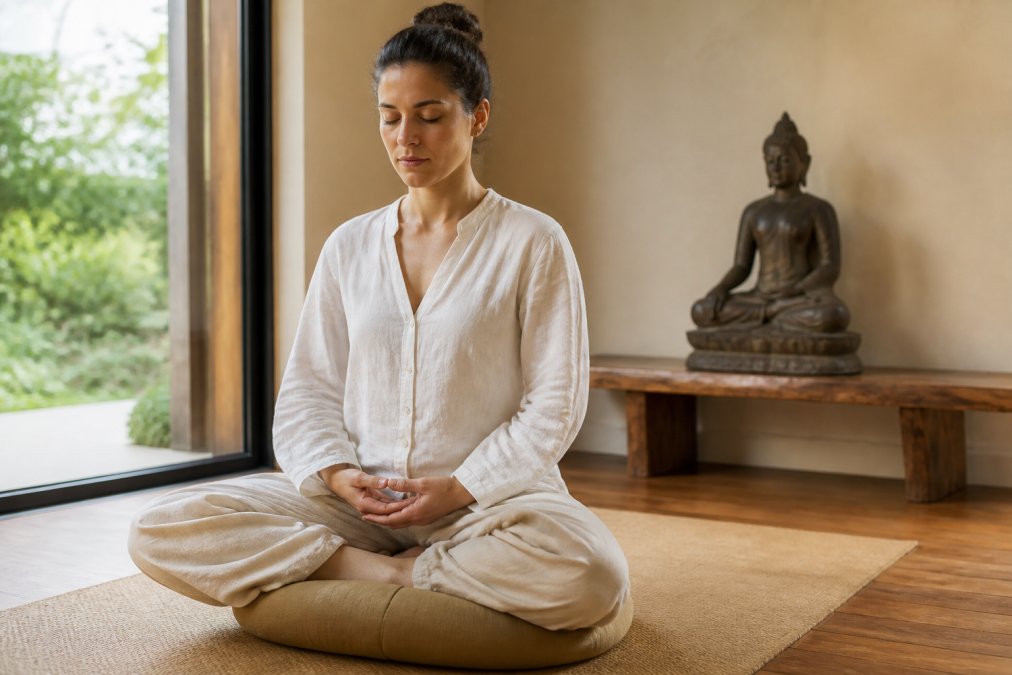
A two-week starter protocol:
- Days 1-3: Five minutes daily, one mudra, seated upright.
- Days 4-7: Extend to ten minutes, same gesture, same time of day.
- Days 8-11: Add slow pranayama breathing, four counts in, six out.
- Days 12-14: Hold fifteen minutes and record one sentence on how you felt.
Frequently Asked Questions
Is there any scientific evidence for mudras?
Yes, though the field is still developing. EEG studies have recorded shifts in alpha and theta wave activity during mudra practice, and MRI imaging has shown activation in the somatosensory and motor cortex when the hands form specific gestures. Researchers describe this as exploratory rather than definitive, but the findings suggest a measurable psychophysiological link between hand position and brain state.
Do hand mudras actually work?
Many practitioners report improved focus, calm, and mental clarity, and early clinical evidence supports some of these claims. The proposed mechanism involves the neural feedback loop: sensory input from the hands travels to the brain and influences arousal and attention networks. Results vary by individual, so treat mudras as a complementary mindfulness tool rather than a medical treatment.
What is a good mudra for brain activation and focus?
Gyan mudra, formed by touching the thumb and index finger, is the most studied for focus and concentration. Some EEG research associates it with increased alpha wave activity, a pattern linked to relaxed alertness. Practicing it for 5 to 10 minutes before a demanding task is a simple way to test its effect on your own mental clarity.
Can hand gestures improve cognitive focus?
Emerging research on hand gestures and cognitive function suggests that purposeful hand movements can support attention and working memory. Mudras may work through the same hand-brain connection, engaging the somatosensory cortex and promoting parasympathetic activation. Combining mudra practice with mindfulness or pranayama tends to produce the most consistent reported benefits for focus.
The challenge with mudra practice is rarely the gesture itself. It is sustaining a routine long enough for the effects to show up, and building a space that invites you back to it. HD Asian Art offers carefully curated Buddhist and Hindu statues, handpicked antique and contemporary pieces, and temple-inspired decor that turns a corner of any room into a place worth sitting in. Browse the collection and find the focal point for your practice.
