






-
Shiva Statue - Antique Javanese Style Bronze Dancing Shiva statue as Lord Nataraja - 64cm(26") Tall
Measures (Height) 64cm/26"
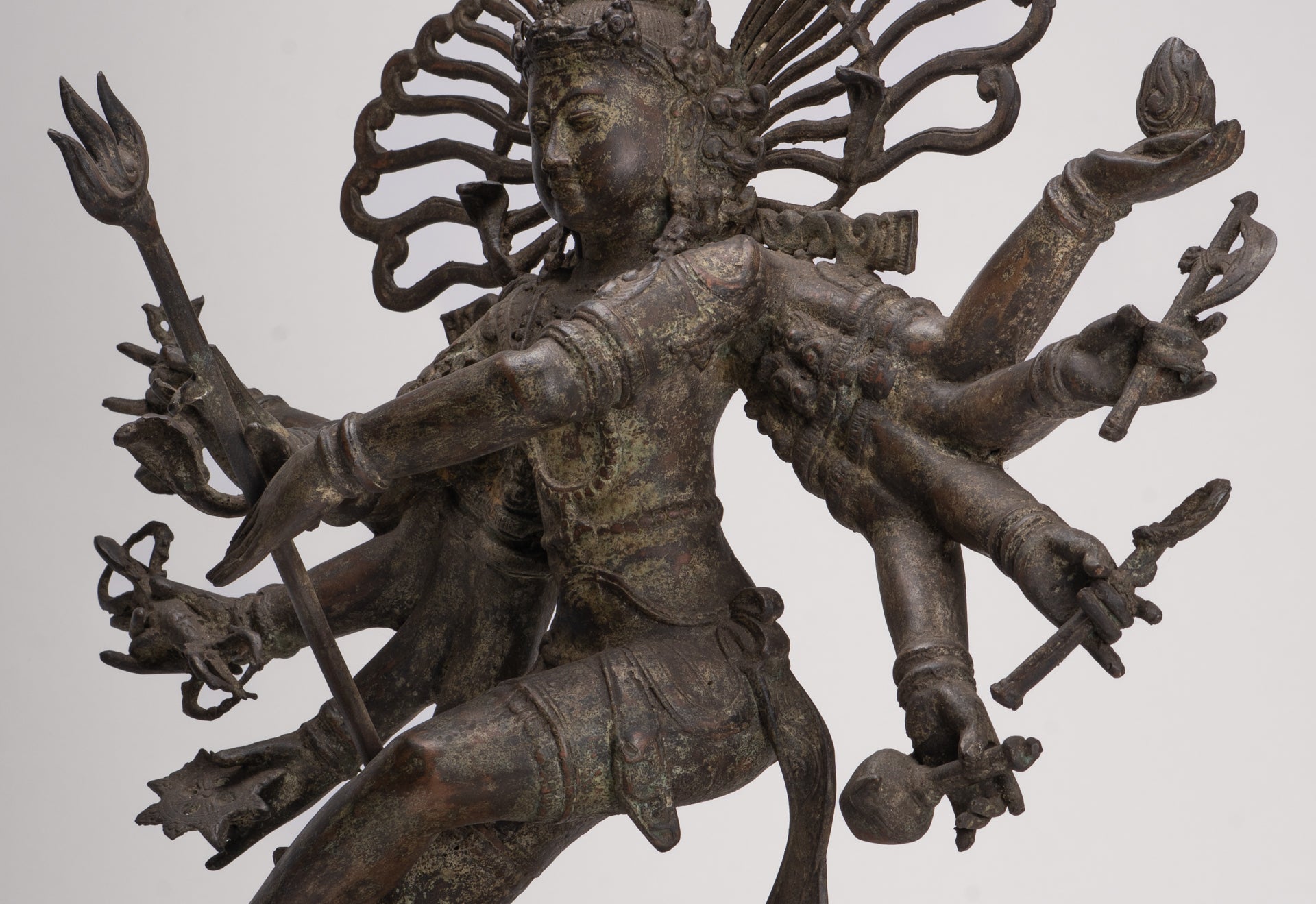
An extraordinary Majapahit‑style multi‑armed Nataraja, depicting Shiva as the divine cosmic dancer in a vigorous, expansive form. The sculpture captures the energy of Tandava, Shiva’s sacred dance through which creation, preservation, transformation, concealment and liberating grace are held in perpetual balance.
Unlike the familiar four‑armed South Indian Nataraja, this Javanese interpretation presents Shiva with an exceptional array of arms and attributes, amplifying the deity’s power and revealing the distinctive Hindu‑Buddhist imagination of Majapahit Java. Multiple arms in Hindu art do not suggest many separate bodies; rather, they make visible the immense range of a deity’s divine capacities—protection, wisdom, creativity, discipline, destruction of illusion and compassionate release.
Shiva dances on one leg, with the other raised in elegant suspension. The lifted foot represents liberation and refuge: the possibility of release from ignorance and the cycle of suffering. The richly flowing sash and the radiating ornamental framework behind the head create a remarkable sense of movement, as if the entire sculpture has been caught at the height of a divine rhythm.
The visible attributes include a powerful range of Shaivite and protective symbols:
-
The trident (trishula) expresses Shiva’s sovereignty over the three fundamental forces of existence—creation, preservation and transformation—and may also signify the three divisions of time: past, present and future.
-
The sword cuts through ignorance, attachment and illusion, acting as an instrument of clear, discriminating wisdom.
-
The axe or parasu represents the severing of harmful tendencies, ego and obstacles that prevent spiritual growth.
-
The noose (pasa) gathers and guides the devotee, symbolically drawing the mind back from distraction and binding destructive impulses.
-
The bow and arrow convey focused intention, disciplined action and the force of consciousness directed towards truth.
-
The drum (damaru) represents the primordial rhythm and sound from which creation unfolds—the pulse of time, movement and life itself.indianculture.gov+2
-
The flame (agni) represents dissolution and transformation: the fire that burns away what has become false, exhausted or obstructive so that renewal can occur.artic+2
-
The mace or club suggests strength, authority and the capacity to overcome forces of disorder.
-
The small ritual implement or vessel held in one hand adds to the figure’s ceremonial character and may refer to sacred offering, ritual knowledge or divine blessing.
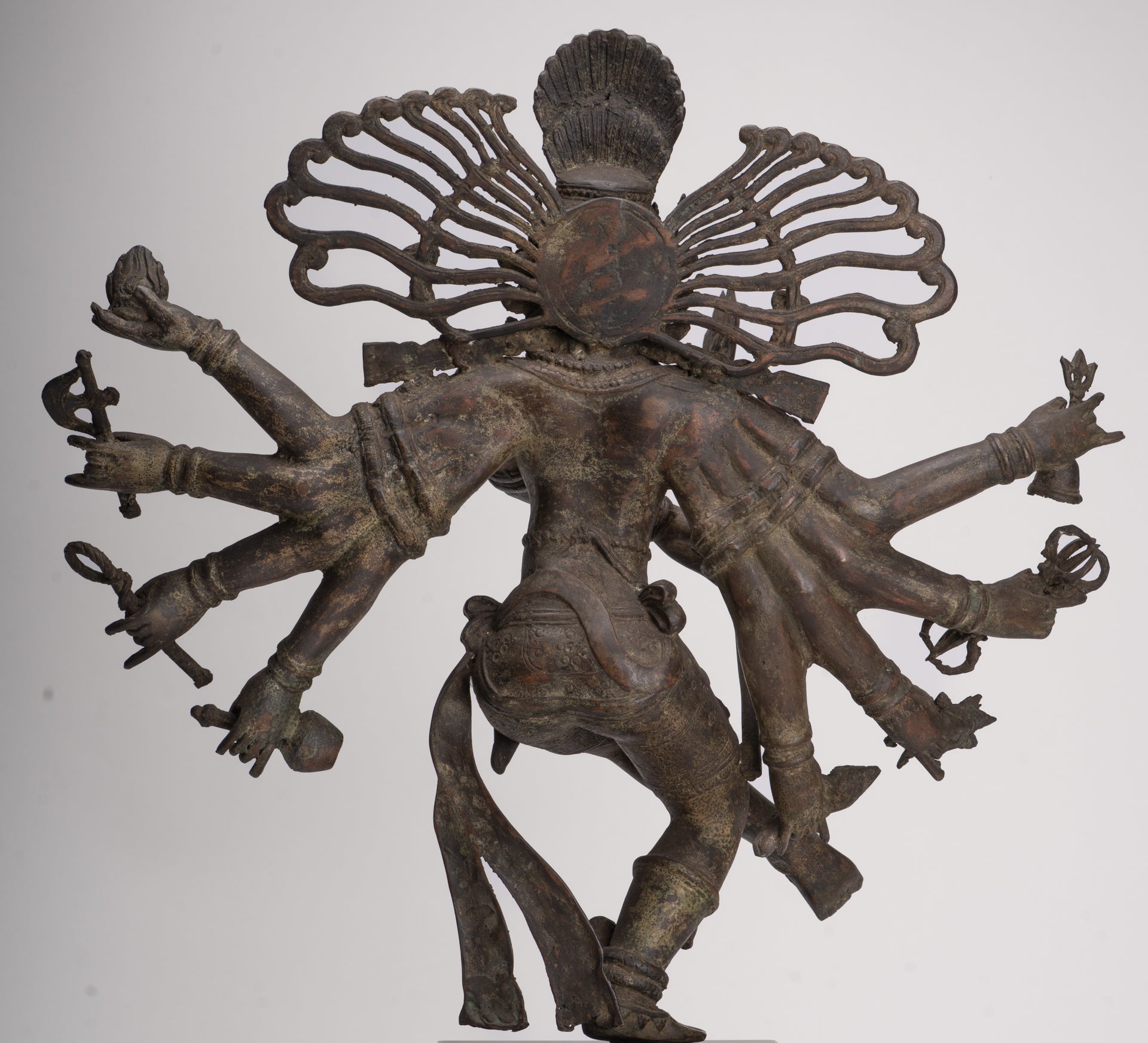
At the centre, one pair of hands is drawn across the body in a dynamic dance gesture, visually binding the many arms into a single, composed form. Behind Shiva rises a complex radiating aureole, whose openwork curves echo the movement of the flying locks and the cosmic energy of the dance. The tall crown, jewellery, sacred thread and patterned dhoti mark Shiva as both ascetic yogi and sovereign lord of the universe.
The bronze displays a beautifully aged surface, with soft green‑brown variation and areas of wear that enhance the modelling of the ornaments, weapons and textile folds. Mounted on a simple black base, this Majapahit‑style Nataraja becomes an exceptional sculptural focal point—equally compelling as a work of Southeast Asian art and as a profound image of energy, courage, transformation and spiritual freedom.
Key Features
-
Majapahit‑style multi‑armed Nataraja – A rare and dynamic Javanese interpretation of Shiva as Lord of the Cosmic Dance.
-
Exceptional multi‑armed iconography – Numerous arms hold Shaivite weapons and ritual symbols, expressing Shiva’s expansive divine power.
-
Dance of cosmic transformation – Shiva performs the Tandava, the sacred dance of creation, preservation, destruction and liberating grace.
-
Symbolic attributes – Visible objects include a trident, sword, axe, noose, bow and arrow, drum, flame, mace/club and ritual implement.
-
Damaru of creation – The drum represents primordial sound, rhythm, time and the arising of the universe.
-
Agni of transformation – The flame symbolises dissolution, purification and the clearing away of ignorance.
-
Raised foot of liberation – The lifted foot signifies refuge, grace and freedom from ignorance and spiritual limitation.
-
Majapahit Hindu‑Buddhist character – Combines Indian Shaivite symbolism with the elaborate ornament, dynamic movement and ceremonial richness of Javanese sacred art.
-
Radiating openwork aureole – A dramatic ornamental framework creates movement, balance and a powerful temple‑icon silhouette.
-
Beautiful aged bronze patina – Varied green‑brown surface tones emphasise the fine ornament, weapons, textiles and sculptural depth.
-
Professionally mounted – Presented on a clean black base for stable, gallery‑style display.
Frequently Asked Questions
Q: Who is Nataraja?
A: Nataraja means “Lord of the Dance.” It is one of Shiva’s most celebrated forms, representing him as the divine dancer whose movement expresses the rhythm of the universe—creation, preservation, transformation and spiritual release.Q: What does Shiva’s cosmic dance represent?
A: Shiva’s dance represents the dynamic nature of all existence. In Hindu philosophy, it embodies Shiva’s five divine activities: creation, preservation, destruction, concealment and grace. The dance teaches that change is not merely loss or chaos, but an essential part of renewal and liberation.Q: Why does this Nataraja have so many arms?
A: Multiple arms are used in Hindu sacred art to express divine power beyond normal human capacity. Each hand may hold an attribute or make a gesture, allowing the sculpture to present Shiva simultaneously as creator, protector, destroyer of ignorance, yogi, teacher and cosmic ruler.Q: Is this the classic four‑armed Nataraja form?
A: No. The most familiar Chola Nataraja has four arms, holding a drum and flame while making protective and liberating gestures. This work is a much more elaborate Majapahit‑style multi‑armed interpretation, reflecting the rich visual experimentation of Javanese Hindu‑Buddhist art.Q: What is the Majapahit tradition?
A: The Majapahit Empire was a major Hindu‑Buddhist kingdom centred in East Java from the late 13th to the early 16th century. Its art adapted Indian deities and sacred narratives into a distinct Indonesian style marked by ornate costume, strong silhouettes, flowing movement and richly layered symbolism.Q: What does the trident mean?
A: Shiva’s trident, or trishula, is one of his most important attributes. It can represent creation, preservation and transformation; the three divisions of time—past, present and future; or the three fundamental qualities of existence. It expresses Shiva’s command over the forces that shape reality.Q: What does the sword represent?
A: The sword symbolises sharp, discerning wisdom. It cuts through maya—illusion, attachment, ego and false understanding—allowing truth and spiritual freedom to emerge.Q: What does the axe represent?
A: The axe, or parasu, represents the cutting away of obstacles, harmful habits and limiting attachments. It reminds the viewer that genuine transformation may require courage and the willingness to release what no longer serves spiritual growth.Q: What does the noose represent?
A: The noose, or pasa, symbolically gathers the devotee towards truth and restrains destructive impulses. It is a metaphor for divine guidance: the mind is drawn back from distraction, ego and harmful desire towards clarity and discipline.Q: What do the bow and arrow represent?
A: The bow and arrow represent focused intention, concentration and purposeful action. The bow is potential energy held in readiness; the arrow is awareness directed precisely towards truth and the overcoming of obstacles.Q: What is the damaru?
A: The damaru is Shiva’s small hourglass drum. Its beat represents the primordial sound from which creation arises—the pulse of time, language, rhythm and life.Q: What does the flame represent?
A: The flame, known as agni, represents dissolution and transformation. It burns away ignorance and what has become stale or obstructive, making space for renewal. In Nataraja imagery, destruction is therefore compassionate and creative rather than merely violent.Q: What does the club or mace represent?
A: The mace or club signifies strength, authority and the ability to overcome forces of disorder. In a multi‑armed Shiva form, it reinforces the idea that divine wisdom is not passive: it has the strength to protect dharma and confront ignorance.Q: What is the small vessel or ritual object in one hand?
A: The small attribute appears to be a ritual implement or vessel. In complex multi‑armed bronzes, small objects may be stylised or worn, so identification should remain cautious without views from every angle. Its presence adds to the image’s ceremonial and devotional character.Q: What does Shiva’s raised foot symbolise?
A: The raised foot is a sign of grace, refuge and liberation. It points to release from ignorance and the cycle of suffering, offering a path beyond the limitations represented by the lower, earth‑bound forces of the image.Q: Where is Apasmara, the demon of ignorance?
A: In the classic South Indian Nataraja form, Shiva’s planted foot stands upon Apasmara, the dwarf figure representing ignorance and forgetfulness. In this Majapahit‑style sculpture, the emphasis is instead on the expansive multi‑armed dance, and an Apasmara figure is not clearly visible in the present composition.Q: What is the openwork aureole behind Shiva?
A: The radiating framework functions as an aureole, or halo‑like sacred backdrop. Its rhythmic openwork design frames Shiva’s movement, echoes the flying limbs and hair, and visually expresses divine energy extending in every direction.Q: Why is Shiva shown with a serene face while dancing so energetically?
A: This contrast is central to Nataraja’s meaning. Shiva’s body embodies intense cosmic activity, while the composed face represents inner stillness, awareness and transcendence. The image teaches that true balance is possible even amid movement, change and challenge.Q: What does the tall crown signify?
A: The crown identifies Shiva as a sovereign deity and cosmic ruler. In Javanese sacred art, elaborate headdresses also contribute to the formal, ceremonial grandeur of the figure and distinguish divine bodies from ordinary human figures.Q: Is this sculpture appropriate for a meditation, yoga or dance space?
A: Yes. Nataraja is particularly meaningful in spaces dedicated to yoga, dance, music, creativity and meditation. He represents disciplined energy, fluid movement, transformation and the possibility of finding stillness within action.Q: Is it suitable for non‑Hindus to display?
A: Yes. Nataraja is appreciated around the world as a profound image of cosmic change, artistic expression and spiritual freedom. It should be displayed respectfully in a clean, stable and considered location.Q: Where should I place the sculpture?
A: The piece works best as a standalone focal point on a stable console, pedestal, shelf or altar. Give it room around the arms and aureole so the full silhouette can be viewed clearly. Avoid placing it near a busy edge where the projecting attributes could be knocked.Q: How should I care for the bronze patina?
A: Dust gently with a soft dry cloth or a natural‑bristle brush. Take particular care around the slender arms, weapons, openwork aureole and crown. Avoid metal polish, chemical cleaners, water immersion, abrasive pads and waxes, as these can damage the aged patina.Q: Can it be displayed outdoors?
A: Indoor display is recommended. Rain, frost, direct sun and fluctuating humidity can alter the bronze surface and increase the risk of damage to the fine, projecting attributes.Q: Who would especially appreciate this piece?
A: This Majapahit‑style Nataraja will appeal to collectors of Indonesian and Southeast Asian art, followers of Shiva, dancers, yoga practitioners, musicians, artists, interior designers and anyone drawn to powerful symbols of transformation, movement and spiritual freedom.SATISFACTION GUARANTEE - We have been offering SE Asian Art for many years and are proud of the reputation we have developed for fair and honest listings. However, if for any reason, whatsoever, you are unhappy with your purchase please just let us know and we will provide a full refund. We want you to be 100% happy with your purchase.
-
-
The majority of orders will be shipped with DHL. This is a secure, express and fully tracked service.
Items less than 2Kg we typically ship using Royal Mail.
Once we receive your order we try to ship all orders the same or next working day.
Large and/or fragile pieces requiring palletising, specialist crating and/or extra packaging may take a little longer. Palletised shipments will be delivered curbside.
All orders over 35 GBP will be shipped free of charge.

-
We genuinely hope that all purchases delight.
However, if they do not, regardless of reason, we will refund all orders upon receipt of the unwanted item. Just notify us within 14 days of receiving your order that you wish to make a return and send the piece back to us with 30 days of delivery.


