



Standing Buddha Statues: A Buyer's Guide to Regional Styles
Standing Buddha Statues: A Buyer's Guide to Regional Styles
What makes two standing Buddha statues look similar at first glance, yet belong to entirely different regional traditions? The answer is not just the material, age, or color. Posture, robe treatment, hand gesture, facial modelling, pedestal and surface finish form a visual language, and a serious buyer needs to read those elements together.
UK collections make this distinction especially important. The British Museum and Victoria and Albert Museum preserve standing Buddhas from different regions, periods and materials, so the category isn't a single style. It's a broad sculptural family whose details can indicate whether an image is Burmese, Thai, Indian, Chinese, Gandharan or Japanese.
Table of Contents
- Understanding the Standing Buddha Form
- Historical Development and Regional Origins
- Key Regional Styles of Standing Buddhas
- Materials Used in Standing Buddha Statues
- Identifying Authenticity and Conservation Marks
- Choosing Standing Buddhas for Home and Display
- Buying Considerations for Collectors and Interiors
- Caring for Standing Buddha Statues Long Term
Understanding the Standing Buddha Form
A standing Buddha is more than a seated Buddha moved onto a taller base. The upright body changes the image's relationship with the viewer. A seated figure often emphasises meditation, teaching or grounded contemplation. A standing figure can create a stronger sense of presence, welcome, protection or compassionate action.
Start with the feet. A fully standing Buddha normally has both feet deliberately connected to the base, even when one leg relaxes or the hips shift slightly. Check whether the weight sits convincingly over one supporting leg, whether the ankles are proportionate and whether the lotus or architectural pedestal gives the composition enough visual and physical support.
Read the body before the surface
The next clue is the line of the body. A calm standing Buddha usually has a controlled vertical axis, with the shoulders, hips and feet working together rather than creating theatrical movement. A subtle shift can suggest readiness or approach, while a symmetrical stance tends to communicate stillness and assurance.
The hands supply another essential clue. A raised palm may indicate reassurance or protection, while a lowered hand can suggest generosity. Other gestures relate to teaching, meditation or the transmission of Buddhist understanding. Never identify a statue from the hand position alone. The gesture must agree with the robe, attributes, facial expression and regional style.
The base also matters. A lotus pedestal frames the figure within a sacred setting, while a plain plinth, rock base or architectural support may point towards a different regional convention or later presentation. Damage, replacement bases and modern mounting can obscure this evidence.
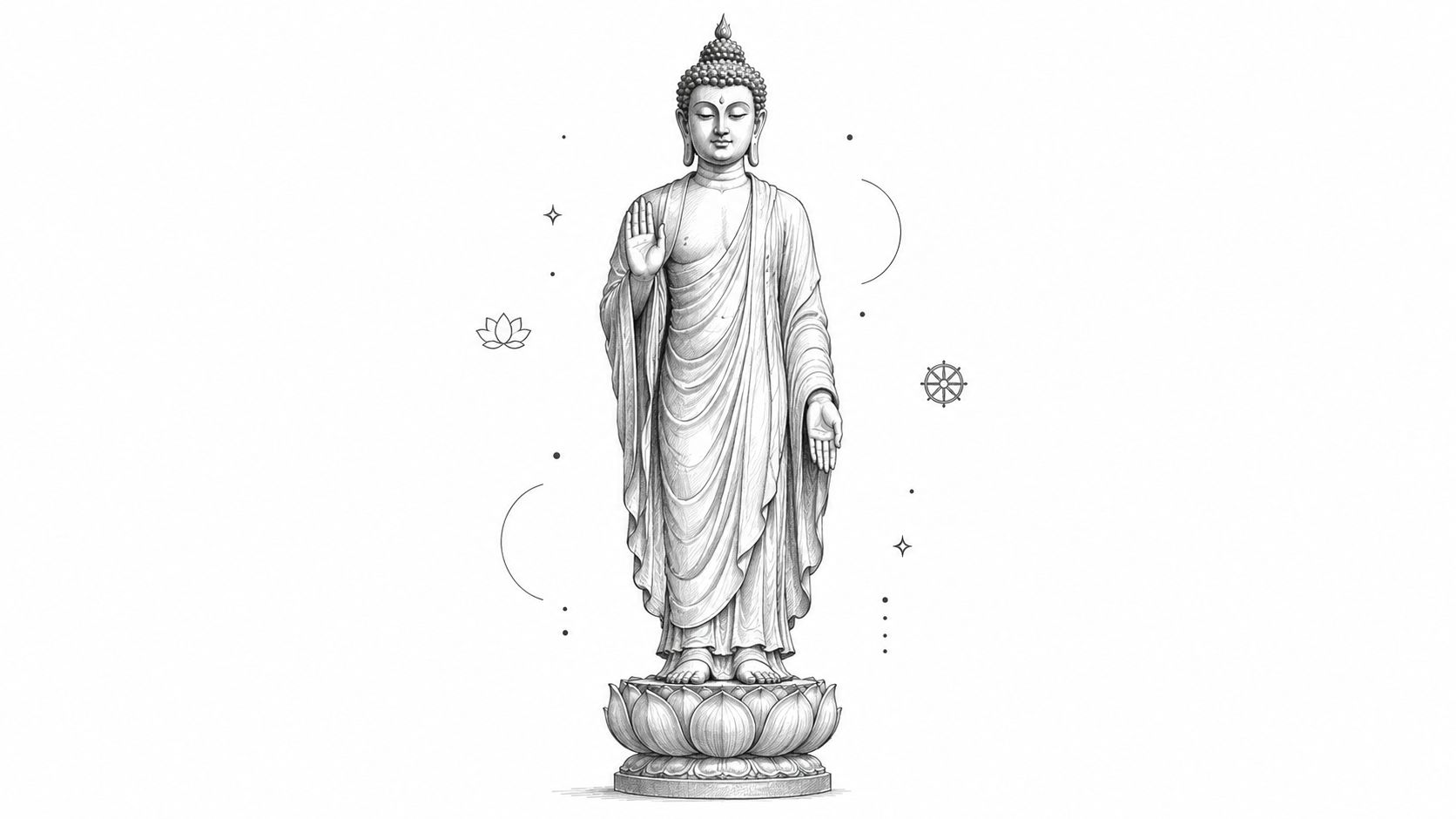
Practical rule: Describe the figure in order, from feet and base to hands, robe, face and crown. That sequence reduces guesswork and makes comparisons much clearer.
Historical Development and Regional Origins
Standing Buddha statues developed through exchanges between religious communities, travelling artists, patrons and workshops across Asia. Early Indian sculptors established important models for the human form, while Gandharan artists developed images with deep, rhythmical drapery and a more naturalistic treatment of the body. Mathuran and Gupta traditions moved towards softer modelling, controlled proportions and increasingly refined robes.
These developments didn't remain within one political boundary. Images, texts, craftsmen and visual conventions travelled into Central, South-East and East Asia. Local workshops adapted the standing form to available materials, courtly ideals, ritual needs and regional ideas of beauty. That process explains why a standing Buddha from Thailand can feel elongated and weightless, while a Chinese figure may appear fuller and more architecturally composed.
The chronology preserved in UK museums provides a useful anchor. The British Museum records standing examples spanning roughly the 2nd to 3rd centuries CE, the 5th to 6th centuries CE and the 7th to 8th centuries CE, demonstrating that the pose continued across a broad historical range. Its collection record for an early Chinese standing Buddha links the image to Chongguang Temple in northern China and a dedication date of AD 585. The museum describes the North Stairs Buddha as one of the earliest surviving examples of Buddhist art from China. Read the British Museum's collection record for the standing Chinese Buddha.
A regional reading of chronology
South Indian production later developed distinctive gilt copper-alloy images, including the V&A's standing Buddha from Nagapattinam, dated to the 11th to 12th century. The same institution records an exceptional standing Buddha from north-eastern India, probably Bihar, dated to the late 6th to early 7th century. These objects show that Indian standing Buddhas continued to vary in modelling, scale and metalwork rather than following a single fixed formula. Compare the V&A's documented standing Buddha from South India.
In South-East Asia, workshops developed distinctive solutions for the robe, hair, flame finial, jewellery and base. Thai sculptors often pursued elegance and vertical movement, Burmese artists frequently emphasised rich lacquer and gilding, and Khmer traditions favoured strong, architectural silhouettes. Chinese and Japanese makers adapted the figure to wood, bronze, stone, lacquer and courtly dress.
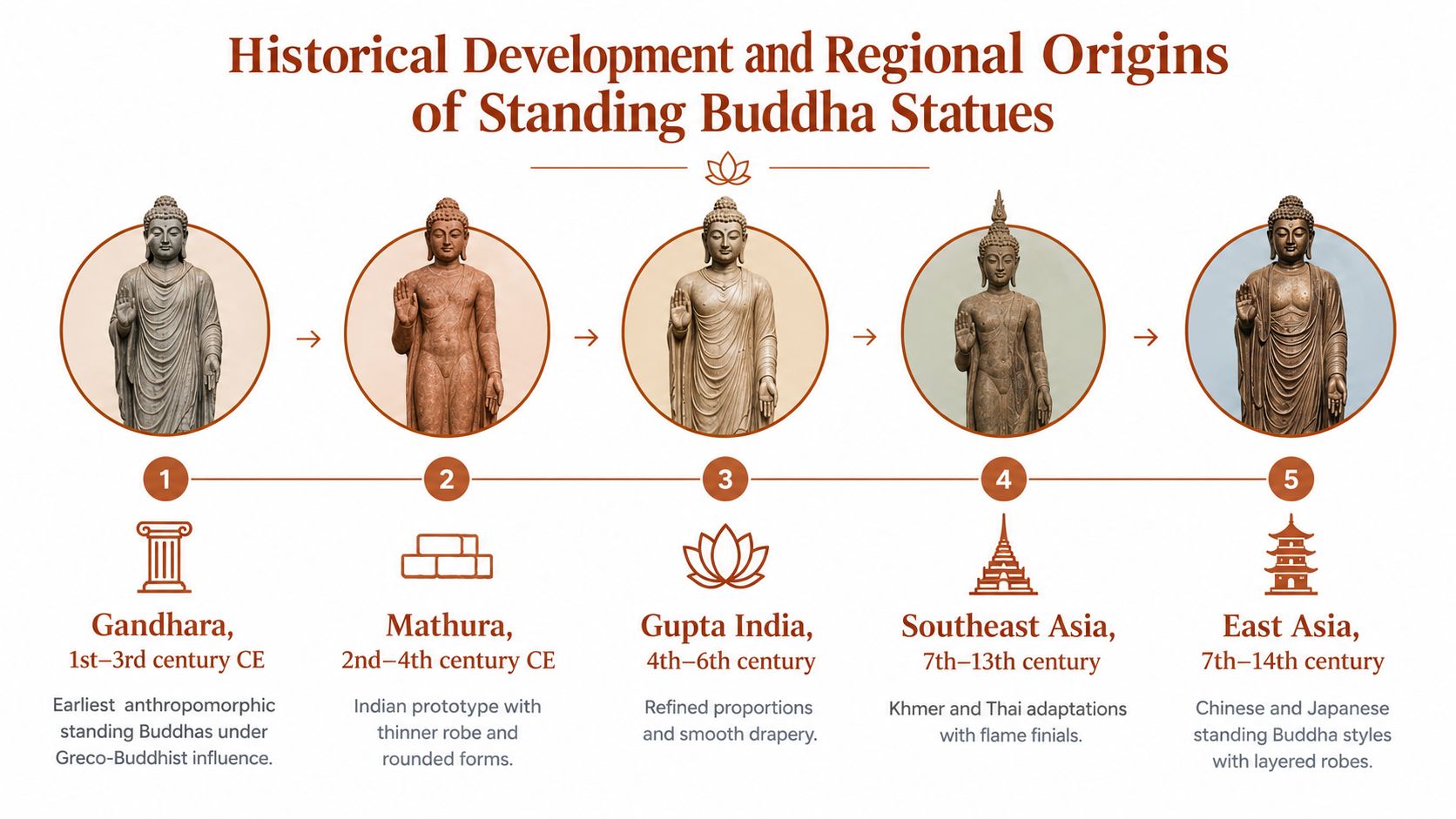
A collector should therefore treat a date and region as a connected hypothesis. If the robe suggests one tradition but the head, base and construction suggest another, the mismatch deserves investigation rather than a confident label.
Key Regional Styles of Standing Buddhas
Regional identification begins with comparison, not recognition by silhouette. The following distinctions are useful starting points, although individual workshops and later restorations can blur them.
Burma, or Myanmar, often rewards close examination of the surface. Standing figures may feature a flame-shaped ushnisha, flowing robes and a strong emphasis on gilding. Lacquer, glass inlay and mirror work can create a lively, reflective finish. The pose may remain composed even when the surface is richly embellished.
Thailand is often associated with elongated proportions, elegant contours and a flame finial. Sukhothai-influenced figures can appear almost weightless, with a smooth head, softly modelled face and robe that follows the body in restrained lines. A raised hand may indicate protection, while a walking figure can convey graceful movement rather than muscular force.
India requires more caution because its standing Buddhas cover varied regions and periods. Gupta-related images may show serene facial modelling, balanced anatomy and a robe treated so lightly that the body appears almost uncovered beneath it. Later South Indian gilt copper-alloy sculpture can have a more tactile surface and a different relationship between figure, ornament and base.
China often presents a fuller body, broader sleeves and layered robes. Large figures may be made from stone, wood, iron or gilt bronze, and the robe can read as a substantial architectural mass. Chinese images also need careful dating because later repairs, repainting and replacement attributes may alter the original appearance.
Pakistan and the wider Gandharan sphere are usually recognised through deep, graphic drapery, wavy hair and a strong interest in the fall of fabric around the body. Processional or shrine-related fragments may differ considerably from freestanding devotional figures. A seller's use of “Gandharan” should never replace an examination of stone, carving depth, facial type and provenance.
Japan adds another important comparison. Standing figures may be carved in wood or made using dry-lacquer techniques, with layered kesa folds and a more restrained, refined presence. A crowned or ornamented figure may be a bodhisattva rather than a Buddha, so identity must be checked through attributes as well as posture.
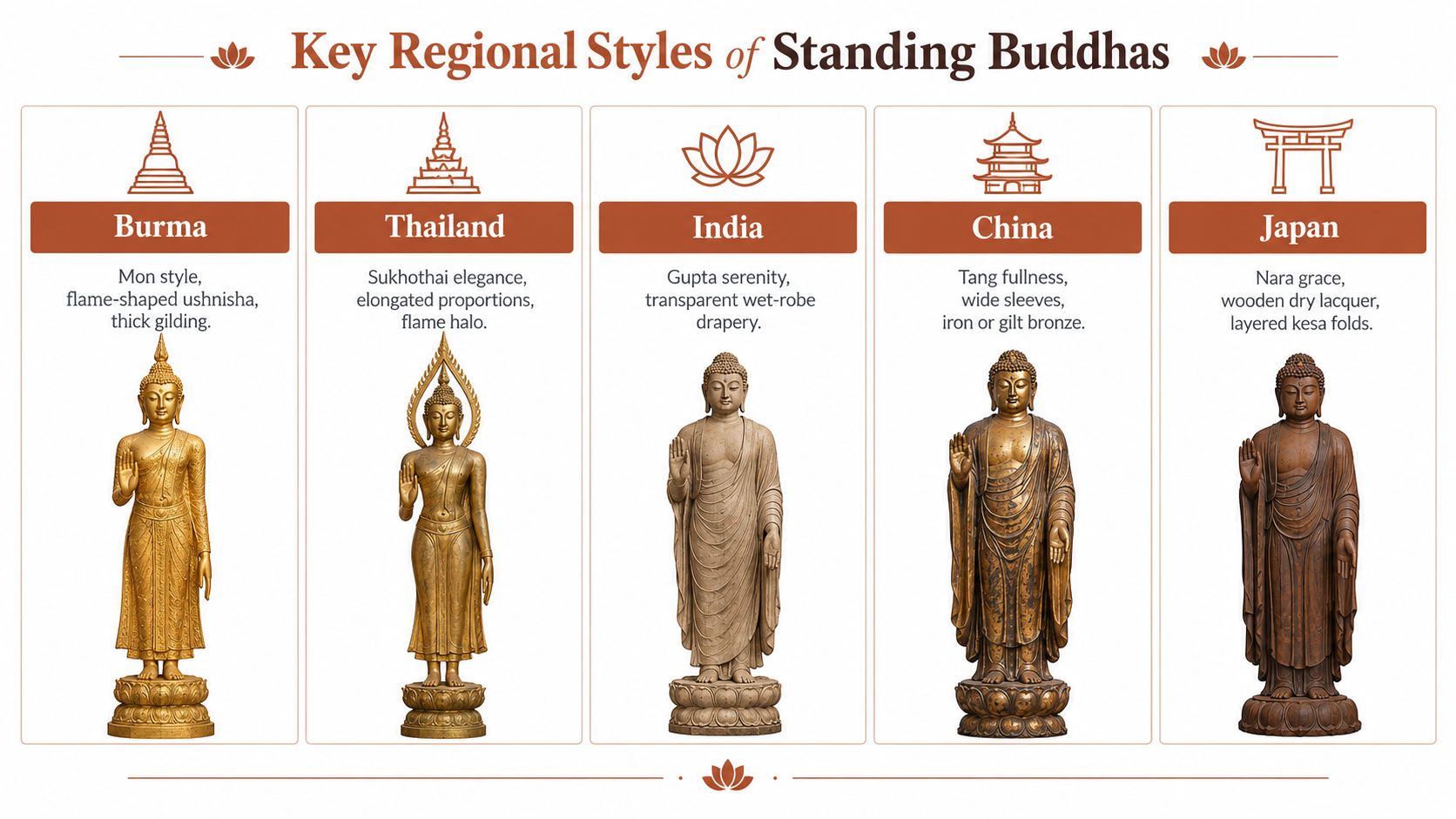
For a broader visual comparison, see this guide to regional Buddha statue styles across Thai, Burmese, Chinese, Tibetan and Gandharan traditions. Use it as a prompt for observation, not as a substitute for object-level documentation.
Materials Used in Standing Buddha Statues
Material gives you evidence, but it doesn't provide an automatic attribution. A dark bronze-coloured surface may be patinated bronze, painted wood, lacquer over a core, brass or a modern composite. The buyer's task is to connect the visible finish with construction, weight, age, tool marks and regional convention.
Bronze and brass support slender limbs and projecting hands effectively, but casting quality varies greatly. Look for seams, joins, chased details and the treatment of the underside. A hollow cast figure behaves differently from a solid carved object, and a modern surface may imitate the appearance of age without reproducing historical construction.
Stone offers visual weight and architectural presence. Sandstone, schist, marble and other stones show different grain, fracture patterns and carving responses. A standing stone figure should be examined at the ankles, fingers, robe edges and base, where old breaks and later restorations are most likely to appear.
Wood requires a different reading. Grain direction, joined sections, inset faces and layered coatings may reveal how the sculptor built the figure. Lacquer can conceal the substrate, while gilding may cover earlier colour or later repairs. The V&A's conservation study of an 18th- to early-19th-century Burmese standing Buddha found that the figure and base were carved from one piece of wood, while the face was a denser separate insert fixed with nails. Conservators used X-radiography and lacquer cross-section analysis to investigate its construction and repair history. Read the V&A conservation account of the Burmese lacquer Buddha.
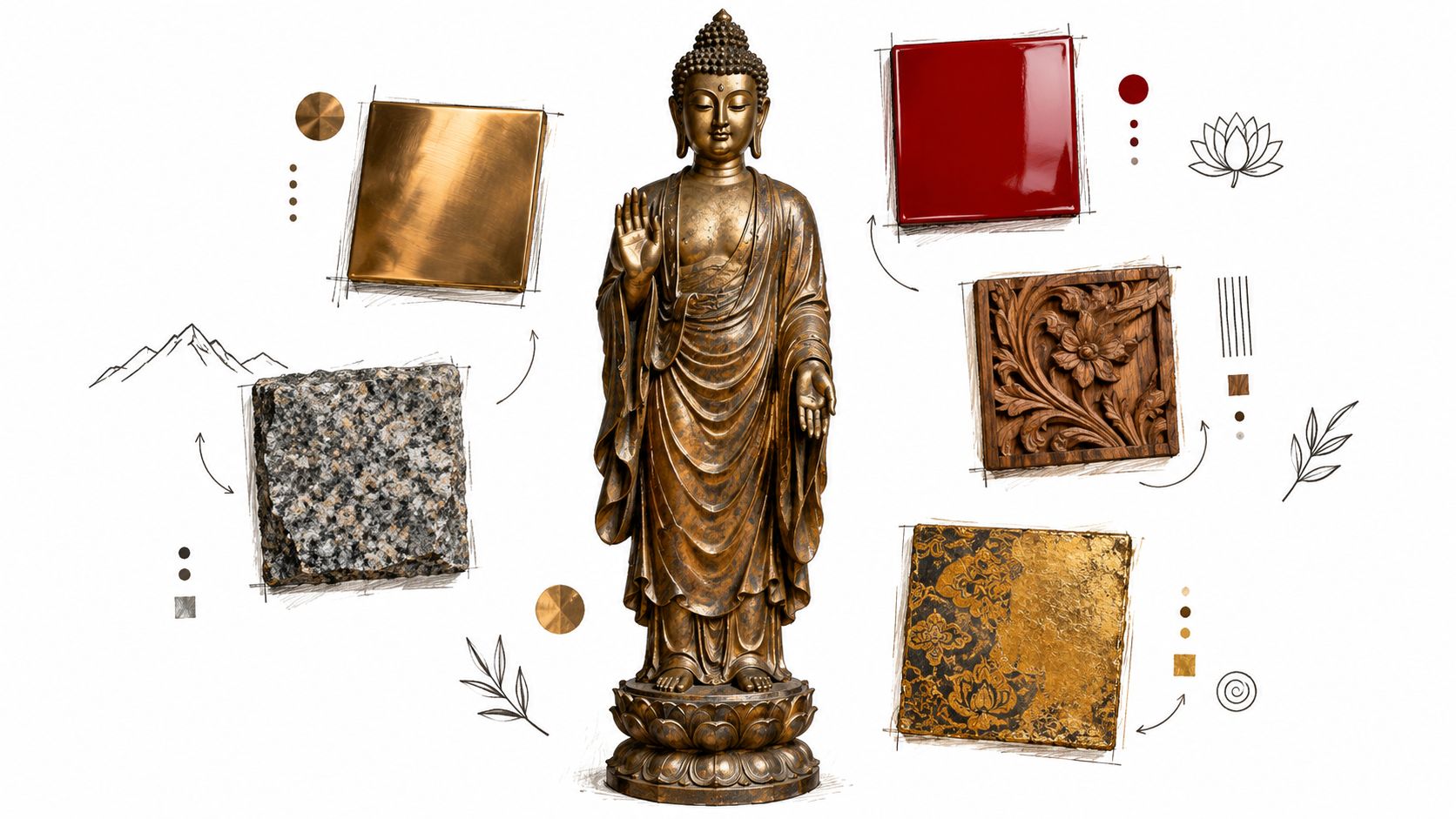
Gilding and pigment traces deserve particular care. Losses don't automatically indicate damage or fraud, and bright new gold doesn't automatically indicate originality. Compare protected recesses, exposed edges and areas around the base, then ask whether a conservator or seller can explain the surface history.
For a concise overview of how bronze, brass, stone, wood and resin differ, consult this guide to Buddha statue materials. The central principle is simple: material claims need physical evidence.
Identifying Authenticity and Conservation Marks
Authenticity isn't proved by patina alone. A convincing evaluation combines iconography, material, construction, wear, provenance and condition. A statue can be old but heavily altered, modern but carefully made, or assembled from older and newer components.
Start with construction
Inspect the join between the body and base, the waist, the arms, the hands and any separately attached halo or attribute. A visible joint may reflect original assembly rather than damage. Equally, a clean break, fresh-looking adhesive or inconsistent surface around a repair can indicate later intervention.
Wooden figures deserve especially close attention. Check whether the grain continues naturally through the body, whether the face is inset and whether nails, dowels or joins sit where structural stress would make sense. Lacquer layers can also tell a story. Uneven black lacquer, worn gilding, coloured underlayers and localised retouching may reflect ritual use, restoration or later alteration.
Monumental sculpture demonstrates why these details matter. The British Museum's colossal standing Amitābha is 5.78 metres tall and has traces of gilding and paint. Conservators identified a visible waist joint and used scanning electron microscopy to identify jujube wood dowels that once held the lost arms and hands. See the British Museum's conservation and scientific analysis of the Amitābha Buddha.
Ask what the repair tells you
Conservation marks aren't automatically negative. A documented repair can show that an object has been examined responsibly, while an undisclosed replacement can affect both attribution and value. Ask for photographs under neutral light, including the underside, back, base, hands, feet and any repaired areas.
Tool marks can help, but they're not decisive in isolation. Modern workshops can imitate older carving patterns, and centuries of cleaning can remove useful evidence. Compare the whole object, then obtain an independent opinion for a significant purchase.
A sound question to ask a seller: Which parts are original, which parts have been repaired, and what evidence supports the stated region and date?
Read this explanation of patina and artificial ageing on Buddha statues before treating a darkened surface as proof of age. A specialist report should distinguish observation from interpretation and should state uncertainty where the evidence is incomplete.
Choosing Standing Buddhas for Home and Display
A standing Buddha can work in a private interior, but the right choice depends on the role you want the image to play. A calm, symmetrical figure can anchor a meditation room or reading area. A Thai protection figure with an elegant forward rhythm may suit an entrance or a tall alcove, provided the base is stable and the gesture is understood.
A Burmese lacquer figure creates a different atmosphere. Its reflective gilding, mirror work and layered surface can become a focal point in a restrained room, but it needs protection from knocks and excessive handling. A stone or bronze figure may feel more architectural, making it suitable for a spacious hall, conservatory or carefully planned garden setting.
Match meaning with placement
Placement should be respectful even when the statue is acquired primarily as art. Keep it raised rather than directly on the floor, give the figure visual space and avoid positioning it in a bathroom, cluttered utility area or location where people will regularly brush against projecting hands and robes.
The face and gesture should remain visible. A raised palm works best when the viewer can read it without obstruction, while a subtle weight shift may disappear if the statue is placed too high. Eye-level relationships, clean sightlines and a stable plinth usually produce a more dignified presentation than crowded shelving.
Consider the viewer's movement through the room. A standing figure facing an entrance can create a welcoming or protective presence. A figure turned towards a meditation corner may support quiet attention. For a non-devotional interior, avoid treating the image as a novelty object or placing it beside unrelated decorative clutter.
Size also changes the experience. A small standing Buddha can sit comfortably on a console, while a larger figure needs a dedicated platform, adequate clearance and a plan for delivery. The British Museum's North Stairs Amitābha demonstrates the architectural scale these images can reach. The museum records the white marble figure at 5.78 metres, with traces of gilding and pigments, standing on a lotus base. View the British Museum record for the colossal Amitābha Buddha.
Buying Considerations for Collectors and Interiors
Buy the evidence, not just the label. A listing that says “antique Thai standing Buddha” gives you a starting point, not a conclusion. Ask how the seller identified the region, whether the base is original, which elements have been replaced and whether the stated date reflects the figure, the finish or a later mounting.
A sensible purchase file should include clear photographs, dimensions, material description, condition notes, provenance where available and written details of restoration. For imported or fragile sculpture, confirm packaging, insurance, delivery access and responsibility for transit damage before payment.
Standing Buddha Buying Checklist
| Criteria | What to Check | Red Flags |
|---|---|---|
| Regional attribution | Compare head, robe, gesture, base and material as a group | A confident regional label with no visual explanation |
| Construction | Ask about joins, inserts, dowels, casting and the underside | Refusal to show the back or base |
| Condition | Request close photographs of hands, feet, ankles, face and pedestal | Fresh adhesive, unstable repairs or unexplained replacements |
| Provenance | Look for collection history, prior sales records or a specialist opinion | Vague claims of temple origin without documentation |
| Scale and weight | Confirm measurements and plan the plinth, doorway and delivery route | A narrow base, rocking figure or unsuitable shelf |
| Surface | Distinguish original lacquer, gilding, pigment, patina and retouching | Uniform artificial ageing or excessively polished detail |
| Shipping | Confirm protective packing, insurance and inspection on arrival | No written damage procedure |
A precise museum record shows the level of information buyers should seek. One British Museum sandstone standing Buddha is recorded at 810 mm high, with a weight of about 100 kg, a width of 350 mm and a depth of 200 mm. Review the British Museum's documented sandstone standing Buddha. Those measurements aren't merely cataloguing details. They affect floor loading, handling, insurance and display design.
For contemporary pieces, prioritise workmanship and honest description. For antiques, accept that condition may be part of the object's history, but don't accept uncertainty about major repairs when the price assumes exceptional originality.
Caring for Standing Buddha Statues Long Term
Care starts with a stable environment. Keep wooden lacquerware away from heaters, draughts, direct sunlight and damp walls. Bronze should be dusted gently and not aggressively polished, while stone needs protection from impact, standing water and unsuitable outdoor conditions.
Use a soft, clean brush around gilding, pigment and projecting robe edges. Don't spray cleaner onto the surface, and don't lift a statue by its arm, halo, scarf or hand. Support the base or the strongest lower section with both hands.
Check the figure periodically for rocking, fresh cracks, lifting lacquer, loose attributes or changes around old repairs. Record photographs and measurements when the object arrives, then consult a conservator if its condition changes. A documented sandstone example in a UK collection shows why precise dimensions and material records matter for responsible handling, not just for catalogues.
If you're comparing regional standing Buddha statues, HD Asian Art offers curated Buddhist and Southeast Asian sculptures organised by region and material, with descriptions intended to support informed selection. Visit the gallery to examine Thai, Burmese, Indian and other Asian forms, then contact the team before purchase if you need help matching iconography, condition and display requirements.
