



Small Bronze Shiva Statue for Home Altar: A Buyer's Guide
Small Bronze Shiva Statue for Home Altar: A Buyer's Guide
Quick Summary
A small bronze Shiva statue for home altar use should stand 4 to 9 inches tall, a practical range that fits most shelves, niches, and tabletop mandirs. Read the material line before the photos, since listings saying bronze finish or bronze-tone often describe a surface treatment on resin or brass rather than solid bronze.
- Four inches suits a niche or travel shrine, while six inches reads well from across a room.
- Solid bronze pieces at 5 to 6 inches usually list a weight; cold-cast pieces often omit it.
- A heavier base is safer on a crowded shelf, since lighter pieces tip more easily.
- A Linga suits daily abhisheka, while a Nataraja suits contemplation and display.
- Allow about two inches of depth beyond the base and a foot of clearance above the crown.
Table of Contents
- Why a Small Bronze Shiva Statue Suits a Home Altar
- Bronze, Brass, and Cold-Cast Bronze Compared
- Which Shiva Statue Is Good for Home?
- Nataraja Statue for Home: A Form Worth Considering
- Shiva Statue Placement at Home
- Finish, Color, and Surface Details That Decide the Look
- Comparing the Options: A Buyer's Table
- Choosing Your Small Bronze Shiva Statue from HD Asian Art
- Frequently Asked Questions
Why a Small Bronze Shiva Statue Suits a Home Altar
A small bronze Shiva statue for home altar use solves a problem most shrine shoppers run into: the form needs presence without taking over the room. Compact bronze pieces hold detail at a small scale better than many other materials. A 5-inch cast figure can still show the trident, the drum, and the coil of hair.
Scale matters more than most guides admit. A Bhunes guide to brass and Panchaloha Shiva murtis suggests 4 to 9 inches as a practical height for a home altar. That range covers most shelves, wall niches, and tabletop mandirs without crowding the lamp or the offering tray.
The 4 to 9 Inch Range That Fits Most Altars
Four inches suits a niche or a travel shrine. Six inches reads well from across a room. Eight to nine inches anchors a dedicated altar table but needs roughly a foot of clearance above the crown for the lamp and offerings. Measure depth as carefully as height, since many Shiva forms extend through the raised arm or the ring of flame.
Bronze, Brass, and Cold-Cast Bronze Compared
Bronze is a copper-tin alloy, brass is copper-zinc, and cold-cast bronze is metal powder mixed into resin. All three can look convincing in photographs, and they can differ in weight and surface behavior. For readers weighing other materials, our alternatives to traditional brass Hindu idols covers the options.
How to Tell What a Listing Actually Offers
Read the material line before the photos. Sellers who cast in solid bronze usually say so plainly and list the alloy or the casting method. Listings that lean on phrases like "bronze finish," "bronze-tone," or "antique bronze color" are often describing a surface treatment on resin or brass, not the metal itself.
A few checks settle most cases:
- Weight in the specs: a solid bronze piece at 5 to 6 inches usually has a listed weight; cold-cast pieces often omit it or list grams that feel light for the size.
- Base construction: solid cast bases are usually open or roughly finished underneath, while cold-cast bases are often flat and sealed.
- Seam and mold lines: cold-cast pieces tend to show softer detail at the fingers, trident tines, and flame ring.
- Seller questions: ask directly whether the piece is solid cast, what alloy it uses, and where it was cast. A serious seller answers all three without hedging.
Watch out: a listing that calls an item "antique bronze finish" may be describing color rather than metal. A current eBay listing for a 6-inch Shiva statue uses exactly that phrase while labeling the piece brand new, which tells you nothing about the alloy.
Durability and Weight on an Altar
Weight is not just a quality signal; it is a safety issue. A taller, lighter piece tips more easily when a lamp or offering tray is moved nearby, so a heavier base is an advantage on a crowded shelf. Solid bronze also holds fine detail at small scale, which is why the trident, drum, and hair coil stay crisp on a 5-inch cast figure where a resin copy softens. Brass sits in the middle: durable and detailed, but bright enough that fingerprints and tarnish show sooner unless the piece is handled sparingly.
Alloy Composition and What Provenance Should Show
Ask what the piece is made of and where it was cast. Provenance can be as simple as the workshop, the region, and the casting method, documented in writing. For a devotional piece, that record also tells you whether the form follows a recognized iconographic tradition or was modeled loosely for the decor market.
Which Shiva Statue Is Good for Home?
The best Shiva statue for home worship is the form you can honor consistently and place properly. That usually means a seated or standing figure at altar scale rather than a large temple piece. Form follows practice: a Linga suits daily abhisheka, while a Nataraja suits contemplation.
For readers weighing Shiva against other deities, our best Hindu statues for home altar buyer's guide sets the wider context.
Poses and Iconographic Forms Side by Side
| Form | What It Shows | Best For |
|---|---|---|
| Nataraja | Dancing Shiva in a ring of flame | Contemplation, living rooms |
| Somaskanda | Shiva with Parvati and the child Skanda | Family shrines |
| Ardhanarishvara | Shiva and Parvati as one body | Reflection on unity |
| Shiva Linga | Aniconic pillar form | Daily puja and abhisheka |
| Chandrasekhara | Shiva bearing the crescent moon | Quiet, seated devotion |
Each form carries its own attributes, and reading them correctly changes how a piece feels in a room. Our Hindu deity attributes and symbols list explains the trident, drum, and raised crown in detail.
Nataraja Statue for Home: A Form Worth Considering
Nataraja is the dancing Shiva, framed by a ring of flames and standing on the demon Apasmara, who represents ignorance. It is the most recognizable Shiva form in the world, and the most misunderstood in a domestic setting. Buyers worry it looks theatrical on a small altar.
Scholarship on the form is deep. A ResearchGate study of a South Indian Chandrasekhara bronze dated roughly 1000 to 1200 CE traces how text and casting technique shaped these figures, and a 2024 ISVS paper on Shiva at Borobudur examines how the deity's imagery communicates across cultures.
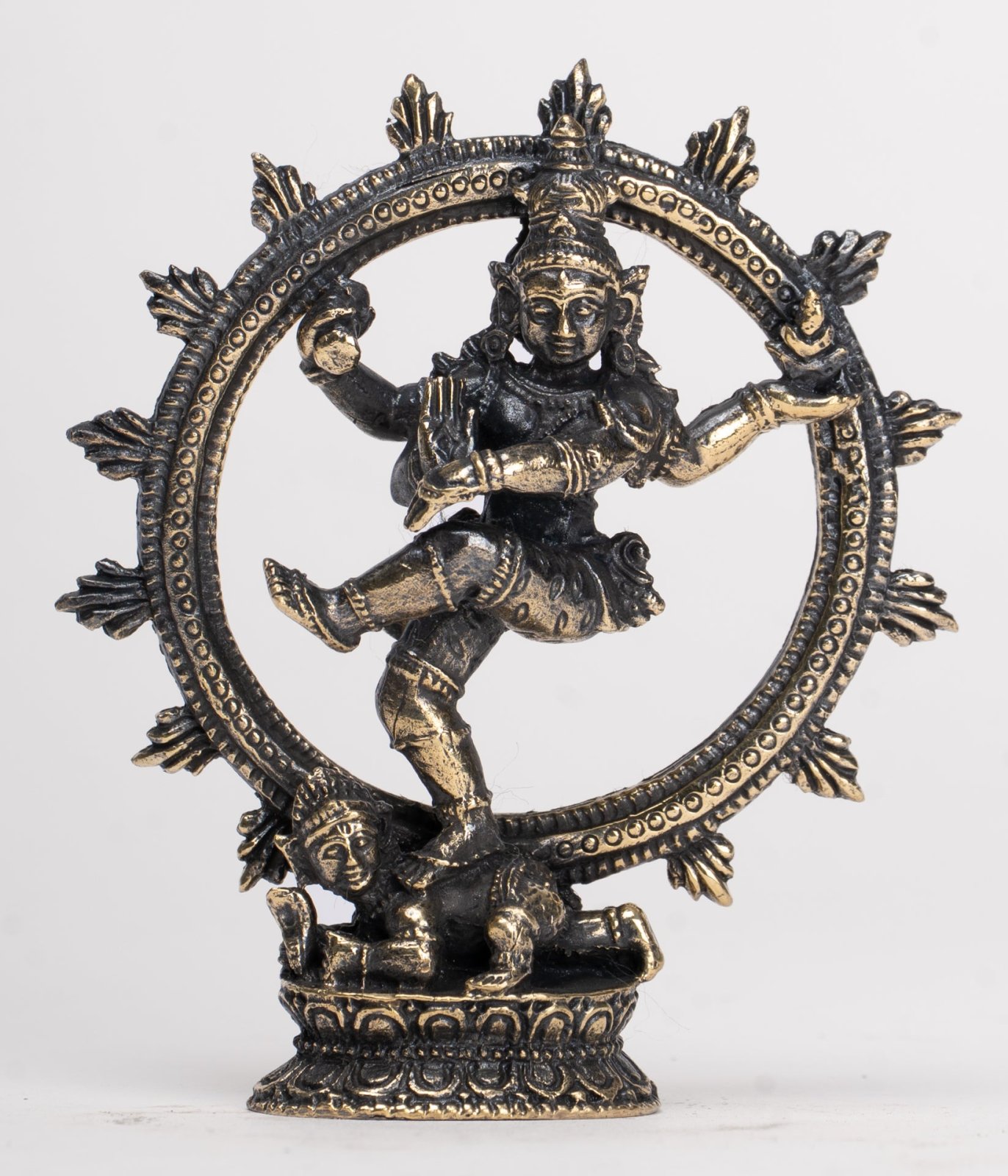
If you are still deciding between forms, our article on whether a Nataraja statue is worth it for home walks through the trade-offs.
Shiva Statue Placement at Home
Placement guidance is best treated as a set of guidelines rather than fixed rules. What generally matters is a clean, elevated, quiet spot that faces the room rather than a doorway.
Keep the statue at eye level or slightly above when seated. Avoid bathrooms, the foot of a bed, and shelves that hold everyday clutter. For compact apartments, our guide to styling a minimalist pooja corner covers small-space layouts.
Finish, Color, and Surface Details That Decide the Look
Finish influences whether a bronze reads as devotional or decorative. A brownish patina with gold accents on the crown and jewelry suits many traditional altars.
- Patina: matte brown, ages gradually with handling
- Gold accents: usually applied to crown, necklace, and belt
- Base finish: lotus base or plain pedestal, check stability
- Scale detail: finer features hold better above 5 inches
Comparing the Options: A Buyer's Table
A product table is only useful if it answers a question. The question here is not "which is best" but "which fits my altar and my practice." The table below sorts the main options by the decision that matters most: how much space the piece needs and what kind of devotion it supports.
| Piece | Height | Material | Best For |
|---|---|---|---|
| HD Asian Art curated Shiva selection | Varies by piece | Bronze and mixed metals | Collectors wanting provenance |
| Mini Bronze Shiva Statue, Etsy | 16 cm × 11 cm | Bronze, stand included | Handmade figure with stand |
| Handcrafted Mini Shiva Linga | 2.5 cm | Bronze | Very compact daily worship |
| SHILPAM Shiva Statue | 8 inches | Bronze | Shelf and desktop display |
How to Read the Table
Start with height, because it is the constraint you cannot change later. A 2.5 cm linga suits a travel shrine or a very small niche, but it disappears on a full altar table. An 8-inch figure anchors a dedicated shelf but needs roughly a foot of clearance above the crown for a lamp and offerings.
Then match the form to practice. A linga supports daily abhisheka because the surface is simple and the offerings run off cleanly. A Nataraja or Chandrasekhara figure suits contemplation and display, where the silhouette matters more than ritual handling.
Finally, weigh material against handling.
Best for: buyers who want documented origin and a curated selection they can compare side by side. Skip if: you need a single fixed size and nothing else, in which case a standalone listing with clear dimensions is simpler.
A Quick Sizing Check Before You Buy
Measure three things before ordering: the height your altar allows, the depth of the shelf, and the clearance above the crown. Many Shiva forms extend through a raised arm or the ring of flame, so a piece that fits the height can still overhang the front edge. A common pattern is to allow about two inches of depth beyond the base and a foot of vertical clearance for the lamp. If the numbers are tight, size down rather than crowd the offerings.
Choosing Your Small Bronze Shiva Statue from HD Asian Art
The right piece is the one whose form, size, and finish you will still be glad to see in five years. HD Asian Art offers a carefully curated collection of Buddhist and Hindu statues alongside Khmer and Southeast Asian sculpture, with antique and contemporary pieces designed for altars, meditation spaces, and refined spiritual interiors.
Start with the height your altar allows, then choose the form that matches your practice. Browse our Shiva selection and compare finishes side by side before you decide.
The hardest part is not finding a beautiful statue. It is choosing one that fits your space and your practice at the same time. HD Asian Art handpicks each bronze and mixed-metal piece, ships free, and specializes in temple-inspired sculpture for meditation spaces and spiritual home interiors. Get started with HD Asian Art and choose a Shiva statue you will keep for decades.
Frequently Asked Questions
Which Shiva statue is good for home?
A seated or standing Shiva murti in the 4 to 9 inch range works well for most home altars. The form matters as much as the size: a meditative lotus-pose Shiva suits a quiet meditation corner, while a Nataraja or Shiva-Parvati grouping reads as a more expressive focal point. A compact bronze piece can still show the trident, drum, and raised crown clearly.
What size Shiva statue works well on a home altar?
Practical guidance from sellers points to 4 to 9 inches for a home altar. Measure your shelf depth and height before buying. A 6-inch statue needs roughly a 4-inch clearance above the crown for offerings and airflow. Miniature pieces under 3 inches suit very compact spaces, while an 8-inch statue like the SHILPAM listing is better on a desktop or mantle than a crowded altar shelf.
How can you tell if a bronze Shiva statue is real?
Ask for the alloy composition and provenance before you buy. Ask a seller to describe where a piece came from and what it is made of before you buy.
What is the difference between a Shiva murti and a Shiva statue?
A murti is a consecrated image intended for worship, while a statue is a broader term covering decorative and collectible pieces too. In practice, sellers use the words loosely, so focus on how you intend to use the piece. If it will sit on a puja altar and receive offerings, look for a murti described for devotional use. For shelf decor, a decorative statue is fine.
Which form of Shiva is suitable for a home altar?
Lotus-pose Shiva, Somaskanda (Shiva with Parvati and Skanda), Ardhanarishvara, and Nataraja all appear on home altars. Lotus-pose Shiva is the quietest and most common choice for a meditation space. Nataraja brings movement and is often chosen by dancers and musicians. Guidance from practitioners is that placement is a matter of guidelines rather than fixed rules, so pick the form you will actually sit with.

