



Kwan Yin Statue Role in Your Home: Collector's Guide
Kwan Yin Statue Role in Your Home: Collector's Guide
A Kwan Yin (Guanyin) statue in the home serves as a symbol and practical anchor of compassion and protection, used for devotional focus, to soften a room’s atmosphere, and as a Feng Shui remedy when placed intentionally. For collectors, that single sentence carries significant weight: the statue is not decorative filler.
It is a devotional object with documented iconographic conventions, regional variations, and placement etiquette that directly affect how it functions in a domestic setting. Feng Shui master Rodika Tchi and the curatorial team at HDAsianArt both emphasize that placement, provenance, and respectful display are the three responsibilities a collector takes on the moment a Kwan Yin enters the home.
Table of Contents
Who is Kwan Yin (Guanyin) and what does she represent?
Kwan Yin is the East Asian bodhisattva of compassion, derived from the Indian Avalokiteshvara. Her name translates roughly as “one who hears the cries of the world.” Over centuries, the figure evolved into female form across China, Japan, Korea, and Vietnam, each culture producing distinct stylistic conventions.
Common iconographic features:
- Lotus base or lotus flower — enlightenment and transcendence of suffering
- Pure water vase (amrita) — relieves suffering; one of the eight Buddhist emblems
- Willow branch — flexibility and healing
- Thousand arms — her capacity to assist in countless ways simultaneously
- Varada mudra (open downward palm) — gift-giving, generosity
- Abhaya mudra (raised open palm) — protection and fearlessness
- Child-bearing / child-giving forms — invoked for fertility and family protection
Regional recognition at a glance:
| Name | Region | Stylistic cues |
|---|---|---|
| Guanyin | China | White porcelain, flowing robes, serene gaze |
| Kannon | Japan | Refined lacquer or gilt bronze, multiple arms common |
| Gwan-eum | Korea | Slender proportions, elaborate crown |
| Quan Âm | Vietnam | Softer facial features, often standing on lotus |
For collectors, material and scale are immediate period indicators. Tang and Song dynasty Chinese examples tend toward compact, heavily gilded bronze. Ming and Qing pieces favor white Dehua porcelain with elongated proportions. Southeast Asian forms in sandstone or gilt wood follow temple-art conventions distinct from Chinese domestic imagery. Reading these cues correctly is the first step in understanding Buddhist statue symbolism.
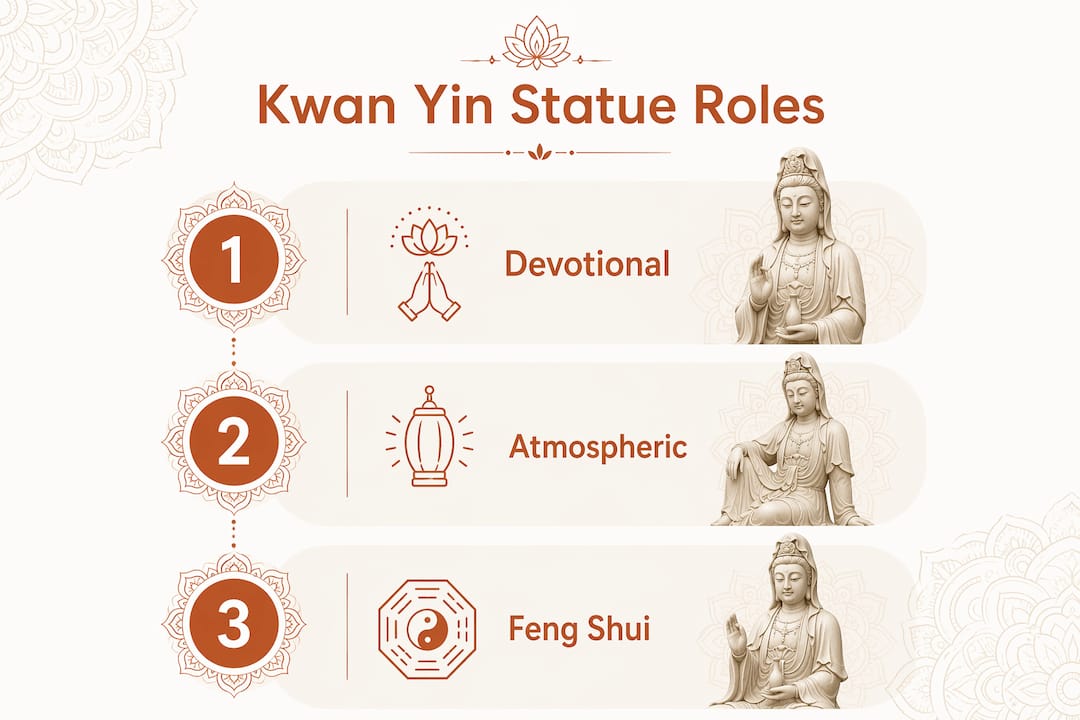
What role does a Kwan Yin statue play in a home?
A Kwan Yin statue serves three distinct roles: devotional object, atmospheric anchor, and Feng Shui remedy. Each role is practical, not merely symbolic.
As a devotional object, the statue provides a physical focal point for meditation, prayer, or quiet reflection. Placing it at eye level in a dedicated corner creates a consistent visual cue that signals a shift in mental state. Collectors report that a well-made Kwan Yin statue shifts a room’s atmosphere in ways a print or painting rarely does. The three-dimensional presence, especially in bronze or carved stone, carries a weight that anchors attention.
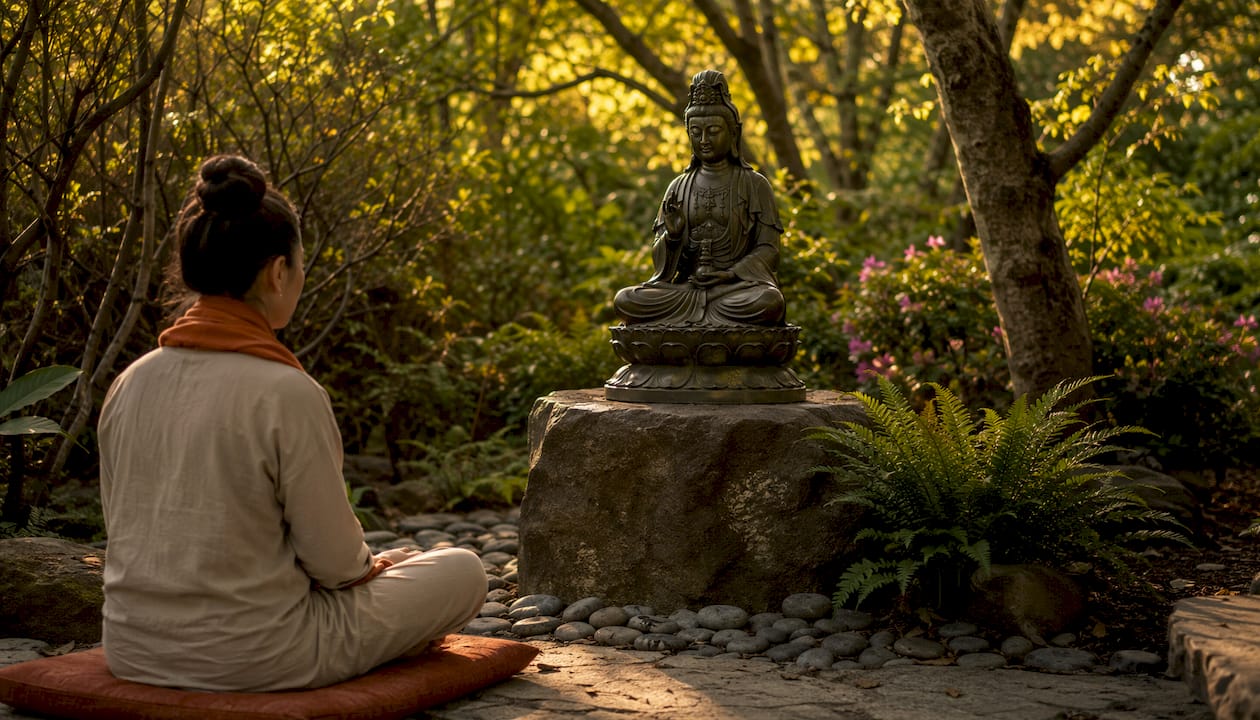
As an atmospheric anchor, the statue functions as a counter-weight to visual noise. A bronze figure absorbs light and grounds a busy room. White Dehua porcelain lifts a heavy corner. The material choice is not arbitrary; it directly shapes the room’s sensory register.
As a Feng Shui remedy, Kwan Yin is among the most flexible cures available.
Popular guides list emotional calming and family harmony among the perceived home benefits, and these align with the statue’s devotional roots. One clarification matters here: Kwan Yin is not a generic good-luck charm. Her function is tied to compassion and the relief of suffering. Treating the statue as a decorative accessory strips it of the intentionality that makes it effective in any of the three roles above.
Where should you place a Kwan Yin statue in your home?
Place Kwan Yin at least 3 feet off the floor, facing inward, in a calm and well-lit area. Living rooms, entryways, and dedicated meditation spaces are the standard choices. The 3-foot minimum height is consistent across Feng Shui and curatorial guidance and applies to any deity figure.
Preferred locations and display notes:
| Room | Recommended | Display notes |
|---|---|---|
| Living room | Yes | Central wall or corner, elevated shelf, inward-facing |
| Entryway | Yes | Near front door, facing inward toward interior |
| Meditation area | Yes | Eye level or slightly above, minimal surrounding objects |
| Study or reading nook | Yes | Seated “Royal Ease” pose works well here |
| Bedroom | No | See bedroom display considerations |
| Bathroom | No | Considered disrespectful in all traditions |
| Kitchen | No | Avoid proximity to cooking and waste |
| Laundry room | No | Avoid |
Dos and don’ts:
- Place on a dedicated shelf, altar table, or elevated surface
- Face the statue inward toward the room’s interior, not outward toward a wall
- Keep the immediate surface uncluttered; a single incense holder is sufficient
- Avoid loud electronics, televisions, or speakers in the immediate vicinity
- Never place the statue directly on the floor
- Avoid rooms associated with bodily functions or waste
A common beginner error is facing the statue outward toward the front door for “protection.” Experienced Feng Shui practice favors inward-facing placement to distribute compassionate energy through the interior. For orientation guidance that applies across Buddhist figures, the principle is consistent.
Regarding material and finish: a white or silver/gold metal statue is particularly well-suited to the West bagua area (Creativity and Children), while a green jade piece aligns with the East (Health and Family) or Southeast (Abundance) areas, per Feng Shui placement guidance.
Pro Tip: Photograph the statue in its intended placement before finalizing the display. The image documents both condition and context, which supports provenance records and helps a conservator or future buyer understand the piece’s display history.
How should you care for a Kwan Yin statue by material?
The core principle: minimal, material-appropriate maintenance, consistent environmental conditions, and thorough photographic records. Household chemicals, abrasive cloths, and temperature swings are the primary threats to antique statues.
Material-specific guidance:
- Bronze: Dust with a soft natural-bristle brush. Avoid acids, vinegar-based cleaners, or anything that strips patina. Stable humidity (45–55% RH) prevents bronze disease. Never polish an antique bronze to a shine; the patina is part of its authenticity and value. Full bronze care guidance covers conservator referral thresholds.
- Stone (sandstone, limestone, granite): Dust regularly with a dry soft cloth. Avoid freeze/thaw cycles if stored near exterior walls. Do not use water on porous stone unless directed by a conservator.
- Wood: Maintain stable humidity; avoid direct sunlight and heat sources. Wood expands and contracts with humidity changes, which cracks lacquer and gilt surfaces over time.
- Porcelain / glazed ceramics: Wipe with a soft, dry or barely damp cloth. No abrasives. Chips and hairline cracks require professional assessment before any cleaning.
“Condition photography is not optional for a serious collector. Full-view shots, close-ups of the base, maker’s marks, repairs, and patina changes form the documentary record that supports provenance and resale value.” — HDAsianArt curatorial guidance, antique stone sculpture storage.
Photograph the piece on acquisition: full view from four angles, base and foot-rim, any visible repairs or losses, and any inscriptions or maker’s marks. Update the record after any cleaning or conservation work. When shipping, insist on a signed condition report before dispatch. A conservator consultation is warranted for any active bronze disease, flaking lacquer, or structural instability.
How do you verify authenticity when buying a Kwan Yin statue?
Provenance and condition documentation are non-negotiable. Visual and material cues alone are insufficient for serious collecting.
Provenance checklist:
- Invoice or ownership history with dates and seller names
- Export permits where applicable (required for pieces leaving certain countries of origin)
- Previous cataloguing, auction records, or exhibition history
- High-resolution photographs of all surfaces, including base and marks
- Signed condition report noting existing repairs, losses, and surface condition
Questions to ask the seller:
- What is the documented country and region of origin?
- Can you provide an ownership chain or prior sale records?
- Has the piece undergone conservation or restoration? If so, by whom and when?
- What are the exact dimensions, weight, and confirmed materials?
- What is your return policy if the piece arrives in a condition inconsistent with the report?
- Is shipping insured, and who bears liability for transit damage?
Red flags:
- Patina that looks uniform and artificially applied under magnification
- Glued repairs visible at joints or along fracture lines
- Missing or tampered base (bases often carry maker’s marks and period indicators)
- Seller unable or unwilling to provide condition documentation
- Pricing significantly below comparable auction results without explanation
For U.S. buyers importing rare pieces, customs classification and duty depend on age, material, and country of origin. Pieces over 100 years old may qualify for duty-free entry under the Antique Goods provision, but documentation of age is required. HDAsianArt provides individual research and condition reporting for each listed piece, with insured DHL shipping to U.S. addresses.
How do you display Kwan Yin respectfully in a secular home?
Respectful display treats the statue as devotional heritage, not decorative art. The distinction is practical: it determines placement decisions, cleaning methods, and what happens to the piece when it leaves the collection.
Avoid placing the statue where it will be visually disrespected: on the floor, near a toilet, or surrounded by clutter. Use gentle handling and appropriate cleaning tools. If the statue is displayed in a semi-public space, a brief explanatory card noting its religious and cultural context is appropriate. It acknowledges the object’s significance to visitors unfamiliar with Buddhist iconography.
For respectful display of Buddhist art in any setting, the same principles apply across traditions. When deaccessioning a sacred statue, transfer to a temple, museum, or specialist dealer is strongly preferred over disposal. U.S. collectors importing sacred art should confirm export documentation from the country of origin; reputable dealers provide this as standard practice.
Key Takeaways
A Kwan Yin statue functions as a devotional focal point, atmospheric anchor, and Feng Shui remedy, and its effectiveness depends entirely on intentional placement, material-appropriate care, and verified provenance.
| Point | Details |
|---|---|
| Symbolism and function | Kwan Yin represents compassion and mercy; she serves devotional, atmospheric, and Feng Shui roles in the home. |
| Placement rules | Elevate at least 3 feet, face inward, and avoid bedrooms, bathrooms, kitchens, and the floor. |
| Material-specific care | Bronze needs stable humidity and no acid; stone avoids freeze/thaw; wood needs consistent humidity away from heat. |
| Authenticity verification | Request provenance documentation, ownership history, export permits, and a signed condition report before purchase. |
| HDAsianArt | Each piece is individually researched, photographed, and shipped with insured DHL delivery and condition reporting for U.S. collectors. |
A curator’s perspective on placement and documentation
The single most common mistake collectors make is treating placement as an afterthought. A Kwan Yin statue placed on a shelf because it fits the space is not the same as one placed with deliberate attention to height, orientation, and surrounding objects. The physical act of choosing a location, clearing the surface, and positioning the figure at the correct height changes how the collector relates to the piece. It shifts the object from inventory to practice.
Documentation deserves equal attention. A maker’s mark on the base of a Guanyin figure can resolve a provenance question that no visual assessment alone can answer. Collectors who photograph their pieces thoroughly on acquisition, including the base, any repairs, and the display context, are consistently better positioned when it comes to insurance, resale, or loan to an institution. The photograph taken the day the piece arrives is often the most valuable record in the file.
The guidance in this article reflects the standards HDAsianArt applies to every piece in its collection. For collectors who want to discuss a specific piece’s placement, condition, or provenance, the gallery welcomes direct consultation.
Authentic Kwan Yin statues, researched and shipped to U.S. collectors
HDAsianArt offers curated Kwan Yin and bodhisattva statues with full provenance documentation, expert condition reports, and insured DHL shipping to U.S. addresses. Every piece in the collection is individually researched and photographed by specialists, with close-up imagery of bases, marks, and surface condition included as standard.
The gallery’s antique and traditional Asian statues include bronze, stone, and wood examples from Cambodia, Thailand, Indonesia, Sri Lanka, Vietnam, and beyond. Collectors looking for a specific form, period, or regional style can contact the gallery directly for bespoke assistance. Condition reports are available before purchase, and the return policy covers pieces that arrive inconsistent with their documented condition. View the current collection or reach out to the curatorial team at hdasianart.com.
Recommended
- Finding the Perfect Place for Your Ganesha Statue in Your Home – HD Asian Art
- Choosing Tranquility: A Guide to Buying Your Own Buddha Statue – HD Asian Art
- A Guide to Purchasing a Buddha Statue: Finding Peace in Art – HD Asian Art
- Hindu Goddess Statue Identifying Features: A Collector’s Guide – HD Asian Art
