



Restoration Ethics for Antique Buddhist Sculptures
Restoration Ethics for Antique Buddhist Sculptures
Table of Contents
- Why Restoration Ethics Matter for Antique Buddhist Sculptures
- Conservation of Sacred Objects: Balancing Spiritual Presence and Material Integrity
- Documentation of Sculpture Conservation: Recording Condition, Provenance, and Past Repairs
- Minimal Intervention in Sculpture Conservation: When to Leave a Sculpture Unchanged
- Reversible Conservation Treatments: Materials, Methods, and Long-Term Monitoring
- A Practical Decision Framework for Whether to Intervene
- Restoration Ethics for Antique Buddhist Sculptures in Practice: Consultation, Consent, and Provenance
- Conclusion
- Frequently Asked Questions
Why Restoration Ethics Matter for Antique Buddhist Sculptures
Restoration ethics for antique Buddhist sculptures is the practice of weighing every proposed treatment against the object's material integrity, its ritual meaning, and its documentary value before any hand touches the surface. At HD Asian Art, we treat that weighing process as the single most important step in stewardship, because a sculpture's spiritual presence and its historical evidence are both destroyed by careless intervention. The stakes are higher than most collectors assume: a 2020 study in Nature on noncontact restoration of a damaged stone Buddha showed that missing parts can now be planned and replaced digitally, which means the question is no longer whether intervention is possible but whether it is justified.
Conservation of Sacred Objects: Balancing Spiritual Presence and Material Integrity
Conservation of sacred objects asks a question most treatment manuals avoid: does repair serve the object's meaning or erase it? Writing in the Journal of the American Institute for Conservation, Chandra L. Reedy's article on religious and ethical issues in Tibetan sculpture conservation addressed how storage, display, and treatment decisions carry religious weight, not just physical consequences.
An active sacred object differs from a museum piece in one decisive way. Devotees may expect it to be complete, consecrated, and fit for ritual use. A museum expects it to remain legible as evidence.
Documentation of Sculpture Conservation: Recording Condition, Provenance, and Past Repairs
Documentation of sculpture conservation is the written and photographic record of an object's condition, ownership history, and earlier interventions, made before treatment begins and updated throughout. Without it, every future decision rests on guesswork.
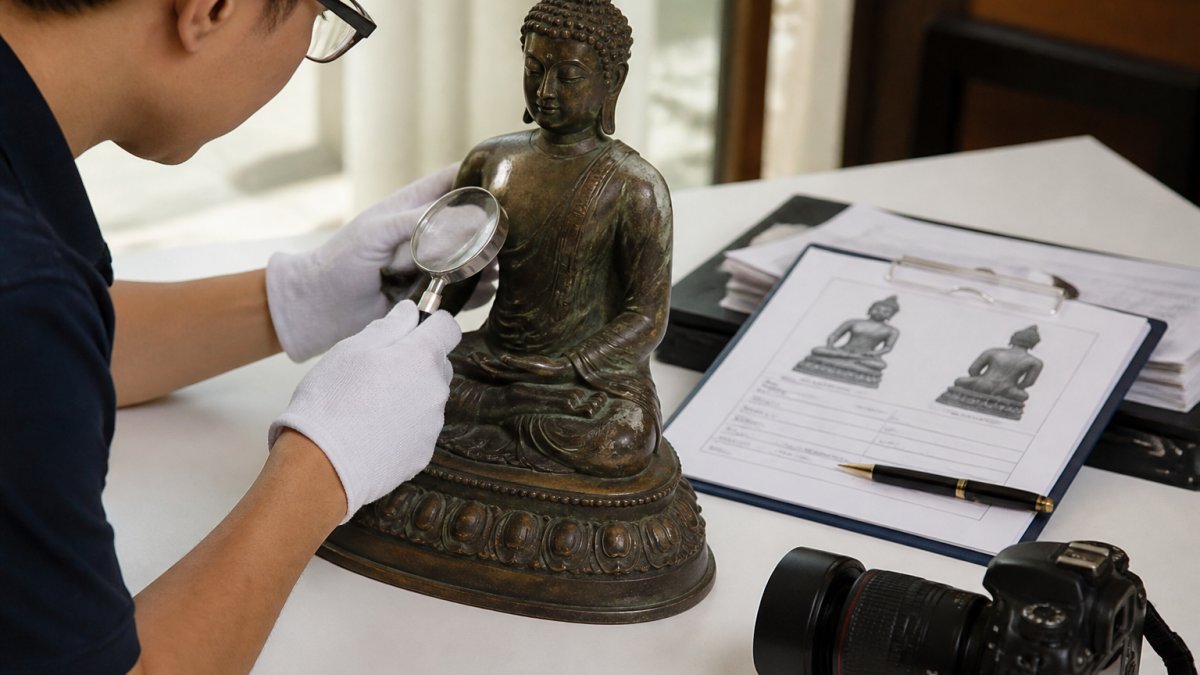
A working condition record should capture, at minimum:
- Material identification: bronze, wood, stone, or composite, with any core or gilding noted
- Surface condition: patina, deposits, corrosion, and active deterioration
- Structural stability: cracks, losses, joint failures, and old repairs
- Iconographic details that a treatment might obscure
- Provenance and any gaps in the ownership chain
Published collector guidance from Butuzou on preserving Buddhist art stresses that repairs should prioritize reversibility, documentation, and cultural respect. Documentation is the thread that ties all three together.
Minimal Intervention in Sculpture Conservation: When to Leave a Sculpture Unchanged
Minimal intervention in sculpture conservation means doing the least that stabilizes an object and no more. Stabilize active corrosion, secure a loose component, improve storage conditions, and then stop.
The case for restraint is stronger than most owners expect. Writing on condition and restoration ethics, Japonista's guide to preserving Buddhist statues frames restoration as intervention after the fact and asks whether that intervention preserves an object's legibility or destroys it. That is the right test. A fill that hides a genuine age crack may look tidier while quietly deleting evidence of the object's history.
Reversible Conservation Treatments: Materials, Methods, and Long-Term Monitoring
Reversible conservation treatments are interventions using materials that can later be removed without harming the original surface, paired with a monitoring schedule that catches deterioration early. Reversibility is not a slogan; it is a specification you can test.
Before approving any treatment, confirm:
- The proposed material is compatible with the substrate and distinguishable from it under examination
- Removal methods are documented and will not abrade original surface
- Fills and inpainting are limited to losses, never extended over original material
- A monitoring interval is set, with photographs at each check
- The treatment rationale is written down and stored with the object
The Journal of Conservation and Museum Studies paper by T. Malkogeorgou examined conservation as a negotiated value through a single copper-alloy Tibetan Buddha case, which is a useful reminder that treatment decisions are arguments, not formulas.
A Practical Decision Framework for Whether to Intervene
Most treatment failures begin before a tool is picked up: someone commissions work without first asking whether work is justified. A decision framework forces that question to the front. The version below is built around four criteria that conservation practitioners commonly weigh, condition, significance, risk, and reversibility, and it is designed to be scored honestly rather than used as a checklist to justify a plan already chosen.
The four criteria
Condition. Is deterioration active or stable? Active corrosion, insect activity, flaking gilding, or a widening crack are different problems from a stable old loss. Active deterioration argues for stabilization; stable condition argues for monitoring.
Significance. What makes this object valuable, its ritual use, its iconography, its age, its provenance, its role in a community? Significance shapes acceptable outcomes.
Risk. What is the likelihood and severity of further loss if nothing is done, and what is the risk of the proposed treatment itself?
Reversibility. Can the intervention be undone without harming the original? Reversibility is not binary, some materials are more retreatable than others, but it should be a gate, not an afterthought.
Scoring the decision
| Question | If Yes | If No |
|---|---|---|
| Is deterioration active or spreading? | Stabilize first | Monitor on a set interval |
| Is structural failure likely? | Secure the component | Leave as is |
| Does the proposed treatment risk original surface? | Reduce scope or decline | Proceed cautiously |
| Is the object in active ritual use? | Consult custodians before any plan | Document and display |
| Will the treatment be reversible and retreatable? | Proceed | Reconsider or decline |
| Is provenance documented? | Record and treat | Resolve records before treating |
Let the lowest-scoring row govern. If reversibility scores poorly, the answer is not to proceed carefully, it is to find a different approach or to stabilize and stop.
The three outcomes
The framework should resolve to one of three answers, not a spectrum of half-measures:
- Leave untouched. Stable condition, low risk, high significance of existing surface evidence. Monitor and improve storage and display.
- Stabilize only. Active deterioration or structural risk, but treatment beyond stabilization would compromise evidence or meaning. Secure, consolidate, improve environment, stop.
- Treat. Justified when deterioration is active, risk of loss is real, the treatment is reversible and documented, and the object's custodians agree.
Restoration Ethics for Antique Buddhist Sculptures in Practice: Consultation, Consent, and Provenance
Ethical restoration is not a set of techniques; it is a sequence of conversations. The sections above describe what good treatment looks like. This section describes who decides, in what order, and what happens when the answers conflict, the part most treatment guides leave out.
Who should be consulted, and when
Consultation is not a single approval at the end. It is a layered process that should begin before a treatment plan exists:
- Owners and custodians. The legal owner holds decision authority, but ownership and stewardship are not the same thing. An owner who acquired an object without understanding its ritual role may not be the right person to decide alone.
- Religious communities and practitioners. Where an object remains in ritual use, or was removed from a community that still holds it sacred, practitioners should be part of the decision, not informed after it. Consecration status, handling expectations, and fitness for ritual use are their expertise, not the conservator's.
- Source communities and cultural authorities. Where provenance points to a specific region or tradition, the relevant cultural authorities may have a legitimate interest in treatment outcomes, particularly where the object's removal is undocumented.
- The conservator. The conservator's role is to state what is and is not technically justifiable, and to refuse work that cannot be done ethically. That refusal is part of the service, not a failure of it.
What consent actually looks like
Consent is not a signature on a work order. Meaningful consent requires that the people consulted understand what will be done, what will be changed, what cannot be undone, and what the alternatives are. A common pattern is for owners to approve a treatment without realizing that a fill or an inpaint will permanently alter how the object reads to future examiners.
Where consultation produces disagreement, for example, a community that wants an object to read as complete versus a conservator who wants to preserve evidence of age, the disagreement should be documented, not smoothed over. Recording the tension is itself an ethical act, because it preserves the reasoning for whoever inherits the object next.
Provenance as a precondition, not an afterthought
Provenance research and restoration decisions are entangled. A documented ownership chain protects the owner, informs the treatment, and settles questions about whether an object should be in private hands at all. Where records are thin, resolve that before restoration, not after, because treatment can affect claims, return processes, and the object's standing in any future discussion about where it belongs.
A practical sequence:
- Assemble what documentation exists, purchase records, exhibition history, prior treatment records, any correspondence.
- Identify gaps and note them explicitly rather than papering over them.
- Consult before treating where the object's origin or ritual status is unclear.
- Record the consultation, the consent, and any disagreement alongside the treatment record.
Active sacred objects versus collections
The same object can require different decisions depending on where it lives. An object in active ritual use may need to be handled, consecrated, and kept fit for offerings; a museum object may need to remain legible as evidence; a private collection sits somewhere between. None of these is automatically the ethical answer, but naming which one applies is the first step toward one.
Conclusion
The hardest part of stewarding an antique Buddhist sculpture is accepting that the best treatment is sometimes none at all, and that the decision belongs partly to the people who hold the object sacred. If you are choosing a piece for a meditation space or a collection, start with an object whose history is documented and whose condition has been honestly described. Browse the HD Asian Art collection to find carefully curated Buddhist and Hindu statues with free shipping, and choose a sculpture you can preserve rather than repair.
Frequently Asked Questions
What ethical principles guide the conservation of Buddhist sculptures?
Key principles include minimal intervention, reversibility, documentation, and cultural respect. Conservators weigh whether a treatment preserves or destroys an object's legibility and spiritual significance. Published guidance from Butuzou emphasizes that repairs should prioritize reversibility, documentation, and cultural respect. The goal is to stabilize deterioration without erasing evidence of age, patina, or previous repairs. Consultation with stakeholders, including religious communities, is also essential before any intervention.
When should an antique Buddhist sculpture be left unchanged?
A sculpture should be left unchanged when its condition is stable and its spiritual or historical legibility is intact. Minimal intervention in sculpture conservation is preferred when cleaning or repair would remove patina, original surface deposits, or evidence of ritual use. If the object is an active sacred object, any intervention should be weighed against its religious significance. Documentation of the current state is essential even when no treatment is performed, so future conservators understand the baseline condition.
What does reversible treatment mean in sculpture conservation?
Reversible treatment means any added material or repair can be removed without damaging the original object. Conservators use materials compatible with the sculpture's substrate and document application methods. This approach allows future specialists to re-treat or reverse work as knowledge and ethics evolve. Reversibility is a core principle in conservation ethics for antique Buddhist sculptures, especially when fills or inpainting are involved. It also protects the object's long-term preservation and value.
How should cultural communities be consulted before conservation work?
Consultation should involve representatives of the originating community, religious leaders, and cultural experts. Discussions should address the object's spiritual presence, intended use, and any concerns about intervention. Consent and documentation of the consultation process are part of ethical practice. For active sacred objects, community input may determine whether treatment is appropriate at all. Provenance and ownership implications should also be clarified before work begins.
