



Parvati Statue: Goddess of Devotion in Asian Art
Parvati Statue: Goddess of Devotion in Asian Art
Few Hindu goddess statues reward close attention the way a Parvati statue does. The moment you understand what you are looking at, the figure stops being decorative and becomes a precise visual argument: about devotion, feminine power, the nature of Shiva's universe, and the sculptor's command of a tradition stretching back well over a thousand years.
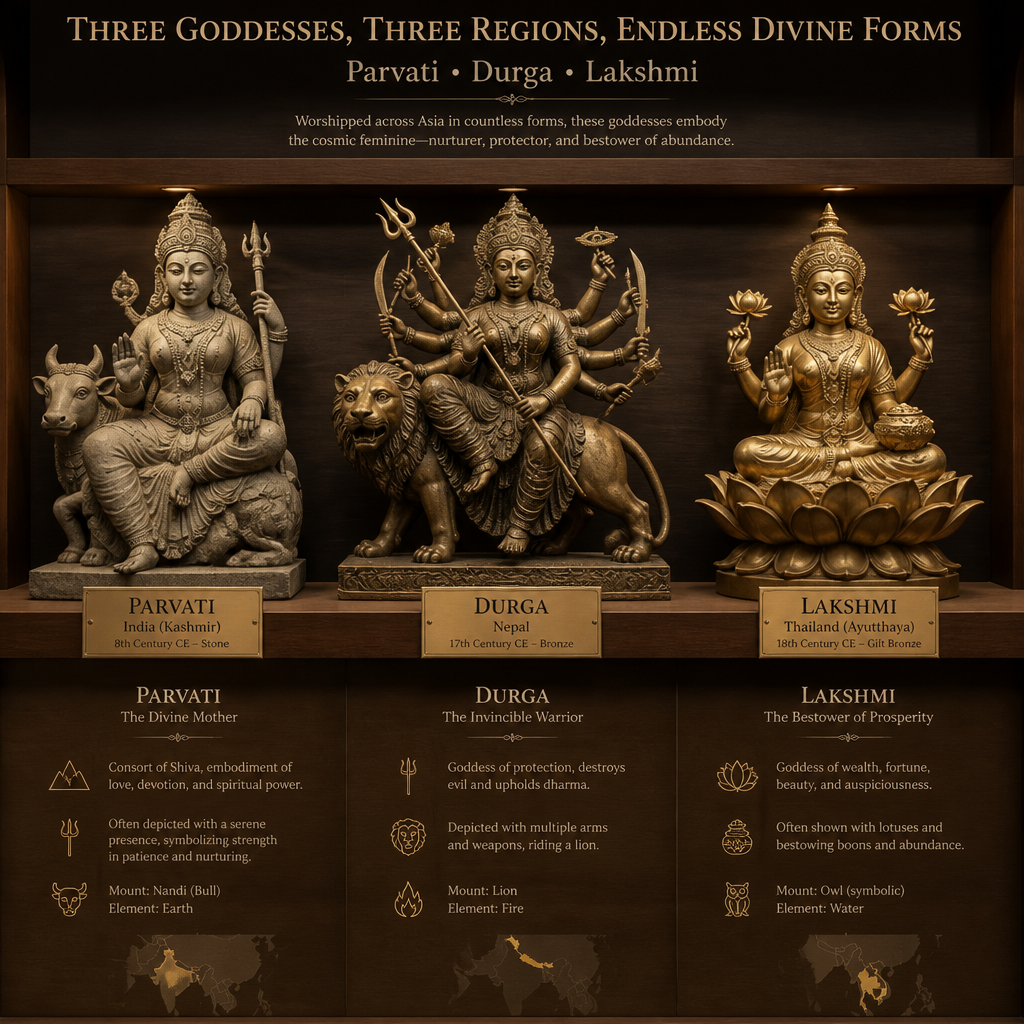
Yet Parvati remains systematically underestimated by collectors who focus exclusively on Nataraja or Ganesha, and she is frequently misidentified by buyers who confuse her with Durga or Lakshmi. This guide addresses both problems directly, covering Parvati's iconography, her sculptural traditions across South and Southeast Asia, how to read her attributes, and what to look for when you decide to buy a Hindu deity statue of this goddess.
Table of Contents
- Quick Takeaways
- Who Is Parvati? Mythology, Role, and Spiritual Meaning
- Reading Parvati Iconography: Attributes, Posture, and Gesture
- South Indian Sculpture: The Chola Bronze Standard
- Parvati Across Southeast Asia: Khmer, Javanese, and Regional Variations
- Parvati's Major Forms: Shivakami, Bhogashakti, and Uma
- Comparing Sculptural Traditions: Which Parvati Is Right for You?
- Buying a Parvati Statue: What Collectors and Devotees Should Know
- Placement, Display, and Care
- Frequently Asked Questions
- References
Quick Takeaways
|
Key Insight |
Explanation |
|---|---|
|
Two arms almost always mean Parvati, not Durga |
A two-armed goddess holding a lotus is almost certainly Parvati. A multi-armed goddess with weapons mounted on a lion is Durga. Arm count is your fastest identification tool. |
|
The Chola bronze tradition defines the visual standard |
Parvati bronzes produced in Tamil Nadu between the 9th and 13th centuries set the iconographic benchmark that all later traditions reference, from Southeast Asia to modern casting workshops. |
|
The tribhanga posture is the signature of South Indian Parvati |
The triple-bend pose, with three curves at neck, waist, and knee, communicates grace, femininity, and divine elegance far more effectively than a rigid standing figure. |
|
Uma and Parvati are the same deity in most sculptural contexts |
Uma is one of Parvati's oldest names. In sculptural terms the two are used interchangeably, though Uma sometimes carries a more transcendent, philosophical emphasis. |
|
Material choice carries meaning for devotional use |
Bronze is the traditional material for South Indian processional and worship murtis. Stone is more common in temple contexts and Khmer pieces. Both are appropriate for home altars. |
|
Parvati as Ardhanarisvara is a different iconographic category |
The half-Shiva, half-Parvati composite form represents the union of masculine and feminine energies. Identify this by the figure's split visual composition before treating it as a standalone Parvati. |
|
Lost-wax casting produces unique pieces, not editions |
Each authentic lost-wax bronze requires a separate wax model, making every cast piece genuinely one of a kind, even when following the same iconographic template. |
Who Is Parvati? Mythology, Role, and Spiritual Meaning
Parvati is the consort of Shiva and the mother of Ganesha and Kartikeya (Skanda). Her name derives from the Sanskrit word for mountain, connecting her to Himavan, the lord of the Himalayas, whose daughter she is in the Puranic tradition. That origin matters sculpturally: the mountain association gives her a quality of permanence and deep rootedness that distinguishes her from more turbulent goddess forms.
In Shaivism, Parvati is understood as Shiva's shakti, the creative energy and power that makes his cosmic function possible. Without her, the god remains an ascetic locked in meditation. With her, the universe has dynamism, form, and life. This theological relationship explains why, in South Indian temple tradition, a bronze image of Nataraja (dancing Shiva) is considered incomplete without a corresponding Parvati figure standing beside him.
Her statues and iconography appear in Hindu temples throughout South Asia and Southeast Asia, and she features extensively in ancient Indian literature including the Ramayana, the Mahabharata, and the Puranas. The plays of Kalidasa in the 5th and 6th centuries were instrumental in fully developing the narrative of Parvati and Shiva as a divine couple, establishing the literary foundation that sculptors would work from for centuries.
"The goddess is not other than the Brahman. Parvati is the supreme reality clothed in form for the benefit of devotees who require a personal deity."
For collectors and spiritual practitioners, this background is not academic footnote material. It is the direct reason why a Parvati statue carries a different quality of presence from purely decorative sculpture. The image was conceived as a meeting point between the human devotee and a specific, precisely defined divine reality.
Reading Parvati Iconography: Attributes, Posture, and Gesture
Identifying a Parvati statue correctly requires reading several visual elements together. No single attribute is definitive on its own, but the combination of arm count, hand gestures, attributes held, and posture resolves most cases cleanly.
Arm Count and Hand Gestures
Parvati is almost always depicted with two arms in her benign, consort form. Her hands may express symbolic mudras or hold specific attributes: a lotus flower, prayer beads (mala), a mirror, a citron, or occasionally a bell. The lotus is her most consistent attribute and her most reliable identifier. When the hands are empty, one is typically raised in varada mudra (the gesture of granting boons) and the other hangs at the side or rests near the hip.
In South Indian tradition she is sometimes shown with the raised hand in katakahasta, the gesture of holding or offering a flower, with one hand supporting her weight in a seated composition. This posture, associated with her aspect as Bhogashakti (goddess of pleasure and abundance), is distinct from her standing processional form.
The Tribhanga Posture
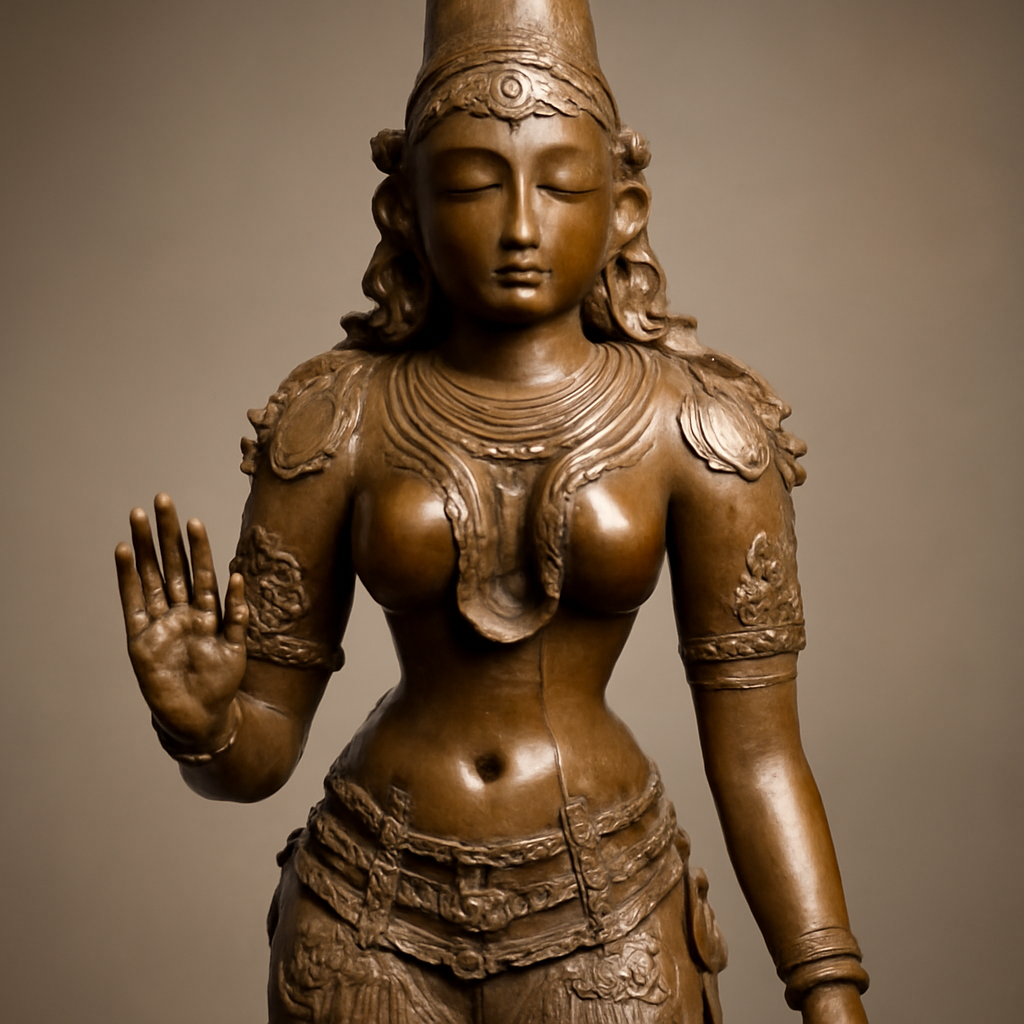
The single most important postural marker of South Indian Parvati sculpture is the tribhanga, or triple-bend pose. The body curves at three points: the neck tilts slightly, the waist bends in the opposite direction, and the knees flex to complete the S-curve. This posture is not decorative invention. It is a deliberate sculptural language that communicates grace, femininity, and divine accessibility. A Chola Parvati standing rigidly upright would feel iconographically wrong to any trained eye.
Crown, Jewelry, and Clothing
South Indian Parvati figures wear a tall, ornate conical crown typical of the regional iconographic style. The body is adorned with intricate necklaces, armlets, bracelets, and rings on fingers and toes. The upper body is often bare, with elaborate jewelry serving as the primary visual emphasis, while the lower body wears sheer or ornately belted garments. Earlobes are elongated, with floral jewelry that falls onto the shoulders. This elaboration is not excess: every element of the jewelry and crown carries iconographic and devotional weight.
Pro tip: When buying a Parvati statue, use the lotus attribute as your primary identifier. A goddess holding or standing on a lotus, with two arms and no weapons, is almost certainly Parvati rather than any of her fiercer manifestations. If weapons appear, you are looking at a different goddess form entirely.
South Indian Sculpture: The Chola Bronze Standard
The Chola dynasty, which ruled a large part of South India from their homeland near Thanjavur on the southeastern coast, produced metal sculptures between approximately the 9th and 13th centuries that are now held in the world's greatest museums. The Metropolitan Museum of Art, the Kimbell Art Museum, and the Toledo Museum of Art all hold significant Chola Parvati pieces, and the language these museums use to describe them, timeless, graceful, surpassing beauty, is not curatorial hyperbole. It reflects a genuine technical and aesthetic achievement.
The manufacturing method was lost-wax casting, known in Sanskrit as Madhu Uchchishtta Vidhana and in French as cire perdue. Each sculpture requires a separate wax model, which means every cast piece is unique. The wax is built up over a clay core, detailed by the sculptor with full iconographic precision, then encased in clay and fired. The molten metal replaces the wax; the clay mold is broken away. What emerges is a bronze that carries the sculptor's hand decisions at every point of the surface.
The Thanjavur (Tanjore) region of Tamil Nadu was the center of this tradition. Among its most celebrated compositions is the Kalyanasundara Murti, a 9th-century piece depicting the marriage ceremony of Shiva and Parvati through two separate statuettes. Shiva extends his right hand to accept Parvati's right hand, and the goddess is shown with a bashful, downcast expression as she steps forward. The emotional specificity of that gesture, achieved in bronze, is extraordinary.
The Chola tradition also produced independent Parvati figures designed to stand beside Nataraja in temple sanctuaries. In this context, she appears as Shivakami, the lord's companion, typically in the standing tribhanga posture on a lotus base. The artistic quality of these processional bronzes reflects the fact that they were made not for private devotion alone but to be seen, carried through cities in festival processions, and placed in direct visual relationship with the deity they accompanied.
Pro tip: When evaluating a South Indian bronze Parvati, look at the base. A lotus pedestal is iconographically appropriate and typically indicates a figure intended for temple or altar use rather than purely decorative placement. A plain or absent base may indicate a later production or a different regional tradition.
Parvati Across Southeast Asia: Khmer, Javanese, and Regional Variations
The spread of Hindu traditions across Southeast Asia carried Parvati's iconography with it, but each regional tradition shaped the goddess to its own aesthetic preferences and theological emphases. Understanding these differences is essential for anyone building a collection of Hindu goddess statues from multiple traditions.
Khmer Parvati: Cambodia and the Angkor Tradition
Cambodian Khmer sculpture of the Angkor period produced goddess figures of extraordinary refinement. Parvati and Uma appear in Khmer temple complexes as consort figures to Shiva, maintaining the iconographic relationship established in South Indian tradition while expressing it through a distinctly Cambodian aesthetic. The Khmer face, with its famous serene expression, its slightly upward-tilted eyes, and its composed stillness, gives these figures a quality of inward calm that is different from the more dynamically posed South Indian bronzes.
Khmer Parvati figures are most often carved in sandstone or granite, which aligns with the monumental stone temple construction of the Angkor tradition. They tend to be less heavily ornamented than their South Indian counterparts, with a greater emphasis on the quality of the facial carving and the elegant simplicity of the form. Collectors who value sculptural restraint frequently prefer the Khmer tradition for exactly this reason.
Javanese Parvati: The Indonesian Tradition
In Java, Parvati appears in Hindu temple complexes from the 9th and 10th centuries, most notably at the Prambanan temple complex, where she was venerated alongside Shiva, Brahma, and Vishnu. Javanese Devi sculptures from this period show a fusion of Indian iconographic structure with local aesthetic preferences, typically featuring rounder facial features and distinctive headdress styles that differ from both South Indian and Khmer conventions.
The Javanese tradition also produced bronze figures, though stone carving was dominant. What makes Javanese Parvati sculpture distinctive is the way South Asian iconographic rules were absorbed and then inflected with local sensibility, producing goddess images that are immediately recognizable as part of the Hindu tradition while being unmistakably Javanese in their visual character.
Parvati's Major Forms: Shivakami, Bhogashakti, and Uma
A significant source of confusion for collectors is the variety of named forms Parvati takes in sculptural tradition. These are not different goddesses. They are aspects of the same deity, each emphasizing a different quality and expressed through specific compositional conventions.
Shivakami: The Standing Consort
Shivakami, meaning "beloved of Shiva," is the standing tribhanga form of Parvati produced primarily for Shiva temples. This is the form designed to stand beside Nataraja in the temple sanctum. She is slender, tall, with broad hips and fine-boned arms and legs. The posture is the clearest visual statement of her role: she is present, graceful, and completed by her relationship to the figure she accompanies. In homes and temples throughout South India, Nataraja bronzes are typically paired with a Shivakami Parvati, and the pairing is understood as iconographically essential.
Bhogashakti: The Seated Goddess
Bhogashakti, the "goddess of pleasure," is the seated form of Parvati on an inverted lotus throne or pedestal. She sits regally, with one hand supporting her weight and the other raised in katakahasta, the gesture of holding or offering a flower. This aspect emphasizes abundance, pleasure in the best sense, and the generative dimension of Parvati's role. Bronze representations in this form are among the most refined compositions in Chola sculpture.
Uma: The Ancient Name
Uma is one of Parvati's oldest and most philosophically significant names. In the Kena Upanishad, Uma Haimavati appears as a form of cosmic wisdom who mediates between the gods and Brahman. In sculptural terms, Uma and Parvati are used interchangeably in most traditions, with Uma sometimes carrying a more transcendent, metaphysical emphasis. The question collectors ask most frequently, whether a "Uma statue" and a "Parvati statue" are different pieces, has a simple practical answer: in most sculptural contexts, they are the same image described from different theological angles.
Comparing Sculptural Traditions: Which Parvati Is Right for You?
|
Tradition |
Key Characteristics |
Best Suited For |
|---|---|---|
|
South Indian Bronze (Chola Style) |
Lost-wax cast, tribhanga posture, elaborate jewelry and crown, lotus base, high iconographic precision, Thanjavur/Tamil Nadu origin |
Devotional altar use, worship murtis, collectors focused on the defining tradition of Hindu bronze sculpture |
|
Khmer / Cambodian Stone |
Sandstone or granite, serene "Khmer smile" expression, restrained ornamentation, emphasis on facial quality and formal elegance |
Display and collecting, interior spaces requiring sculptural presence without visual complexity, collectors drawn to meditative stillness |
|
Javanese / Indonesian |
Fusion of Indian iconography with local aesthetic, rounder facial features, distinctive headdress, both stone and bronze examples, 9th-10th century peak |
Collectors building a cross-regional Hindu sculpture collection, those interested in the transmission of Indian traditions through Southeast Asia |
The Chola bronze tradition defines the iconographic standard, and it remains the most widely recognized and sought-after form of Parvati sculpture in the collector market. That said, iconographic significance and collector preference are not the same thing. Khmer goddess figures and North Indian stone carvings have their own deep traditions and command serious scholarly and market attention. The right choice depends on your purpose, your existing collection, and your honest aesthetic response to the work.
Buying a Parvati Statue: What Collectors and Devotees Should Know
A common mistake when buying a Hindu deity statue is treating iconographic correctness as secondary to visual appeal. In practice, the two are inseparable. A Parvati figure with the wrong number of arms, an inappropriate mount, or attributes belonging to a different deity is not a stylistic variation. It is a misidentification that will trouble you once you know enough to notice it.
Identify the Deity Before Purchasing
Before committing to a purchase, identify three things: the deity, the specific aspect or form, and the regional sculptural tradition. For Parvati, the checklist is: two arms (unless specifically an Ardhanarisvara or another composite form), lotus attribute or empty hands in varada and katakahasta mudras, no weapons, no animal mount in standard consort depictions, and the tribhanga posture in South Indian bronzes. If any of these elements conflict without explanation, ask the seller for a precise iconographic identification before buying.
Material and Intended Use
For devotional use and home altar placement, bronze is the traditional and most appropriate material for South Indian Parvati figures. It is durable, holds fine detail, and has been the medium of choice for Indian processional and worship murtis since at least the 9th century. Many devotees perform daily puja with their bronze figures, including abhisheka (ritual bathing in ghee, milk, or coconut milk), which bronze handles well.
Stone and marble figures are appropriate for display settings, garden placement, or collectors whose priority is sculptural presence over devotional use. For outdoor placement, high-quality stone is the more durable choice. At HD Asian Art's Hindu deity statue collection, pieces are sourced directly from regions with living sculptural traditions, which matters when you want a figure made by craftspeople working within a continuous lineage rather than a mass production facility.
Size and Placement Context
Scale affects everything. A small bronze Parvati of 15 to 20 centimeters is appropriate for a personal altar or meditation space. A larger piece of 50 centimeters or more makes a statement in a dedicated display setting but requires proportionate space and, ideally, a purpose-built plinth or niche. The figure should never appear cramped or isolated from a considered context. As part of a broader Hindu deity collection, a Parvati figure works best when her relationship to other deities in the space is considered, particularly her relationship to any Shiva figure.
Pro tip: If you plan to display Parvati alongside a Nataraja or Shiva statue, position her to his left. In South Indian temple tradition, Parvati stands to Shiva's left, and maintaining this spatial relationship in a home display is both iconographically correct and visually coherent.
Placement, Display, and Care
Bronze Parvati statues require minimal maintenance precisely because of the material's durability. For figures used in daily puja with regular abhisheka, no additional cleaning is necessary since the ritual bathing keeps the surface clear of dust and residue. For figures displayed rather than bathed regularly, dust with a soft cloth as needed to prevent accumulation in the carved details of the jewelry and crown.
Avoid abrasive cleaners entirely. The patina on a well-aged bronze is part of the piece's character and value. Stripping or aggressively polishing a bronze Parvati to make it appear new is one of the most common and damaging mistakes a new collector makes. If a piece has an antique patina, that surface has developed over time and enhances rather than diminishes the figure's quality.
For stone figures, the care is simpler still. Wipe with a dry or slightly damp cloth. Stone Parvati figures placed outdoors in temperate climates like the UK handle weather well, but should not stand in standing water or be sealed with inappropriate coatings that trap moisture.
In terms of placement philosophy, the principle that guides South Indian temple tradition is also practical for home display: Parvati should be given a dedicated, elevated position. A figure placed on the floor or used as a casual table ornament loses its visual authority. Elevating the figure on a plinth, shelf, or altar surface, with clear space around it, allows the tribhanga posture and the sculptural detail to be read properly.
Explore the full range of Parvati statues available at HD Asian Art, including pieces sourced from South Indian, Khmer, and Javanese traditions, each documented with iconographic notes to support informed collecting. For those building a broader devotional or display context, the Hindu deity statue collection spans the full range of consort and companion figures that complement a Parvati piece.
Frequently Asked Questions
What is the difference between a Parvati statue and a Durga statue?
The fastest visual distinction is arm count and attributes. Parvati is almost always depicted with two arms, holding peaceful attributes such as a lotus, prayer beads, or a mirror. Durga typically has eight or ten arms carrying weapons, is mounted on a lion, and is depicted in active combat with the buffalo demon Mahishasura. If the figure holds weapons and rides a lion, you are looking at Durga, not Parvati.
What does a Parvati statue symbolize?
Parvati symbolizes devotion, love, fertility, creative energy (shakti), and the divine feminine as understood within Shaivism. As Shiva's consort, she represents the principle that makes cosmic creation and regeneration possible. For devotees, her image is a focus for prayers related to marriage, family, spiritual practice, and the cultivation of patience and persistent love, qualities that define her mythological character across the Puranic stories.
Is it appropriate to display a Parvati statue at home without practicing Hinduism?
This is a question collectors and home decorators ask frequently, and the honest answer is that Hindu tradition does not have a single universal rule on the subject. Many people display Hindu deity statues as art objects, as focuses for meditation, or as expressions of respect for the tradition. The more important consideration is how the figure is treated in the space. Placing a Parvati statue in an elevated, considered position, rather than casually among purely decorative objects, reflects appropriate respect for both the tradition and the sculptural quality of the piece.
What materials are authentic Parvati statues made from?
The most historically significant material for South Indian Parvati figures is bronze, specifically the copper alloy cast using the lost-wax method. Stone (sandstone and granite) is the primary material in the Khmer tradition and in many North Indian sculptural contexts. Wood carving is found in regional traditions including those of Bali and parts of South India. All three materials have long, documented traditions of use for Parvati figures. Marble became more common in later periods. For devotional murtis, bronze remains the traditional preference in South Indian practice.
How do I identify the quality of a Parvati bronze statue?
Start with the surface detail: the jewelry, the crown, and the facial features should be crisply defined rather than blurred or flattened. In a genuine lost-wax cast piece, the detail quality is consistent across all surfaces because the sculptor worked directly on the wax model. Look also at the posture. A skilled Chola-tradition bronze will hold the tribhanga posture with structural coherence, not as a stiff approximation. The base matters too: a lotus pedestal with well-formed petals indicates care in the overall composition. Finally, ask about the casting method and the origin of the piece. A reputable seller will be able to tell you where the piece was made and by what method.
Can a Parvati statue be used in daily puja?
Yes. Bronze Parvati figures have been used in daily puja, including abhisheka (ritual bathing), for over a thousand years in South Indian temple and home practice. The material handles regular contact with liquids including milk, ghee, and coconut milk without damage. For stone figures, daily puja is also appropriate but heavy liquid abhisheka is less common. If you intend to use your statue in regular ritual practice, confirm with the seller that the specific piece is suitable for the care that practice involves.
Where does HD Asian Art source its Parvati and Hindu goddess statues?
HD Asian Art sources Hindu deity statues directly from regions with living sculptural traditions across Asia, including India, Cambodia, Indonesia, Sri Lanka, and Thailand. Each piece in the collection is chosen for museum-quality sculptural standards, with iconographic accuracy treated as a baseline requirement rather than an optional detail. The collection includes both bronze and stone pieces representing multiple regional traditions, allowing collectors to compare South Indian, Khmer, and Javanese approaches to Parvati and related goddess figures within a single curated source.
If you have direct experience collecting Hindu deity statues or display Parvati in a home altar or meditation space, we would like to hear what informed your choice of tradition, material, or form.
We would love your feedback and any insights you would share with others. What perspective would you add?
References
-
Metropolitan Museum of Art: Chola period Parvati sculpture in the permanent collection
-
Daily Art Magazine: detailed guide to the iconography of Parvati in Hindu sculpture
-
Toledo Museum of Art: Chola dynasty Parvati sculpture and iconographic description
