



Parvati Goddess Statue: Iconography, Styles & Placement
Parvati Goddess Statue: Iconography, Styles & Placement
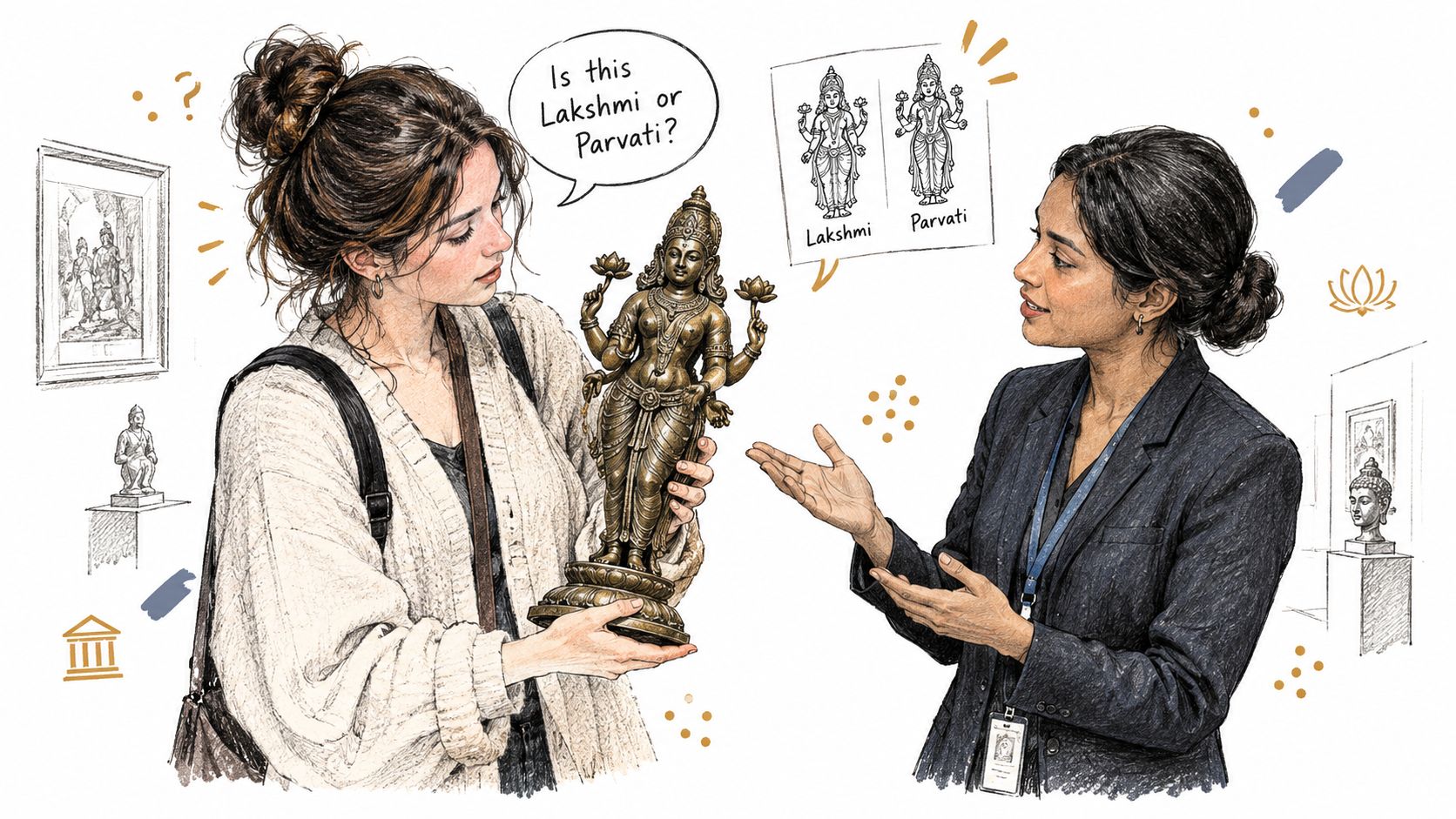
You're standing in a gallery in London or Birmingham, turning a small bronze figure towards the light. The crown looks regal, the body curves gently, and one hand seems to hold a flower. Then the question arrives: “Is this Lakshmi or Parvati?”
That uncertainty is understandable. A Parvati goddess statue can be a devotional image, a carefully chosen interior object, or a serious work of Asian art. The right interpretation depends on more than appearance. Pose, attributes, material, regional style and provenance all change how the figure should be understood and used.
This guide treats the subject as a curator might treat a gallery shelf. It will help you decide whether you're looking for a figure for daily worship, a sculpture for a considered room scheme, or an object whose value rests on craftsmanship and documented history. A short introduction to Hinduism and its enduring traditions can provide useful wider context, but the practical questions begin with the statue itself.
Table of Contents
- What a Parvati Goddess Statue Is and Why It Matters Today
- Understanding Parvati's Role in Hindu Tradition
- Reading the Iconography of a Parvati Statue
- Regional Styles Found in UK Collections
- Materials, Sizes and Craftsmanship Explained
- How Parvati Statues Are Displayed in the UK
- Placing a Parvati Statue at Home, on an Altar or in a Design Scheme
- Choosing the Right Parvati Statue for Your Purpose
What a Parvati Goddess Statue Is and Why It Matters Today
A Parvati goddess statue is a three-dimensional image of Parvati, the Hindu goddess and consort of Shiva. Sculptors have represented her in stone, bronze, brass, wood and, in modern retail, resin. The scale can range from a small piece held comfortably in one hand to a substantial architectural sculpture intended for a temple or museum setting.
The same visual subject can serve three different purposes in a UK home or collection.
- Worship: A bronze or brass murti may stand on a dedicated altar and become part of daily prayer or puja. Here, respectful handling, clean surroundings and suitable placement matter more than whether the surface matches a particular interior.
- Decoration: An interior designer may choose Parvati for her flowing silhouette, jewellery and sense of narrative. In this role, the statue works alongside furniture, lighting and colour, while still deserving culturally informed placement.
- Collecting: A buyer may focus on regional style, carving quality, casting technique and provenance. A documented history can matter as much as the image's visual appeal.
A UK museum record shows how broad the category can be. The British Museum holds a stone Shiva and Parvati from Orissa, India, dated to the 12th or 13th century, with a recorded height of 184.2 cm and width of 119.4 cm. The sculpture has been displayed in London in Room 33, and its record notes that John Bridge purchased it at Christie's in June 1830 before it entered the Museum in 1872 through a donation by Mrs John Bridge and relatives. That is not the buying story of a contemporary altar piece, but it demonstrates how a Parvati image can also become part of a documented national collection. (British Museum record for Shiva and Parvati)
The pages ahead will help you read identity and iconography, compare regional approaches, understand materials and sizes, plan a display, and finish with a practical buying checklist. First decide which job the statue must perform. A worship object needs suitability and respect, a decorative piece needs visual balance, and a collectible needs evidence.
Understanding Parvati's Role in Hindu Tradition
Parvati is best understood through her relationship with Shiva, but not reduced to it. In the idea of Shakti, she represents active feminine power, the energy that gives movement and expression to consciousness. The composite form of Ardhanarishvara makes that relationship visible by joining Shiva and Parvati within one body, with Parvati's side expressing the feminine principle as an inseparable part of the whole.
That symbolism explains why a standalone Parvati statue and a Shiva-Parvati pair can feel different in a room. Parvati alone often presents the gracious householder, mother and giver of care. Together, the couple presents balance, partnership and divine union. The difference is not just whether one figure or two occupy the plinth. It's the relationship the sculpture asks the viewer to read.

The goddess in her own right
Parvati is traditionally associated with the mountain lineage, marriage, fertility, children, devotion and the life of the household. Those associations don't make her passive. They give the figure a particular kind of authority, one grounded in persistence, relationship and creative energy rather than the battlefield imagery associated with fiercer goddess forms.
A graceful curve through the body often reinforces this reading. The term tribhanga means a triple-bend pose, with the body bending at the knees, hips and shoulders. Rather than standing like a rigid column, the figure seems to breathe and shift weight. Harewood House identifies its bronze Parvati as an 11th-century devotional object, probably the oldest object currently displayed in the house, and describes her tribhanga posture and hands in mudras. (Harewood's Parvati object record)
For a first-time buyer, tribhanga is easiest to recognise as an elegant S-curve. It doesn't prove an identification on its own, but it helps distinguish a benign consort or householder image from a figure designed around combat, weapons or dramatic movement. The story and symbolism of Parvati as Shiva's divine mother and consort offers further context for why artists repeatedly return to this balance of tenderness and strength.
Reading the Iconography of a Parvati Statue
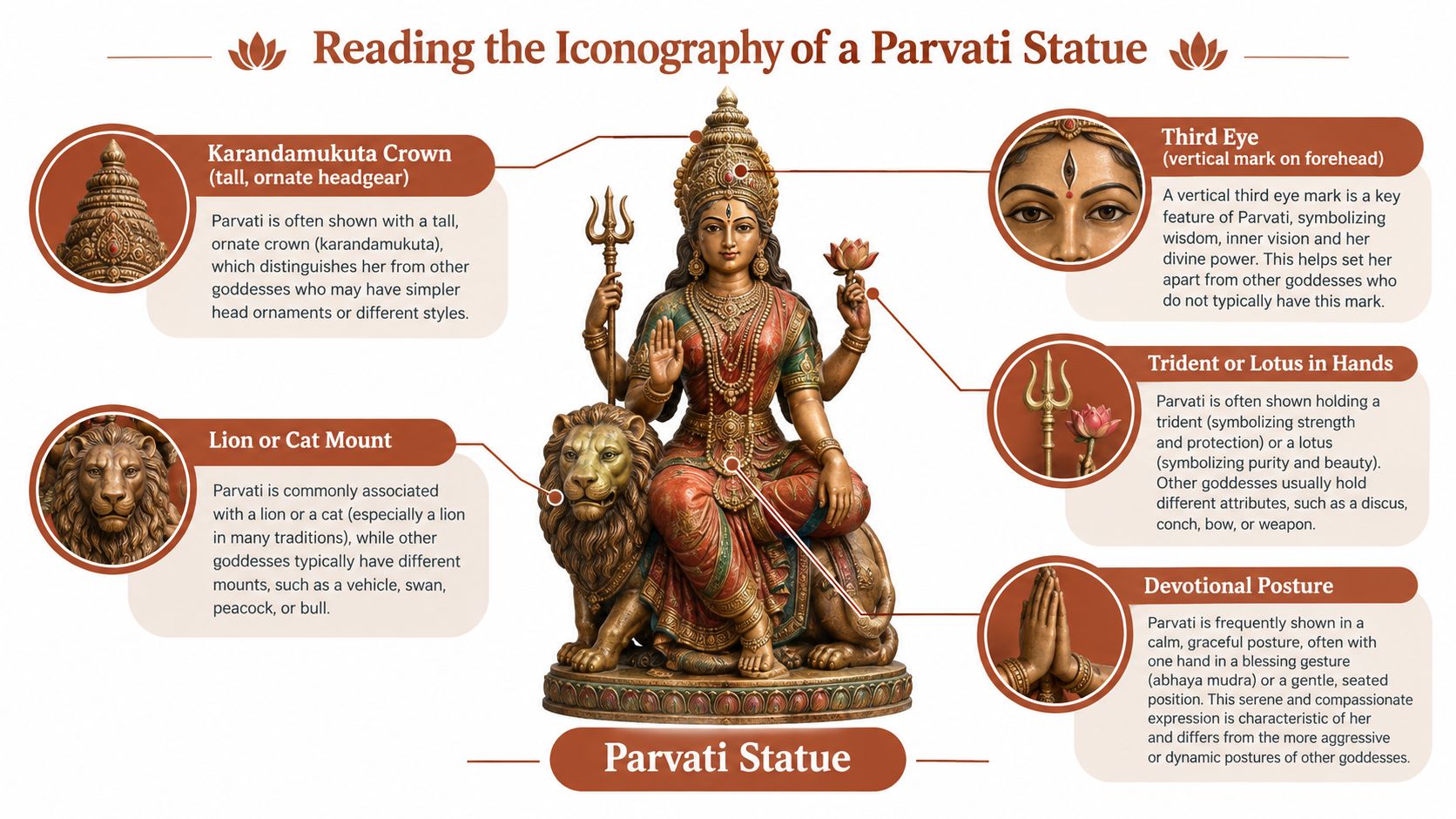
Identification works best as a sequence. Don't seize on one flower or one hand gesture and decide immediately. Start at the head, move down through the arms and body, then finish at the mount or pedestal.
Begin with the crown and face
A tall karandamukuta headdress can signal royal or divine status. Look for an organised, formal crown rather than an ordinary hairstyle. Catalogue descriptions may also record a third eye, jewellery, a lotus pedestal or other features, but a crown alone won't distinguish Parvati from every other goddess.
Move to the arms. Many peaceful Parvati images have two arms, while some representations use four. Four arms can indicate divine sovereignty, but arm count needs to be read alongside attributes and context. A figure with weapons, an aggressive stance and a lion or cat mount may belong to another goddess form rather than the benign Parvati being sought for a home shrine.
The hands provide the next clue. Depending on the regional tradition and form, the upper hands may hold a lotus, mirror or sugar cane bow, while the lower hands may show abhaya, the gesture of reassurance, and varada, the gesture of generosity or granting a boon. A lotus can suggest purity and cultivated grace, but it isn't a shortcut that replaces the rest of the reading.
Follow the body to the base
The tribhanga posture shifts weight onto one leg and creates a controlled, sensuous curve through the body. Look at the neck, waist and knees together. If the bend feels accidental or stiff, the figure may be a modern decorative approximation rather than a carefully proportioned image in a particular sculptural tradition.
The base matters too. A lotus pedestal lifts the goddess above ordinary ground and frames the statue as a sacred image. Some figures stand within a larger architectural composition, while others have a plain modern plinth. The absence of a lotus doesn't automatically disqualify a figure, especially where a regional style uses a different base or where the original support is missing.
The V&A provides a useful example of why several clues must be read together. Its 15th-century Majapahit-style sculpture is identified as Parvati with four arms, a closed lotus bud, a possible mortuary symbol, a fly-whisk and lower hands clasped at the waist. The same record notes the faceted crown, flame-pattern border, lotus pedestal and flowering vases as regional markers for East Javanese Hindu sculpture. (V&A record for a Parvati sculpture)
Practical rule: Treat iconography as a sentence, not a single word. Crown, arms, attributes, gesture, posture and pedestal become persuasive when they agree.
For another UK-held comparison, the British Museum records a bronze Śiva and Pārvatī Kalyāṇasundara marriage scene from the early 11th century, measuring 34 cm high, 19 cm wide and 8 cm deep. The museum evidence shows that Parvati-linked images vary greatly in subject and scale, from an intimate marriage composition to a monumental stone couple. (British Museum record for the Kalyāṇasundara sculpture)
A careful reading therefore does more than name the goddess. It tells you whether you're looking at Parvati alone, Parvati with Shiva, a marriage scene, a regional variation or a composite form. A detailed guide to identifying Hindu goddess statue features can support that process, but the best habit is to inspect the whole figure before making a decision.
Regional Styles Found in UK Collections
A buyer in the UK may encounter Parvati through several visual traditions rather than one universal style. Compare the figure's material, body proportions, surface treatment and relationship to its base. Those clues often reveal more than a seller's broad label such as “Indian goddess”.
South India and Orissa
South Indian bronzes are often associated with elegant bodies, elaborate jewellery and a lively sense of movement. Lost-wax casting allows the sculptor to model fine details in the wax before the metal is poured, which helps explain the crisp transitions around crowns, necklaces and fingers in well-made examples.
Orissan stone tends to make a different impression. The British Museum's Shiva and Parvati from Orissa is a large stone image in which Parvati sits in Shiva's lap. The BBC explains that the pair were carved with decorated loincloths, heavy necklaces and head-dresses, and that the sculpture may have been installed above a temple doorway, where its message of divine union and marital fidelity would meet worshippers moving through the space. (BBC coverage of the Orissan Shiva and Parvati sculpture)
East Java and other Asian traditions
The V&A's Majapahit example shows how East Javanese artists adapted Hindu imagery through regional details such as the faceted crown, flame-pattern border and flowering vases. The National Museum of Scotland also lists a bronze figure identified as Parvati or Lakshmi, made in India for religious observances and displayed in its “Traditions in Sculpture” gallery. That uncertainty in the identification is instructive. Museum catalogues sometimes preserve ambiguity rather than forcing a confident label where the attributes overlap. (National Museum of Scotland record)
| Region / Period | Typical Material | Distinguishing Features | Notable UK Example |
|---|---|---|---|
| South India, medieval and later traditions | Bronze | Fluid posture, fine jewellery, carefully modelled hands and facial features | British Museum early 11th-century Śiva and Pārvatī marriage bronze |
| Orissa, medieval period | Stone | Monumental scale, architectural framing, close Shiva-Parvati relationship | British Museum Orissan Shiva and Parvati |
| East Java, Majapahit tradition | Stone and bronze | Faceted crown, flame-pattern borders, lotus pedestal and regional decorative details | V&A 15th-century Majapahit-style Parvati |
| India, religious bronze traditions | Bronze | Compact devotional form, ritual use and overlapping goddess attributes | National Museum of Scotland figure identified as Parvati or Lakshmi |
| Contemporary workshop production | Brass, bronze, wood and resin | Simplified or adapted iconography, varied finish and modern display scale | Contemporary pieces encountered through UK dealers and retailers |
The table isn't a ranking. A Chola-influenced bronze may suit a collector drawn to movement and casting, while an Orissan stone figure may suit someone who wants architectural weight. A Majapahit sculpture can appeal to a buyer interested in how Hindu visual language changed across Southeast Asia.
Materials, Sizes and Craftsmanship Explained
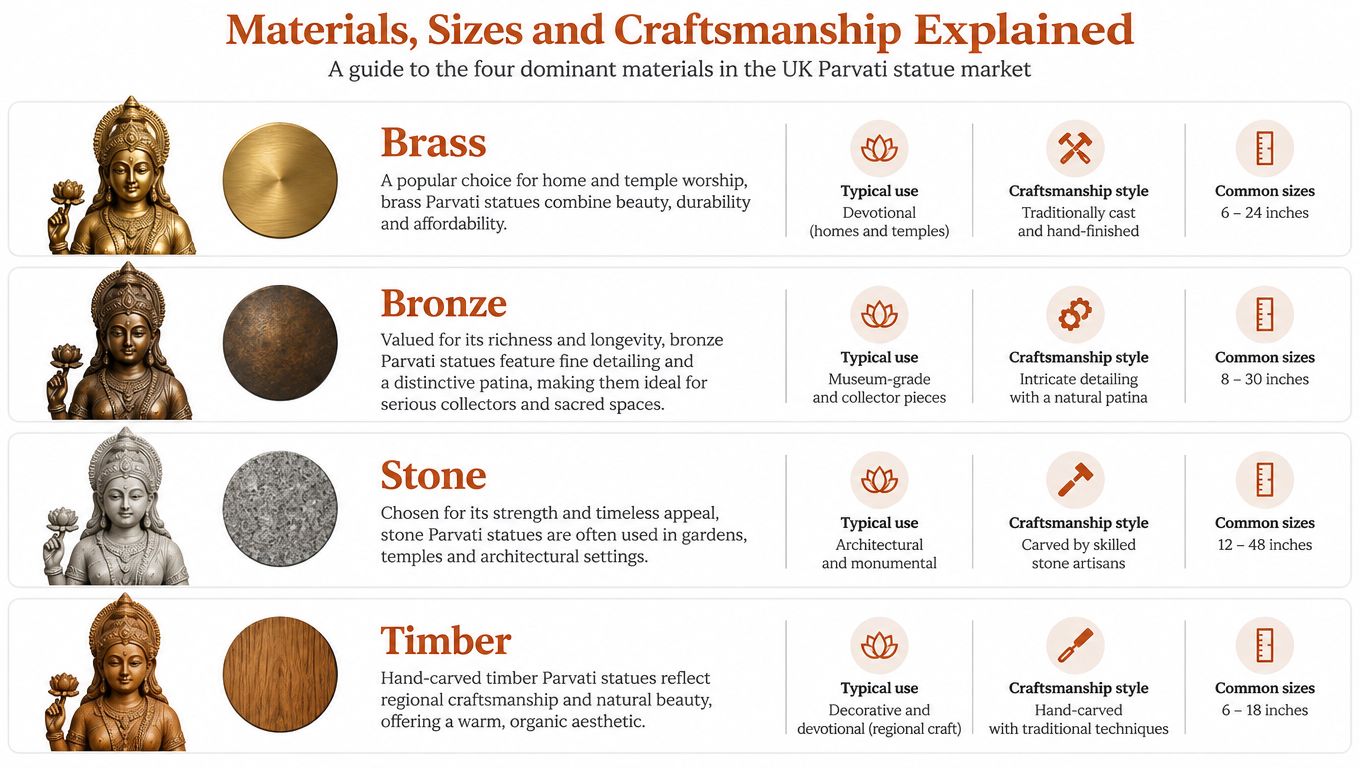
Material sets the first practical boundary. A figure intended for a home altar has different requirements from a stone sculpture chosen as the anchor of a large room. Start by asking where the statue will live, how it will be handled and whether you want ritual function, visual presence or historical evidence.
Brass and bronze
Brass is common in devotional retail because it provides a warm gold-like surface and tolerates ordinary household handling. Inspect the polish, edges and recesses. A very uniform, mirror-like finish may indicate recent production, while an uneven surface can reflect hand finishing, age or inconsistent workmanship.
Bronze gives a sculptor strong control over fine detail and patina. In South Indian traditions, lost-wax casting is especially significant because the model is formed in wax before casting. Examine the face, fingers, jewellery and the meeting points between the figure and base. Blurred ornament or awkward joints may suggest a weaker reproduction, though only a qualified specialist should make claims about age or authenticity.
Stone has physical authority. Orissan and related Indian stones can create a heavy, architectural presence, and the quality of carving depends on depth, proportion and surface handling rather than size alone. Wood offers warmth and a direct sense of the maker's tool marks, but centrally heated UK rooms can create challenging changes in humidity, particularly for older or finely joined carvings.
Choose scale by use
Think in zones rather than chasing a particular dimension.
- Small format: A compact piece works for travel, a personal shelf or a discreet meditation space.
- Shelf format: A medium figure can hold its own on a mantelpiece or console without overwhelming nearby objects.
- Altar format: A larger statue needs a stable, dedicated surface and enough clearance to read the hands, crown and body curve.
- Statement format: A substantial stone or bronze figure becomes part of the room's architecture and may require a professionally made plinth.
Quality appears in details that are easy to miss online. Check whether seams have been disguised, whether the patina sits naturally in recesses, whether the polish is consistent and whether the base supports the figure securely. Ask for photographs from several angles, especially beneath the hands, around the crown and at the feet.
Collector's note: A large statue isn't automatically more important. Proportion, iconographic clarity, surface quality and documented history can matter more than physical scale.
Descriptions should also distinguish age, material and provenance. “Traditional style” doesn't mean antique, and “bronze” doesn't by itself establish a particular casting tradition. Request a condition report for an older piece, and ask how the seller reached the stated date and regional attribution.
How Parvati Statues Are Displayed in the UK
A statue changes character according to its surroundings. Place a small bronze among crowded ornaments and its posture disappears. Give the same figure a calm background, steady plinth and considered light, and the curve of the body becomes legible.
Harewood House offers a particularly revealing UK context. Its bronze Parvati is described as an 11th-century devotional object and is displayed within an English country-house setting. The juxtaposition matters because the sculpture doesn't stop being devotional merely because it now sits among domestic interiors and historic furnishings. It demonstrates how an object can carry one history of use while acquiring another history of display.
A museum case creates a different reading. The Orissan Shiva-Parvati sculpture associated with British Museum collections is the kind of work that benefits from space around the stele, controlled illumination and a background that doesn't compete with the carved jewellery or architectural frame. In a home, a comparable approach might mean placing a stone piece against a quiet painted wall rather than a patterned wallpaper.
Domestic display decisions
For a bronze on a mantelpiece, check that the shelf doesn't flex and that the figure won't be exposed to persistent heat. A stone stele needs a console or plinth capable of supporting its weight. Brass figures grouped with Shiva, Ganesha or Nandi can create a coherent altar, but leave enough separation for each figure to remain readable.
Glass cloches can protect heirloom brass from dust, though they may trap condensation if placed in a damp or poorly ventilated spot. Soft, indirect lighting usually reveals facial detail more gently than a bare spotlight. Angle the light so it models the features without producing sharp shadows across the hands.
The same principle applies to objects sharing the room. If a Parvati statue sits near plants or a bonsai display, choose vessels and surfaces that don't compete with the figure. A practical guide to how glazed pots affect bonsai health is useful when living plants form part of the surrounding composition, particularly because glaze, moisture and placement can affect the care routine.
A good display lets the statue breathe. The English country-house interior can remain warm and layered, but the figure needs a visual pause around it so its devotional and sculptural qualities aren't lost.
Placing a Parvati Statue at Home, on an Altar or in a Design Scheme
Placement begins with intention. A devotee may want a stable, clean and raised setting for worship. A collector may prioritise visibility and protection. An interior designer may need the statue to sit comfortably within a composition without turning a sacred image into an accidental prop.
When Parvati appears with Shiva, the relationship between the figures deserves attention. A BBC transcript describing a Shiva and Parvati sculpture records a specific devotional ordering, worshippers should offer respect to Parvati first and then approach Shiva. (BBC transcript on the Shiva and Parvati sculpture) For a home altar, that can guide the arrangement of a pair. Keep Parvati slightly raised or visually prominent, while avoiding a forced layout that makes the figures unstable or cramped.
A practical home arrangement
Place a worship figure on a dedicated shelf or altar rather than directly on the floor. A seated worshipper should be able to see the face and hands without bending awkwardly. If you follow Vastu or another household tradition, an eastward-facing position may feel appropriate, but the arrangement must also work with the actual room, natural light and safe access.
Keep brass and bronze away from direct radiator heat. Wood needs particular care in centrally heated rooms, where repeated changes in warmth and humidity may stress the material. Use felt pads beneath smaller pieces, and ask a conservator or specialist framer about a conservation-grade mount for a fragile or valuable object.
For a design scheme, pair a dark plinth with bronze when you want the warm metal to stand forward. Give stone more space, especially where its silhouette depends on an architectural stele or broad base. Don't hide the tribhanga line behind books, tall plants or decorative accessories.
Respectful placement is also good design. Clear space, stable support and appropriate height help a viewer understand the statue before they decide what they feel about it.
Renters can create a thoughtful setting without drilling into walls. A sturdy console, removable felt protection and a discreet tray can keep surfaces safe while giving the figure a defined place. The aim isn't to make every room look like a temple. It's to avoid careless placement and allow the object's identity to remain visible.
Choosing the Right Parvati Statue for Your Purpose
Start with the use, not the finish. If the statue is for worship, prioritise clear iconography, respectful scale, stable construction and a material suited to your practice. If it's for decoration, judge the silhouette, negative space and relationship to the room. If it's for collecting, require more evidence, including regional attribution, condition, casting or carving details and provenance.
Use this checklist before buying:
- Define the purpose: Decide whether the primary role is altar, interior display or collection.
- Read the figure: Check the crown, arms, attributes, mudras, tribhanga posture and base together.
- Match the scale: Measure the shelf, plinth or altar before choosing the statue.
- Assess the material: Consider handling, heat, humidity, cleaning and the visual character you want.
- Ask about origin: Request information about the workshop, region, artisan tradition and ethical sourcing.
- Request condition details: For an older piece, ask for a written condition report and clear photographs.
- Compare in person: Visit the V&A, British Museum or a reputable Asian art dealer to see how different traditions handle Parvati's form.
A useful purchase often sits at the meeting point of the three purposes. A well-made bronze can support devotion, enrich a room and reward close study. A historic stone sculpture can be a powerful interior object while also demanding scholarly care. The best choice is the one whose identity, material and setting all agree.
HD Asian Art offers curated Hindu and Buddhist statues, including Parvati-related works from Asian sculptural traditions, with information intended to support informed display and collecting. If you're comparing a devotional bronze with a regional collectible, visit HD Asian Art to browse the collection and contact the specialist team before making your choice.
