



Murugan Statue: Tamil War God & His Iconography
Murugan Statue: Tamil War God & His Iconography
Pick up any Murugan statue and you are holding one of the most iconographically dense objects in all of South Asian religious art. Every detail, from the number of faces to the angle of the vel spear, carries doctrinal weight that has been argued over, codified, and refined across more than two thousand years of Tamil religious tradition.
Yet most buyers, even serious collectors, treat these sculptures as decorative objects without understanding what they are actually looking at. That is a significant loss, because understanding the iconography transforms your relationship with the piece entirely.
Table of Contents
- Who Is Murugan? Origins and Regional Names
- Quick Takeaways
- The Vel Spear: Murugan's Defining Attribute
- Six Faces, Twelve Arms: Reading the Shanmukha Form
- The Peacock and the Rooster: Two Symbols, One Story
- The Consorts: Valli and Devasena
- Regional Forms of Murugan in South Indian Sculpture
- Comparing the Three Principal Sculptural Forms
- What to Look For When You Buy a Hindu Murugan Statue
- Frequently Asked Questions
- References
Who Is Murugan? Origins and Regional Names
Murugan is the pre-eminent deity of Tamil Nadu and one of the oldest continuously worshipped gods in South Asia. The name itself derives from a Tamil root meaning "handsome" or "youthful," and that sense of eternal, vigorous youth runs through every form his statues take. He is never depicted as aged, never as passive. The Tamil tradition insists on him as Kumara, the eternal youth, full of energy and divine purpose.
Across the Puranic and regional traditions, this deity carries a remarkable number of names. The most commonly encountered in sculpture and ritual contexts include Kartikeya, Skanda, Subrahmanya, Saravana, Shanmukha, Arumukha, Devasenapati, Guha, Kumara, and Velayuda. Each name reflects a different aspect or origin story. Skanda, derived from the Sanskrit root meaning "to leap or to attack," emphasises his warrior nature. Shanmukha and Arumukha both mean "six-faced," referring to his most striking iconographic feature. Velayuda simply means "wielder of the vel," his spear.
In the Sanskrit Puranic tradition, he is born as the son of Shiva and Parvati and raised by the six Krittika star-nymphs, which is the origin of his six heads. In the Tamil Sangam tradition, he is a native deity of considerable antiquity, rooted in the kurinji landscape of mountainous terrain, worshipped long before the Sanskrit Puranic framework was imposed. The Tirumurukaarruppadai, a Sangam-era text, is among the earliest literary sources describing his iconography in explicit detail. This dual heritage, Tamil and Puranic, explains why his sculptural tradition is so rich and sometimes internally inconsistent: two living traditions are layered on top of each other.
In Tamil Shaivism, Murugan is not simply a war god. He is the embodiment of divine knowledge, the one who corrects even Shiva himself in matters of sacred wisdom. The warrior exterior is a vehicle for a fundamentally gnostic role.

Quick Takeaways
|
Key Insight |
Explanation |
|---|---|
|
The Vel spear is a symbol of wisdom, not war |
In Tamil Shaivism, the Vel represents the piercing of ignorance and ego. The weapon's spiritual role outweighs its martial one in iconographic terms. |
|
Murugan carries at least six canonical names |
Skanda, Kartikeya, Subramanya, Saravana, Shanmukha, and Kumara all refer to the same deity, each name reflecting a distinct regional or doctrinal tradition. |
|
The peacock mount is not decorative |
The peacock (Paravani) trampling a cobra represents the conquest of ego and pride. In some forms the cobra appears explicitly beneath the bird's feet. |
|
Six faces reflect a specific theological claim |
Shanmukha, meaning "six-faced," indicates Murugan's omniscience and his capacity to perceive all directions simultaneously. The six faces also link to the six Krittika mothers of the birth legend. |
|
The rooster banner signals doctrinal affiliation |
A rooster on the battle flag identifies the sculpture as aligned with the Tamil Shaiva Siddhanta tradition. Its origin lies in the myth of Murugan splitting the demon Surapadman. |
|
Chola bronze technique remains the benchmark |
South Indian Chola-period bronzes from Tamil Nadu set the standard for authentic Murugan sculpture. The lost-wax (cire perdue) method used then is still employed by skilled craftsmen in Swamimalai and surrounding villages. |
|
Panchaloha is ritually significant, not merely aesthetic |
Bronze and panchaloha (the traditional five-metal alloy of gold, silver, copper, iron, and lead) are considered ritually active materials in South Indian temple practice. This matters for buyers seeking statues for devotional use. |
Understanding these fundamentals changes what you look for in a sculpture entirely. A Murugan statue is not simply a figure holding a spear and riding a bird. Every element has been assigned meaning by centuries of living religious tradition, and a well-made statue respects that canon down to the gesture of each hand.
The Vel Spear: Murugan's Defining Attribute
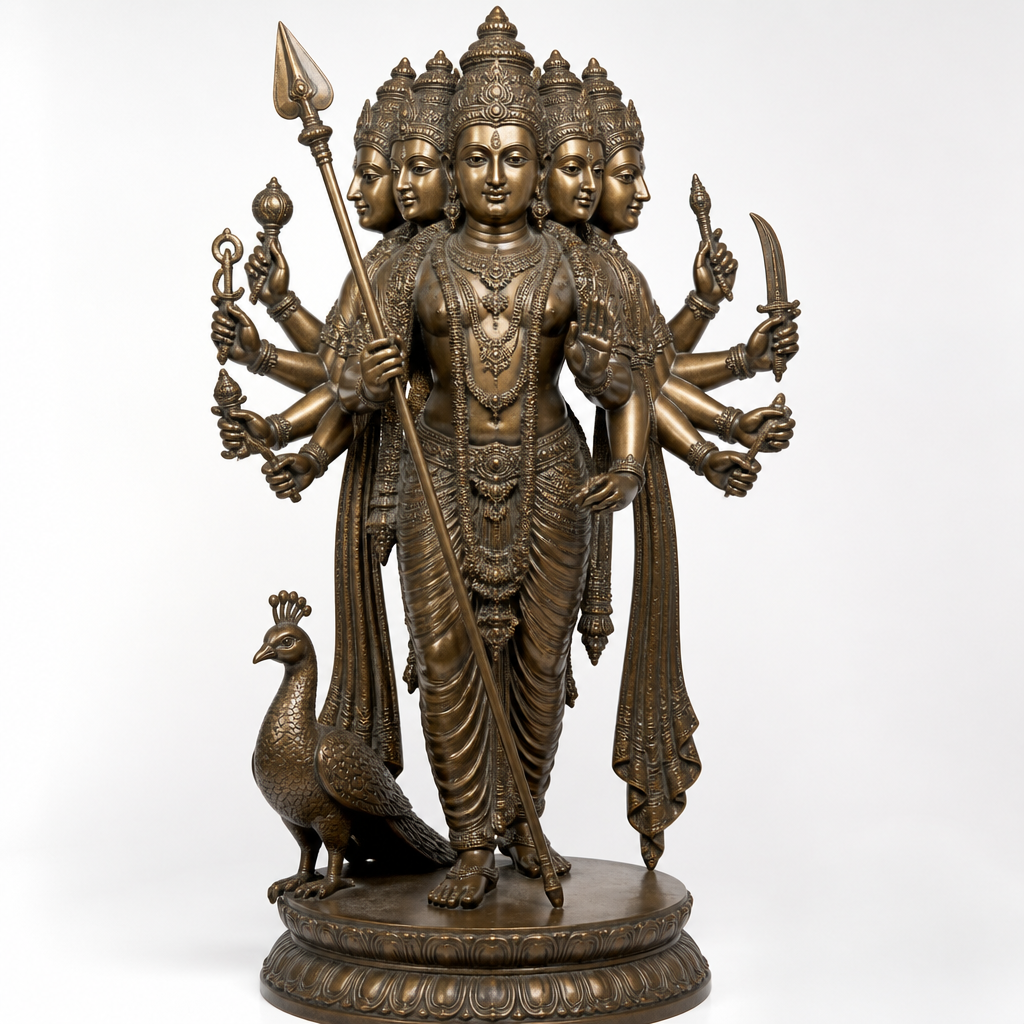
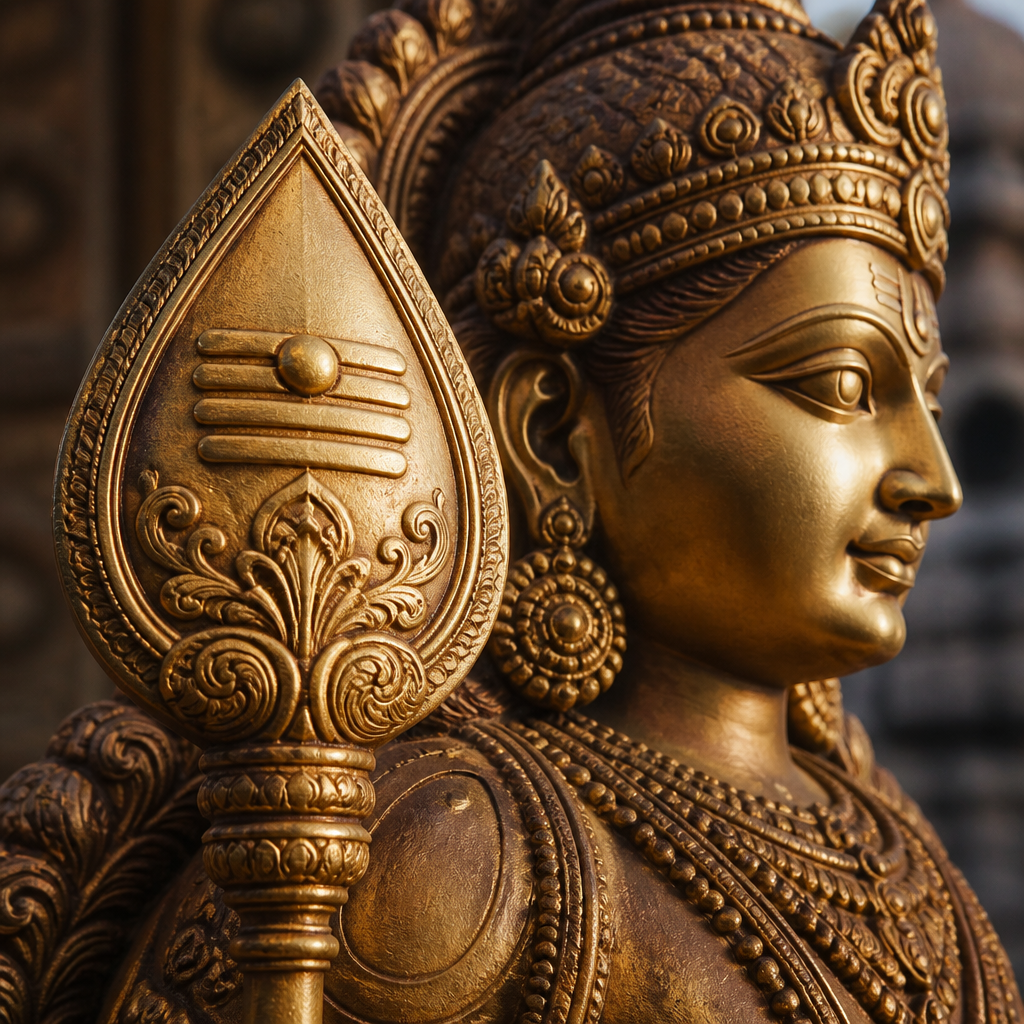
No element of Murugan's iconography is more immediately recognisable, or more frequently misunderstood, than the vel. It is a divine spear gifted to Murugan by his mother Parvati before he went into battle against the demon Surapadman. In purely narrative terms it is a weapon, and a decisive one: according to the Skanda Purana, Murugan hurled the vel to defeat the forces of Surapadman, and when the demon transformed himself into a mango tree to hide, Murugan split the tree in two with the same spear.
In sculptural depictions, the vel is held in the right hand, often pointing downward or raised as if ready to strike. This positioning is not arbitrary. The Agamic manuals that govern South Indian temple sculpture, known as the Agamas and the Shilpashastras, specify exact hand positions for each attribute. A vel held with the tip pointing downward is described in some traditions as a form of blessing, as if the weapon's divine power is being directed toward the earth and its inhabitants rather than at an enemy.
The deeper interpretation, consistent with Tamil Shaivism, is that the vel represents jnana, divine knowledge, and its action is the piercing of maya, illusion. This transforms the war god into a teacher, or more precisely, into a deity whose act of warfare is itself an act of spiritual instruction. A common mistake among buyers is to classify Murugan statues purely as martial imagery. The vel is the primary reason that assumption is wrong.
Pro tip: When evaluating a Murugan statue, check whether the vel is rendered as a complete implement with a distinct leaf-shaped blade (called the vel mukha) and a clear shaft. Sculptures that reduce the vel to a generic rod or eliminate its distinctive blade shape are cutting corners on iconographic accuracy, and that matters whether your interest is devotional, scholarly, or aesthetic.
Six Faces, Twelve Arms: Reading the Shanmukha Form
The Shanmukha form, meaning "six-faced," is Murugan's most elaborate and theologically complete sculptural representation. The Skanda Purana describes him in this form as having twelve hands carrying the vel, a bow, a sword, a discus, and other divine weapons, wearing golden attire with a radiant aura. In practice, sculptors working in the Chola tradition and its descendants depict the twelve arms arranged in a circular pattern, each bearing a specific attribute, with the two foremost hands often holding the vel horizontally.
Why Six Faces?
The six-headed form traces back to two layered mythological explanations. In the birth legend, Shiva's divine seed was carried by Agni (fire) and deposited in the Ganges, then received by six Krittika nymphs, each of whom nursed one of six babies. When Parvati embraced the six infants simultaneously, they merged into one child with six heads. This is the origin story. The theological elaboration adds that the six faces allow Murugan to see and understand in all six directions simultaneously, a symbol of total omniscience and the capacity to govern the cosmos without a blind spot.
The Twelve Arms in Practice
According to the Sritatvanidhi, one of the authoritative South Indian iconographic texts, the Shanmukha form carries twelve arms. The Kumaratantra describes a six-handed variant. In South Indian bronze tradition, the twelve-armed Shanmukha is the prestige form, associated with major temples and processional bronzes. For a private collector, encountering a well-executed twelve-armed Shanmukha in bronze is a serious find: the casting complexity is considerable, and the iconographic detail required across twelve individual hands leaves no room for approximation.
A common mistake when viewing Shanmukha sculptures is to focus only on the faces and ignore the hand attributes. In fact, the attributes are where the doctrinal content is concentrated. Each object held in each hand corresponds to a specific divine power or narrative episode, and a sculptor who knows the tradition will have arranged them according to Agamic prescription. A sculptor who does not will simply fill the hands with generic weapons.
The Peacock and the Rooster: Two Symbols, One Story
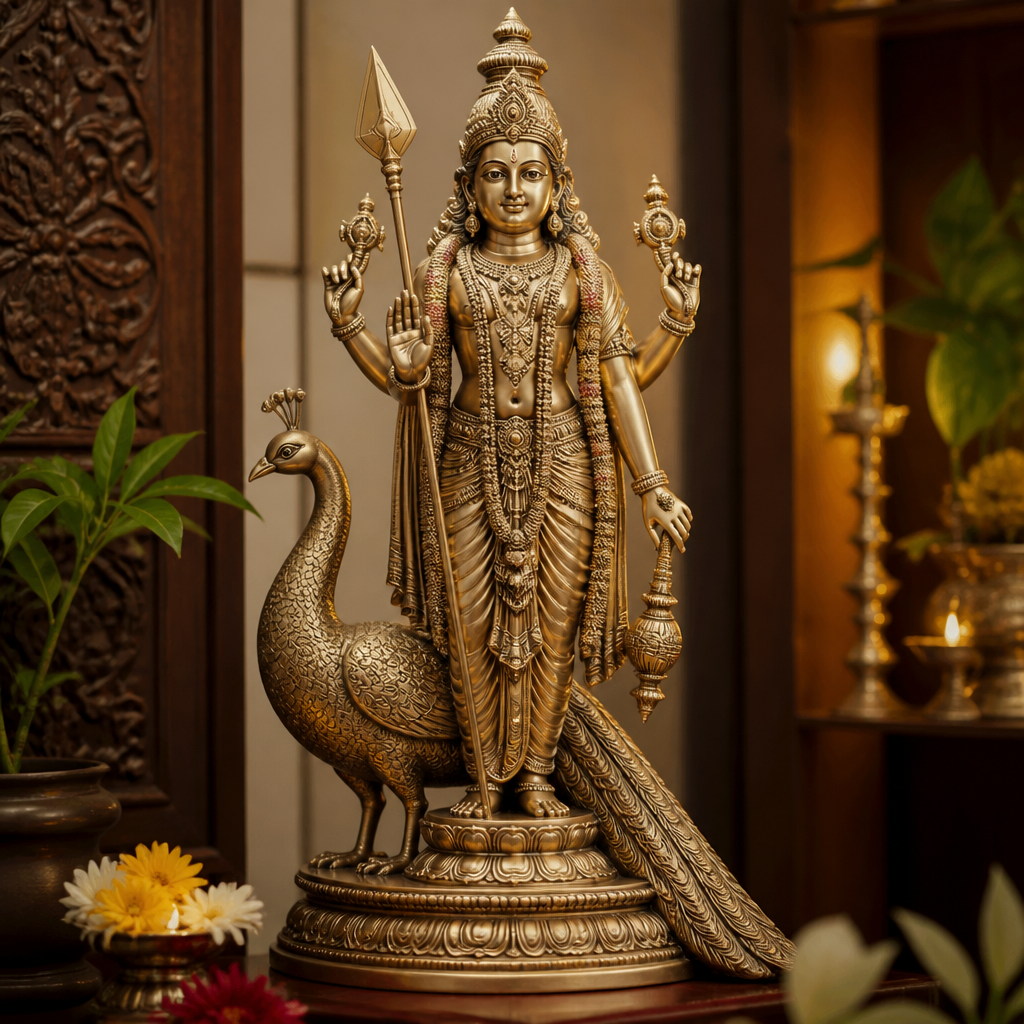
Murugan's peacock vahana is named Paravani. The peacock's association with Kartikeya was noted in texts as early as Kalidasa's Raghuvamsa, placing it securely in the Gupta period, around the fifth century CE. In sculptural terms, the peacock appears either as the mount Murugan rides, or standing beside him, or in some forms lying prostrate at his feet. In the prostrate form, the peacock is sometimes shown trampling a cobra, which adds a second layer of symbolism: the serpent, representing ego, subdued by the bird, which in turn is commanded by Murugan.
The rooster, less visually prominent but equally significant, appears on Murugan's battle standard. Its origin lies in the same episode as the peacock's: when Murugan split the demon Surapadman with his vel, the mango tree that had been the demon's hiding place split into two halves. One half became the peacock, which became his vahana, and the other became a rooster, which became the emblem on his battle flag. The two symbols are therefore a pair, two halves of one vanquished enemy, permanently incorporated into Murugan's iconographic identity as trophies of his most celebrated victory.
Pro tip: When assessing a Murugan statue for devotional use or collection, look for whether the rooster banner (kodi) is included. Many simplified commercial sculptures omit it entirely. Its presence is a reliable marker that the sculptor was working from a well-informed iconographic tradition rather than from a generic template.
The Consorts: Valli and Devasena
In South Indian tradition, Murugan has two consorts: Devasena (also called Devayanai), the daughter of Indra, and Valli, a tribal forest girl. Their pairing is not incidental. Devasena represents divine grace and the power of sanctioned, celestial action. Valli represents the power of personal devotion, the love of an ordinary human soul for the divine. Together they stand on either side of Murugan in the canonical triumphal group sculpture, embodying the two paths to liberation that Tamil Shaivism recognises.
Sculptural groups showing Murugan with both consorts are known as Murugan-with-Shaktis compositions. In the most elaborate versions, the peacock appears behind or beside Murugan, making the group a five-figure composition. These are the processional bronzes that define South Indian temple culture and have, since the Chola period, been carried through the streets during festivals such as Thaipusam and Vaikasi Visakam.
For collectors of Hindu deity statues, the with-consorts form is iconographically and aesthetically the most complete representation of Murugan. It is also the most demanding to execute well: the relative heights, poses, and hand gestures of all three figures must be coordinated, and the sculptors working in Swamimalai and the broader Tamil Nadu bronze tradition have refined this compositional problem over many generations.
Regional Forms of Murugan in South Indian Sculpture
South Indian religious art has never been uniform, and Murugan's iconography reflects that regional diversity. While the Shanmukha form is the most elaborate, several other canonical forms appear regularly in both temple and private collections.
Dandayudhapani: The Ascetic at Palani
At Palani in Tamil Nadu, Murugan appears in a form so different from the warrior Shanmukha that it can surprise first-time viewers. The Dandayudhapani form, described in the Shiva Purana, shows Murugan as a renunciant ascetic, shaven-headed, carrying only a staff (danda), wearing minimal ornaments, and standing in a posture of serene detachment. The Shiva Purana describes this as the staff-wielding ascetic form symbolising renunciation. The story behind it involves Murugan withdrawing from his family in a dispute and retreating to the Palani hills in the state of a renunciant.
In sculptural terms, the Palani Murugan is unmistakable: the shaved head and staff are diagnostic features that cannot be confused with any other form. This is a form frequently requested by Tamil devotees for home altars, precisely because of the Palani pilgrimage's importance in the Tamil religious calendar.
Velayuda: The Lance-Bearer
The Velayuda form presents Murugan in a standing posture with the vel as his sole or primary attribute. The peacock often appears beside him, sometimes with a cobra beneath its feet. This is a relatively straightforward compositional form, and it accounts for a large proportion of the bronze Murugan statues in private collections and smaller temples. The iconographic emphasis is on the vel itself as a complete symbol, rather than on the full array of weapons seen in the Shanmukha form.
Skanda on Peacock: The Rider Form
The mounted form, with Murugan seated or standing on the peacock, appears in both one-faced and six-faced versions. The Sritattvanidhi specifies the peacock vehicle (Indranilaratha) as the defining element. In this form, the deity is shown in full command of his vahana, often with one or more weapons raised. This is the form that appears most frequently in narrative temple sculpture, particularly in scenes depicting the defeat of Surapadman.
Comparing the Three Principal Sculptural Forms
|
Form |
Key Iconographic Features |
Primary Symbolic Meaning |
|---|---|---|
|
Shanmukha (Six-Faced) |
Six faces, twelve arms, full array of divine weapons including vel, bow, sword, discus; peacock mount; consorts Valli and Devasena often included; rooster banner |
Omniscience, divine sovereignty, complete mastery of all six directions and the full spectrum of cosmic knowledge |
|
Dandayudhapani (Palani Form) |
Single face, shaved head, staff (danda) as sole weapon, minimal ornamentation, standing or seated posture, lotus base common |
Renunciation, spiritual withdrawal, the supremacy of ascetic wisdom over worldly power |
|
Velayuda / Shikhivahana (Lance-Bearer on Peacock) |
Single or six faces, two to twelve arms, vel as primary attribute, peacock standing beside or as mount, cobra sometimes beneath peacock's feet |
Divine victory, the piercing of ignorance, the warrior-teacher aspect in its most direct sculptural expression |
What to Look For When You Buy a Hindu Murugan Statue
Buying a Murugan statue without understanding the iconographic canon is like buying a manuscript without being able to read the script. You can appreciate the physical object, but you are missing the content. This section is for buyers who want to make an informed choice, whether for devotional use, scholarly collecting, or serious home display.
Material and Casting Method
The tradition that defines quality in South Indian Murugan sculpture is bronze casting using the lost-wax method, known in Tamil as kondai velai. This technique has been practiced continuously in the Swamimalai region and surrounding villages since the Chola period, roughly the ninth to thirteenth centuries CE. Panchaloha, the five-metal alloy traditionally composed of copper, gold, silver, iron, and lead in prescribed proportions, is considered the ritually correct material for temple bronzes. For devotional use, the material is not merely an aesthetic choice: South Indian temple tradition regards panchaloha bronzes as ritually active in a way that stone or resin sculptures are not.
In practice, most contemporary South Indian bronzes for the collector market are cast in copper-dominant alloys with varying small percentages of the other metals. The key quality indicator is the casting precision, which in lost-wax work means no two pieces are identical, and the surface finishing, which in the finest examples preserves fine detail across facial features, jewelry, and individual weapon attributes.
Iconographic Accuracy
For a Murugan statue to be iconographically coherent, the vel must be correctly formed with its distinctive leaf-shaped blade, the peacock must appear with clearly defined feathers rather than as a generic bird shape, and the hand mudras must be intentional rather than arbitrary. A Shanmukha form should have all twelve hands with distinct attributes: a haphazard arrangement of generic weapons in the additional hands is a sign of a sculptor working from general intuition rather than from specific Agamic training.
The face or faces are often the most reliable guide to quality. A well-executed Murugan face follows precise sculptural conventions: downward-cast eyes suggesting inner absorption rather than outward aggression, elongated earlobes indicating divine status, a crown (kiritamakuta or karanda makuta depending on the form), and the urna or frontal mark. These features are not difficult to describe but they are very difficult to execute well in metal, which is why the difference between an experienced South Indian foundry and an inexperienced one is immediately visible in the face.
Provenance and Regional Style
South Indian Tamil sculpture has distinct regional stylistic signatures. The Chola style favours elongated limbs, full-bodied torsos, and extraordinary refinement in jewelry detail. The Vijayanagara period (roughly fourteenth to seventeenth century) introduces a heavier, more ornamented style with broader crowns and more dynamic postures. Contemporary Swamimalai work, when done by skilled hereditary craftsmen, consciously follows Chola-period proportional canons and is the closest living tradition to the historical benchmark.
For collectors interested in South Indian religious art, understanding these stylistic periods adds an important layer to collection building. A Chola-period bronze and a contemporary Swamimalai casting of the same iconographic form are very different objects in historical terms, but the contemporary piece, if well made, can be an entirely serious work of religious art in its own right.
At HD Asian Art, the collection of Hindu deity statues includes pieces sourced from across the South Asian sculptural tradition, offering collectors and spiritual practitioners access to authentic work that respects the iconographic conventions described in this article. If you are building a home altar or a collection of South Indian religious art, the ability to read these sculptures correctly is what separates a considered acquisition from a generic purchase. Explore the Hindu statue collection to see how these iconographic traditions translate into available pieces.
Frequently Asked Questions
What is the difference between a Murugan statue and a Kartikeya statue?
They represent the same deity but reflect different regional and textual traditions. The name Murugan is rooted in Tamil Sangam literature and the Tamil Shaiva Siddhanta tradition, which emphasises his role as a deity of divine knowledge and Tamil cultural identity. Kartikeya is the Sanskrit Puranic name, emphasising his birth from the six Krittika nymphs and his role as the divine warrior son of Shiva and Parvati. Iconographically, statues described as Murugan often follow South Indian Tamil conventions more closely, while Kartikeya depictions sometimes reflect North Indian sculptural traditions with slightly different forms and attributes.
Why does Murugan have six faces in some statues but only one face in others?
Both forms are iconographically canonical. The six-faced form, known as Shanmukha or Arumukha, is the elaborate theological statement: the six faces represent omniscience, the capacity to perceive all directions simultaneously, and they link to the birth legend of the six Krittika mothers. The single-faced form is used in less elaborate compositions, including the Velayuda, Dandayudhapani, and Shikhivahana forms. The Agamic texts specify which form is appropriate for which ritual context, and South Indian sculptors follow these specifications. Neither form is more "authentic" than the other. They serve different iconographic and devotional purposes.
What does the vel spear represent in Murugan's iconography?
The vel is the weapon given to Murugan by his mother Parvati before his battle against the demon Surapadman. In narrative terms it is the weapon that won the decisive cosmic battle. In theological terms, within Tamil Shaivism, the vel represents divine knowledge, specifically the kind of penetrating wisdom that destroys ignorance and ego. This is why Murugan, despite being called a war god, is also considered the embodiment of jnana, sacred knowledge. The vel's action is simultaneously martial and gnostic. In ritual contexts across Tamil Nadu, the vel is itself an object of worship in Murugan temples.
What is panchaloha, and why does it matter when buying a Hindu statue?
Panchaloha is the traditional five-metal alloy used in South Indian temple sculpture, composed of copper, gold, silver, iron, and lead in proportions prescribed by Agamic texts. In South Indian temple tradition, a bronze or panchaloha statue is considered ritually active and suitable for consecration and regular worship, while statues in other materials such as resin or cold-cast composites are not. For buyers seeking a statue for devotional use, panchaloha or high-quality bronze is the correct choice. For purely aesthetic or scholarly collecting, the material matters primarily in terms of its relationship to the historical tradition of Chola-period temple sculpture.
How do I identify a Palani Dandayudhapani Murugan statue?
The Palani Dandayudhapani form is one of the most distinctive in all of Murugan iconography and is easy to identify once you know the features. The defining characteristics are a shaved head with no crown or elaborate hairstyle, a staff (danda) as the primary or sole hand attribute rather than a vel, minimal ornaments compared to the fully jewelled Shanmukha form, and a posture of serene stillness rather than dynamic warrior readiness. This form depicts Murugan as a renunciant, and the contrast with the fully armed Shanmukha is deliberate and theologically significant. The Shiva Purana specifically describes this form as symbolising renunciation.
Is the rooster or the peacock more important symbolically in Murugan iconography?
The peacock is visually the dominant symbol, appearing as Murugan's vahana in most sculptural forms. But the rooster is not a lesser symbol, it carries specific doctrinal information. Both originate from the same myth: when Murugan split the demon Surapadman with the vel, the demon became the peacock (Murugan's mount) and the rooster (the emblem on his battle flag). The rooster on the kodi, the battle standard, identifies a sculpture as aligned with the Tamil Shaiva tradition. In terms of ritual significance, the peacock is more universally represented, but the presence or absence of the rooster banner on a Murugan statue is one of the most reliable indicators of whether the sculptor was working from a well-informed iconographic tradition.
If you have a Murugan statue in your collection or home altar, we would love to hear what drew you to this particular deity and how you read its iconography now that you have this framework.
We would love your feedback and any insights you would share with others. What perspective would you add?
References
