



Lakshmi Statue Guide: Iconography & Regional Styles
Lakshmi Statue Guide: Iconography & Regional Styles
Lakshmi Statue Guide: Iconography & Regional Styles
Many people buying a Lakshmi statue make the same mistake: they choose based on aesthetics alone, then later discover the piece is iconographically incomplete, regionally mismatched with everything else they own, or cast in a material unsuited to their purpose.
The goddess of wealth, beauty, and spiritual abundance is one of the most iconographically rich figures in the Hindu pantheon, and every element of her representation, from her hand gestures to the number of her arms, from the lotus beneath her feet to the elephants flanking her throne, carries precise theological meaning. This guide covers the full picture: what her symbols mean, how regional traditions differ in meaningful ways, and how to make a deliberate, well-informed choice before you buy.
Table of Contents
- Quick Takeaways
- Lakshmi Iconography Explained: Reading Every Symbol
- The Eight Forms: Ashta Lakshmi and What They Look Like
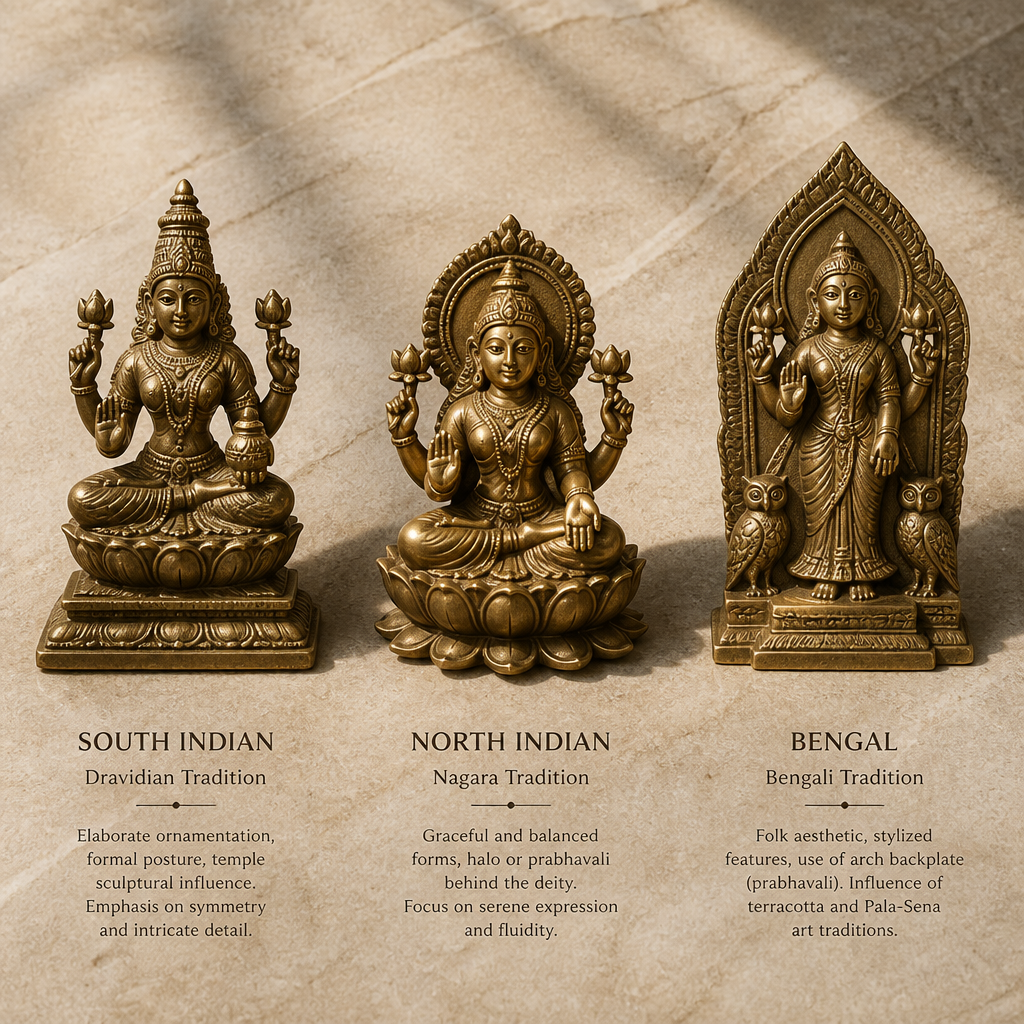
- Regional Variations: How Geography Shapes the Goddess
- Comparing Sculptural Traditions: A Practical Breakdown
- Choosing the Right Lakshmi Statue for Your Purpose
- Material and Craft Quality: What Museum-Quality Actually Means
- Frequently Asked Questions
- References
Quick Takeaways
|
Key Insight |
Explanation |
|---|---|
|
The lotus is non-negotiable |
A Lakshmi statue without a lotus, either as a seat, in her hands, or as a base, is either a highly unusual regional variant or warrants closer authenticity scrutiny. |
|
Four arms signal devotional intent; two arms signal aesthetic purpose |
Votive images are almost always four-armed, while two-armed depictions are typically aesthetic or classical in character. Know which you need before you buy. |
|
The varada mudra (coin-pouring gesture) is her defining hand position |
An open downward palm with gold coins flowing from it is one of Lakshmi's most recognisable and theologically significant gestures, directly symbolising the bestowal of material and spiritual wealth. |
|
South Indian Chola-period bronzes set the quality benchmark |
Chola-period bronzes (9th to 13th centuries CE) remain the reference point for technical and aesthetic excellence. Contemporary Tamil Nadu workshops that follow this tradition produce the finest new bronzes available. |
|
Khmer Lakshmi looks architecturally different from Indian versions |
Khmer forms are more frontal, restrained in surface rhythm, and subtly authoritative, distinct from the sinuous, jewel-heavy South Indian style. Mixing traditions without awareness creates visual inconsistency. |
|
Gaja Lakshmi is specifically identified by flanking elephants |
When two elephants appear pouring water from golden vessels, you are looking at the Gaja Lakshmi form, which specifically emphasises royal power, strength, and abundant blessings flowing from above. |
|
North Indian stone and South Indian bronze are not interchangeable aesthetics |
North Indian stone Lakshmi figures are fuller, more frontal, and more hieratic. South Indian bronzes are sinuous and dynamic. Both are correct; they are different artistic traditions, not quality grades. |
Lakshmi Iconography Explained: Reading Every Symbol
Every element of a canonical Lakshmi statue is a deliberate theological statement, not decoration. Once you learn to read these elements, the difference between a carefully crafted devotional object and a generic "pretty figure" becomes immediately obvious.
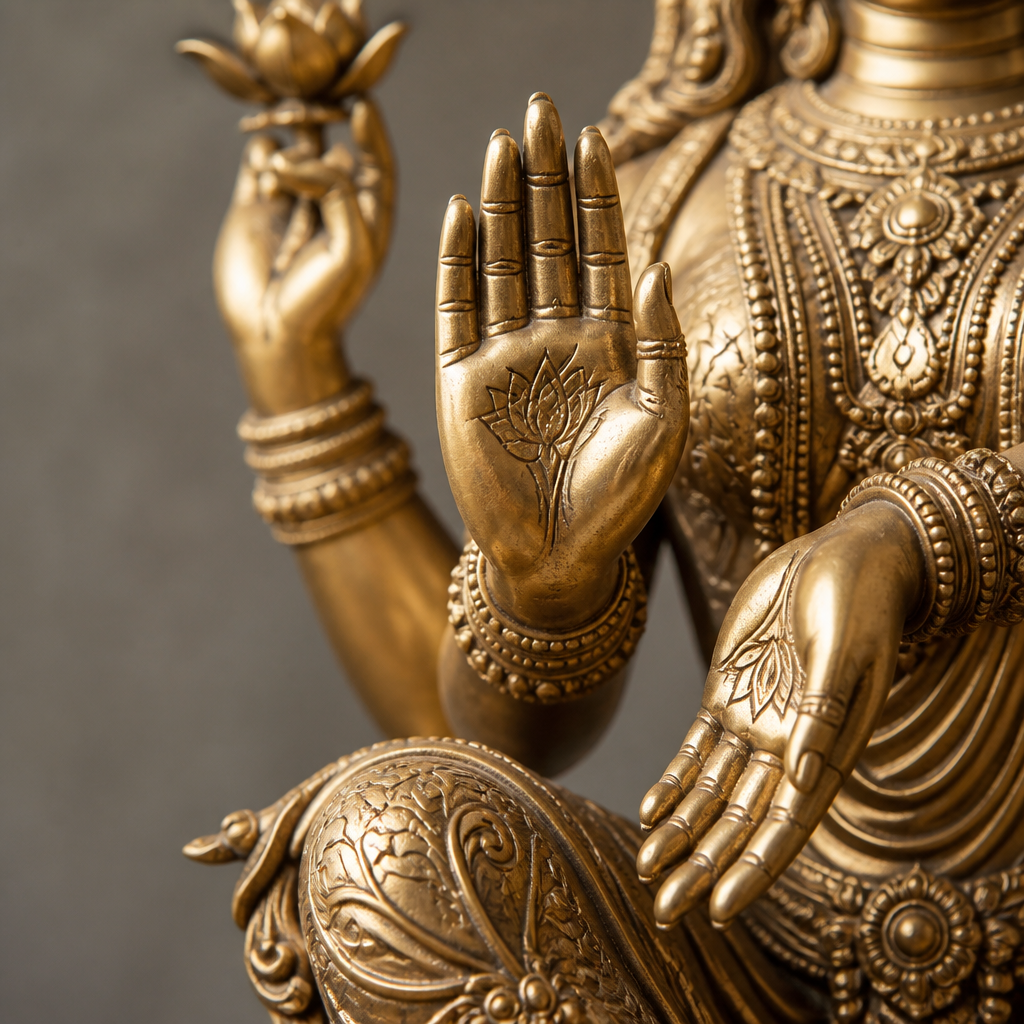
The Lotus: Purity, Detachment, and Spiritual Enlightenment
Lakshmi is almost always depicted either seated or standing on a fully bloomed lotus flower. The lotus represents purity, beauty, and spiritual enlightenment: it grows in muddy water and remains untouched by it, which directly mirrors the quality of Lakshmi's blessings. True prosperity, in the theological framework her iconography embodies, is not corrupted by greed but remains pure in origin and effect. She also holds lotus flowers in two of her hands and may wear a garland of lotus buds.
The lotus also carries the specific meaning of detachment. Her iconography teaches that one may live fully in the material world without being defined or trapped by it. This is why the lotus appears so consistently across every regional tradition: it is not an aesthetic preference, it is the theological core of the image.
The Varada Mudra and the Abhaya Mudra
Lakshmi's hands do more theological work than almost any other element of her figure. Her most recognisable gesture shows an open palm facing downward with gold coins cascading from it. This is the varada mudra, the gesture of bestowal, and it communicates both material wealth and spiritual generosity. Gold coins flowing from the palm signal that abundance moves outward from the goddess toward the devotee.
The abhaya mudra, an open palm raised to face the viewer, conveys protection and the dispelling of fear. When both gestures appear on a four-armed figure, the image is theologically complete in a way that a two-armed version simply cannot be. The gold coins that flow from her hand represent material wealth, but they also symbolise spiritual wealth. These are not the same thing, and the iconography holds both meanings simultaneously.
Number of Arms: Devotional Versus Aesthetic Purpose
Early Lakshmi images appear to have been two-armed. Over time, four-armed depictions became standard for votive and devotional contexts, while two-armed figures continued to serve aesthetic and classical purposes. This distinction matters when you are choosing a piece. A two-armed Lakshmi is not iconographically incorrect, but it signals a different function. If the piece is intended for active worship or as a devotional centrepiece for a home altar, a four-armed figure is the more complete choice.
Elephants: Strength, Royalty, and the Gaja Lakshmi Form
When elephants appear flanking Lakshmi and pouring water from golden vessels over her, this specific arrangement identifies the Gaja Lakshmi form. The elephants symbolise strength, wisdom, and royal power. The act of pouring water represents the constant flow of prosperity and the auspicious blessings of the heavens. White elephants, associated with Indra's mount Airavata, appear most commonly in this form. As Goddess Kamala, she is portrayed with four elephants performing the nectar ablution known as Abhishekam.
Pro tip: If you are placing a Lakshmi statue in a business context or space associated with material prosperity, the Gaja Lakshmi form is the most iconographically direct choice. The dual elephant arrangement is one of the most immediately legible symbols of abundant blessing in the entire Hindu sculptural vocabulary.
The Owl: The Absent Vahana
Unlike most Hindu deities, Lakshmi's animal vehicle, the owl, rarely appears in her sculptural iconography. The owl carries complex and sometimes contradictory symbolism: wisdom and vigilance on one hand, darkness and ignorance on the other. Because Lakshmi is primarily worshipped as a goddess of light, prosperity, and auspiciousness, her iconographic tradition consistently emphasises the more universally positive symbols, the lotus, the coins, and the elephants, rather than the owl. Do not be surprised when it is absent from a piece. Its absence is the tradition, not an omission.
The Eight Forms: Ashta Lakshmi and What They Look Like
The Ashta Lakshmi are the eight forms of Lakshmi, each governing a distinct domain of abundance. Collectors and practitioners who understand this framework can choose a specific form with deliberate theological intent, rather than buying a generic "Lakshmi figure."
The eight forms are: Adi Lakshmi (the primordial form, associated with compassion), Dhana Lakshmi (material and inner wealth, depicted with six arms including a discus, conch, bow and arrow, water pitcher, lotus, and the varada mudra with gold coins), Dhanya Lakshmi (agricultural abundance), Gaja Lakshmi (strength and royalty, flanked by elephants), Santana Lakshmi (the blessing of progeny), Veera Lakshmi (also called Dhairya Lakshmi, courage and fortitude), Vidya Lakshmi (knowledge and learning), and Vijaya Lakshmi (victory). Dhana Lakshmi is most commonly worshipped during Diwali and Dhanteras, while Gaja Lakshmi is the most widely reproduced in sculptural form.
Every element of a canonical Goddess Lakshmi sculpture is a deliberate theological statement. Once you learn to read them, you will never look at a Hindu deity statue the same way again.
When shopping for Hindu goddess statues, knowing which of the eight forms you are looking at changes the entire conversation. The number of arms, the specific objects held, and the presence or absence of elephants all point to one specific form rather than another. A retailer who cannot tell you which form a statue represents is selling you an object, not a piece with any depth behind it.
Regional Variations: How Geography Shapes the Goddess
Lakshmi worship spread across Asia along trade routes, and each regional tradition adapted her iconography to its own artistic vocabulary. The result is a group of sculptural traditions that share a theological core while diverging dramatically in aesthetic character. Understanding these differences is essential before you make a purchase decision.
South Indian Bronze: The Chola Standard
South Indian bronze Lakshmi figures from the Chola period (9th to 13th centuries CE) represent the high-water mark of Hindu sculptural tradition. These figures are characterised by sinuous, elongated proportions, heavy jewellery rendered in extraordinary detail, and a fluid quality in the drapery that no other tradition quite matches. Contemporary workshops in Tamil Nadu continue producing pieces using traditional methods, though quality varies significantly between workshops. The finest new bronzes in this tradition are genuinely museum-quality works, not souvenirs.
Black granite, the material favoured in Tamil Nadu temple traditions, is used for carved stone pieces and represents one of the most demanding craft processes in Hindu sculpture. Each stone piece is unique; unlike bronzes, which can be cast from the same mould multiple times, a stone carving cannot be duplicated.
North Indian Stone: Fuller Forms and Frontal Poses
North Indian Lakshmi sculptures in sandstone, schist, or marble show a markedly different aesthetic. The figures tend to be fuller, with wider hips and shoulders, heavier jewellery, and a more frontal, hieratic pose. Mathura school sculptures from the Kushana period (1st to 3rd century CE) are among the earliest clearly identifiable Lakshmi images in stone. Rajasthani marble Lakshmis continue this broader tradition and are often richly painted with mineral pigments.
The North Indian aesthetic favours weight and solidity. If South Indian bronzes feel dynamic and animated, North Indian stone figures feel grounded and permanent. Neither is superior; they express different theological emphases through different artistic means.
Nepalese Bronze: Fine Detail and Selective Gilding
Nepalese Lakshmi sculptures, typically cast in bronze using lost-wax techniques, emphasise intricate detail work with elaborate jewellery and frequently selective gold gilding. Artisans in the Kathmandu Valley are known for facial refinement and compositional balance. The Nepalese tradition prioritises ornamental density, crowns, armlets, necklaces, and ankle decorations that are rendered with a level of precision that reflects centuries of metalworking expertise.
Pro tip: When examining a Nepalese-style bronze, pay particular attention to the face. Workshops producing genuinely high-quality pieces invest heavily in facial modelling: the slight downward tilt of the gaze, the precision of the lips, and the treatment of the eyes distinguish a museum-quality casting from a production piece.
Khmer (Cambodian) Style: Architectural Restraint
Khmer sculpture gives Lakshmi a distinct presence that collectors often find initially surprising. Compared with the sinuous South Indian bronzes, Khmer forms tend to feel more architectural in stance and more restrained in surface rhythm. The figure appears calm, frontal, and subtly authoritative. Ornamentation exists, but it is more controlled; the visual weight is distributed differently, with the face and posture carrying more of the expressive burden than the jewellery.
This matters for collection-building. Mixing iconographic traditions without awareness can create visual inconsistencies that undermine an otherwise coherent altar or collection. If your primary Buddha statues are in the Thai or Cambodian style, adding a Khmer Lakshmi beside them is coherent because both traditions grew from the same Theravada and Brahmanical synthesis in mainland Southeast Asia. Placing a heavily ornamental Nepalese bronze in the same setting requires more considered composition.
Regional Style Markers to Look For
Across all traditions, regional style tends to show up in the same visual areas: how volume is distributed across the body (some traditions favour softer curves, others sharper linearity), how densely jewellery and crown detail is rendered, the quality of facial expression (serenity can appear gentle, regal, or abstracted depending on the tradition), and the form of the lotus base and throne. A Kashmir-influenced piece will feel different from a Nepalese stone carving even when both are iconographically correct. The theology holds across all traditions; the artistic accent changes.
Comparing Sculptural Traditions: A Practical Breakdown
|
Tradition |
Typical Material and Method |
Distinctive Visual Character |
|---|---|---|
|
South Indian (Chola style) |
Bronze, lost-wax casting (Panchaloha alloy in finest examples); also black granite for stone pieces |
Sinuous, elongated proportions; heavy jewellery in fine detail; fluid drapery; dynamic even when static. The most reproduced tradition and the quality benchmark for devotional bronzes. |
|
North Indian (stone traditions) |
Sandstone, schist, marble; carved rather than cast; Rajasthani marble sometimes painted with mineral pigments |
Fuller body with wider hips and shoulders; frontal, hieratic pose; heavier jewellery rendered in relief; a sense of solidity and permanence. Earlier than most surviving bronzes. |
|
Khmer / Southeast Asian |
Sandstone and bronze; forms shaped by Cambodian and broader Southeast Asian artistic conventions |
More architectural in stance; restrained surface ornament; calm and frontal; visual authority carried by posture rather than jewellery density. Coherent alongside Thai and Cambodian Buddhist sculpture. |
Choosing the Right Lakshmi Statue for Your Purpose
The right Lakshmi statue depends on three questions answered in order: What is the primary purpose? What tradition fits your existing context? What material serves that context best? Answering these in reverse order, starting with materials, produces mismatches that are expensive to correct.
For Devotional and Altar Use
If the statue is intended for active devotional practice, a home puja room, or a dedicated altar, iconographic completeness matters most. Choose a four-armed figure in the standard canonical form: lotus in the upper hands, varada mudra in the lower right, and the fourth hand in the abhaya mudra. If you follow a specific form of Lakshmi worship tied to Diwali or wealth blessing, Dhana Lakshmi or Gaja Lakshmi are the most theologically direct choices. Size matters too: a small figure placed at eye level works differently from a larger piece placed at floor level. The figure should be positioned so the deity's gaze meets the devotee's naturally.
For Art Collection and Display
Collectors focused on artistry and regional significance should prioritise regional coherence within their collection and invest in pieces where the craft is visibly exceptional. South Indian Chola-style bronzes remain the prestige choice for bronze collectors. Khmer and Southeast Asian pieces offer a different aesthetic that rewards close study of how the same theological template is expressed through radically different artistic means. Stone pieces, particularly black granite carvings, are genuinely unique objects that cannot be replicated.
For Home Decoration
Practitioners placing a Lakshmi statue in a living space rather than a formal altar still benefit from iconographic awareness. A figure with no lotus, no mudra, and no readable theological content is simply a figure. A piece that is both beautiful and iconographically correct serves the space better on every level, because it carries meaning that a purely decorative object cannot.
Material and Craft Quality: What Museum-Quality Actually Means
The phrase "museum-quality" is applied so broadly that it risks meaning nothing. In practice, when evaluating a buy Hindu statue decision, it refers to a specific set of standards: iconographic correctness, material integrity, casting or carving precision, and finishing quality that would withstand close scholarly scrutiny.
Bronze: Lost-Wax Casting and Why It Matters
Genuine lost-wax casting (known historically as the madhuchishta vidhana method) produces a mould from wax that is then destroyed in the casting process. No two pieces from the same original wax model are identical. This is categorically different from production casting, where the same metal mould is used repeatedly, producing identical pieces with softer edges and less detail. The distinction is visible: look at the sharpness of jewellery edges, the precision of facial features, and the quality of finishing work on the back of the figure. Production pieces typically show minimal finishing on the reverse. A properly cast, hand-finished bronze shows evidence of craft on all surfaces.
Panchaloha, the sacred five-metal alloy used in the finest South Indian bronzes, has a specific composition associated with the Chola temple tradition. Not all bronzes sold as "South Indian" use this alloy. A specialist retailer with genuine sourcing relationships can confirm material composition and workshop provenance; a generic marketplace seller typically cannot.
Stone: The Non-Replicable Object
Carved stone Lakshmi sculptures represent the most demanding craft process in this tradition. Each piece is inherently unique. The quality test for stone is different from bronze: look at the rendering of drapery folds, the treatment of the face, and whether the lotus base is carved as an integrated part of the figure or added separately. Integrated carving indicates a single stone, a more technically demanding and more authentic approach.
Pro tip: When evaluating any museum quality sculpture, ask the retailer specifically about the workshop and the region of origin. A retailer who can give you specific, verifiable answers about provenance is one who actually knows what they are selling. Vague answers like "handcrafted in India" tell you almost nothing useful about the quality of the piece.
Frequently Asked Questions
What are the most important symbols to look for in an authentic Lakshmi statue?
The lotus is the single most important element, either as a seat, in her hands, or as a base. Beyond that, the varada mudra (open palm with coins flowing downward) is her most theologically specific gesture. A statue missing both of these elements is not a canonical Lakshmi image. Secondary symbols include the number of arms (four for devotional pieces, two for aesthetic or classical works), the presence of elephants for the Gaja Lakshmi form, and a golden or jewelled crown appropriate to her royal status.
What is the difference between Gaja Lakshmi and the standard Lakshmi depiction?
Gaja Lakshmi is a specific form of the goddess identified by two flanking elephants pouring water from golden vessels over her. This arrangement directly symbolises the constant flow of abundance and the blessings of heaven. The standard Lakshmi depiction may not include elephants at all, or may include them in a non-active flanking arrangement. If elephants are present and actively pouring water, you are looking at the Gaja Lakshmi form specifically, not a general Lakshmi image with decorative elephants.
Is a South Indian bronze Lakshmi better than a North Indian stone one?
Neither is superior. They are distinct artistic traditions expressing the same theological content through different materials and aesthetic vocabularies. South Indian Chola-style bronzes are the most celebrated in terms of technical virtuosity and are widely regarded as the reference standard for Hindu bronze sculpture. North Indian stone figures offer a different quality of presence: solidity, weight, and frontality that bronzes rarely achieve. The right choice depends on your existing collection, your purpose, and which aesthetic resonates with you.
How do I know if a Lakshmi statue is genuinely museum-quality?
Genuine museum-quality pieces show specific characteristics: sharp jewellery edges and precise facial modelling in bronzes, which indicates lost-wax casting rather than production mould casting; integrated rather than added bases in stone pieces; evidence of hand-finishing on all visible surfaces, not just the front; and iconographic completeness, meaning all elements are present and correctly rendered. The retailer's ability to provide specific workshop provenance and material information is itself a quality signal. If the seller cannot tell you where the piece was cast and by whom, they do not know what they are selling.
Can I mix Lakshmi statues from different regional traditions in a single collection or altar?
Yes, but do it deliberately rather than accidentally. Mixing traditions without awareness creates visual inconsistencies that even non-specialists notice. The most coherent combinations are those that share a regional tradition: Thai and Khmer pieces work well together because they share the same Southeast Asian artistic synthesis. South Indian bronzes and Nepalese bronzes both sit within the Indian Subcontinent tradition and share enough visual grammar to coexist comfortably. The combination that requires the most compositional care is placing a heavily ornamental Nepalese piece beside a more restrained Khmer figure.
Where should a Lakshmi statue be placed in a home?
For devotional use, Lakshmi is traditionally placed facing east or north, positioned so her gaze meets the devotee at eye level during prayer. She should not be placed on the floor or in a bathroom. For collection display, placement should ensure the figure is seen from its intended viewing angle: most Lakshmi statues are designed to be viewed frontally, with the most finished surfaces facing forward. Good lighting that falls from above or slightly to the front reveals the detail work in bronze pieces and the surface quality of stone carvings. Avoid direct sunlight on painted stone pieces, which can fade mineral pigments.
Share your experience with Lakshmi statues in the comments below: which regional tradition resonates most with you, and what drew you to it?
References
-
Overview of Goddess Lakshmi's iconography, symbols, and their theological meanings
-
Guide to the sacred symbols associated with Goddess Lakshmi in Hindu tradition
-
The eight forms of Ashta Lakshmi and their distinct iconographic attributes
-
Lakshmi's legacy and symbolism across the history of Indian art
