



Indonesian Hindu-Buddhist Sculpture: Majapahit, Singhasari and East Java Style
Indonesian Hindu-Buddhist Sculpture: Majapahit, Singhasari and East Java Style
You're standing in front of a dark stone figure in a gallery, trying to decide whether its tall headdress suggests Majapahit, Singhasari, or merely a later reproduction. The label may offer a region and a broad date, but it rarely answers the questions a collector really has: what should the stone feel like, which details matter, and how can an object be acquired responsibly?
Indonesian Hindu-Buddhist sculpture rewards slow looking. East Java produced related but distinguishable artistic traditions, and the most useful comparison begins with securely catalogued objects in British museums. By placing Singhasari volcanic stone beside 15th-century Majapahit works, you can follow a developmental arc without treating every elongated figure or ornate crown as proof of a particular period.
Table of Contents
- Tracing the East Javanese Sculptural Arc
- Identifying the Hallmarks of the East Java Style
- The Singhasari Tradition and Volcanic Stone Mastery
- Majapahit Aesthetics and Ritual Objects
- Navigating Provenance and Repatriation Realities
- A Practical Framework for Collectors and Curators
Tracing the East Javanese Sculptural Arc
Begin in a UK museum gallery and resist the temptation to start with a label alone. Look at the weight of the stone, the direction of the figure's gaze, the treatment of jewellery, and the relationship between the body and its base. Museum objects make chronology tangible because their records preserve not only stylistic descriptions, but also acquisition histories and comparisons with related works.
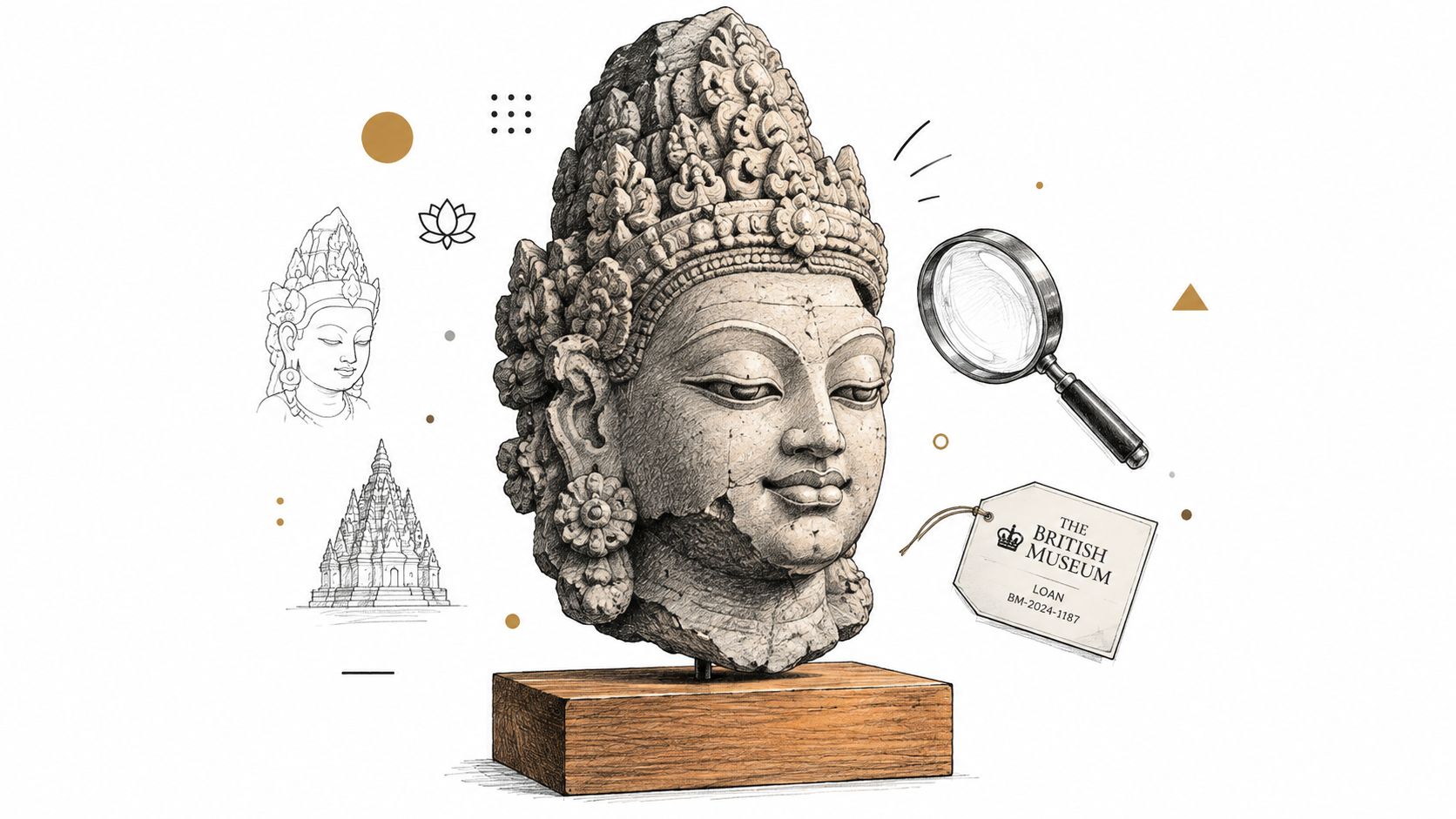
The Victoria and Albert Museum provides an important reference point for Majapahit-style sculpture from East Java. Its collection includes a monolithic Parvati recorded as “Majapahit style” and dated to the 15th century, as well as a monolithic guardian figure described as “Majapahit Style, East Java, Indonesia, ca. 15th century” in the V&A's catalogue record for a Parvati sculpture. These objects give collectors a securely dated museum context for the later East Javanese horizon.
A museum trail through East Java
One V&A altar relief provides an especially revealing connection between Java and Britain. The object is described as a stone altar slab in Majapahit style from East Java, and its record states that it entered the Royal Asiatic Society collection in 1832 as a gift from a resident of Surabaya, East Java. Its dating to the early 15th century places the relief within the same broad Majapahit period as the museum's other East Javanese works. The catalogue entry for the V&A altar relief turns a general story about collecting into a traceable object history.
The earlier horizon appears in the British Museum's collection. Its 50 cm volcanic-stone figure of the Buddhist goddess Māmakī came from Candi Jago, a site associated with Singhasari, and was taken by Sir Stamford Raffles in 1815. The museum record identifies the work as Māmakī and dates it to 1268–1280, making it a particularly valuable comparison with the later V&A pieces.
Curatorial rule: Treat museum records as anchors, not shortcuts. A stylistic resemblance can suggest a period, but a documented object history gives the comparison much greater weight.
This distinction is central to any study of Indonesian Hindu-Buddhist sculpture, Majapahit, Singhasari and East Java style. Singhasari belongs to an 11th to 14th-century East Javanese stone-sculpture tradition, while the securely dated Majapahit examples in UK collections belong mainly to the 15th century. For broader context, collectors can also consult this discussion of the Indonesian Buddhist sculpture legacy from Majapahit and Srivijaya, while keeping the museum catalogues as the primary dating references.
Identifying the Hallmarks of the East Java Style
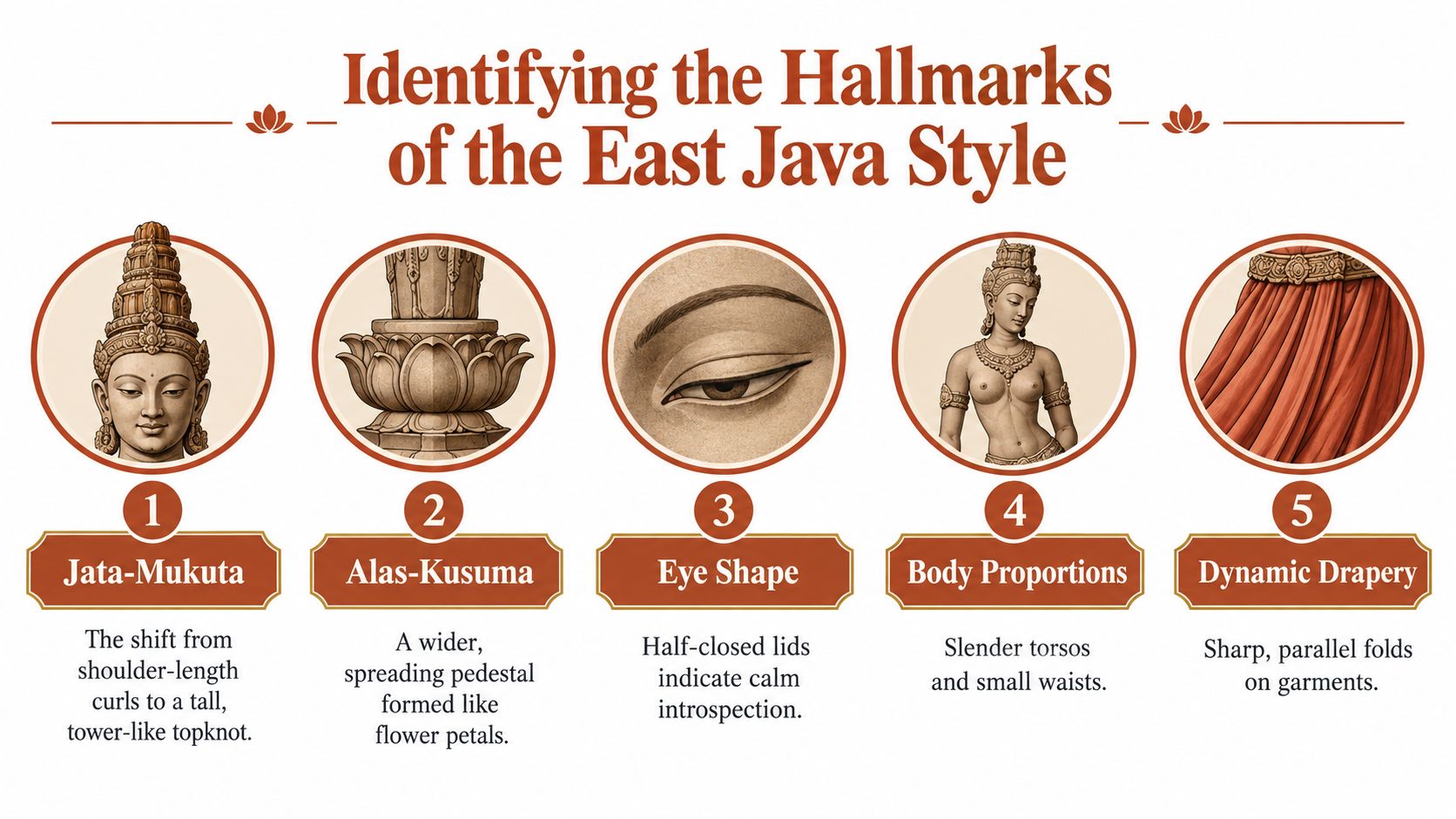
A collector first encounters East Javanese style through proportion and surface. The body may appear elongated, the headgear unusually tall, and the ornaments more densely arranged than on earlier Central Javanese examples. These are not decorative accidents. They form part of a stylistic development in which artists transformed inherited religious imagery into a more vertically organised and richly articulated visual language.
A scholarly overview of Indonesian art describes East Javanese style as developing from earlier Central Javanese forms. It identifies elongated bodies, taller headgear, denser ornaments, and the introduction of a third bracelet as characteristic features. The same overview says the style reached its apex in the late 10th or early 11th century, a point that needs careful handling because stylistic maturity and the later Singhasari or Majapahit political periods aren't interchangeable categories.
Read the figure from the crown downward
Start with the head. Taller headgear changes the silhouette, drawing the eye upward and giving the figure a more vertical presence. A collector should ask whether the headdress belongs coherently to the face, ears, neck, and shoulders, rather than treating height alone as a date marker.
Then examine the torso. Elongated bodies and small waists can create a graceful, almost weightless effect, but the best examples retain structural balance. Look for the way the shoulders, abdomen, hips, and legs connect. A figure that is merely stretched may imitate the outline without understanding the underlying design.
Jewellery deserves equal attention. Denser ornamentation may include layered necklaces, armlets, belts, pendants, and patterned textiles. The addition of a third bracelet is especially useful as part of a comparative checklist, although missing arms, surface loss, or later alteration can make the feature difficult to assess.
Use several markers together
No single feature proves a date or attribution. A disciplined reading combines the following:
- Headgear: Compare its height, construction, and relationship to the hair and face.
- Body proportions: Note elongation, waist size, shoulder width, and the balance of the limbs.
- Ornaments: Assess density without confusing later embellishment with original carving.
- Bracelets: Check whether the third bracelet survives and whether it belongs to the figure's visual system.
- Surface rhythm: Study folds, jewellery lines, and the transitions between smooth and detailed areas.
A useful comparison begins with the whole silhouette, then moves to the smallest surviving detail.
The visual checklist helps separate East Java style from a generic “Indonesian” label. It also protects against a common mistake: assigning a sculpture to Majapahit solely because it has a tall crown. The V&A's securely dated Majapahit works are valuable precisely because they provide comparative reference points, not because every similar-looking market object must share their date.
For a private collector, photography under strong directional light can reveal whether folds and bracelets are carved, abraded, repaired, or newly sharpened. Those observations don't replace specialist examination, but they create a useful record for discussion with a dealer, conservator, or museum curator.
The Singhasari Tradition and Volcanic Stone Mastery
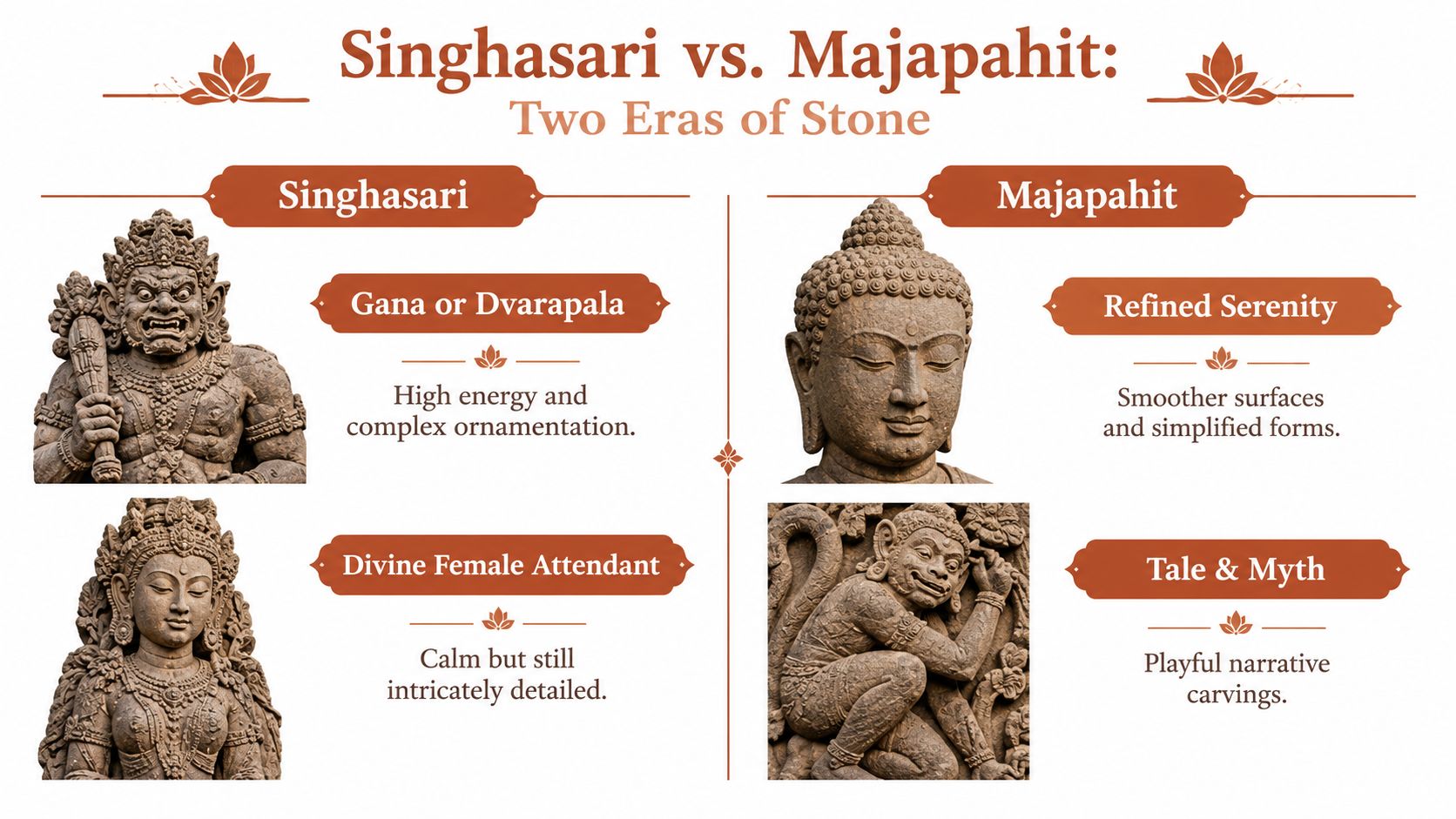
Singhasari sculpture should be approached through material, iconography, and date together. The tradition belongs within the long East Javanese sequence described by Cambridge as “Kediri and Singhasāri: Stone Sculpture from the Eleventh to the Fourteenth Century”. That chronology places Singhasari before the securely dated 15th-century Majapahit objects held by the V&A.
The British Museum's Māmakī offers a precise case study. The figure is carved from volcanic stone, measures 50 cm, and is dated 1268–1280. It came from Candi Jago and was taken from the site by Sir Stamford Raffles in 1815, facts recorded in the British Museum's object record for Māmakī.
Material is part of the argument
Volcanic stone gives Singhasari sculpture a particular physical authority. It can support durable carving while retaining details needed to identify a deity, including attributes, hand positions, throne forms, and ritual symbols. The surface may look severe when compared with bronze, but close inspection often reveals highly controlled transitions between the body, ornaments, and architectural base.
Māmakī is identified through her lotus attribute and her seated position on an oval lotus throne. These details aren't optional decoration. They help preserve the tantric and sectarian reading of the image, allowing a museum or scholar to distinguish a particular Buddhist goddess from a more general female divine figure.
Singhasari and Majapahit are not interchangeable
The comparison with Majapahit must remain chronological as well as visual. Singhasari's place in the 11th to 14th-century stone-sculpture sequence makes its volcanic-stone tradition an earlier horizon than the V&A's 15th-century Majapahit examples. A later sculpture may share East Javanese elegance, intricate ornament, or Buddhist-Hindu visual dialogue without being Singhasari.
| Question | Singhasari reading | Later Majapahit comparison |
|---|---|---|
| Historical horizon | 11th to 14th centuries | 15th-century museum examples |
| Material emphasis | Volcanic stone, with durable carved detail | Stone remains important, alongside ritual bronze |
| Identification | Attributes and throne forms support precise iconography | Broader mature East Javanese vocabulary |
| Collector's caution | Avoid confusing age with later stylistic imitation | Avoid calling every East Javanese figure Singhasari |
A useful introduction to related forms appears in this guide to Javanese Buddhist sculpture. For attribution, however, the strongest approach is comparative. Ask whether the material, iconography, carving quality, and documented history point in the same direction. If they don't, describe the object cautiously rather than forcing a confident period label.
Majapahit Aesthetics and Ritual Objects
The 15th-century Majapahit style appears in UK collections through figures that make the later East Javanese aesthetic accessible to close study. The V&A's monolithic Parvati and guardian figure show how sculptors could combine monumental presence with a highly organised decorative vocabulary. Their catalogue descriptions identify them as Majapahit style and place them in East Java, giving collectors a useful benchmark for shape, posture, and ornament.
From temple image to collectible object
Majapahit sculpture isn't limited to freestanding stone deities. The V&A altar relief is a stone altar slab in Majapahit style from East Java, and its documented history connects it with the Royal Asiatic Society and a gift from a Surabaya resident in 1832. Reliefs and altar elements remind us that religious art operated within architectural and ritual settings, rather than existing only as isolated gallery objects.
The same collection also records a Holy Water Vessel as a hanging ceremonial censor in bronze, described as Majapahit style and originating from East Java, Indonesia. It belongs to the South & South East Asia Collection and carries accession number IS.7-1994, as shown in the V&A-related object listing for the Holy Water Vessel. The object broadens the collector's field of vision from carved stone to ritual metalwork.
Bronze changes the reading experience. It permits suspended forms, openwork, handles, and moving or hanging components that would be difficult to achieve in a monolithic stone image. A vessel associated with ceremonial use should therefore be examined for attachment points, wear around suspended elements, interior residues, and signs of later repair, without assuming that any one surface mark proves ritual use.
A mature visual language
Majapahit aesthetics often reward attention to relationships. A serene divine face may sit above dense jewellery; a carefully arranged garment may contrast with a more animated narrative relief; a ritual bronze may depend on movement rather than frontal stillness. These objects belong to the same broad cultural environment, but they don't all communicate in the same way.
For collectors, that variety has a practical consequence. A smaller bronze can offer a more manageable entry into East Javanese material culture, while a stone figure or altar relief demands closer attention to scale, damage, mounting, and conservation. Neither format should be treated as automatically more authentic or historically important.
Material lesson: Stone records the discipline of mass and silhouette. Bronze reveals how ritual design can depend on suspension, attachment, and movement.
Compare the object's claim with its evidence. A dealer may describe a piece as “Majapahit-inspired”, “East Javanese”, or “15th-century Majapahit”. Those phrases carry different levels of certainty. A responsible catalogue should distinguish a securely documented historical object from a later work that borrows the visual language.
Navigating Provenance and Repatriation Realities
A museum acquisition history can look reassuring, but it isn't the same as a universal guarantee that every related object is ethically clear. The V&A altar relief has a documented path into the Royal Asiatic Society collection in 1832, while the British Museum records that Māmakī was removed from Candi Jago by Raffles in 1815. These histories should be read in their colonial context, not treated as neutral stamps of approval.
Recent reporting states that the Netherlands returned four 13th-century Singasari statues and hundreds of other Indonesian objects. The same reporting says that Indonesia has not formally started talks with British authorities about artefacts held in the British Museum, leaving open questions around future provenance reviews, loans, and repatriation discussions. Collectors should follow developments through the report on Indonesian treasures returned from the Netherlands, while recognising that an unresolved diplomatic question isn't proof of a claim against any particular object.
Separate documented history from assumptions
A secure acquisition history should identify previous owners, dates, locations, invoices, export documents, and publication or exhibition records where available. “Old collection” is not enough. Nor is an attractive patina, a familiar style, or a dealer's confidence.
Ask for the full provenance file before committing funds:
- Ownership sequence: Who held the object, and when did it change hands?
- Export history: Which country issued export permission, if applicable?
- Publication record: Has the object appeared in a catalogue, exhibition, or scholarly reference?
- Condition history: Are repairs, replacements, and restored surfaces recorded?
- Legal review: Has the seller checked relevant cultural-property and customs requirements?
The distinction matters for institutions as well as private buyers. Museums must also consider how objects are stored, displayed, monitored, and protected. Guidance on secure museum exhibits can help institutions think about physical protection alongside ethical documentation, especially when a display combines vulnerable stone, bronze, and fragile architectural fragments.
Ethical confidence requires restraint
Repatriation discussions don't make every British-held object illegitimate, just as a long UK provenance doesn't remove the need for scrutiny. Collectors should avoid buying objects that cannot be explained in plain terms. If the seller refuses to disclose an ownership chain or treats provenance questions as an inconvenience, walk away.
A fuller discussion of responsible acquisition appears in this legal and ethical guide to collecting Southeast Asian art. The practical standard is straightforward: buy the object whose history can be examined, not merely the object whose appearance is persuasive.
A Practical Framework for Collectors and Curators
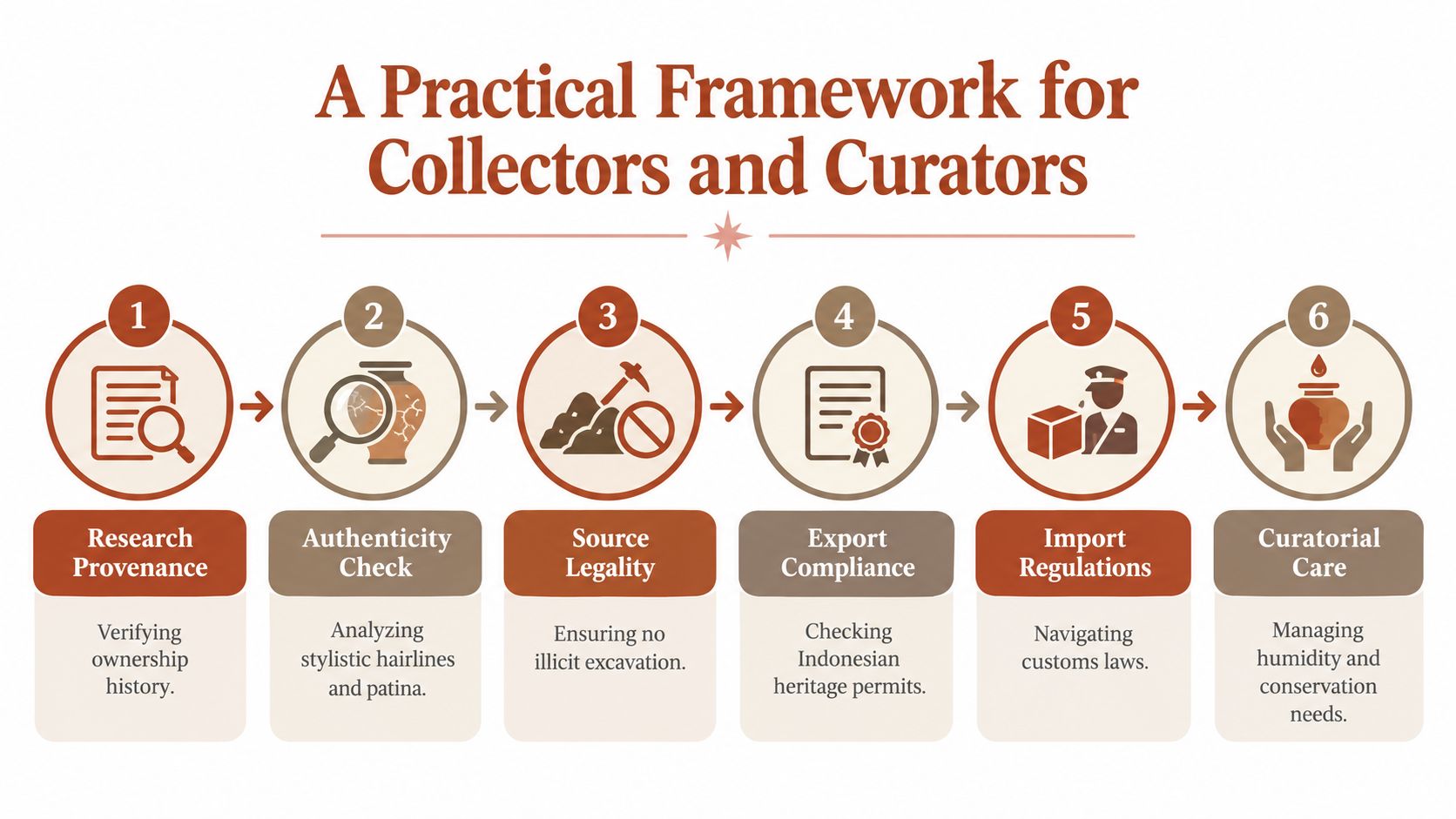
A good acquisition file begins before the object enters your home or gallery. Start with the photograph, catalogue description, measurements, material, condition, and seller's stated date. Then test each claim against the visual evidence and the documentary record.
Six questions to ask in order
-
What is the material?
Identify volcanic stone, another stone type, bronze, or a combination of materials. Material doesn't establish a date by itself, but it determines which technical comparisons make sense. A Singhasari attribution should be tested against the object's handling of volcanic stone, while a Majapahit ritual object may require close study of bronze construction. -
What does the style show?
Check the silhouette, headgear, body proportions, ornament density, bracelets, garment folds, and base. Record observations before accepting the seller's terminology. The third bracelet and elongated East Javanese proportions are useful evidence, but neither should stand alone. -
Can the iconography be read?
Identify attributes, gestures, throne forms, companions, and ritual implements. Māmakī's lotus attribute and oval lotus throne demonstrate why iconographic details matter. If parts are missing, use a qualified description such as “female Buddhist figure” rather than assigning a precise deity without support. -
Is the condition honestly described?
Ask whether the surface has been cleaned, recoloured, consolidated, rebuilt, or mounted. Examine joins and breaks under magnification. Freshly sharpened details can make a later or heavily restored object appear older than it is. -
Does the provenance survive scrutiny?
Request invoices, ownership records, export papers, photographs, and previous catalogue entries. A pre-1970 document can be useful evidence, but no single year creates automatic legitimacy. The complete sequence matters more than one attractive piece of paperwork. -
What will responsible care involve?
Plan the mount, handling method, display position, lighting, environmental monitoring, and security before purchase. Stone can suffer from unsuitable mounting and repeated movement, while bronze may require careful attention to corrosion and surface deposits. A conservator's advice is particularly important for damaged or assembled works.
Build an evidence-led comparison
Use the V&A and British Museum records as comparison points, not templates to imitate. The V&A's early 15th-century altar relief and 15th-century Majapahit figures help establish a later East Javanese horizon. The British Museum's Māmakī offers an earlier Singhasari reference with documented material, iconography, site association, and dating.
A private collection can remain modest and still be rigorous. One well-documented bronze, relief, or stone figure is more valuable intellectually than a room of objects whose origins cannot be explained. If you need a specialist marketplace to compare regional categories, deity types, and materials, HD Asian Art offers curated Indonesian, Hindu, Buddhist, Southeast Asian, and Majapahit-related pieces alongside educational resources for collectors.
Acquisition standard: If the seller can't answer what the object is, where it came from, and why the attribution is plausible, the correct next step is further research, not a deposit.
Use a written checklist, keep every document, and ask an independent specialist to review important purchases. That habit protects your finances, respects Indonesian cultural heritage, and allows the sculpture to remain meaningful long after the excitement of acquisition has passed.
If you're ready to compare East Javanese stone and bronze works with provenance and iconography in mind, explore the curated selections at HD Asian Art. Use the site's regional, material, and deity categories to narrow your search, then contact the team for further details before acquiring a piece for a private collection, institution, or interior.
