



Incorporating Buddhist Mudras into Yoga Practice: A Guide
Incorporating Buddhist Mudras into Yoga Practice: A Guide
Table of Contents
- What Are Buddhist Mudras and Why They Matter in Yoga
- The Benefits of Yoga Mudras for Body and Mind
- How to Practice Dhyana Mudra for Deep Meditation
- A Yoga Mudra Sequence for Beginners
- Integrating Mudras with Pranayama and Asana
- Common Mistakes and Modifications When Incorporating Buddhist Mudras into Yoga Practice
- Frequently Asked Questions
What Are Buddhist Mudras and Why They Matter in Yoga
Buddhist mudras are hand gestures used in spiritual practice to shape the flow of energy and focus the mind. In yoga, they turn an ordinary seated pose into a deliberate act of attention.
At HD Asian Art, we work with collectors and practitioners who want their practice spaces to feel intentional. A statue on your altar and a gesture in your hands do the same job: they anchor the mind.
Most guides treat hand positions as decoration. That misses the point.
The hands are one of the few parts of the body you can hold still for a long time without strain. That stillness gives the mind something to rest on. National Center for Complementary and Integrative Health overview of meditation and mind-body practices notes that focused attention practices are among the most studied forms of meditation.
The Origins of Hand Gestures in Buddhist Practice
Hand gestures appear across Buddhist traditions, from early Indian art to later Tibetan and Southeast Asian practice. They carry meaning in three ways:
- Teaching - a gesture shows what the Buddha was doing when a story took place
- Meditation - a gesture sets the tone for a seated session
- Devotion - a gesture expresses reverence without words
Statues preserve these gestures in bronze, stone, and wood. A figure with hands resting in the lap is teaching stillness. A raised palm is teaching reassurance.
That is why serious practitioners often keep a sculpture nearby. The gesture is a reminder you can see.
The Benefits of Yoga Mudras for Body and Mind
The benefits of yoga mudras come from two places: what the hands do to your attention, and what your attention does to your body.
Many practitioners report the same handful of effects:
- Steadier focus during seated practice
- A calmer emotional state before meditation
- Less restlessness in the hands and shoulders
- A clearer sense of when a session has actually begun
None of this is magic. The gesture works because it gives the mind a small, repeatable task. Small tasks calm busy minds.
How Mudras Regulate the Nervous System
Slow, deliberate hand positions pair naturally with slow breathing, and slow breathing is what shifts the nervous system toward calm. Harvard Health overview of relaxation techniques and the stress response explains that controlled breathing is one of the most reliable ways to calm the body's stress response.
The mechanism is simple. Long exhales signal safety. Still hands reduce fidgeting, and fidgeting feeds arousal.
Put the two together and you get a settled state that is easier to enter each time you practice.
How to Practice Dhyana Mudra for Deep Meditation
Dhyana mudra is the gesture of meditation: both hands resting in the lap, right hand over left, palms up, thumbs lightly touching.
Here is how to practice dhyana mudra in five steps:
- Sit in a comfortable cross-legged or chair position with a tall spine
- Rest your hands in your lap, palms facing up
- Place the right hand on top of the left
- Touch the thumbs together, forming a soft triangle
- Let the shoulders drop and close the eyes
Expected result: Within a few minutes, the hands stop fidgeting and the breath slows on its own.
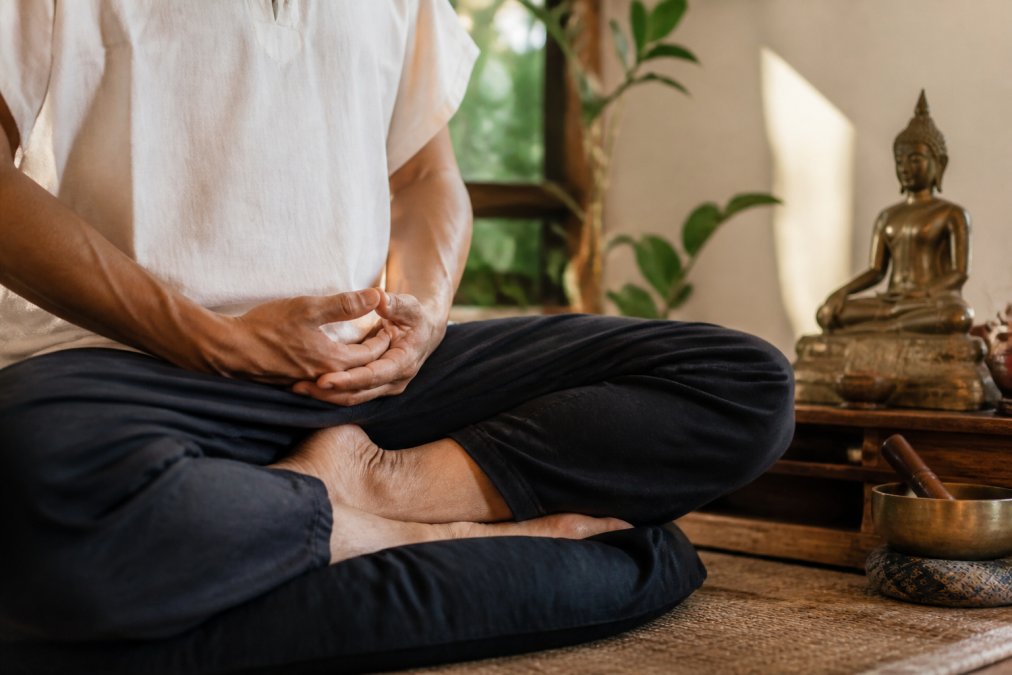
A common mistake is pressing the thumbs together hard. Keep the contact light. Tension in the thumbs travels straight up into the shoulders.
A Yoga Mudra Sequence for Beginners
A yoga mudra sequence for beginners should be short, ordered, and easy to repeat. This one takes about ten minutes.
- Settle - sit tall, hands on knees, five slow breaths
- Dhyana mudra - hands in the lap, three minutes of quiet breathing
- Anjali mudra - palms together at the chest, one minute, to mark intention
- Return to dhyana mudra - two minutes, letting the breath lengthen
- Release - hands to knees, open the eyes slowly
Keep the same order every time. A fixed sequence removes decisions, and decisions are what break a habit.
Integrating Mudras with Pranayama and Asana
Most guides tell you to add a mudra to your existing practice and leave it there. The more useful question is which mudra fits which style of yoga, because a gesture that works beautifully in a slow Yin hold will feel out of place in a fast Vinyasa flow.
Here is how to match the gesture to the practice.
For Vinyasa and Flow Styles
In a flowing practice, the hands are rarely still, so a seated lap mudra does not fit. Instead, use gestures that ride along with the movement:
- Anjali mudra at the top of a sun salutation, palms together at the chest, to mark the transition
- Open-palm gestures during standing poses, letting the fingers spread rather than curl
- A brief dhyana mudra only during the final seated cool-down, when the hands finally stop
The rule in a flow is simple: the gesture should not interrupt the breath rhythm. If holding a shape forces you to hold your breath, drop the gesture and pick it up again in the seated portion.
For Yin and Restorative Styles
Yin is where mudras earn their keep, because the hands are already still for three to five minutes at a time. This is the natural home for the classic seated gestures:
- Dhyana mudra during long forward folds and seated twists
- Anjali mudra during a supported backbend, palms at the heart
- Chin mudra (thumb and index finger touching, other fingers extended) during any long hold where you want the mind alert rather than sleepy
Because Yin holds are long, this is also where hand fatigue shows up first. Rest the hands on a folded blanket or block if the arms start to ache, and switch the gesture halfway through the hold if you need to. Cultivating this physical ease creates the necessary stillness to start a spiritual practice that extends far beyond the duration of your mat work.
For Hatha and Slow Classical Styles
Hatha sits between the two. The pace is slow enough for seated gestures but active enough that you can move between them:
- Begin standing with anjali mudra to set intention
- Move through a short standing sequence with open hands
- Settle into a seated pranayama practice and add chin mudra once the breath is steady
- Close in dhyana mudra for the final few minutes
The Order That Actually Works
The sequence across all three styles follows the same logic:
- Move first, to loosen the hips and spine
- Sit and settle the breath, lengthening the exhale
- Add the hand gesture once the breath is steady, not before
Order matters because the gesture is a focal point, and a focal point only works when there is something for it to land on. Place the hands before the breath is steady and the mind has nothing to settle into yet.
A Note on Gaze and Focal Point
In all three styles, a physical focal point at eye level, a sculpture, a candle, a small object on a shelf, gives the gaze somewhere soft to rest. This is often easier on the eyes than closing them completely, especially in longer holds where closed eyes can drift toward sleep.
Common Mistakes and Modifications When Incorporating Buddhist Mudras into Yoga Practice
The biggest mistakes when incorporating Buddhist mudras into yoga practice are all about pace and pressure.
- Gripping too hard - the hands should feel light, never tense
- Chasing sensations - expecting heat, tingling, or energy on day one
- Skipping the breath - a gesture without slow breathing is just a hand position
- Changing gestures weekly - depth comes from repetition, not variety
- Ignoring discomfort - numbness in the fingers means you are pressing too long
Modifications are easy. Rest your hands on a cushion if your arms tire. Use one hand if the other is injured.
Frequently Asked Questions
Can beginners easily incorporate mudras into their daily yoga practice?
Yes. Start with one or two gestures, such as dhyana mudra or anjali mudra, and hold them for five to ten breaths during seated meditation or savasana. Beginners do not need perfect finger placement to benefit. Consistency matters more than precision, so practice the same gesture daily for a week before adding another. A short yoga mudra sequence for beginners takes only five minutes and fits easily into an existing routine.
What are the most common Buddhist mudras used in yoga?
The most common include dhyana mudra (meditation), anjali mudra (prayer or greeting), vitarka mudra (teaching or discussion), and bhumisparsha mudra (earth-touching, representing grounding and resolve). Each appears in Buddhist art and translates naturally into seated yoga practice. Dhyana and anjali mudras are the easiest starting points because the hand positions are simple to hold for longer periods without strain.
How do mudras influence energy flow during yoga?
In yogic tradition, the hands contain nerve endings that connect to the subtle body and its energy channels, called nadis. Specific finger placements are believed to direct prana, or vital energy, toward different areas of the body and mind. Modern practitioners often describe the effect as improved focus and a calmer emotional state. Whether you approach it through tradition or physiology, pairing mudras with pranayama breathing makes the effect more noticeable.
Who should avoid practicing yoga mudras?
Anyone with hand injuries, arthritis, or recent surgery on the fingers or wrists should modify or skip mudras that require sustained pressure. Pregnant practitioners and those with high blood pressure should avoid mudras paired with breath retention. If a gesture causes pain or numbness, release it immediately. Consult a healthcare provider before adding mudra practice if you have a medical condition affecting circulation or nerve function.
