



Durga Statue Guide: Hindu Goddess Sculptures Explained
Durga Statue Guide: Hindu Goddess Sculptures Explained
Most people encountering a Durga statue for the first time see a beautiful multi-armed woman mounted on a lion and assume the imagery is purely decorative. It is not. Every attribute she carries, every arm she raises, and every creature beneath her feet encodes a specific theological statement about the nature of divine power in Hindu thought.
If you are collecting Hindu goddess sculpture seriously, or selecting a piece for a home altar, understanding that iconographic language is what separates a meaningful acquisition from an expensive ornament.
Table of Contents
- Quick Takeaways
- Who Is Durga? The Goddess Behind the Sculpture
- Iconography of Durga Statues: Reading What You See
- Regional Styles of Devi Sculpture Across Asia
- Durga and Her Forms: Parvati, Kali, and the Devi Tradition
- Choosing a Durga Statue: Material, Scale, and Placement
- Comparing Approaches to Hindu Goddess Sculpture
- Frequently Asked Questions
- References
Quick Takeaways
|
Key Insight |
Explanation |
|---|---|
|
Durga's multiple arms are not decorative excess |
Each arm holds a specific weapon or symbol received from a different deity, representing the combined power of the entire Hindu pantheon channelled into one goddess. |
|
The lion or tiger mount signals active power |
Her vehicle (vahana) is always a predatory animal, distinguishing her from gentler goddess forms and emphasising her role as a warrior protector. |
|
Durga is the Supreme Being in Shaktism |
Within the Shakta tradition, Durga is not a subsidiary deity but the Para Brahman, the absolute. This informs why her statues are treated as focal points of worship, not merely as art objects. |
|
Regional sculptural traditions differ significantly |
A South Indian bronze Durga, a Cambodian stone Devi, and an Indonesian relief carving reflect entirely different aesthetic canons, even when depicting the same goddess. Knowing the regional tradition helps you assess authenticity and quality. |
|
The word "Durga" means fort in Sanskrit |
That etymology matters for placement decisions. She is a protective force, making her an appropriate deity for a home or studio entrance rather than only an interior altar. |
|
Durga's forms include Parvati and Kali |
If you are building a collection around the divine feminine, recognising that Parvati statues and Kali figures are understood as aspects of the same Devi tradition gives your collection theological coherence. |
|
Mahishasuramardini is the most common sculptural narrative |
Durga slaying the buffalo demon Mahisha is the single most frequently depicted scene in Devi sculpture across South and Southeast Asia, and understanding it is essential for reading any major piece correctly. |
Who Is Durga? The Goddess Behind the Sculpture
Durga is one of the most significant deities in Hinduism, and within the Shakta tradition she holds the position of supreme reality. She is the goddess of power, strength, protection, and motherhood, and she governs creation, preservation, and destruction. The Sanskrit root of her name means "fort," which is precisely how her devotees understand her: an inviolable stronghold against forces of chaos and evil.
Her primary texts include the Devi Mahatmya, the Devi-Bhagavata Purana, and the Shakta Upanishads. If you want to understand why a particular sculptural attribute appears where it does, reading even a summary of the Devi Mahatmya is more useful than any collector's guide.
She is also known by a range of names, including Mahishasura-mardini (slayer of the buffalo demon), Chandika, Ambika, Bhavani, and Adi Parashakti. Each name corresponds to a specific aspect or episode, and sculptors across centuries have depicted each of them. When you encounter a Hindu goddess sculpture and are unsure which form is represented, the name-attributes are your decoding tool.
The iconographic complexity of Durga is not a puzzle to be solved but a theology to be read. Each element in a well-made sculpture is intentional and corresponds to doctrinal meaning that stretches back over two thousand years of living tradition.
Her festivals include Durga Puja, Navaratri, and Vijayadashami. These celebrations are not peripheral to her identity: they are the context in which her larger sculptural forms are commissioned, installed, and ritually dissolved. Understanding the festival cycle gives collectors a deeper appreciation for why certain poses and compositions recur.
Iconography of Durga Statues: Reading What You See
A well-executed Durga statue is a structured visual argument, not a decorative arrangement. Once you know the grammar, you can read any piece in seconds and know immediately whether a sculptor understood their subject or was working from a corrupted model.
The Arms and Their Weapons
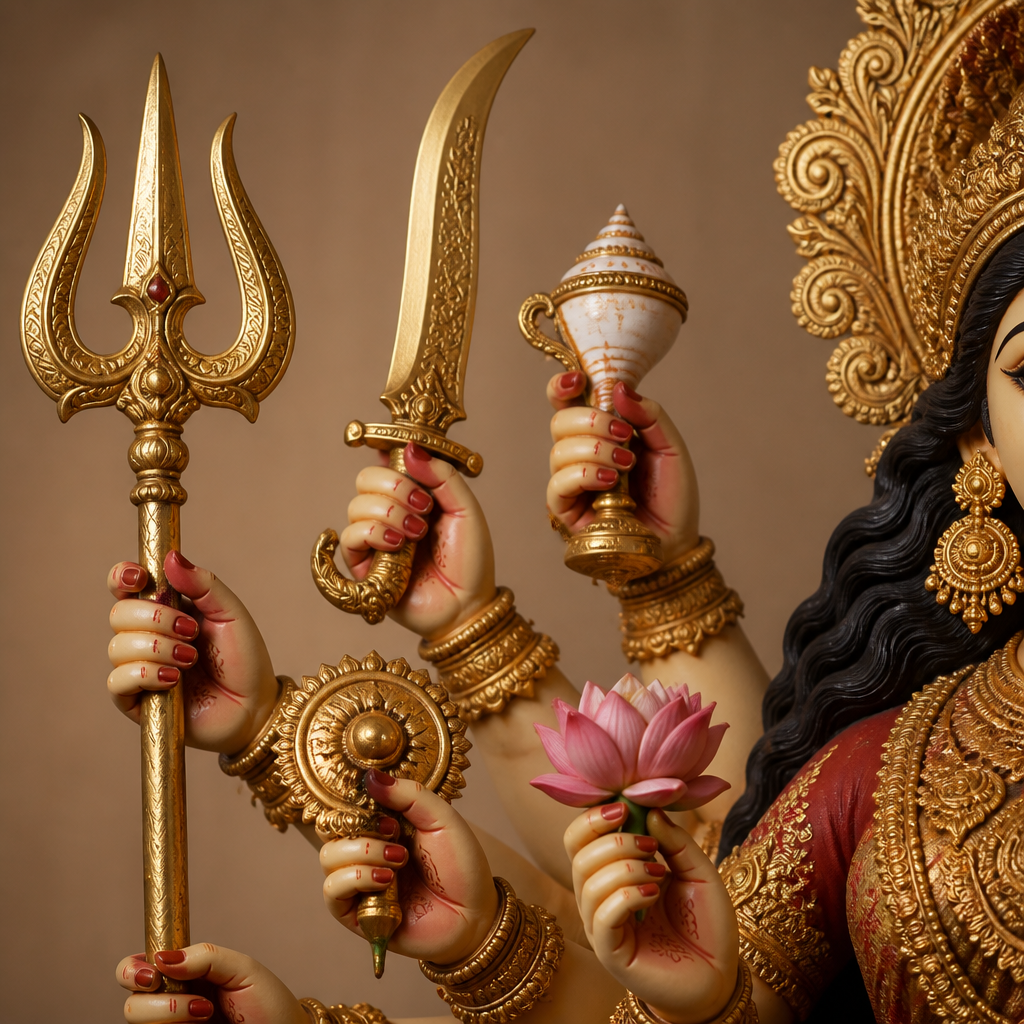
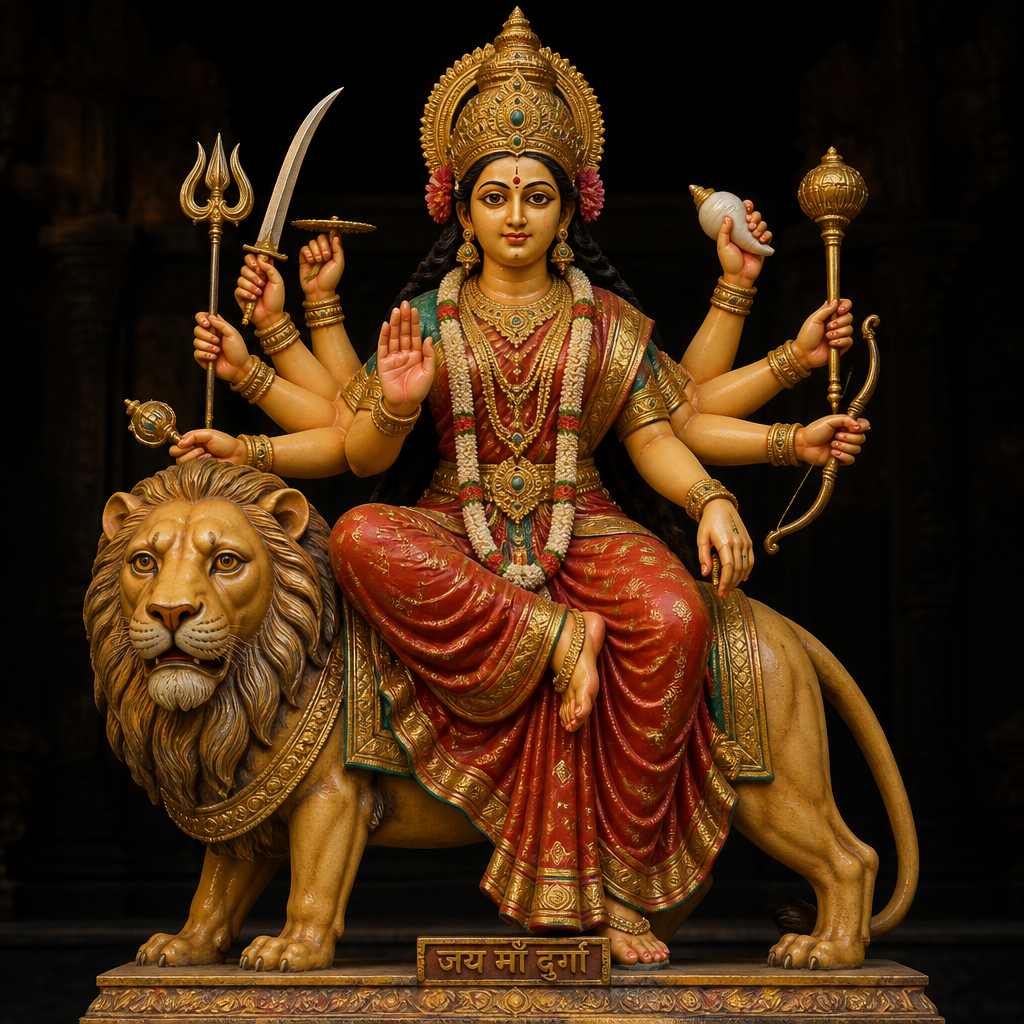
Durga is most often depicted with eight or ten arms, though forms with four, twelve, or eighteen arms exist in different regional traditions. The weapons she carries include the chakra (discus), trishula (trident), gada (mace), bow and arrow, and a sword. Each of these was given to her by a different god, which is the theological point: she concentrates the power of the entire male pantheon. A statue missing key weapons is either depicting a specific lesser-known form or is iconographically incomplete.
The hand positions (mudras) matter as much as the weapons. An abhaya mudra, palm facing outward, signals protection and reassurance. A varada mudra, palm facing down with fingers extended, signals the granting of boons. Both can appear simultaneously across different pairs of hands.
The Lion or Tiger Mount
Durga's vahana is always a lion or tiger. This is not interchangeable decoration. The predatory mount signals active, martial divine energy. In contrast, Saraswati rides a swan and Lakshmi is associated with the lotus: both images of receptive, gentle power. Durga's mount marks her immediately as a goddess of combat and protection.
The Mahishasuramardini Composition
The single most common narrative scene in Devi sculpture across South and Southeast Asia is Mahishasuramardini, Durga defeating the buffalo demon Mahisha. In this composition, Durga stands or rides above a defeated buffalo, often with a demon figure emerging from it. Her spear or trident typically pierces the demon. Relief carvings of this scene have been found across India and as far as Indonesia, including pieces dating to the 9th and 10th centuries.
When you see this composition, you are looking at the central mythological event of the Devi tradition. It is the visual equivalent of the crucifixion in Christian art: its recurrence is not repetition but emphasis.
Pro tip: If you are evaluating a Mahishasuramardini sculpture, look at the treatment of the buffalo demon's face. In skilled pieces, even the defeated figure is rendered with care. Poorly cast or carved reproductions often reduce the demon to a shapeless mass, which tells you the craftsperson was copying a model without understanding it.
Regional Styles of Devi Sculpture Across Asia
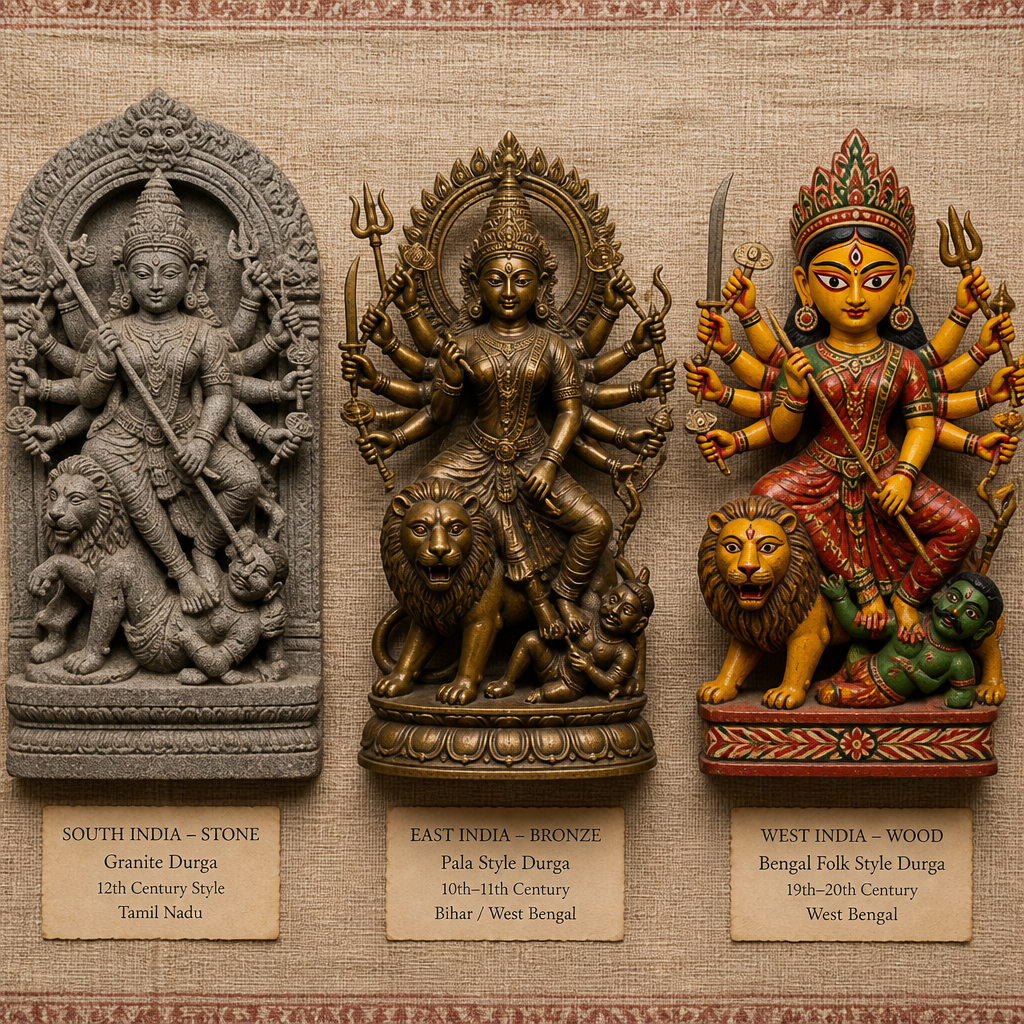
The Devi sculpture tradition spread from the Indian subcontinent across Southeast Asia, and each region developed its own aesthetic conventions while preserving the core iconographic framework. A collector who treats all Hindu goddess sculpture as a single category is missing the most interesting part of the field.
South Indian Bronze Tradition
The Chola bronze tradition of South India produced some of the most technically accomplished Durga and Devi sculptures ever made. These figures are typically cast using the lost-wax method, with sinuous postures, finely detailed jewellery, and precisely articulated facial features. The bronzes produced in this tradition set the standard against which later Devi sculpture is often measured. Contemporary South Indian bronzes in this style remain among the most sought-after pieces for serious collectors.
North Indian Stone Carving
In North India, stone temples produced relief carvings of Durga that prioritised narrative over individual beauty. The figures are often more dynamically posed and compositionally complex than their southern bronze counterparts, because stone carving allowed for multi-figure scenes in a way that casting does not. The Vindhyachal region, one of Durga's traditional abodes, has been a centre of her worship for centuries and has its own regional sculptural vocabulary.
Southeast Asian Interpretations
Hindu religious art was carried to Indonesia, Cambodia, and other parts of Southeast Asia through trade and cultural exchange. Indonesian Devi sculptures from the 9th and 10th centuries show a fusion of Indian iconographic structure with local aesthetic preferences, typically featuring rounder facial features and distinctive headdress styles. Cambodian Devi figures from the Khmer tradition are among the most refined sculptural works in the world, characterised by a serene facial expression known as the Khmer smile, and an understated elegance entirely different from the more elaborate South Indian forms.
At HD Asian Art, the collection spans multiple regional traditions, which means you can compare these styles directly rather than relying on descriptions alone. That comparative access is genuinely useful for collectors building a thematic collection around the divine feminine.
Durga and Her Forms: Parvati, Kali, and the Devi Tradition
One of the most common points of confusion for collectors new to divine feminine Hindu art is the relationship between Durga, Parvati, Kali, Lakshmi, and the broader category of Devi. These are not entirely separate goddesses in the way that, say, Apollo and Athena are separate Greek deities. They are better understood as aspects, manifestations, or forms of a single divine feminine principle.
Parvati: The Nurturing Form
Parvati is the spouse of Shiva and one of the most widely depicted goddesses in Hindu art. She is associated with love, devotion, and the domestic sphere. A Parvati statue typically shows a serene, beautifully adorned woman, often depicted with Shiva or with their children Ganesha and Kartikeya. She holds two or four arms, far fewer than Durga's martial forms. In the Shakta understanding, Parvati is the same Devi as Durga, expressing a different mode of power: nurturing and relational rather than combative and protective.
For collectors who find the multi-armed warrior iconography of Durga overwhelming, Parvati offers an entry point into the same theological tradition through a gentler visual vocabulary.
Kali: The Fierce Form
Kali is the most intense of Durga's manifestations. She is dark-skinned, tongue extended, garlanded with severed heads, and standing or dancing on the prone body of Shiva. To a viewer unfamiliar with the tradition, Kali sculpture can appear terrifying. Within the tradition, she represents time, transformation, and the dissolution of ego. Durga is sometimes described as taking the form of Kali in the heat of battle, when her rage outstrips her other forms.
Kali statues require more contextual knowledge to place well in a home or collection. They are not appropriate for every altar context, and serious practitioners are usually very specific about whether they are drawn to Kali's fierce aspect or to a gentler Devi form.
The Coherence of a Devi Collection
A thoughtfully built collection around the divine feminine Hindu tradition might include a Durga in Mahishasuramardini pose, a Parvati in a serene standing form, and a Kali in a standing or dancing composition. These three pieces together tell the complete story of the Devi tradition: protective power, nurturing love, and transformative fury. That narrative coherence is what distinguishes a collection from an accumulation.
Pro tip: When pairing Durga and Parvati statues on the same altar or display surface, match the regional sculptural tradition if possible. A South Indian bronze Durga alongside a North Indian stone Parvati creates an aesthetic dissonance that detracts from both pieces. Consistency of regional style creates visual and theological harmony.
Choosing a Durga Statue: Material, Scale, and Placement
The material a Durga statue is made from affects not just its appearance but its durability, its ritual appropriateness in some traditions, and, frankly, its long-term value as a collected object.
Bronze and Brass
Bronze and brass are the dominant materials for high-quality Devi sculpture intended for home altars or serious collections. Bronze develops a patina over time that adds to its visual depth. Brass is slightly more affordable and holds fine detail well. Both are appropriate for ritual use and are easy to maintain. Lost-wax cast bronzes from traditional South Indian workshops are the benchmark of quality in this material.
Stone
Stone sculptures, whether sandstone, granite, or black stone, have the advantage of age: the oldest surviving Devi sculptures are carved stone. Stone pieces are typically heavier and less portable than bronze, making them better suited to permanent installation. If you are creating a garden shrine or a fixed altar space, a stone Durga or Devi figure can be an excellent choice.
Scale and Placement
The word "durga" means fort, and that etymology should inform placement. She is a protective goddess, making the entrance of a home, studio, or meditation space a natural location. Larger sculptures (above 60cm) command a dedicated space and should not be crowded by other objects. Smaller statues (under 30cm) are versatile for desk or shelf placement but should still be positioned at or above eye level when possible, which is both a matter of visual respect and aesthetic proportion.
Comparing Approaches to Hindu Goddess Sculpture
|
Approach |
Best For |
Key Consideration |
|---|---|---|
|
Single iconic Durga in Mahishasuramardini pose |
Collectors and spiritual practitioners who want one definitive piece that encapsulates the entire Devi tradition |
Composition complexity demands skilled craftsmanship. A poorly executed Mahishasuramardini is worse than a simpler, well-made standing Durga. |
|
Devi trinity: Durga, Parvati, Kali |
Serious collectors building a thematically coherent divine feminine collection |
Regional stylistic consistency across the three pieces is important for visual harmony. Mixing traditions without intention creates aesthetic confusion. |
|
Single serene Parvati or standing Devi |
Home decorators and those new to Hindu goddess sculpture who prefer accessible, non-martial imagery |
A standing Parvati or serene Devi is iconographically versatile and works in almost any interior context, but it represents a narrower slice of the theological tradition. |
Frequently Asked Questions
What is the difference between a Durga statue and a Devi sculpture?
Devi is a generic Sanskrit term meaning "goddess" and is used to refer to the divine feminine principle in Hinduism broadly. Durga is a specific form of Devi, characterised by her warrior attributes, multiple arms, weapons, and lion mount. All Durga statues are Devi sculptures, but not all Devi sculptures depict Durga specifically. When you see the term "Devi sculpture" used without further specification, it usually refers to a goddess figure that embodies the Shakta tradition, of which Durga is the most prominent expression.
How many arms should a Durga statue have?
The most common forms show eight or ten arms, though four-armed and twelve-armed forms exist in specific regional traditions. Eight arms are the most widely recognised across both South Asian and Southeast Asian sculptural traditions. If a statue is described as Durga but has only two arms without any other distinguishing features, it may be depicting Parvati or a generic goddess form rather than Durga specifically.
Is a Durga statue appropriate for a non-Hindu home?
This depends on the context and intention. Many collectors and home decorators who do not practise Hinduism keep Durga statues as objects of art that happen to carry profound symbolic meaning. The key is approaching the piece with informed respect rather than treating it as anonymous decor. Understanding what a statue represents does not require religious practice, but it does require engagement with the tradition it comes from.
What is the relationship between Durga and Parvati?
Within the Shakta tradition, Parvati and Durga are understood as aspects of the same divine feminine principle, expressed in different modes. Parvati is the gentle, nurturing, domestic form. Durga is the warrior, protective form. In some theological accounts, Durga manifested from Parvati as a distinct power when the demon Mahisha needed to be defeated. A Parvati statue and a Durga statue in the same collection are not duplicates; they are complementary expressions of a single, complex divine identity.
Which material is best for a Durga statue intended for daily worship?
Bronze and brass are the traditional and most practical materials for a worship statue used daily. They are durable, easy to clean, and appropriate for ritual use including the application of offerings. Stone is excellent for permanent installations but less practical if the statue needs to be moved or incorporated into a portable altar setup. Resin and composite materials are widely available but are generally considered less appropriate for serious ritual use by practitioners who follow traditional guidelines.
What is the Mahishasuramardini and why does it appear so often in Devi sculpture?
Mahishasuramardini means "she who slew the buffalo demon Mahisha" and refers to the central narrative of the Devi Mahatmya, the foundational text of the Shakta tradition. The story describes how the male gods, unable to defeat the demon Mahisha, combined their energies to produce Durga, who then destroyed him. This narrative is the theological core of her worship, which is why it is depicted so frequently across centuries and regions. Relief carvings of this scene have been found as far from India as Indonesia, in pieces dating to the 9th and 10th centuries.
If you have a Durga statue in your collection or on your altar, we would love to hear what drew you to that particular piece and how you have placed it in your space.
References
