



Collectors & Designers: Conservator Backed Advice on Bronze, Stone, or Wood
Collectors & Designers: Conservator Backed Advice on Bronze, Stone, or Wood
For permanent outdoor or institutional presence, bronze is often chosen. For monumental, low-maintenance permanence, stone is preferred. For intimate interior warmth at a lower entry price, wood is usually kept strictly indoors.
Each choice carries a trade-off in weight, upfront cost, or ongoing care, covered in the comparison and checklist sections below.
Key Features:
- Stone, especially granite, is the most weather-resistant material suitable for permanent outdoor display, outperforming marble in wet climates.
- Bronze sculptures require periodic rewaxing every one to two years to maintain their patina and prevent oxidation, especially when placed outside.
- Wood pieces are best kept indoors due to vulnerability to humidity, insects, cracking, and damage from direct sunlight or heating vents.
- Always verify a sculpture’s provenance, condition, and shipping details before purchase, and measure weight and space to ensure proper placement.
- Antique pieces are environmentally preferable since they avoid the resource costs of new manufacturing, but condition and provenance are critical for authenticity and value.
Table of Contents
- Bronze, Stone, or Wood: Comparing Asian Sculpture Materials
- How Do Bronze, Stone, and Wood Read in a Room?
- What Practical Factors Determine Where a Sculpture Fits?
- What Should You Ask About Provenance Before Buying?
- Buying and Care Checklist for Bronze, Stone, and Wood
- Why Trust HDAsianArt’s Material Guidance?
- How Sustainable Is Each Sculpture Material?
- An Editorial Take on Choosing Sculpture Materials for Collectors and Designers
- Start Your Search for an Authentic Asian Sculpture
- Sources
- FAQ
Bronze, Stone, or Wood: Comparing Asian Sculpture Materials
Bronze, stone, and wood each carry a distinct history in Asian sculpture, and each demands a different kind of commitment from the person who brings a piece home.
Bronze is an alloy, typically copper mixed with tin, shaped through lost-wax casting, a process that lets carvers capture fine detail in fingers, jewelry, and drapery folds that stone and wood struggle to match. Bronze pieces are heavy, often requiring reinforced shelving or a dedicated pedestal, and outdoor placement demands periodic rewaxing to protect the patina from oxidation. The upfront cost runs higher than wood, but a well-maintained bronze statue can last for centuries with minimal structural degradation.
Stone (marble, granite, soapstone) has served as the primary medium for monumental sculpture for good reason: it resists weather, holds crisp carved lines, and needs little more than occasional dusting indoors. Granite tolerates rain and temperature swings far better than marble, which etches when acidic cleaners or even citrus touch its surface. Soapstone carves easily and shows fine detail, but it is softer and more prone to scratching. All three are heavy enough that floor loading and secure anchoring matter before you commit to a piece.
Wood appears either fully carved from a single trunk or built using hollow-core lacquer construction, a technique that produces large-looking, deceptively light figures with layered lacquer surfaces. Wood offers the warmest visual texture and the lowest starting price of the three, but it is vulnerable to humidity swings, insects, and cracking, so it belongs indoors, away from direct sun and heating vents.
- Best for permanent outdoor display: stone, with granite outperforming marble in wet climates.
- Best for detailed figures with lasting resale value: bronze.
- Best for warm interior accents on a moderate budget: wood.
Pro Tip: Ask any seller for the piece’s approximate weight before buying bronze or stone. A 24 inch bronze figure can be quite heavy, which changes your shipping cost and your furniture requirements.
How Do Bronze, Stone, and Wood Read in a Room?
Material shapes perception before a viewer reads a single label. Bronze tends to signal institutional weight, the kind of presence you associate with a museum entrance or a formal foyer. Stone reads as timeless and monumental, at home in a garden courtyard or a minimalist entry where its mass can breathe. Wood feels organic and intimate, better suited to a meditation nook, bedroom, or reading corner than a grand hallway.
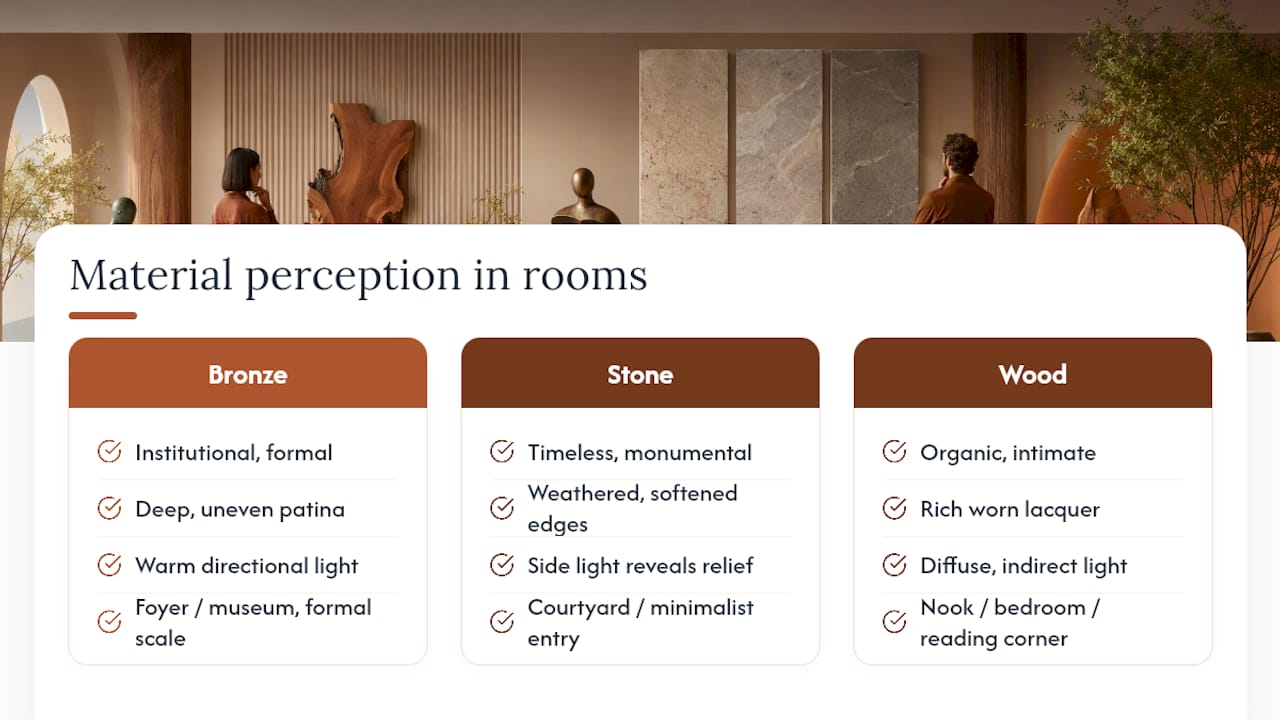
Finish and scale change how old or authentic a piece appears. A deep, uneven patina on bronze suggests decades of handling and oxidation, while a bright, uniform surface can look freshly cast even on an older piece. Weathered stone with softened edges reads as ancient regardless of actual age, and a rich, worn lacquer on wood conveys history that a glossy refinish erases.
Lighting and pedestal choice matter more than most buyers expect. Warm, directional light flatters bronze’s texture; stone benefits from side lighting that reveals carved relief; wood looks best with diffuse, indirect light that avoids drying the surface. Pairing a wood figure with a stone base, or setting bronze against a plain wall, keeps the material itself as the visual focus. For bedroom or private sanctuary settings, smaller-scale wood or bronze pieces tend to work better than monumental stone.
What Practical Factors Determine Where a Sculpture Fits?
Before any material decision becomes final, run through the physical logistics. A piece that looks perfect in a photo can be unworkable once weight, doorways, and climate enter the picture.
- Check floor and shelf load capacity for stone and bronze pieces over roughly 30 pounds; a standard bookshelf usually cannot hold either safely.
- Measure doorway and stairwell clearances before ordering anything over 3 feet tall, especially mounted wood figures with wider bases.
- Confirm foundation or mounting needs for outdoor stone or bronze; both often require a concrete pad or bolted base to resist tipping.
- Assess your climate for wood: rooms below 40% relative humidity crack lacquer, while above 60% invites mold and insect activity.
- Plan for bronze rewaxing on any outdoor installation, budgeting for a specialist visit every one to two years.
- Ask about crating and insurance before you buy; heavy stone and bronze pieces ship on pallets and typically take four to eight weeks for insured international delivery.
Climate risk varies sharply by material. Wood needs a stable indoor environment, ideally with a small dehumidifier in humid regions and distance from radiators or direct sun. Bronze tolerates outdoor exposure but needs its wax barrier renewed on a schedule; skip it and you get streaking and dulling within a season. Stone handles freeze-thaw cycles reasonably well, though marble is the most vulnerable to acid rain and pollution staining among the three.
What Should You Ask About Provenance Before Buying?
Material affects long-term value as much as age does, so ask for documentation before you ask about price. Request a condition report, a written restoration history, a provenance chain tracing the piece back through prior ownership, and high-resolution photographs of every surface, including the base and any joins.
Red flags differ by material. On wood, look for filled cracks, replaced limbs, or drill holes suggesting past insect damage. On bronze, an inconsistent patina, patches that look newer or a different color than the rest of the surface, often points to repair or a modern recast rather than age. On stone, crisp tool marks that look machine-cut rather than hand-carved suggest a recent reproduction rather than an antique original.
Survival rates matter too. Wood pieces from centuries past are genuinely rare because organic material decays; a well-preserved antique wood figure often commands a premium precisely because so few survived. Bronze and stone survive longer on average, but scarcity within a specific regional style or period still drives collector interest and, correspondingly, conservation cost.
Buying and Care Checklist for Bronze, Stone, and Wood
Use this before you commit to any piece, and again the week it arrives.
- Verify provenance documentation and ask directly whether the piece has ever been restored.
- Inspect photos (or the piece in person) for hidden repairs, fill lines, or replaced sections.
- Confirm shipping method, insurance coverage, and estimated delivery window in writing.
- Measure your space and clearances against the seller’s listed weight and dimensions.
- Set wood pieces away from vents and direct sunlight, and keep indoor humidity in a moderate, stable range.
- Rewax bronze on a one to two year schedule if displayed outdoors; skip it and the patina dulls faster.
- Clean stone with a dry or lightly damp cloth only. Avoid acidic or ammonia-based cleaners entirely.
Pro Tip: Photograph your new piece from four angles the day it arrives. That record becomes invaluable if you ever need to document condition for insurance or resale.
For long-term upkeep, bronze benefits from a specialist conservator every few years, while stone pieces in storage need padded, upright support rather than flat stacking to prevent stress cracks.
Why Trust HDAsianArt’s Material Guidance?
HDAsianArt’s recommendations rest on direct work with antique Buddhist and Hindu sculpture from Cambodia, Thailand, Indonesia, Sri Lanka, and Vietnam, not general appraisal experience. Every piece in the gallery’s collection is individually researched, photographed, and described, with provenance notes and condition detail included before a buyer ever asks.
James, of HDAsianArt.com, draws on the gallery’s published scholarship, including its guides on temple bronze casting and antique bronze care, to ground each material recommendation in documented technique rather than guesswork. Worldwide insured shipping backs every sale.
How Sustainable Is Each Sculpture Material?
Sustainability looks different for antique pieces than for newly manufactured ones, and that distinction matters for anyone buying with a conscience.
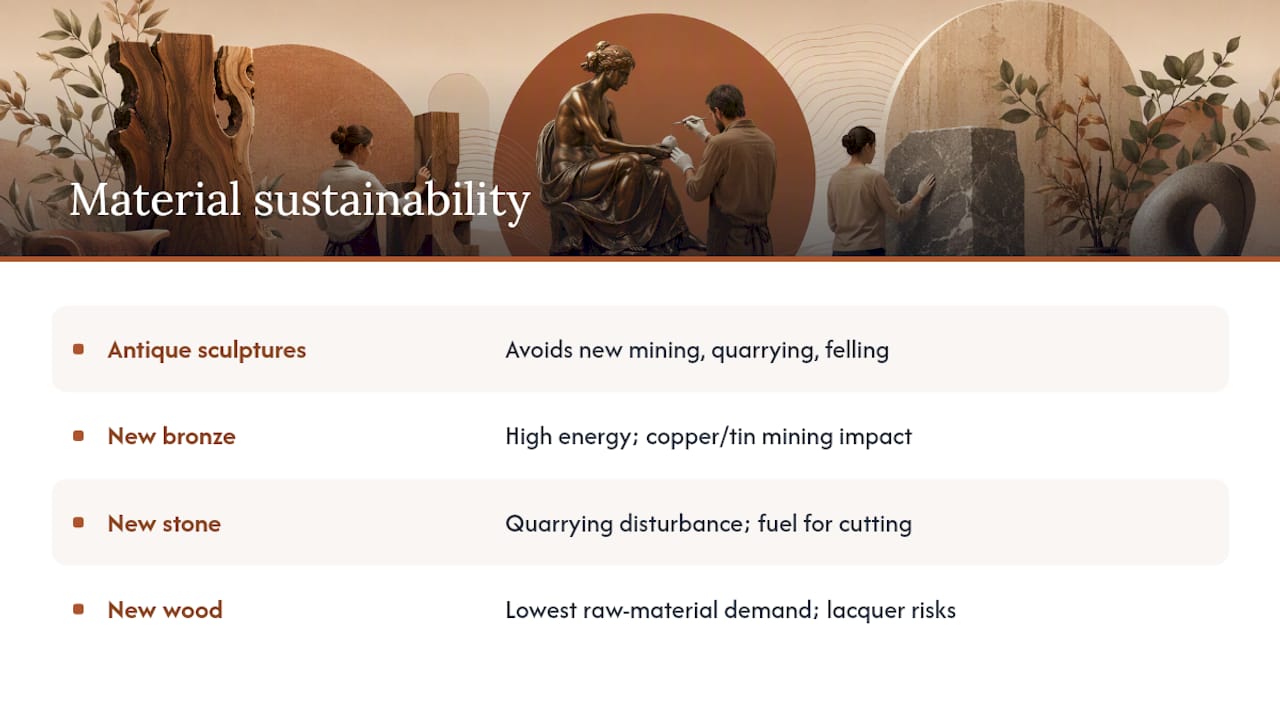
Buying an antique bronze, stone, or wood sculpture, rather than commissioning a new one, sidesteps most of the environmental cost entirely. No new ore gets mined for the alloy, no quarry gets cut into a hillside, and no tree gets felled. The piece’s environmental footprint was paid decades or centuries ago; acquiring it secondhand is closer to preservation than production.
Among newly made pieces, the calculus shifts. New bronze casting requires significant energy for smelting and firing kilns, plus mining impact tied to copper and tin extraction. New stone carving involves quarrying, which disturbs land and consumes fuel for cutting and transport, though the finished stone itself needs no ongoing chemical treatment. New wood carving has the lightest raw-material footprint of the three when sourced from managed forests, but lacquer finishes historically relied on natural resin that requires careful, low-impact harvesting to avoid depleting slow-growing lacquer trees.
For a collector weighing environmental impact against authenticity, an antique piece with documented provenance offers both, at once. It carries genuine history and avoids the resource demands of new production, which is one more reason condition and provenance paperwork belong at the top of your buying checklist rather than an afterthought.
An Editorial Take on Choosing Sculpture Materials for Collectors and Designers
Most buying guides treat material choice as a matter of taste. It isn’t. It’s a matter of physics and climate, and the guides that skip that part do collectors a disservice.
The overlooked truth is that maintenance cadence should drive the decision more than aesthetics do. A buyer who falls for a bronze temple guardian but lives somewhere humid and never plans to rewax it is setting up a slow disappointment. A buyer who wants monumental stone but has a second floor apartment with no reinforced flooring is planning a problem, not a purchase.
The conventional advice, pick what you love, isn’t wrong, but it’s incomplete. What actually works is picking what you love among the options your space, climate, and maintenance willingness can genuinely support. Wood rewards buyers who can control humidity. Stone rewards buyers with the floor and the patience for its heft. Bronze rewards buyers willing to treat maintenance as part of ownership, not an inconvenience.
Provenance should never be optional, regardless of material. That single habit separates serious collectors from casual buyers every time.
— James, HDAsianArt.com
Start Your Search for an Authentic Asian Sculpture
Buyers should seek documented provenance and insured global shipping for each piece, features not always available from generic decor retailers or unverified marketplace listings. Consider this Indonesian-style Javanese Bodhisattva bronze statue, a compact bronze piece suited to a formal shelf or altar space, or this antique Khmer-style wood Enlightenment Buddha, which shows the warmth and detail carved wood delivers at 28 inches tall.
Every listing includes a condition report on request, high-resolution photographs of every surface, and researched provenance notes so you know exactly what you’re buying before you commit. If you want additional photos, a shipping quote for your region, or guidance choosing between two pieces, reach out to the gallery directly and ask. For collectors weighing cultural sensitivity alongside material choice, this guide on questions to ask before buying culturally specific art pairs well with HDAsianArt’s own provenance standards. Contact HDAsianArt today for a condition report on any piece that catches your eye.
Sources
For deeper technical background, see the Smithsonian’s Materials & Techniques overview, its essay on lacquer and Buddhist sculpture, and Britannica’s entry on sculpture materials.
- Lacquer and Buddhist sculpture in East Asia, sixth–eighth century — Smithsonian research essay
- Sculpture — Materials (Britannica)
- Sculpture materials: clay, bronze, marble, and found objects — Quiet Canvas
FAQ
Which Material Lasts Longest for Outdoor Display?
Stone, particularly granite, generally withstands weather better than bronze or wood, though bronze can last just as long outdoors with regular rewaxing.
Is Bronze or Stone Heavier for Shipping Purposes?
Both are considerably heavier than wood, and exact weight depends on size and density; always request the piece’s measured weight before ordering.
Can Wood Sculptures Be Displayed Outdoors?
No. Wood construction, especially hollow-core lacquer work, is vulnerable to humidity and insects and should stay indoors in a stable climate.
How Often Does Bronze Need Rewaxing?
Outdoor bronze typically needs rewaxing every one to two years to protect its patina from oxidation and weather exposure.
Does HDAsianArt Provide Condition Reports Before Purchase?
Yes, HDAsianArt researches and documents provenance and condition for each piece and provides additional photos or reports on request before you buy.
