



5–20 Layers and 4–8 Months: Why Collectors Value Burmese Lacquerware
5–20 Layers and 4–8 Months: Why Collectors Value Burmese Lacquerware
Burmese lacquerware is a family of objects built from thitsi, the sap of Melanorrhoea usitata, applied in as many as 20 hardened layers over a woven bamboo or wood core. The finest pieces carry yun engraving, where cured lacquer is carved and packed with mineral pigment.
Collectors value them for the labor locked into every layer and for provenance tied to Bagan, a link that museums like the V&A have documented for more than a century.
Key Features:
- Genuine Burmese lacquerware from Bagan is rare due to declining artisan numbers and rising material costs, making documentation crucial for value.
- Authentic pieces feature layered construction, variable yun engraving, and natural mineral pigments, with higher layer counts indicating higher craftsmanship.
- Proper authentication Demand proof of provenance, inspection of engraving irregularities, and visible lacquer layering, rather than relying solely on appearance or price.
- Traditional pigments like cinnabar and orpiment are sealed beneath lacquer layers, posing minimal risk if the surface is intact but dangerous if damaged or mishandled.
- Modern production schedules for new commissions typically require 12 to 24 weeks, with synthetic pigments enabling safer, more affordable alternatives today.
Table of Contents
- What Is Burmese Lacquerware, and Why Does It Matter to Collectors?
- Thitsi, Thayo, and the Techniques That Define Quality
- How Burmese Lacquerware Is Made, Step by Step
- How to Authenticate and Care for Burmese Lacquerware
- A Practical Buying Checklist for Burmese Lacquerware
- What the Motifs on Burmese Lacquerware Actually Mean
- The Tools Behind Every Lacquer Surface
- Where Tradition Meets Modern Practice
- Why Demand for Burmese Lacquerware Keeps Rising
- Living with Lacquerware: Everyday Risks and Safe Handling
- A Gallery’s View on Stewardship
- Own a Piece of This Tradition, Documented and Insured
- Sources
- FAQ
What Is Burmese Lacquerware, and Why Does It Matter to Collectors?
Burmese lacquerware production traces back to at least the 13th century, when lacquer-coated objects appeared alongside the temples of Pagan (modern Bagan). Archaeological finds inside the Laymyethna temple confirm lacquer use in that period, giving collectors a documented starting point for a craft that has run continuously for roughly 800 years.
The Victoria & Albert Museum’s Burmese lacquer holdings function as a reference library for attribution. Curators there have cataloged pieces by technique, pigment, and form long enough to establish stylistic timelines that dealers and appraisers still lean on today. Jataka scenes, depicting episodes from the Buddha’s past lives, recur across manuscript chests, offering vessels, and monastic boxes, and reading those narrative cycles correctly is one of the fastest ways to place an object within a regional workshop tradition.
Bagan remains the practical center of the craft, not just its historical birthplace. Several factors keep it central to how collectors evaluate lacquerware today:
- The Lacquerware Technology College, founded in 1924, still trains new artisans in Bagan and anchors technical standards for the region.
- Multi-generation family workshops in and around Bagan continue producing yun ware using methods largely unchanged since the 19th century, according to field reporting from Xinhua.
- That same reporting notes rising raw material costs and a shrinking pool of young artisans entering the trade, both of which affect how much genuine hand-built lacquerware reaches the market each year.
- Scarcity, paired with the months-long production cycle, means well-documented pieces with clear Bagan attribution tend to hold value better than undocumented ones.
For a collector, that scarcity is not an abstraction. It is a reason to prioritize documentation now, while workshop records and living artisan knowledge are still available to consult.
Thitsi, Thayo, and the Techniques That Define Quality
Thitsi sap, tapped from Melanorrhoea usitata trees native to Myanmar, is the material foundation of every genuine piece. It cures into a hard, glossy, chemically resistant surface, and that curing behavior is what allows craftsmen to build up the deep, almost ceramic-like finish associated with fine Burmese lacquerware.
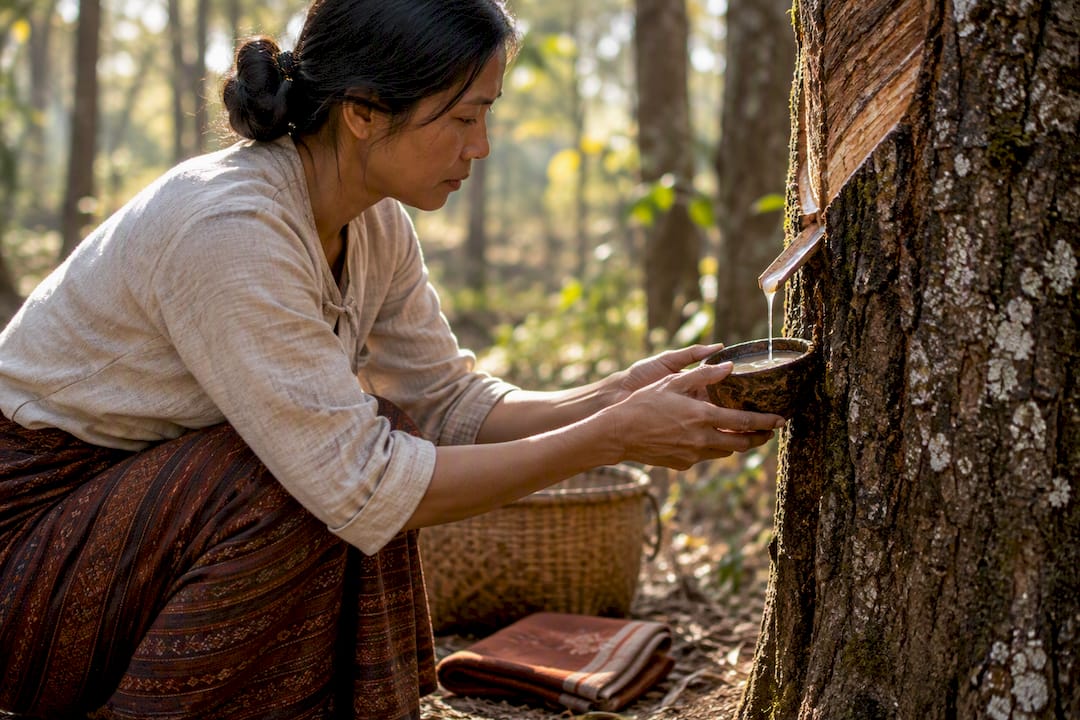
A quick technical note: the layering process typically runs 5 to 20 coats, with drying time built in between each application. More layers generally signal a higher-effort, higher-value object, though layer count alone never substitutes for a full condition and provenance check.
Three techniques account for most of what collectors encounter:
- Thayo ground work. A putty made from lacquer mixed with ash fillers, progressing from coarse to fine, builds up relief patterns and smooths the substrate before final coats go on.
- Yun engraving. Cured lacquer is incised and the grooves are filled with pigment, one color at a time, with drying and polishing between each fill. Barrier layers, often neem resin or acacia gum, keep colors from bleeding into each other during multi-color designs.
- Moulded lacquer and gilding. Raised thayo relief can be finished with gold leaf, a technique called shwe cha, most often reserved for religious and ceremonial pieces.
Traditional pigments included cinnabar (mercuric sulfide) for red, orpiment (arsenic trisulfide) for yellow, and a mixed orpiment and indigo compound for green. Scientific analysis published in npj Heritage Science confirms these markers in historic objects and traces a documented shift toward Prussian blue and, later, synthetic phthalocyanine pigments in 20th century production. That shift matters for dating: an object using phthalocyanine blue cannot predate the pigment’s commercial availability.
How Burmese Lacquerware Is Made, Step by Step
Understanding the build sequence is the fastest way to judge whether a piece was hand-built or mass-produced.
- Substrate construction. Many objects start as split bamboo woven into shape, sometimes reinforced with horsehair for flexibility and strength. Wood cores appear on larger or flatter forms like trays and boxes.
- Thayo infill. Coarse filler goes on first to fill gaps in the woven structure, followed by progressively finer filler coats that smooth the surface for lacquering.
- Successive lacquer coats. Thitsi is applied in 5 to 20 or more layers, each one drying and getting polished, often with agate or fossilized wood, before the next goes on.
- Engraving and pigment cycles. For yun ware, the cured surface is incised, one pigment is packed into the grooves, and the piece dries and gets cleaned back before the next color’s engraving begins.
- Barrier layering. Resin barriers separate color fields during multi-pigment work, a step that museum conservators cite as a marker of careful, unhurried craftsmanship, per the V&A’s Burmese lacquer research.
- Final sealing and polishing. A last lacquer coat and polish, sometimes finished with tung oil, gives the surface its characteristic depth and shine.
Historic, high-quality pieces reportedly took 4 to 8 months to complete from start to finish. Modern workshops producing for export report 12 to 24 week lead times, a faster pace but still far longer than anything mass-manufactured.
Pro Tip: Tilt a piece under raking light and look at the engraved lines under magnification. Hand-cut yun grooves show slight irregularity and tool drag; machine-etched imitations look uniformly clean, almost printed.
How to Authenticate and Care for Burmese Lacquerware
Authentication starts with the engraving itself. Genuine yun work shows engraving depth that varies slightly across a design, tooling marks consistent with hand carving, and pigment fill that sits fractionally below the lacquer surface rather than sitting flush like printed decoration. Cross-section evidence of multiple lacquer layers, visible at any chip or worn edge, is another strong indicator, since mass-produced imitations rarely bother with more than one or two coats.
Provenance documentation worth requesting includes prior collection history, any museum or catalog references the piece has appeared in, and, where available, workshop or regional attribution. A dealer who can speak to all three is doing more diligence than the market typically requires.
Watch for these condition red flags:
- Inconsistent sheen across a surface, suggesting spot repolishing rather than full restoration.
- Overpaint that doesn’t match the engraved groove pattern underneath.
- Fills that look unnaturally smooth or bright compared to surrounding aged lacquer.
Safety matters here, not just aesthetics. Historic pigments include cinnabar (mercury-based) and orpiment (arsenic-based), confirmed through material analysis of Burmese lacquer objects. Never sand, scrape, or attempt to remove old pigment yourself, and avoid household cleaners or abrasive cloths on any painted or engraved surface. Dust gently with a soft, dry brush, keep pieces away from direct sunlight and fluctuating humidity, and consult a professional conservator before any restoration work.
Pro Tip: If a piece smells faintly chemical or the surface feels tacky rather than hard, stop handling it and isolate it. That can indicate incomplete curing or a modern coating rather than aged thitsi lacquer.
A Practical Buying Checklist for Burmese Lacquerware
Before buying, confirm four things: provenance history, a written condition report, visible technique markers (yun depth, layer evidence, substrate type), and export documentation if the piece is leaving its country of origin.
Pricing tracks technique complexity and rarity more than size. A multi-color yun piece with fine engraving and gilded relief will command more than a single-color, undecorated lacquer box of the same dimensions, and museum-referenced provenance adds a further premium collectors are generally willing to pay.
This is where a specialist gallery earns its place in the process. Authentication, detailed photography, and condition documentation are hard to replicate through a marketplace listing with a few phone photos and no expert description behind it. HD Asian Art curates its Burmese lacquerware collection with that level of detail as standard, alongside insured worldwide shipping for pieces that often cannot be replaced if damaged in transit.
- Request a written condition report before purchase, not after.
- Ask which layer count and technique (plain lacquer, yun, moulded, gilded) the piece uses.
- Confirm export legality if the object is an antique leaving its country of manufacture.
- Factor in that new commissioned pieces from Myanmar workshops typically ship in 12 to 24 weeks, useful context if you’re comparing an antique purchase against a custom order.
What the Motifs on Burmese Lacquerware Actually Mean
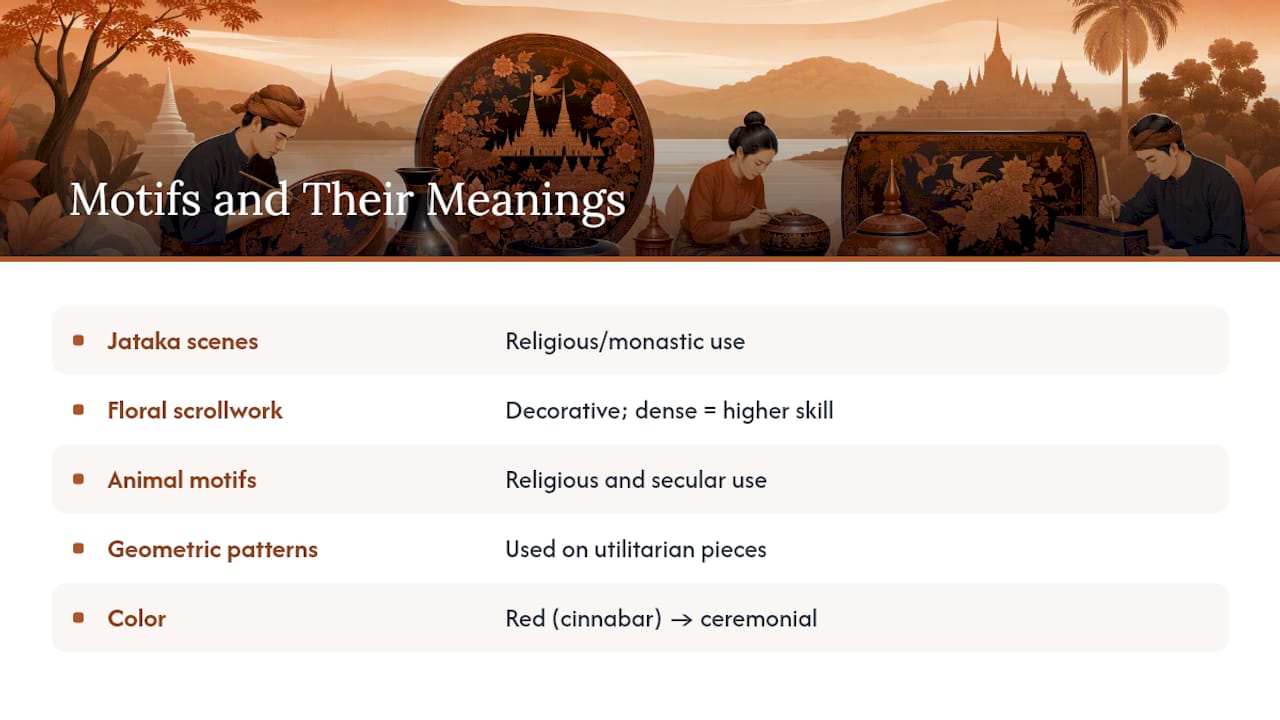
Jataka scenes dominate the religious end of Burmese lacquerware, illustrating episodes from the Buddha’s past lives across monastic boxes, offering vessels, and manuscript chests. Reading these scenes correctly often tells you what an object was made for, since narrative panels almost always signal religious or monastic use rather than domestic decoration.
Floral and vine scrollwork, sometimes called kanote, fills the background space around figural scenes on many pieces. It is decorative but not random. Dense, evenly spaced scrollwork generally indicates a higher skill level than sparse or irregular filler patterns, since the engraver had to maintain rhythm across a large surface without a stencil.
Animal motifs, particularly elephants, peacocks, and mythical creatures like the chinthe (a lion-like guardian figure), appear on both religious and secular objects. Chinthe figures often flank entryways to temples in stone form, and their appearance on lacquerware, especially on betel boxes and offering stands, echoes that protective symbolism into domestic and ceremonial use.
Geometric lattice and diaper patterns, meanwhile, tend to show up on utilitarian pieces, cups, trays, and storage boxes where a full narrative scene would be impractical given the object’s shape. Color choice carries meaning too: red from cinnabar often marks ceremonial or offering objects, while more muted palettes appear on everyday items. Recognizing which motif category a piece falls into is one of the fastest ways to estimate its original function, long before you get to questions of age or workshop attribution.
The Tools Behind Every Lacquer Surface
The tool kit for Burmese lacquerware has changed remarkably little over the centuries, which is part of why the craft still reads as handmade even on recent pieces.
Bamboo splitting starts the process on woven-core objects, using simple blades to shave strips thin enough to weave into the coiled or basket-style forms that underlie boxes and trays. Horsehair sometimes gets worked into that weave for added structural flexibility, a detail that shows up in cross-section on damaged pieces.
For the lacquer stages, artisans use flat spatulas and palette-style tools to spread thitsi evenly across the substrate, then rely on fine engraving needles, essentially small, sharpened metal points, to cut the grooves that define yun work. Polishing tools include natural abrasives like agate stones or fossilized wood, prized for smoothing lacquer without scratching it the way modern sandpaper would.
Pigment application uses small brushes and packing tools to press mineral color into engraved grooves, a manual process that explains why multi-color yun pieces take so much longer than single-tone lacquerware. None of this equipment is mechanized in traditional workshops, which is exactly why layer counts and drying times stretch into months rather than days.
Where Tradition Meets Modern Practice
Modern Burmese lacquerware production has adapted in a few specific ways without abandoning the core thitsi and yun methods that define the craft.
Export-oriented workshops now organize around defined production schedules, with sector reporting citing 12 to 24 week turnaround times for completed orders, a shift from the more open-ended timelines of purely domestic, commission-based work. That scheduling discipline reflects overseas demand rather than a change to the underlying technique.
Pigment sourcing has shifted the most. Where cinnabar and orpiment once supplied the standard red and yellow palette, analysis of 20th-century objects shows a documented move toward Prussian blue and later synthetic phthalocyanine pigments, likely driven by cost, availability, and safety concerns with mercury and arsenic-based compounds. That shift also gives appraisers a rough dating tool, since certain synthetic pigments simply didn’t exist before specific decades.
Verification access has changed too. Sector organizations now arrange virtual workshop tours for overseas buyers who cannot travel to Myanmar to inspect production in person, a meaningful development for collectors trying to confirm a piece’s origin without an in-country visit. The Lacquerware Technology College continues training new artisans in Bagan, which keeps the traditional skill base alive even as export logistics and pigment sourcing modernize around it.
Why Demand for Burmese Lacquerware Keeps Rising
Interest in Burmese lacquerware has grown steadily among collectors drawn to decorative arts with both aesthetic depth and documented cultural history, and that demand runs into a supply constraint that isn’t going away soon.
Field reporting from Bagan workshops describes rising material costs and a shrinking base of young artisans willing to spend years learning yun engraving before producing sellable work. That combination, more buyers chasing a craft with a slower, harder-to-scale labor pipeline, tends to push well-documented antique and museum-quality pieces toward stronger long-term value retention compared to undocumented or recently mass-produced imitations.
Export markets, including the United States, remain active outlets for both antique and newly commissioned lacquerware, according to sector trade data. For collectors, that ongoing export activity is a double-edged fact: it means genuine pieces are still reaching Western markets, but it also means the market includes a wide range of quality levels, from hurried commercial work to museum-caliber craftsmanship, often at overlapping price points.
The practical takeaway is that price alone tells you very little about quality in this category. A piece’s value comes down to layer count, technique complexity, pigment authenticity, and documentation, not just what a listing charges for it. That is exactly why the identification checks covered earlier in this guide matter more here than in most decorative arts categories.
Living with Lacquerware: Everyday Risks and Safe Handling
Cinnabar and orpiment, the traditional red and yellow pigments confirmed in material analysis of historic Burmese lacquer objects, contain mercury and arsenic compounds respectively. On a stable, well-sealed antique surface, these pigments pose minimal risk during normal handling and display, since they are locked beneath cured lacquer layers rather than exposed as loose powder.
Risk rises sharply with damage. Flaking, chipped, or actively deteriorating lacquer can expose pigment particles, and any sanding, scraping, or aggressive cleaning of a painted surface can release dust containing those same compounds. Never attempt to remove old paint or lacquer yourself, and never use abrasive pads, solvents, or household cleaning sprays on any decorated surface, cured or damaged.
Safe daily care is simple and low-intervention:
- Dust with a soft, dry brush rather than a cloth that could catch on raised engraving.
- Keep pieces out of direct sunlight, which accelerates lacquer degradation and pigment fading over time.
- Maintain stable humidity; swings between damp and dry conditions stress the bamboo or wood substrate underneath the lacquer.
- Never apply oils, waxes, or commercial furniture polish to a lacquer surface.
If a piece shows active flaking, discoloration consistent with old restoration, or any surface damage, the right move is a professional conservator, not a home fix. That single step protects both the object’s value and anyone handling it.
A Gallery’s View on Stewardship
Every piece researched receives full condition documentation before being offered, with transparent notes on confirmed and unconfirmed aspects of its history. Responsible collecting means supporting the artisans and workshops still practicing this craft, not just acquiring their output. If you’re weighing a piece and want deeper provenance research or a condition assessment before committing, that’s a conversation worth having before, not after, a purchase.
— James, HDAsianArt.com
Own a Piece of This Tradition, Documented and Insured
The edge of specialist galleries often includes research behind each listing, expert-written descriptions, detailed photography, and authentication before sale. These details are important in this category since layer count, pigment identity, and workshop attribution are often missing from generic marketplace listings.
Every piece in the Burmese Lacquerware collection ships worldwide with full insurance, so a hand-engraved yun box or offering stupa that took months to build arrives the way it left the workshop. If your interest runs toward related devotional pieces, the Buddha statue collection and Hindu statue collection follow the same curation standard. Browse the current Burmese lacquerware listings now, or reach out directly for provenance questions before you buy.
Sources
- The evolution of the materials used in the yun technique for the decoration of Burmese objects: lacquer, binding media and pigments | npj Heritage Science
- Highlights of the lacquer collection from Myanmar (Arts of Asia / V&A highlights)
- Bagan lacquerware tradition preserved by multi-generation workshops (Xinhua)
- Discover Quality Craftsmanship from Myanmar’s Lacquerware (BurmaCrafts / MLA)
FAQ
What Makes Burmese Lacquerware Different From Other Asian Lacquer?
Burmese lacquerware relies on thitsi sap and the yun engraving technique, where cured lacquer is carved and packed with mineral pigment rather than painted on top. That engraved, inlaid finish, built up over 5 to 20 lacquer layers, is a distinct signature compared to surface-painted lacquer traditions elsewhere in Asia.
How Long Does It Take to Make a Piece of Burmese Lacquerware?
High-quality historic pieces reportedly took 4 to 8 months from substrate to finished object. Modern workshops producing for export report 12 to 24 week lead times for new commissions.
Is It Safe to Own Antique Burmese Lacquerware With Cinnabar or Orpiment Pigments?
Yes, on a stable, undamaged surface, since analysis of historic pigments confirms these compounds are sealed beneath cured lacquer layers. Avoid sanding, scraping, or abrasive cleaning, and consult a conservator if you see flaking or chipped areas.
How Can I Tell if a Piece Is Authentic Bagan Lacquerware?
Look for engraving depth that varies slightly across the design, visible layering at any chip or worn edge, and consistent tooling marks rather than uniform, printed-looking lines. Provenance documentation and museum or catalog references, where available, add further confidence alongside those physical checks.
Does HD Asian Art Sell Authenticated Burmese Lacquerware?
Yes, HD Asian Art curates a Burmese lacquerware collection with expert research, detailed photography, and condition documentation on each piece. Pricing varies by piece and is listed on the collection page itself.
