



Buddhist Offerings for Daily Home Worship: A Guide
Buddhist Offerings for Daily Home Worship: A Guide
Summary
Buddhist offerings for daily home worship are small, repeated acts of generosity that turn a quiet corner of your home into a living practice, with attention mattering more than decoration. Common items include water for clarity, flowers for impermanence, incense for discipline, light for wisdom, and food for gratitude. A simple ten-minute morning routine of lighting a lamp, filling water bowls, bowing, and setting an intention keeps the practice realistic.
- Water stands for clarity and purity of mind, while flowers stand for impermanence because they fade.
- The traditional water bowl count is seven, though three is a common beginner compromise and one bowl is a recognized minimal practice.
- Place water bowls in a straight row close but not touching, roughly the width of a grain of rice between rims.
- Fill each bowl to about a finger's width below the rim and empty and dry them before nightfall.
- A ten-minute morning routine of lamp, incense, water bowls, three bows, and an intention beats an hour you never repeat.
Table of Contents
- Why Buddhist Offerings Anchor a Daily Home Practice
- Buddhist Offerings Meaning: What Each Gift Represents
- The Eight Offerings in Buddhism and the Traditional Offering Set
- Buddhist Water Bowl Offerings: A Step-by-Step Setup
- Flowers, Incense, Light, and Food: Choosing and Arranging Each Offering
- Daily Buddhist Prayer at Home: A Simple Morning Routine
- Low-Cost, No-Flame, and Small-Space Alternatives
- What to Do with Offerings Afterward, and Common Mistakes to Avoid
- Frequently Asked Questions
Why Buddhist Offerings Anchor a Daily Home Practice
Buddhist offerings for daily home worship are the small, repeated acts of generosity that turn a quiet corner of a home into a living practice. The point is not decoration. The point is attention.
The Pew Research Center's 2026 study of Buddhism's decline in East Asia describes how families traditionally performed daily rituals at home altars, burning incense, lighting candles, and leaving food offerings.
Below, we walk through what each offering means, how to arrange it, and how to keep the routine realistic on a busy morning.
Buddhist Offerings Meaning: What Each Gift Represents
Buddhist offerings meaning comes down to one idea: you are practicing generosity and letting go. Each item on the shrine stands for a quality you are trying to cultivate, not a payment you are making.
Here is what the common items represent:
- Water stands for clarity and purity of mind.
- Flowers stand for impermanence, since they fade.
- Incense stands for discipline and the spread of good conduct.
- Light stands for wisdom cutting through confusion.
- Food stands for gratitude and the wish that others be nourished.
- Music or a bell stands for the sound of teaching.
A common mistake is treating the altar as a transaction. In practice, this means the offering matters less than the state of mind behind it.
The Eight Offerings in Buddhism and the Traditional Offering Set
The eight offerings in Buddhism is a set of symbolic gifts used across many traditions. The exact list shifts by lineage, so treat any version as a teaching tool rather than a fixed rule.
The Eight Auspicious Offerings in Order
The eight auspicious offerings in order typically run: water for drinking, water for bathing, flowers, incense, light, perfume or scented water, food, and music. Each one maps to a quality worth developing.
The Five Offerings: Form, Sound, Scent, Taste, Touch
Some traditions condense the set into five offerings tied to the senses: form, sound, scent, taste, and touch. This shorter version suits small spaces. You can cover all five with a flower, a bell, incense, a piece of fruit, and a clean cloth.
Buddhist Water Bowl Offerings: A Step-by-Step Setup
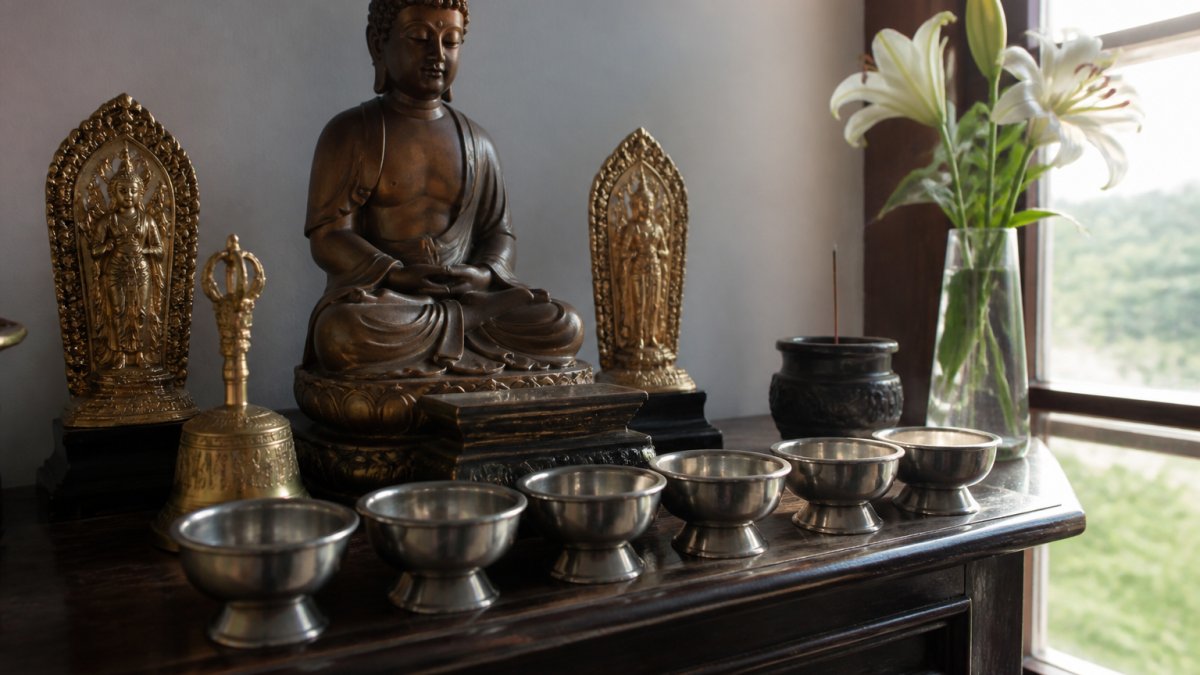
Buddhist water bowl offerings are the simplest and most forgiving part of the practice, and also the part most beginners get vaguely wrong. The bowls are not decoration and they are not a vase arrangement.
How Many Bowls, and Why
Seven is the traditional number in Tibetan-style practice, and the count maps to the seven water-related offerings in the longer set: drinking water, washing water, flowers, incense, light, perfume, and food (Buddhist Water Bowl Offerings as an Antidote to Attachment). Many practitioners use seven because the row itself becomes a reminder of the full offering set. Three is a common beginner compromise and still reads as a complete gesture. One bowl is not a failure, a single clean bowl of water offered with attention is a recognized minimal practice in several traditions. Choose the number your shelf can hold in a straight, uncrowded line, and keep it consistent rather than changing it week to week.
Spacing and Fill Level
Place the bowls in a straight row, close together but not touching, roughly the width of a grain of rice between rims is the traditional guide. The gap matters because each bowl is a distinct offering; bowls that clink or overlap blur that. Fill each bowl to about a finger's width below the rim. The water should be clean enough to drink, and the level should be even across the row. An uneven row reads as rushed, and the whole point is unhurried attention.
The Setup Sequence
- Wipe each bowl dry and place it upside down overnight, or stack them rim-down between sessions.
- Turn the bowls upright one at a time as you pour, rather than setting them all upright first.
- Fill each bowl to about a finger's width below the rim, keeping the level even.
- Arrange them in a straight line, close but not touching.
- Offer the row with a short bow or a quiet intention.
- Empty and dry the bowls before nightfall.
Emptying and Drying
Empty the bowls before nightfall, or at the end of your evening session if you practice at night. Pour the water out gently, down a drain or onto a plant, rather than tipping the bowls abruptly. Wipe each bowl dry and set it upside down or stack it rim-down. Leaving water standing overnight is the most common water-bowl mistake: it invites residue, and in some traditions the offering is understood to be a daytime one.
How Traditions Differ
The seven-bowl row is most associated with Tibetan and other Himalayan-lineage practice. Theravada home shrines often keep a simpler water offering, sometimes a single cup, alongside flowers and a candle. Mahayana shrines vary widely by country and lineage, and many combine water with a small food offering. None of these is the 'correct' version. Pick the count and timing your tradition or teacher uses, and if you have no teacher, pick the version you will actually keep.
Flowers, Incense, Light, and Food: Choosing and Arranging Each Offering
Fresh flowers, a stick of incense, a small lamp, and a modest food offering cover most of what a home shrine needs. Arrange them so the tallest item sits at the back and nothing blocks the statue's face.
A few practical notes:
- Flowers: trim stems and change the water daily.
- Incense: one stick is enough; use a proper holder with an ash catcher.
- Light: a battery candle works as well as a flame.
- Food: keep portions small and remove them before they spoil.
Food Offerings: Rice, Fruit, and Milk
Rice, fruit, and milk are the classic food offerings. A small bowl of uncooked rice, a single piece of fruit, or a small glass of milk all work. Keep it modest. The offering is not a meal service, and a large plate left out will only attract pests.
Daily Buddhist Prayer at Home: A Simple Morning Routine
Daily Buddhist prayer at home does not need to take long. Ten focused minutes beats an hour you never repeat.
Try this sequence:
- Light the lamp and offer a stick of incense.
- Fill the water bowls.
- Bow three times.
- Recite a short prayer or take a few quiet breaths.
- Set a simple intention for the day.
- Close with a bow.
The same sequence at night, in reverse, closes the practice. Consistency matters more than length.
Low-Cost, No-Flame, and Small-Space Alternatives
You do not need a dedicated room or a large budget. A shelf, a windowsill, or the top of a low cabinet can hold a complete shrine.
Low-cost and no-flame options:
- Battery-powered candles in place of open flame
- A single bowl of water instead of seven
- One fresh flower instead of a bouquet
- A small bell or a recording in place of incense
- A clean cloth as the shrine surface
If you are furnishing the space around the practice, our guide to creating a calm meditation corner may help you choose a focal piece that suits a compact room.
For a focal statue, HD Asian Art curates Buddhist and Hindu pieces, including Khmer and Southeast Asian sculptures, sized for altars and meditation spaces. Every piece ships free.
What to Do with Offerings Afterward, and Common Mistakes to Avoid
What happens to the offerings afterward matters as much as the offering itself. Water goes down the drain or onto plants. Flowers go to compost. Food is removed and either eaten, shared, or discarded respectfully. None of it should sit and rot.
Common mistakes we see:
- Leaving water bowls full overnight out of guilt
- Letting flowers wilt on the shrine for weeks
- Overfilling bowls until they spill
- Treating the altar as storage for unrelated objects
- Skipping the practice entirely because the setup is too elaborate
Traditions differ here. Some lineages emphasize elaborate daily ritual, others a bare bowl of water. Both are valid. Pick the version you will actually keep, and let the shrine stay simple enough to maintain.
Frequently Asked Questions
What can you offer at a Buddhist home altar?
A traditional home altar can hold water bowls, fresh flowers, incense, a light offering such as a candle or butter lamp, and food offerings like rice, fruit, or milk. Many practitioners also include the eight auspicious offerings, which pair each item with a quality such as purity or generosity. You do not need every item to begin; clean water alone is a complete and respected offering. As your practice deepens, you can add flowers, incense, and food in a way that fits your space, budget, and tradition.
Do Buddhist offerings need to be made every day?
Daily practice is encouraged in many traditions, but it is not a rigid requirement. The value of Buddhist offerings lies in the intention behind them, not in perfect consistency. A short morning routine of replacing water and lighting incense can take only a few minutes. If you miss a day, simply resume the next morning without guilt. Many laypeople make offerings daily, while others practice on observance days or weekends. What matters is that the offering is made with attention and gratitude.
How do you make daily offerings to the Buddha at home?
Start by cleaning the altar and arranging fresh water in clean bowls, usually seven or eight small bowls filled to about the same level. Light incense or a candle, then offer flowers or a small food item such as rice or fruit. Recite a short prayer or chant, bow three times, and set a clear intention for the day. Afterward, empty the water, remove perishable food, and dispose of flowers respectfully. The whole routine can take five to ten minutes and is best done at the same time each morning.
What should you do with offerings after prayer?
Water from offering bowls can be poured onto plants or outside rather than down a drain, as a gesture of respect. Flowers are usually composted or placed outdoors. Food offerings such as fruit or rice may be eaten, shared, or given away; many traditions treat them as blessed and avoid wasting them. Incense ash can be scattered in a garden. The key principle is to handle each item with care and avoid discarding it casually in the trash.
Building a daily practice asks for patience more than equipment. If you want a focal piece that holds the room without overpowering it, HD Asian Art offers carefully curated Buddhist and Hindu statues, handpicked antique and contemporary works, and temple-inspired decor for meditation spaces and refined home interiors. Browse the collection and find the piece that anchors your practice.
