



Collectors: Halt Bronze Disease in 8–12 Weeks Using Conservator Steps
Collectors: Halt Bronze Disease in 8–12 Weeks Using Conservator Steps
Bronze disease is a chloride-driven corrosion cycle that feeds on itself, converting stable metal into powdery, expanding pustules unless someone intervenes. Once cuprous chloride inside the bronze meets humid air, it triggers a chemical chain reaction that can outpace casual cleaning.
The right response is to stabilize the environment and isolate the object immediately, then move through a measured treatment chain rather than reaching for a polishing cloth or a wire brush.
Key Features
- Chloride buildup inside bronze can remain dormant for decades but activates with humidity, causing self-perpetuating corrosion and surface blistering.
- Mechanical removal of loose corrosion is the first step in treatment, followed by slow desalination in sodium sesquicarbonate to reduce chloride reservoirs.
- Environment control, especially humidity regulation, is crucial for preventing recurrence, requiring sealed cases and microclimate management.
- Electrolytic reduction can be effective for severe cases but carries risks and should be performed by professionals.
- Alloy composition influences susceptibility and treatment, with high-tin bronzes more resistant and leaded alloys more prone to internal chloride migration.
Table of Contents
What Bronze Disease Looks Like: Identification and Field Diagnosis
Active bronze disease announces itself differently from the smooth, adherent patina collectors prize. Stable patina sits flat and hard, often in shades of brown, green, or black, and it does not grow. Bronze disease does the opposite: it spreads, blisters, and crumbles.
Look for these signs during a routine inspection:
- Powdery, pale green or bluish pustules that sit on top of the surface rather than fused into it
- Blistering or cracking of the existing patina, sometimes with a faint white crust underneath
- A chalky texture that flakes off under light pressure, unlike the glassy hardness of true patina
- Localized pitting that seems to spread outward from a single point over weeks or months
One useful field check: raise the object’s local humidity slightly (a sealed bag with a damp paper towel nearby, monitored closely) and watch for new powder formation within a day or two. If pustules reactivate quickly, chloride reservoirs are present and active. For anything on an archaeological object or a piece with real market value, a chloride spot test or lab-based ion analysis is worth the cost before you touch a scalpel to it.
The Chemistry Behind a Self-Perpetuating Corrosion
Bronze disease starts with nantokite, the mineral name for cuprous chloride (CuCl), which forms inside bronze during long burial or exposure to chloride-rich environments, like soil, sea water, or old adhesive residues. Nantokite itself is stable in dry conditions, which is why an object can sit quietly for decades before trouble starts.
The trouble begins with moisture. Once relative humidity climbs, cuprous chloride hydrolyzes, reacting with water and atmospheric oxygen to form hydrated copper chlorides, chiefly atacamite and paratacamite. That reaction releases hydrochloric acid as a byproduct, which attacks fresh metal nearby and generates more cuprous chloride to continue the cycle. The new crystalline compounds also occupy more volume than the metal they replaced, and that expansion is what physically bursts through the overlying patina, producing the telltale pale pustules.
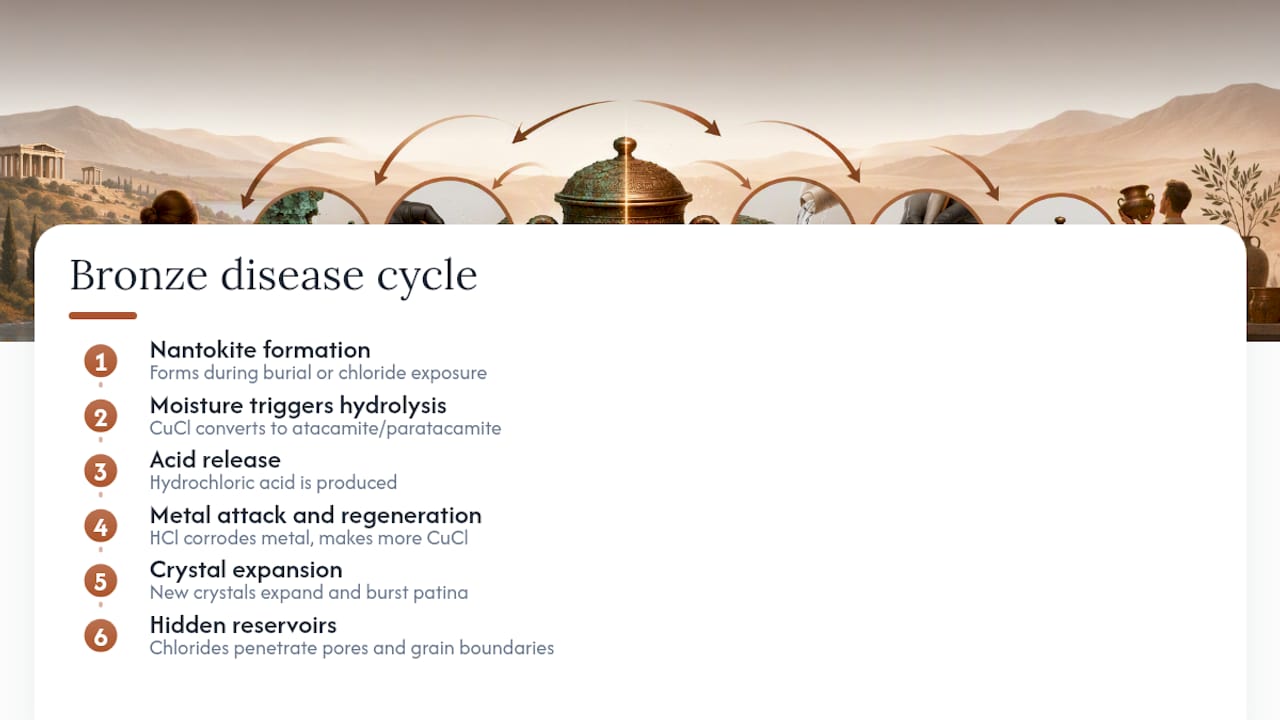
This is why bronze disease is genuinely self-perpetuating rather than a one-time surface blemish. Chloride ions rarely sit only on the surface. They migrate into porous corrosion layers and sometimes into the metal’s grain boundaries, creating internal reservoirs that survive surface cleaning entirely. Getty’s conservation guidelines note plainly that removing every trace of chloride from a compromised bronze is notoriously difficult, which is exactly why humidity control matters as much as any chemical treatment.
A Stepwise Treatment Protocol Conservators Actually Use
Treating bronze disease is a sequence, not a single fix. Skipping steps or reversing the order tends to trap chloride rather than remove it.
- Mechanical removal under magnification. Using a scalpel or fine brass brush, remove only the loose, powdery corrosion products. Leave intact, adherent patina alone. Work under a microscope or strong loupe so you can stop the moment you reach sound metal.
- Desalination in sodium sesquicarbonate. A conservative approach uses a dilute sodium sesquicarbonate solution in distilled water, with the bath changed on a weekly to biweekly schedule. NumisLens recommends tracking solution color and testing for continued chloride release; when two consecutive 14-day cycles show no new activity, the bath phase is done. This method is slow, often running weeks to months, but it protects patina better than aggressive alkaline stripping.
- BTA stabilization. Benzotriazole (BTA), typically in a 1 to 3% ethanol or aqueous solution, forms a protective complex with copper ions at the surface. Ethanol carriers penetrate faster; aqueous solutions are gentler on fragile surfaces. Dwell times generally run from a few minutes to overnight soaking for heavily affected pieces, though BTA does not reach chloride buried deep in the metal.
- Electrolytic reduction, when justified. Severely degraded archaeological bronzes sometimes warrant electrolytic treatment, which mobilizes chloride out of the corrosion layer. This carries real risk of over reduction and patina loss, and it belongs in a conservator’s hands, not a home workbench.
- Final coating and monitoring. A microcrystalline wax or Paraloid B-72 lacquer seals the treated surface. Monitor weekly for the first month, then monthly for at least a year.
Pro Tip: Keep a dated photo log at every stage. Bronze disease recurrence is often subtle at first, a faint powder in one corner, and a photo series catches it long before the naked eye would.
Does Dechlorination Actually Work? What the Research Shows
Not every dechlorination method performs equally, and the research on this is more specific than most collector guides let on.
- NaOH desalination converts cuprous chloride into copper trihydroxychloride, a more stable compound, but a quantitative study of dechlorination mechanisms found this conversion can measurably enlarge the corrosion layer even as chloride content in solution drops. Chloride is leaving the object, but the object is not shrinking back to its original form.
- Electrolytic dechlorination showed current-density-dependent behavior in that same research: a low current density around 2.5 μA/cm² improved chloride migration out of the object, but higher currents caused chloride readings in solution to fall again, likely because chlorine gas was evolving instead of chloride ions migrating cleanly into the bath.
- Zinc dust versus silver oxide is the more decisive contrast. Cardiff University’s conservation notes and a published humidity-exposure study both found that zinc-dust treatments formed a tougher, more adherent barrier that resisted bronze disease recurrence for years, while comparable silver-oxide seals failed under the same humid conditions.
Practical monitoring for any of these methods should include ion chromatography for a lab-confirmed chloride endpoint whenever the object’s value justifies it, and simple visual indicators, such as bath clarity and pH shift, for lower-stakes collector treatment at home.
Preventing Recurrence: Humidity, Microclimates, and Quarantine
Chemical treatment buys time. Environmental control is what actually keeps bronze disease from coming back, and Getty’s guidance treats climate management as the primary long-term defense, not a secondary precaution.
Build a practical system around that target:
- Silica-gel boxes or sealed display cases with humidity indicator cards for smaller pieces and coins
- A digital hygrometer placed inside the case, not just in the room, since room readings can mislead
- Physical isolation for any object with a confirmed or suspected active outbreak, since chloride-laden dust transfers between objects sharing a shelf or box
- Separate handling tools (brushes, cloths) for quarantined pieces to avoid cross-contamination
Our guide to caring for antique bronze statues covers routine handling that supports this same climate discipline day to day. After any treatment, check weekly for the first month, then shift to monthly and eventually quarterly inspections once the object shows a full quarter without new activity.
When to Call a Conservator
Some situations move past collector-level DIY. Structural weakness, deep pitting that has visibly thinned the metal, chloride spread that seems to be tracking along casting seams, or any object with archaeological provenance all call for a professional conservator rather than a home treatment.
Anyone handling BTA, solvents, sodium hydroxide, or electrolytic setups should work with gloves, eye protection, and real ventilation. NaOH in particular is caustic and demands care in mixing and disposal. Keep written documentation of every step, since reversible, well-recorded treatment protects both the object’s value and its provenance history. Professional stabilization typically runs from a few hundred dollars for a small coin to several thousand for a large sculpture, with follow-up monitoring visits built into that estimate.
Storing and Displaying a Bronze That Has Had Disease
A bronze that has been treated for chloride corrosion is not the same as one that never had it, even after stabilization looks complete. Treat it as a permanently higher-risk object for storage and display purposes.
Display cases should include a humidity indicator card visible without opening the case, and ideally a small silica-gel packet sized to the case volume rather than the room. Avoid wood display stands and boxes that have not been tested for off-gassing, since some woods and adhesives release acidic vapors that can reactivate dormant chloride. Acid-free tissue, inert plastic supports, and metal or glass display stands are safer long-term choices than the felt-lined wooden boxes common in older collections.
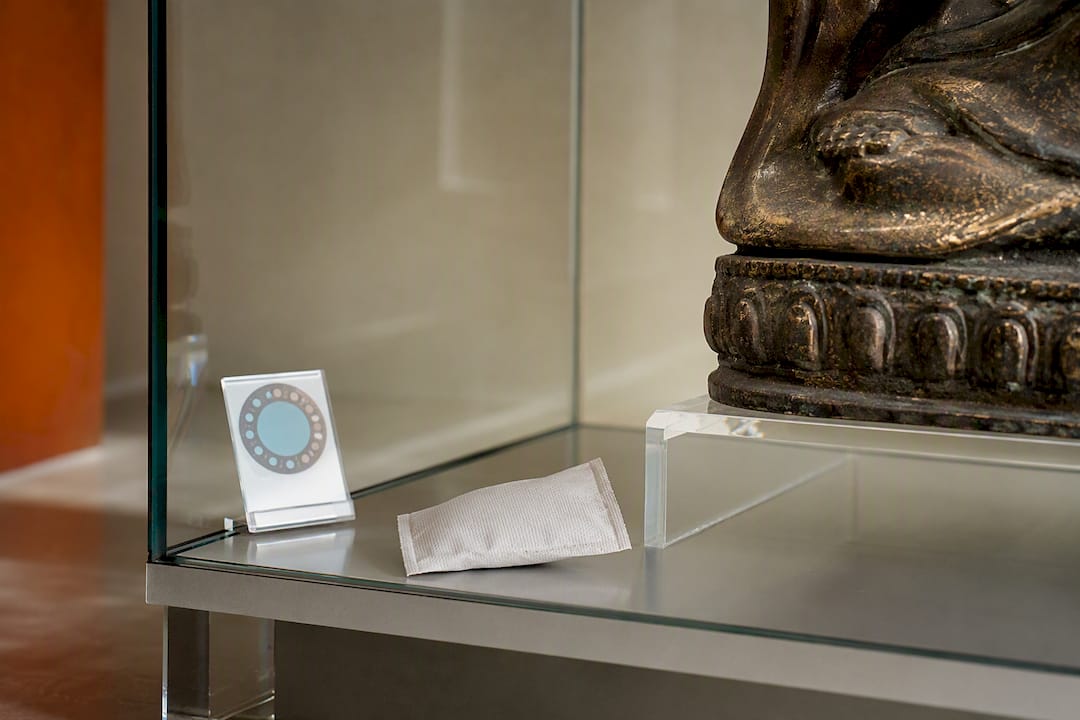
Keep treated bronzes away from exterior walls, windows, and HVAC vents, all of which create humidity swings even in an otherwise controlled room. If the piece travels for exhibition or sale, pack it with its own microclimate, a sealed bag with conditioned silica gel, rather than relying on the transit case’s ambient air. Revisit the object visually every time it is unwrapped or moved, since handling itself is one of the more common moments a dormant reservoir gets exposed to enough humidity to restart.
Objects that have gone a full year without any sign of new powder or blistering can move to a standard monitoring schedule, but “cured” is a relative term with chloride corrosion. Treat continued vigilance as part of ownership, not a phase that ends.
Real-World Treatment Outcomes: What Success and Failure Look Like
Two patterns show up repeatedly in conservation casework. The first is the slow, conservative success story: a small bronze coin or figure with mild surface pustules, run through a sesquicarbonate bath over eight to twelve weeks with regular solution changes, finished with BTA and wax. These cases tend to stay stable for years because the underlying chloride burden was shallow enough for a gentle bath to reach.
The second pattern is the archaeological piece with deep, long-buried chloride contamination, the kind found in excavated coin hoards or river-recovered figures. These objects often need electrolytic reduction or repeated dechlorination cycles, and even then, conservation guidance acknowledges that a full chloride purge is rarely achievable. Success in these cases looks like extended dormancy under controlled humidity, not permanent elimination.
The variable that predicts outcome better than any single treatment choice is how early the intervention happens. A coin caught at the first sign of pale powder responds well to a gentle bath. The same coin left untreated for another year, with pustules bursting through multiple points on the surface, often needs mechanical removal aggressive enough to lose fine surface detail permanently. Timing, more than technique, decides how much of the object survives intact.
Why Alloy Composition Changes the Disease Risk
Not all bronze is equally vulnerable, and the alloy recipe matters more than most collectors realize. Traditional Southeast Asian and South Asian bronze casting often used higher tin or leaded-bronze formulations, and those compositional differences change both how fast chloride corrosion progresses and how the metal responds to treatment. Our overview of ancient Asian bronze casting covers how regional alloy traditions differ in tin, lead, and copper ratios.
Higher-tin bronzes tend to form denser, more protective patina layers initially, which can slow the onset of chloride attack. Leaded bronzes, common in many temple castings, have softer grain structures that let chloride migrate more readily along internal boundaries, which is part of why some archaeological figures show disease spreading from the inside out rather than starting purely at the surface. Objects that were originally buried in marine or coastal soil carry a heavier initial chloride load than those recovered from dry inland sites, regardless of alloy, which is why provenance and find-site history are worth recording alongside any condition report.
Treatment response follows the same logic. A high-tin bronze often tolerates a longer sesquicarbonate bath without surface damage, while a softer leaded alloy may need gentler handling and shorter bath cycles to avoid disturbing fragile original patina. There is no universal alloy that resists bronze disease outright, but knowing the general composition of a piece, even an approximate regional attribution, helps set realistic expectations for both risk and recovery.
HDAsianArt’s View on Caring for Collectible Bronzes
HDAsianArt curates antique bronze statues from Cambodia, Thailand, Indonesia, and beyond, and our approach leans conservative: stabilize first, document everything, and refer active chloride cases to qualified conservators rather than attempting aggressive in-house cleaning. Every listing includes condition notes so buyers know exactly what they are acquiring. If you’re considering a piece like this antique Javanese Avalokiteshvara Bodhisattva statue, ask about its patina history before you ask about price.
— James, HDAsianArt.com
Where to Read More on Bronze Disease Treatment
For deeper technical grounding, start with Getty’s bronze sculpture guidelines on chloride chemistry and prevention, the peer-reviewed dechlorination study on NaOH and electrolytic methods, Cardiff University’s conservation notes on zinc dust versus silver oxide, and NumisLens’s step-by-step treatment guide for a practical collector workflow. For related corrosion questions, British Chains’ guide to tarnish versus patina offers a useful comparison across metal types.
Sources
- Guidelines for the Technical Examination of Bronze Sculpture | Patina
- Quantitative study of NaOH desalination and electrified dechlorination mechanisms
- Bronze Disease: Even Metal Gets Sick - CU Conservation - Cardiff University
- Bronze Disease Treatment: A Step-by-Step Guide | NumisLens
