



Benefits of Bronze Statues for Spiritual Grounding
Benefits of Bronze Statues for Spiritual Grounding
Table of Contents
- Why Bronze Statues Anchor a Spiritual Practice
- The Bronze Buddha Statue Meaning: Stillness, Stability, and Compassion
- Choosing a Buddha Statue for Meditation Space
- Spiritual Statues for Home Altar: Placement and Respect
- A Step-by-Step Grounding Practice Using a Bronze Statue
- Bronze Versus Other Materials: What the Metal Adds
- Care, Safety, and Everyday Upkeep
- Conclusion
- Frequently Asked Questions
Why Bronze Statues Anchor a Spiritual Practice
A bronze statue works as a grounding object because it gives the body something fixed to return to. The weight, the unchanging posture, the way light moves across a dark surface: these are physical cues that pull attention out of mental noise and into the present. At HD Asian Art, we have spent years watching collectors describe the same thing in different words. They do not usually say the statue changed their life. They say the room feels different when it is there.
That is the honest version of the benefits of bronze statues for spiritual grounding. Not magic. A visual and tactile anchor that reinforces a practice you already intend to keep.
It helps to separate two kinds of benefit that are often blurred together. The first is symbolic: a figure encodes stillness, stability, and compassion, and those meanings matter to the person who chose it. The second is environmental and behavioral: a consistent visual cue in a fixed location can support a routine, and routines are what most meditation teachers actually credit for change. Neither claim requires a statue to do anything supernatural. Both are stronger when the object is heavy, stable, and visually unchanged from one day to the next, which is exactly what bronze provides.
Research published in Heritage Science on the hidden contents of Tibetan bronze statues documents that many Tibetan bronze figures were made with hollow interiors holding sealed relics, which tells you these objects were never purely decorative. They were built to hold meaning.
That history is worth knowing because it reframes what you are buying. A bronze figure is not a mood board item with a spiritual label. It is a made object with a tradition behind it, and treating it as such, placing it deliberately, returning to it consistently, is what turns a sculpture into a practice support.
Below, we walk through what the metal actually contributes, how to choose a piece for a real room, and a short practice you can run tomorrow morning.
The Bronze Buddha Statue Meaning: Stillness, Stability, and Compassion
The bronze Buddha statue meaning sits in three qualities the figure encodes: stillness, stability, and compassion.
Stillness shows up in the posture. Seated figures do not fidget. Stability comes from the material itself, because bronze has mass and does not shift when a shelf is bumped. Compassion appears in the hand gestures and the downward gaze, which practitioners read as attention turned toward others rather than inward.
A common mistake is treating the figure as a mood board. The meaning is not in the silhouette. It is in what the silhouette reminds you to do.
Choosing a Buddha Statue for Meditation Space
Selecting a Buddha statue for meditation space comes down to one test: does the figure hold your attention without demanding it? If you have to rearrange the room around the piece, it is too large. If you forget it is there, it is too small.
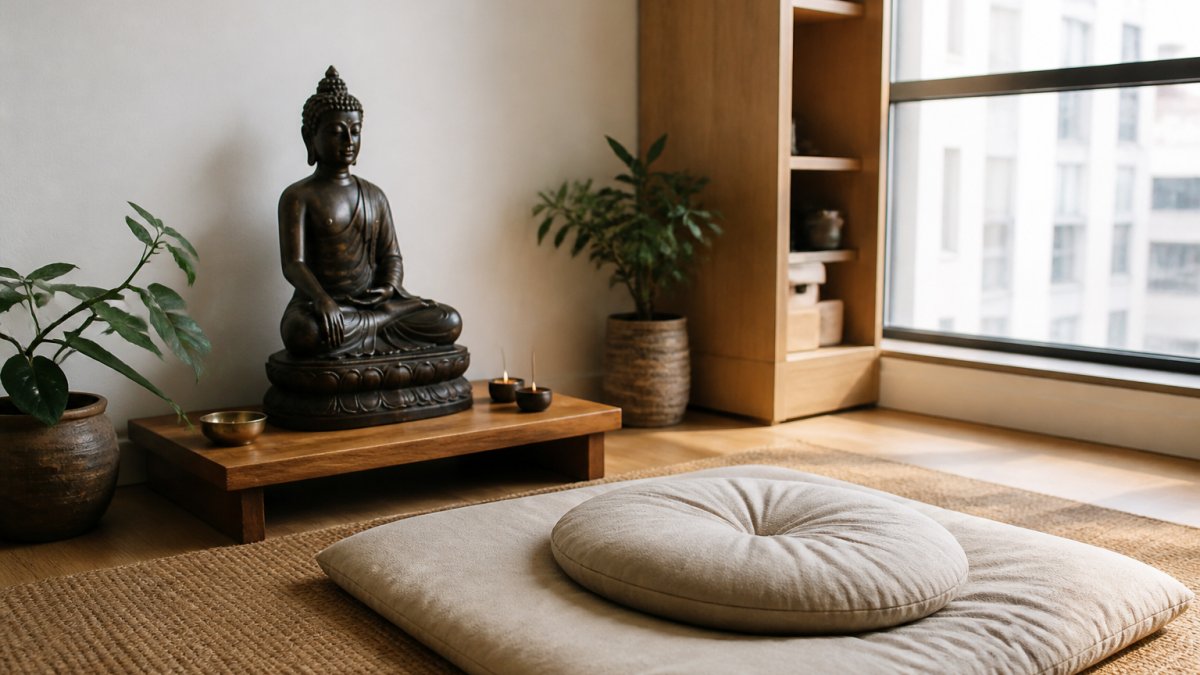
Scale, Gaze, and Posture in a Small Corner
Small rooms are not a limitation. They are the normal case.
- Scale: a figure between roughly 15 and 30 cm tall suits a corner altar or a low shelf without crowding it
- Gaze: set the eyeline at or slightly below your own seated eye level, so the face meets you when you sit down
- Posture: seated figures read as settled; standing figures read as presence and arrival
HD Asian Art curates Buddhist and Hindu pieces specifically for altars and compact meditation spaces, so scale is something you can judge from the listing rather than guess at.
Spiritual Statues for Home Altar: Placement and Respect
Spiritual statues for home altar use follow a simple principle: the figure belongs where the practice happens, not where the foot traffic is. A hallway console looks elegant and does nothing for grounding. Placing the bronze figure in a quiet corner transforms the space into a sanctuary where spiritual grounding practices become a steady rhythm in the daily reminders of God's love.
Place the piece on a surface that is stable and slightly elevated. Keep it clear of clutter, cables, and anything you would have to move to sit down. Face it toward the room, or toward your cushion if the room allows.
Indoor and Outdoor Display Considerations
Indoors, bronze is forgiving. It tolerates normal humidity and does not need direct sun. Outdoors, a covered porch or sheltered garden niche works better than open exposure, where constant moisture and temperature swings do more work on the surface than most people expect. A patina developing over time is normal and, for many collectors, part of the appeal.
A Step-by-Step Grounding Practice Using a Bronze Statue
A grounding practice does not need to be elaborate. Twenty minutes, done consistently, beats an hour done once.
- Set the room. Sit facing the statue at the distance where the face is clearly visible but the whole figure fits in your view.
- Settle the body. Three slow breaths, hands resting on your knees or lap.
- Anchor the eyes. Rest your gaze on the statue's hands or the point where it meets its base. Soft gaze, not a stare.
- Name the quality. Silently note the quality you are working with that day: stillness, steadiness, or compassion.
- Hold for five to ten minutes. When attention drifts, return to the anchor. Drifting is the practice, not a failure.
- Close deliberately. One breath, a short bow if that fits your tradition, then stand.
Run it daily for two weeks before judging whether it works. Most people quit on day three because the mind is loud, which is exactly the point at which the anchor starts earning its place.
Bronze Versus Other Materials: What the Metal Adds
Most guides to spiritual statues treat material as a decor decision. For grounding, material is the mechanism. The metal determines how the object feels in the hand, how it holds a room, how it ages, and how reliably it returns your attention to the same physical cue day after day.
Here is how bronze compares with the materials a grounding statue is most often made from.
| Material | Weight and stability | Surface and feel | Behavior over time | Best for |
|---|---|---|---|---|
| Bronze | Heavy, resists tipping and nudging | Cool to the touch, dense, with a subtle grain under the patina | Develops a patina; stable indoors | Daily practice, heirloom pieces, altar centerpieces |
| Brass | Moderate to heavy, lighter than bronze at the same scale | Warm yellow tone, brighter reflectivity | Tarnishes; can be polished back | Smaller altars, brighter rooms |
| Stone | Very heavy, immovable once set | Cold, matte, porous | Can stain or chip; sensitive to moisture | Garden niches, permanent installations |
| Wood | Moderate, can warp or crack | Warm, light-absorbing | Moves with humidity; cracks in dry air | Warm interiors, lighter shelves |
| Resin | Light, can shift when bumped | Uniform, flat, often painted | Stable but visually static | Budget decor, high shelves, outdoor seasonal use |
| Plaster | Fragile, chips at edges | Porous, marks easily | Absorbs moisture; surface degrades | Temporary or seasonal setups |
The difference that matters for grounding is not prestige. It is sensory consistency. A bronze figure has a temperature and a density that a resin cast does not, and that physical presence is what makes it function as an anchor rather than a picture of one. When you rest your gaze on the same patinated surface each morning, the cue is identical to the one your brain registered yesterday. Resin and plaster can look similar in a photograph, but they do not deliver the same unchanging tactile signal.
Weight also changes behavior. A heavy piece stays exactly where you set it, so the geometry of your practice space does not drift. A light piece gets nudged, rotated, or moved to dust around, and each small change weakens the association between the object and the moment of sitting down.
Bronze is not the right answer for every room. A very small shelf, a child-height surface, or a rental where nothing can be mounted may favor a lighter piece. But when the goal is a stable, sensory-rich anchor for a practice you intend to keep, bronze earns its place through physics rather than symbolism.
Care, Safety, and Everyday Upkeep
Keep the piece dry, dust it with a soft dry cloth, and leave the surface alone. Handling bronze with bare hands transfers oils that dull the finish over time, so lift it by the base when you need to move it. On a high shelf or in a home with children and pets, secure the base with a museum putty or a non-marking pad.
Conclusion
The real test of a grounding object is whether you return to it on the days you least feel like sitting down. Bronze earns that return because it is heavy, quiet, and unchanging in a way that most things in a home are not.
HD Asian Art curates Buddhist and Hindu statues, Khmer and Southeast Asian sculptures, and temple-inspired pieces chosen for altars and meditation spaces. Every order ships free, and each piece is selected to hold a room rather than fill it. Browse the collection and find the figure your practice keeps coming back to.
Frequently Asked Questions
Why is bronze preferred in the making of statues?
Bronze holds detail well, resists wear, and gains a patina that deepens with age, which is why so many bronze statues survive for centuries. That weight and stability make a bronze piece feel planted wherever you set it, which supports the sense of stillness people want in a meditation space. Research published in Heritage Science in 2026 also notes that Tibetan bronze statues often have relics sealed inside their hollow interiors, adding a layer of sacred context to the material.
How can a statue support a grounding meditation practice?
A bronze statue gives your attention a fixed point. Sit facing it, let your gaze rest on the posture and hand gestures, and use the weight of the piece as a visual cue for settling. A simple routine works well: three slow breaths, a few minutes of steady gazing, then eyes closed while you hold the image. The statue becomes a visual reminder that pulls you back when your mind drifts, and the practice gets easier the more consistently you return to it.
Where should you place a spiritual statue in a meditation space?
Choose a spot at or slightly above eye level when you are seated, on a stable surface that will not be bumped. Keep it away from clutter, direct heat, and high-traffic walkways. A corner with a low stand works in small apartments, and a dedicated shelf works in larger rooms. Face the statue toward where you sit so its gaze and hand gestures are visible during practice, and avoid placing it where it competes with a television or busy screen.
What should you consider when choosing a bronze statue for an altar?
Start with the size of your altar and the height you will view it from, then choose a piece that fits without crowding. Check the posture and hand gestures, since these carry specific meaning and should match the tone you want. Ask about provenance and craftsmanship before you buy, especially for higher-value pieces. If the piece is sacred to you rather than decorative, confirm the details in person or through detailed photos so it does not feel hollow once it arrives.
