



Which Way Does Buddha Face in a UK Home? a Practical Guide
Which Way Does Buddha Face in a UK Home? a Practical Guide
In a UK home, a Buddha statue usually faces into the room, toward the people who sit with it. East or north-east is a customary preference tied to sunrise and the Buddha's awakening, not a universal rule that overrides how a room works.
Most of the advice you'll find online treats "face east" as though it were a commandment. It isn't. The guidance that holds up for British homes puts sightline, height and stability first, then treats compass direction as a refinement you apply if the room allows it. Root and Still's UK buying guide makes the same call: facing the main living space beats a compass point that forces the figure into an awkward corner.
Table of Contents
- Which Way to Face a Buddha Statue at a Glance
- Where the East-Facing Idea Comes From
- How the Statue's Pose Sets Its Orientation
- Step-by-Step Placement Method and Physical Checks
- Room-by-Room Examples in British Homes
- Confirm the Placement Before You Commit
Which Way to Face a Buddha Statue at a Glance
Facing into the room does two things at once. It keeps the figure visible from the sofa, the meditation cushion or the chair you use, and it stops the statue reading as décor that has been turned to the wall. A Buddha facing out of a window into a garden is a beautiful object with its back to the household, which is rarely what someone intends when they clear a shelf for it.
Compass direction sits on top of that decision, not underneath it.
Below is a starting orientation for each setting a UK household is likely to have. Read it as the first option to test, not a verdict. The first column names the room, the second gives the orientation to try, and the third explains why it works.
| Setting | Starting orientation | Why it works |
|---|---|---|
| Shared living room with a calm focal wall | Into the room, toward main seating | Visible to everyone who uses the space |
| Dedicated meditation corner | Toward the seated practitioner | Keeps the image in the practitioner's line of sight |
| Entrance hall or porch | Facing inwards, toward people coming in | Suits a welcoming or protective role |
| Bedroom | Into the room, not toward the foot of the bed | Avoids a figure aligned with the bed's foot |
| Room where a window fills the only suitable wall | Into the room, with the face out of glare | Glare hides the face and can block light |
| Compact flat with no fixed altar wall | Free-standing shelf, facing into the room | Practical compromise when layout limits choice |
| Shrine room in a Buddhist community | Follow the lineage or teacher's guidance | Tradition and local custom override general advice |
Find the row closest to your room and test that orientation first. If it fails on a physical check, such as glare on the face or a shelf too shallow for the base, move to the next sensible option rather than forcing it.
The rest of this guide separates the east-facing custom from placement mechanics, then gives you a method you can run in an afternoon.
Where the East-Facing Idea Comes From
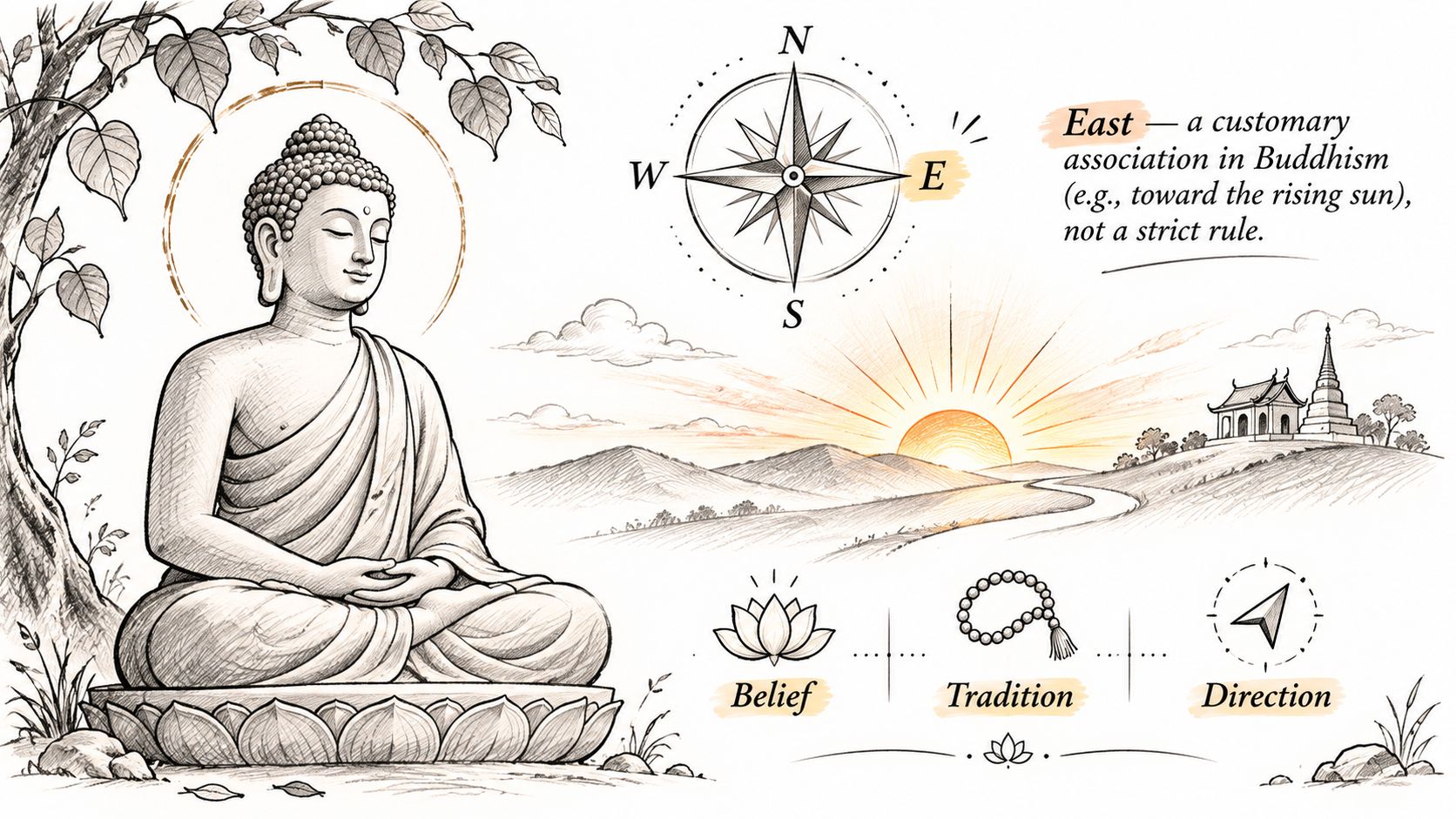
East carries weight because of sunrise and awakening. Buddhist traditions link the Buddha's awakening to the eastern direction, and temple layouts align sacred images with entrances, courtyards and ritual approaches, so a person moving through the building meets the figure along a deliberate path. Household shrines copied that logic on a smaller scale.
No single direction is universally prescribed, in Britain or anywhere else. Orientation depends on the tradition, the statue's iconography, the building's layout and what the image is for. The rule you see repeated in placement guides is better described as a customary association: east-facing is a meaningful traditional option, and it does not bind every Buddha image in every home. I treat it as the first hypothesis worth testing, and I drop it without hesitation when the room argues back.
The scale of the community, and why the census can't set a rule
The 2021 Census for England and Wales recorded 272,508 people identifying as Buddhist, equal to 0.5% of the population, according to the Office for National Statistics religion data. For comparison, Our World in Data's religion figures put the United Kingdom at approximately 310,000 Buddhists in 2020.
That 0.5% figure gets quoted constantly in placement articles, usually to imply a shared practice. It shows nothing of the kind. The census measures religious identification, and that single category gathers people from many different traditions and cultural backgrounds. A number about affiliation says nothing about whether a household keeps an altar, follows a particular school, or cares which wall the statue is on.
A census counts affiliation. It cannot tell you which way anyone's statue faces, because it never asked.
Theravada, Mahayana and Vajrayana communities keep different customs, and some lineages give no compass direction at all. A Thai forest tradition shrine, a Tibetan altar with seven offering bowls and a Japanese butsudan are not arranged to the same template. Treating them as interchangeable is where the east-facing shorthand goes wrong.
The pose narrows the answer
Reach for the compass last. Identify what the figure is doing first, because a seated figure drawn inward wants a different sightline from a standing figure read as movement. The role shapes the presentation, and in a British room the physical checks carry more weight than the compass point. Height off the floor, a stable base and a clean line of sight to the face decide whether a placement holds; the bearing only decides which wall you try first.
How the Statue's Pose Sets Its Orientation
The mudra, the hand gesture, is the clearest clue to what a figure is for, and it settles the placement question before you've thought about walls. HD Asian Art's product descriptions set out the symbolism of each pose and mudra, so you can identify the role before buying rather than guessing from a photograph. The guide to the meanings behind the Buddha's positions is the place to check which gesture you're looking at.
Meditation figures, seated with hands cupped in the lap, turn inward. Put one at seat level where you sit, so the face meets your eye line directly. A meditation figure placed high on a wall bracket above head height loses the quality that makes it useful.
Teaching figures, one hand raised with palm outward and thumb and forefinger joined, address the room. These work facing into a main living area where the household can see them during ordinary use, not tucked into a corridor.
Protective or blessing figures, with an open palm raised and fingers together, suit an entrance or hall where they meet people coming in. Keep them clear of the door's swing and out of the path where bags and coats get dropped.
Standing and walking figures are judged on sightline and stability more than anything else. A customer in London described a walking Buddha as very well moulded and finely detailed, and said it looks beautiful in the hall facing visitors, which is exactly the role that form suits.
Decorative pieces in a collection or a museum-style display can be oriented for the viewer. There's no ritual relationship to protect, so light, sightline and the object's own best angle decide it.
The gesture is the most reliable indicator of intended role, and the role is what you settle first. Everything after that is measurement.
Step-by-Step Placement Method and Physical Checks
Run these in order. Each step rules something out, so by the end you've narrowed the room to one position rather than debating six.
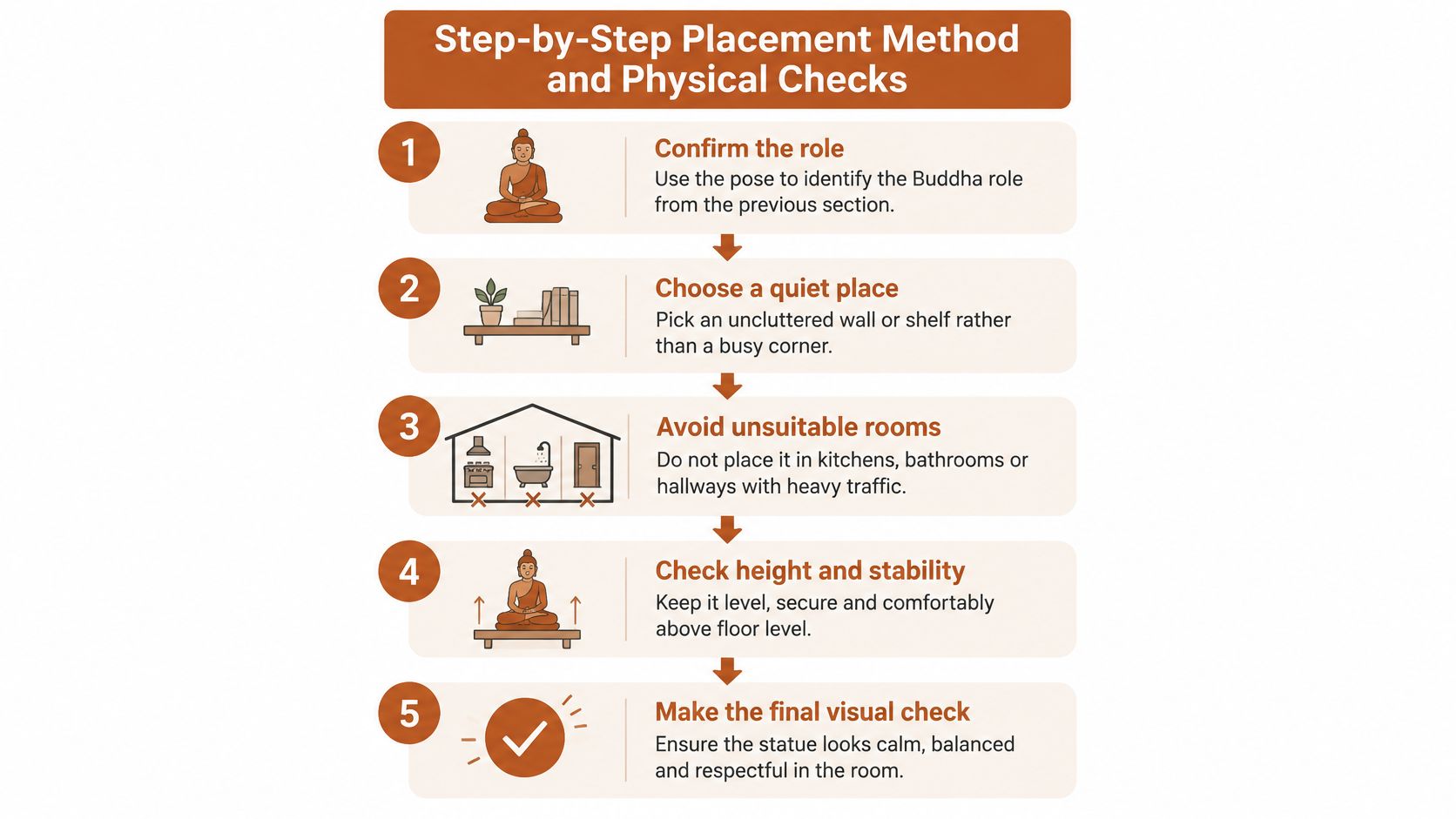
- Confirm the role from the pose. Meditation, teaching, protection or display, using the section above. This decides whether the figure faces a person or a room.
- Choose a quiet, uncluttered wall or shelf over a busy corner. Skip kitchens, bathrooms and hallways with heavy foot traffic entirely.
- Set the height at eye level or higher when you're seated, on a raised shelf or altar. HD Asian Art's Buddhist home altar layout guide recommends exactly this: a raised position in a clean, quiet spot, well off the floor.
- Check the base. The full base should sit flat on a stable surface. Never on the floor, never on a wobbly console, never balanced with an overhang at the front edge.
- Check the sightline from your usual seat. The face should point into the room or toward the practitioner. If you can't see the face from where you sit, the orientation hasn't solved anything.
- Test east and north-east with a compass app, then reject any option that puts glare on the face, blocks a window or lands the statue in a traffic path. Standing in the spot with the phone held flat is enough; you don't need a proper compass.
- Reject alignments that fail on respect. As a matter of general placement practice, a direct line to a bathroom door, a mirror facing the image, the foot of a bed, staircases, sloped ceilings and overhead beams are all out. HD Asian Art's display guidance covers the everyday version of the same idea: keep the statue clean, raised from the floor, and away from bathrooms, cluttered areas and anywhere it would be treated casually.
Sightline and respect come first. A steady north-facing shelf beats a cramped east-facing spot every time, and no amount of correct compass work rescues a figure squeezed between the bin and the recycling.
The physical checks worth running before you commit
| Factor | Suitable placement | Avoid |
|---|---|---|
| Height | Eye level or higher when seated | Floor level or sitting on the floor |
| Shelf depth | Statue height roughly one-third to one-half of the surface depth | Oversized or tiny figure on a deep, bare shelf |
| Base and surface | Full base supported on a stable surface | Wobbly console or edge-balanced figure |
| Room type | Living room, quiet corner or meditation space | Kitchens, bathrooms and busy hallways |
| Alignment | Clear sightline without a direct line to the bathroom door | Foot of bed, staircases, sloped ceilings or beams overhead |
| Reflections | No mirror reflecting the image | Mirror opposite the statue |
| Cleanliness | Dusted, clear surround, handled with care | Clutter, casual handling or dust build-up |
Room layout drives most of these decisions, so think about furniture arrangement before you drill anything into a wall. A short guide to how to arrange furniture in a room helps you find the calm sightline first, then place the statue into it.
Proportion is the detail that catches people out. A tall figure on a deep, empty console looks marooned, and a small figure on the same shelf disappears. Check the pair together against the table above before you commit to the spot.
Room-by-Room Examples in British Homes
A meditating figure and a teaching figure do different work in the same room: one turns inward, the other addresses whoever stands in front of it. Read the meaning of Buddha statue poses and mudras before deciding which way either should sit, because the symbolism tells you what the figure is doing. Beyond the pose, British rooms are compact, often rented, and frequently open-plan, so blanket directional advice fails quickly. Six settings show how the same decision plays out.
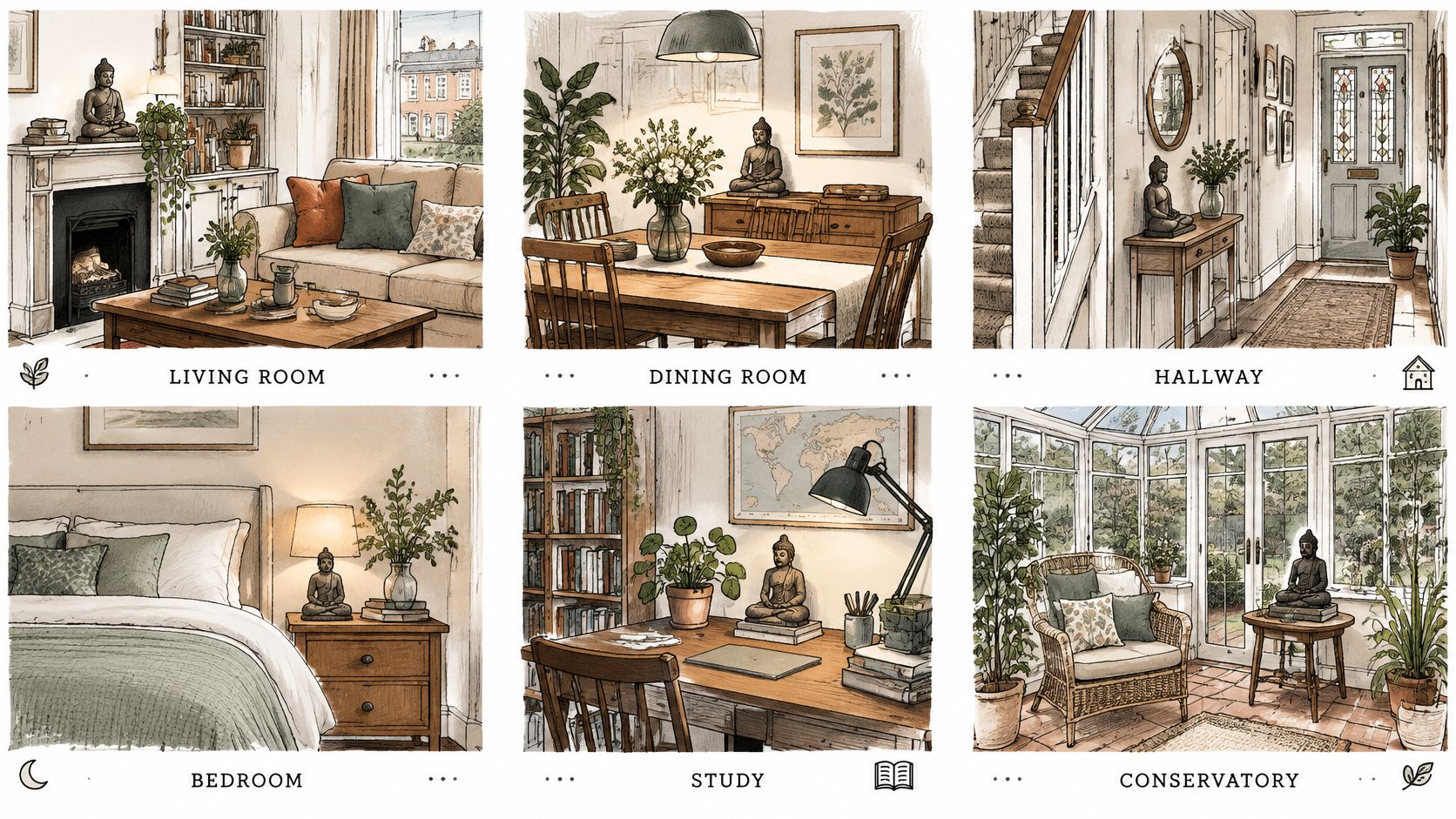
A terraced living room with a wide chimney breast. The statue sits on a raised sideboard, facing into the room toward the sofa. The chimney breast supplies a natural focal point; the raised position and clear surround supply the etiquette. A customer said their piece occupies pride of place in their lounge room, which is exactly this arrangement.
A meditation corner in a box bedroom. A small shelf by the window, angled so the seated practitioner sees the face without glare from the glass. If the window wall happens to face east, the traditional direction falls into place on its own. Keep the foot of the bed out of line with the figure.
A hallway with a narrow console. The figure faces inward toward people coming in, clear of the front door's swing. Depending on the pose, that reads as welcoming or protective. Check the console depth against the figure's height, because a narrow shelf exaggerates any mismatch. A customer in London keeps a walking Buddha in the hall facing visitors, and it looks beautiful there.
A home office. On a bookcase at eye level, away from the desk's clutter and the cable run. Etiquette, mostly. Nobody wants a Buddha behind a tangle of chargers.
A conservatory. Out of direct sun, away from the damp corner where condensation gathers. Pure practicality. Wood and resin both suffer in a spot that swings between hot afternoons and cold nights.
A rented flat with no fixed wall. A free-standing shelf that can move with you, facing into the room. A practical compromise with no tradition attached, and honest about it.
Orientation cannot compensate for disrespectful surroundings. A statue on the correct compass point but sitting on the floor beside clutter is worse placed than one facing an unconventional direction from a clean, raised shelf.
If you're building a corner from scratch, HD Asian Art's step-by-step guide to creating a sacred space with a Buddha statue covers the wider arrangement. The room's proportions usually settle the answer before the compass does. In a living room, work out how to plan a living room layout before you position the statue, because the sightline you create with the sofa decides where it can go.
Confirm the Placement Before You Commit
Four things should be true before you stop moving furniture. You tested the direction from your usual seat, not from the doorway. The face points into the room or toward the practitioner. The statue sits at eye level or higher on a surface that supports its full base. And it's clear of bathrooms, kitchens, mirrors and the foot of the bed.
If any one of those fails, fix it before you think about the compass.
Then decide which kind of object you own. For devotional use, ask a local temple, Buddhist centre or teacher before settling on a direction. Lineage guidance outranks anything general you'll read online, and a teacher who knows your practice will give a better answer than a blog post. For decorative use, the same respect for surroundings still applies, even though the ritual relationship doesn't.
Write the chosen position down, photograph it, and look again after a week. Rooms reveal their problems slowly: the afternoon glare you didn't notice, the shelf that gathers dust, the corner the household keeps dumping post in.
That week of use is the check many skip. It's also the one that tells you whether the placement works.
Two things help the room settle around it. A candle or two, chosen for a low, even burn rather than scent, sets the tone for a corner used in the evening; this guide to the best candles for meditation covers which waxes and wicks perform best in a small room. And the daily care routine matters more than the orientation: HD Asian Art's guidance on how to worship and respect a Buddha statue covers handling and display in detail, which is where most placement mistakes show up.
The question of which way a Buddha faces has a short answer and a long one. The short answer is into the room, toward the people who use it. The long answer depends on the pose, the lineage, and the wall you've got.
HD Asian Art supplies Buddha statues by region, from Burmese and Thai pieces to Japanese and Sri Lankan forms, and each listing explains the pose and mudra so you know what the figure represents before it arrives. If you're settling a placement question, start with the pose, then choose the statue that suits the room you have. Visit HD Asian Art to browse the current collection and the Collector's Journal guides on display, care and iconography.
