



Symbol for Meditation: Meanings, Uses and How to Choose
Symbol for Meditation: Meanings, Uses and How to Choose
Choosing whichever meditation symbol looks most peaceful isn't always good advice. A Buddha image, a mandala and a string of mala beads aren't interchangeable accessories. Each can serve a different purpose, and some belong to practices that need more context than a decorative label provides.
The useful question isn't just which symbol for meditation looks right in your room. It's what you want to practise, what the symbol means, and whether having an object helps you pay attention at all. Sometimes the most suitable choice is an uncluttered space with no symbol.
Table of Contents
- Meditation Symbols at a Glance
- Posture and Mudras in Buddha Images
- Mandalas and Mala Beads as Working Tools
- Regional Origins and Lineage Matter
- How to Set Up an Altar or Meditation Corner
- Where Symbols Help and Where They Stop
- Choosing Your Symbol and Starting Practice
Meditation Symbols at a Glance
A symbol for meditation is an image or object that gives attention a place to rest. It may also express a teaching, recall an event or support devotion. The same form can carry different associations across traditions, so begin with its purpose rather than its appearance.
Common meditation symbols, meanings and best use
| Symbol | Core meaning | Main tradition | Best used for |
|---|---|---|---|
| Lotus | Purity and spiritual potential | Buddhist, Hindu | Calm focus on growth |
| Buddha in seated pose | Stillness and awakening | Buddhist | Seated practice and reference |
| Bodhi tree | The Buddha's awakening | Buddhist | Reflection on insight |
| Mandala | The cosmos and the individual | Buddhist, tantric | Visualisation practice |
| Mala beads | Counting repeated mantras | Buddhist, Hindu | Mantra recitation |
| Om | Sacred sound | Hindu, Buddhist | Mantra focus |
| Dharma wheel | The path to enlightenment | Buddhist | Study and teaching |
| Empty throne | The Buddha through absence | Buddhist | Practice without a human-form image |
The lotus, seated Buddha and Bodhi tree belong together as reminders of spiritual development, but they emphasise different things. The lotus suggests potential, the seated figure presents contemplative composure, and the tree recalls a particular awakening.
The mandala, mala and Om connect more directly with ways of practising. A diagram offers visual structure, beads keep count, and a sacred sound supports recitation. Owning them doesn't mean you're using the practices they accompany.
Starting test: Name your practice, then your intention. Choose the row that matches both, rather than the object that happens to match your furnishings.
The dharma wheel is especially useful as a teaching reference. The empty throne challenges the assumption that meditation needs a human figure at its centre. Treat the table as an orientation, not a rulebook: calm focus, devotion and repetition aren't the same activity.
Posture and Mudras in Buddha Images
Two seated Buddhas can look calm in the same way and mean different things. The difference sits in the hands. A posture sets the body for stillness. A mudra gives that stillness a subject.
The seated lotus posture communicates physical stability, inward attention and withdrawal from everyday activity. It works like a road sign, giving a visual instruction before any label is read. The lotus adds purity and spiritual potential, rising clean from muddy water.
Historical scholarship on Buddhist meditation in Britain identifies 1853 to 1945 as a formative period and records the British Museum's acquisition of a seated monk in lotus posture in 1879.
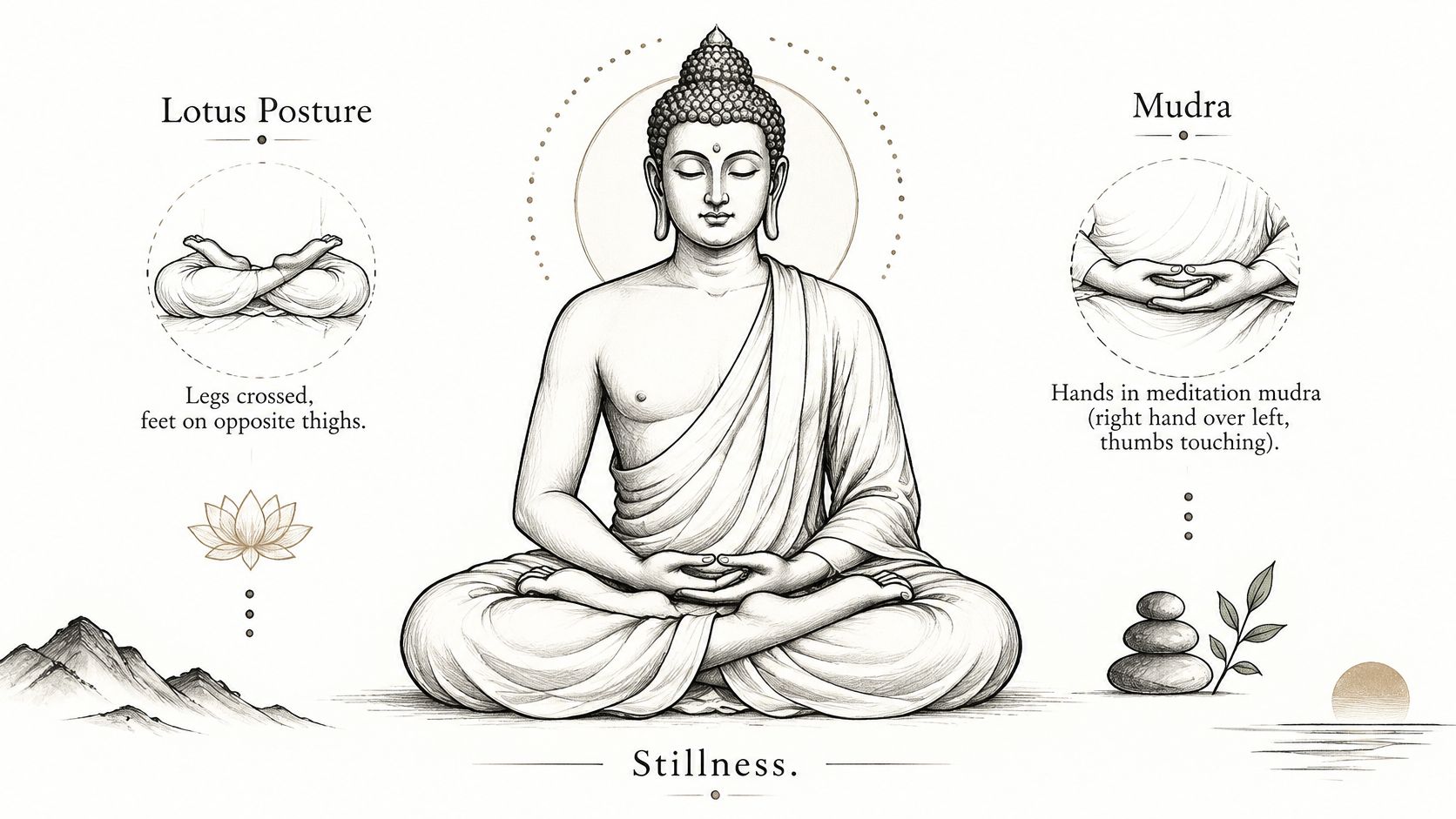
Read the hands before choosing
A mudra is a meaningful gesture. Learn five and most confusion clears.
Common mudras and what they signal
| Mudra | Hand position | Meaning | Suits |
|---|---|---|---|
| Dhyana | Hands in lap, palms upward | Meditative concentration | Quiet sitting practice |
| Bhumisparsha | Right hand touches the ground | Awakening, earth as witness | Awakening and teaching themes |
| Vitarka | Right hand raised, thumb and index finger touching | Teaching and discussion | Study sessions |
| Abhaya | Right hand raised, palm outward | Fearlessness and protection | Calm reassurance |
| Varada | Hand lowered, palm outward | Generosity and granting wishes | Devotional and giving themes |
Dhyana expresses meditative concentration. Choose it when the image should correspond directly with quiet sitting, rather than a particular narrative event.
Bhumisparsha recalls the Buddha calling the earth to witness his awakening. It suits contemplation of that event and teaching centred on awakening.
Vitarka signifies teaching and discussion. It makes a fitting reference beside texts or in a space used for learning.
Abhaya expresses fearlessness and protection. Its open palm can serve as a reminder of reassurance. It does not imply that a statue physically protects its owner.
Varada conveys generosity and granting wishes. Use it to reflect on giving or within an appropriate devotional setting. It is not a promise that wishes will be fulfilled.
Match the image to the activity
Our guide to the meditation mudra offers a closer explanation of the lap-held gesture. Look at the hands themselves rather than relying on a product title that merely says meditation Buddha.
Interest in mindfulness has widened well beyond specialist collectors, which makes accurate distinctions more useful in ordinary homes. For selection, dhyana is the most direct fit for quiet meditation. Bhumisparsha suits awakening themes. Vitarka suits study, while abhaya and varada suit reassurance and generosity. No image does the sitting for you.
Mandalas and Mala Beads as Working Tools
A mandala and a mala ask you to do different things. With a mandala, you attend to an organised visual field. With mala beads, you follow a sequence of repetitions without keeping a running total in your head.
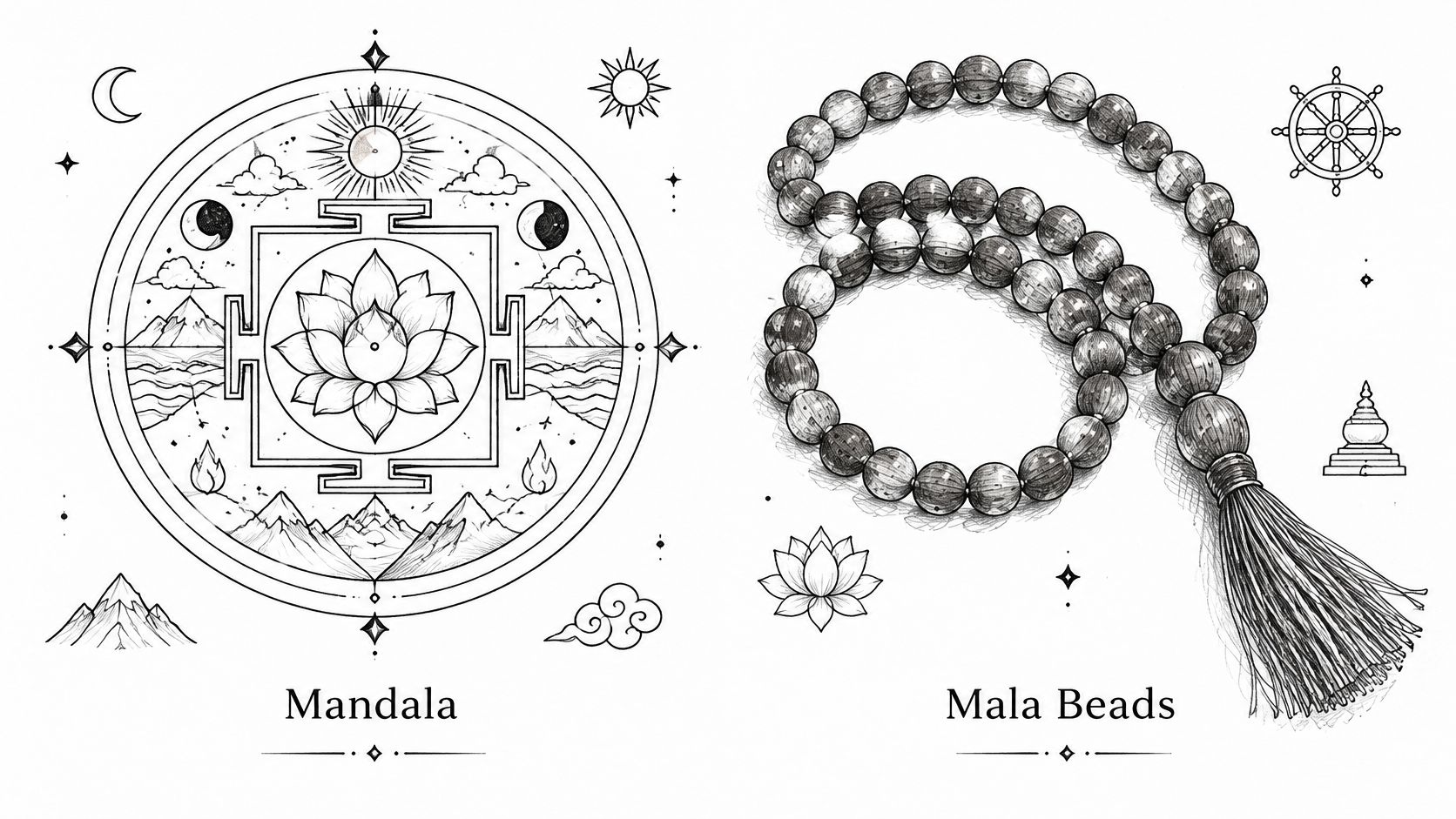
Understand the diagram
A mandala represents the cosmos and the individual within Buddhist meditation rituals and tantric practice. In the V&A's mandala hanging, the central Buddha, Vairocana, belongs to an arrangement of Buddhas and bodhisattvas associated with the Five Meditation or Wisdom Buddhas.
The centre, surrounding figures, directions and symmetry matter. Think of the diagram as an organised map, not merely an attractive circular pattern.
Before buying or displaying one, establish:
- Tradition: Which Buddhist tradition does the diagram belong to?
- Central figure: Who occupies the centre, and which figures surround it?
- Intended use: Was it made as a sacred diagram or as a contemporary decorative interpretation?
- Practice context: Does its use require instruction from a teacher?
A decorative circular design can be appreciated as art. It shouldn't automatically be described as a ritual mandala.
Use the beads for repetition
A mala is a string of beads used to count repeated mantras. Our introduction to Buddhist prayer beads explains their role in practice.
For a basic counting method, move a bead with your thumb after each repetition. Let the movement handle the counting so you can attend to the recitation. Follow your teacher's handling instructions where these differ.
If your tradition combines recitation and visualisation, begin by studying the diagram, then recite while moving through the beads and recalling the prescribed imagery. Don't combine unrelated mantras and diagrams merely because they look compatible. When finished, store the objects cleanly and respectfully, preferably raised rather than left where they may be stepped on.
Regional Origins and Lineage Matter
A country label helps identify an object, but it doesn't tell you everything about its religious use. A Buddha image from Thailand may belong to a devotional setting that a decorative catalogue barely describes. A piece from Myanmar also needs its own context, rather than being treated as an equivalent regional style.
The same care applies to Sri Lanka, India and China. Ask about the figure, gesture, associated teaching and intended setting, not just the country. None of these regions has a single, uniform way of making or using sacred images.
Contemplation isn't the same as veneration
For contemplation, you might use a seated figure or lotus as an attentional reference. You're choosing something to look towards while settling into practice.
For veneration, a shrine image may receive offerings and take a defined place within devotional life. Its care and placement belong to that relationship, not just to an interior design scheme.
| Intended role | Main question | Practical implication |
|---|---|---|
| Contemplative focus | Does this help me attend? | Keep the arrangement visually simple |
| Devotional image | How is this honoured in its tradition? | Follow appropriate guidance on offerings and placement |
| Collected artwork | What does this represent, and where did it come from? | Preserve its identity alongside its artistic value |
A Buddha statue, lotus, mandala and Om shouldn't be presented as culturally identical versions of peace. Similar personal responses don't erase different origins.
Use this origin check:
- Identify the tradition and region. Look for a description that explains more than the material and finish.
- Match the practice where possible. Choose a form that belongs with the teaching you follow.
- Be cautious with unknown origins. If you use the piece as a general focus, don't claim a ritual identity you haven't established.
Calling an unidentified piece a focus object doesn't remove the need for respectful treatment. For a UK home meditation space, clear information about origin and intended use is more useful than judging authenticity by appearance alone.
How to Set Up an Altar or Meditation Corner
You don't need to turn a whole room into a shrine. A quiet shelf and a comfortable place to sit can be a workable beginning. These are informal suggestions, not universal rules for every religious tradition.
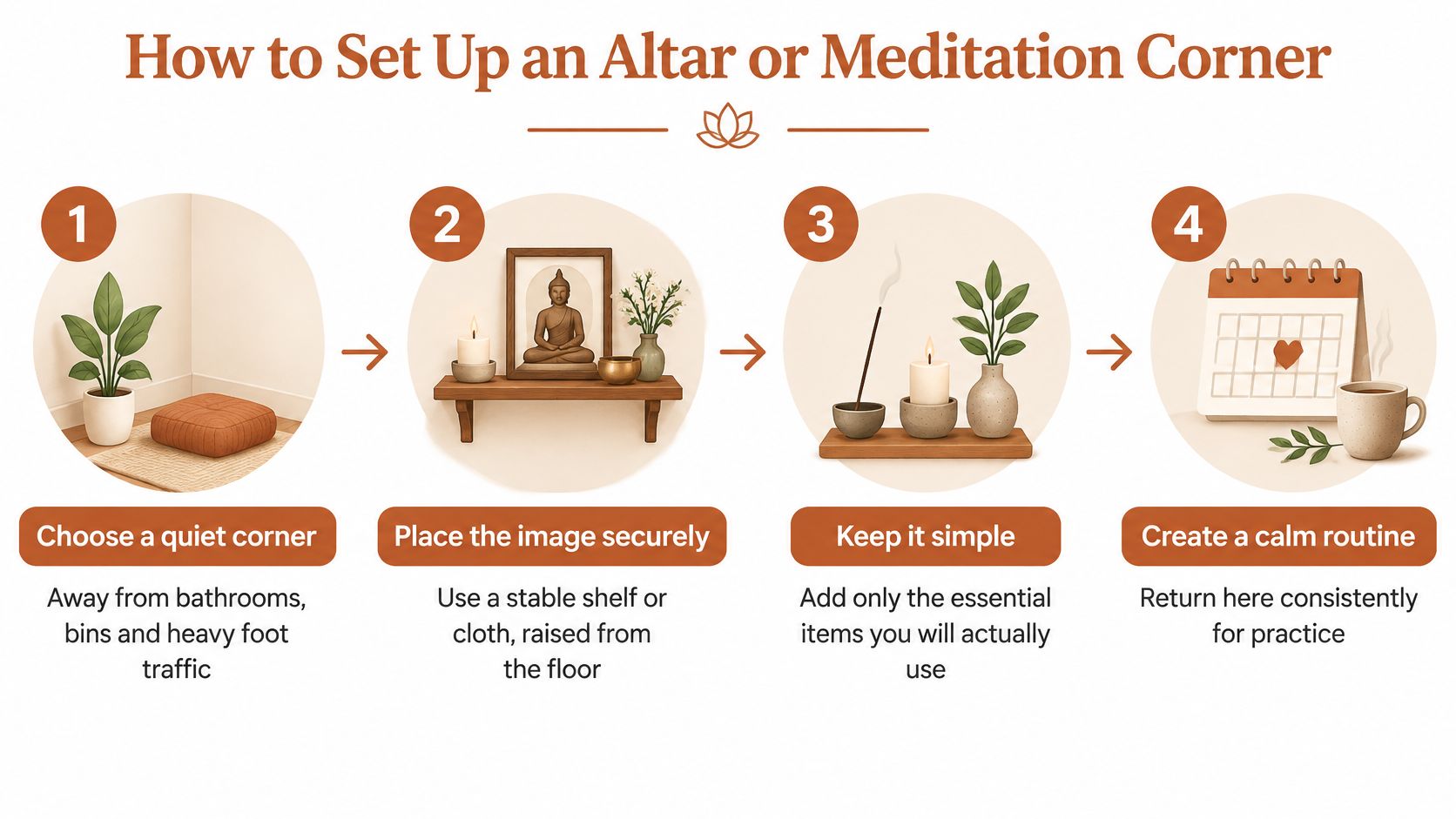
- Choose a quiet corner. Keep it away from bathrooms, bins and heavy foot traffic where possible. This separates the practice space from activities that interrupt attention or encourage casual handling.
- Place the image securely. Use a stable shelf or low table, with a cloth if suitable, raised from the floor. Raised placement expresses respect and reduces the chance of accidental knocks.
- Check seated eye level. Sit in your usual chair or on your cushion before deciding the height. You should be able to look towards the image without lifting your chin or bending your neck.
- Clear surrounding clutter. Remove packaging, spare ornaments and objects unrelated to your practice. Leave enough space to see the chosen form clearly rather than searching for it among other things.
- Add a useful companion object. A mala, cushion or candle may be enough. If you use a flame, keep it clear of cloth and other combustible materials, and never leave it unattended.
- Handle the object carefully. Support it securely when moving it and use a cleaning method appropriate to its material. Avoid rubbing fragile surfaces or applying household polish without knowing whether it's suitable.
Start small and adjust
At HD Asian Art, we offer informal guidance on creating a meditation corner or home shrine through our practical home altar guide. Add items only when you know how you'll use them.
For another perspective on a dedicated wellbeing setting, the Zen Room at Integrative Psychiatry of America provides a useful point of comparison, rather than a template every home must copy.
Sit down before calling the arrangement finished. The symbol should meet your gaze comfortably without demanding that you keep looking at it.
If the corner feels busy, remove something before buying anything else.
Where Symbols Help and Where They Stop
Evidence for meditation isn't evidence for meditation objects. A physical symbol may give you a reminder to begin or a place to rest your gaze. That doesn't establish that owning it improves mental health.
A Universities of Bath and Southampton study tested an app-delivered mindfulness intervention with 1,247 adults from 91 countries and found that ten minutes daily produced greater improvements than the control condition in wellbeing, depression, anxiety and health-related intentions, with benefits largely maintained after 30 days. The intervention was delivered through an app, not through statues, beads or sacred images.
Separate the method from the object
An NHS Foundation Trust staff mindfulness evaluation examined an eight-week course and reported lower sickness absence afterwards, but had no controlled comparison and incomplete post-course data. It therefore couldn't establish that meditation caused the change, still less that any symbol did.
Structured programmes also differ from casual attention practice. The University Hospitals Dorset NHS mindfulness guide distinguishes Mindfulness-Based Stress Reduction, intended to help people cope with stress, from Mindfulness-Based Cognitive Therapy, designed for people with recurrent depression. Displaying a lotus or following the breath beside a Buddha image isn't equivalent to either programme.
Notice when practice doesn't help
The Mental Health Foundation's mindfulness guide reports that approximately 8% of people who try meditation experience adverse effects, including increased anxiety, depression, stress or cognitive anomalies.
- Treat the symbol as a focus, not a treatment. Religious meanings of healing or protection aren't clinical guarantees.
- Stop if distress increases. Don't force yourself through a practice because the setting is supposed to feel peaceful.
- Seek appropriate support. Speak to a GP about mental-health concerns and a qualified teacher about adapting the practice.
A meaningful object can accompany care. It shouldn't replace it.
Choosing Your Symbol and Starting Practice
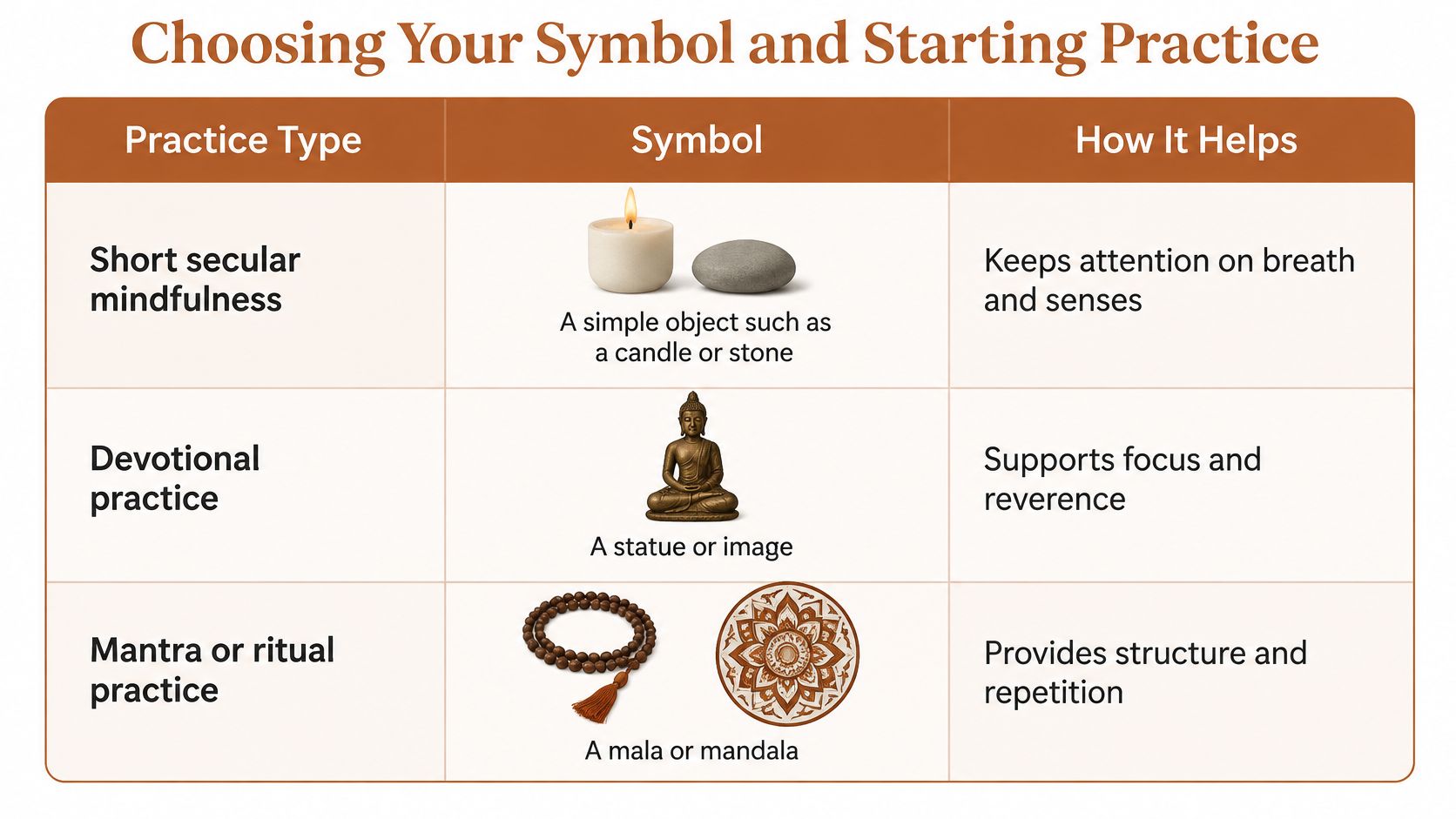
Treating every symbol as equivalent makes selection harder, not easier. Begin with the activity you intend to do, then choose a focus that fits.
Matching practice types to a suitable symbol
| Practice | Suggested focus | Why it fits |
|---|---|---|
| Short secular mindfulness | Simple object such as a candle or stone | Keeps attention on breath and senses |
| Devotional Buddhist practice | Lineage-specific Buddha image | Matches the tradition and its teaching |
| Visualisation | Mandala or lotus | Gives the imagination a structure |
| Mantra recitation | Mala beads with Om | Beads count repetitions; Om supplies a mantra where appropriate |
| Silent awareness | No object | Avoids visual distraction |
For a calm room or altar, our default suggestion is a meditation Buddha; for other intentions, we associate Ganesha with new beginnings and wisdom, Shiva with transformation, Vishnu with protection, and Lakshmi with abundance. These are distinct religious figures, not interchangeable tools for producing a desired result.
For mantra practice, choose a mala and a mantra appropriate to your tradition, which may include Om. For visualisation, choose a mandala only once you understand its context and any instruction it requires.
Make the final checks
Our website explains Buddha postures and mudras associated with meditation, teaching, protection and blessing. Before purchase, compare the description with a clear photograph of the hands.
- Match the tradition. Know whose teaching or practice you're drawing on.
- Match the form to the intention. Choose deliberately rather than relying on a general peaceful expression.
- Place the piece respectfully. Make its setting suitable for its intended role.
The Manchester Museum's Vesak guide distinguishes meanings such as the lotus's purity and spiritual potential from the Bodhi tree's association with awakening. The empty throne, documented in V&A collections, offers a further possibility: representing the Buddha through absence rather than a human figure. Choosing no physical symbol at all can also be a sensible practical decision, although it isn't the same as using that historic symbol.
Try a modest starter routine
Use this ten-minute routine as an experiment, not a promised treatment:
- Choose a regular time and sit comfortably.
- Rest your gaze for two minutes on your chosen focus, without straining.
- Attend to breathing for the remainder, gently returning when distracted.
- Review after two weeks, noting comfort, distraction and willingness to return.
Skip the visual stage if it doesn't suit you, and stop if you become distressed. The practice matters more than the object.
HD Asian Art offers Buddhist and Hindu sculptures alongside explanations of their postures, gestures and symbolism. Visit HD Asian Art to compare a piece's meaning with its photographed details and choose a suitable focus for your meditation space.
