



Lord Shiva Parvati Image: How to Identify Each Form
Lord Shiva Parvati Image: How to Identify Each Form
When you search for a Lord Shiva Parvati image, are you looking at a marriage scene, a divine household, or a single figure combining both deities? The familiar search phrase hides an important distinction: these aren't interchangeable pictures, and recognising the form changes how you understand, choose and display the work.
A collector needs more than an attractive silhouette. Posture, hands, companions and regional style help establish what an image represents, while material and condition determine whether it suits a devotional shelf, a public display or a private collection.
Table of Contents
- Identifying Which Shiva and Parvati Form You Are Looking At
- Reading Posture, Attributes and Attendants
- Regional Styles and Dates From the 9th to the 19th Century
- Stories Behind the Couple and Their Family
- Ardhanarishvara and Respectful Ways to Read the Image
- Choosing Material, Size and Setting for Your Space
- Keeping the Image Safe on Display
- Confirm the Form and Placement Before You Buy
Identifying Which Shiva and Parvati Form You Are Looking At
Which form is this? Begin with a simple visual check: how many figures can you see, are they seated or standing, and are Shiva and Parvati represented through separate bodies or a single composite body? Count the smaller figures too, including those tucked beneath the seat.
The Victoria and Albert Museum's Uma-Maheshvara record shows why identification needs more than the names Shiva and Parvati: the seated relationship, hand-held objects and accompanying figures distinguish a particular image. Start with the overall arrangement before examining a tiny object in a hand.
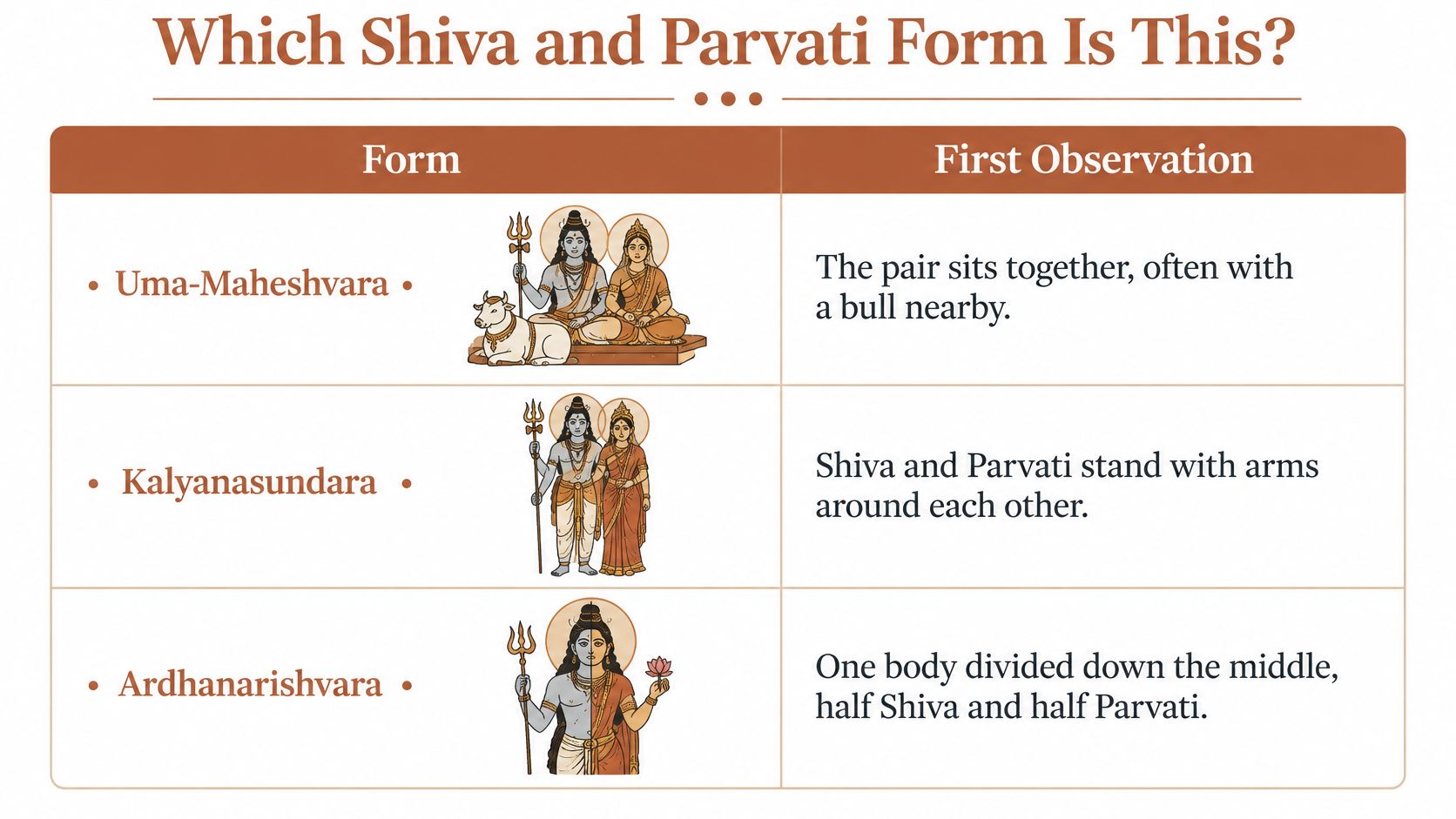
Match the overall scene first
Shiva and Parvati forms and how to recognise them
| Form | Defining pose or scene | Companion figures | UK collection example |
|---|---|---|---|
| Uma-Maheshvara | Shiva and Parvati seated together, often with Shiva in lalitasana and an arm around Parvati | Nandi, sometimes Ganesha and a lion | V&A copper-alloy group from Bangladesh |
| Kalyanasundara (marriage) | Couple standing with arms around each other | The recorded pair provides the identification; additional companions aren't specified | British Museum South Indian copper-alloy sculpture |
| Shiva as Dakshinamurti with Parvati | Shiva as teacher, Parvati beside him gesturing towards their son | Kartikeya | V&A stone relief from Kumaon |
| Shiva and Parvati riding or with Nandi | Pair mounted on or accompanied by the bull | Nandi | V&A Uma-Maheshvara collection records with the bull |
| Ardhanarishvara | Single composite body with male and female halves | None required for identification | V&A interpretation of the composite Shiva-Parvati form |
| Family scene | Couple with children and attendants | Ganesha, Karttikeya, attendants | British Museum groups incorporating multiple heads and halos |
| Parvati alone, four-armed | Closed lotus bud, lotus pedestal, flame-patterned frame | None | V&A East Javanese figure in Majapahit style |
Read the seated-pair row first if the figures share a seat. Uma-Maheshvara commonly emphasises their closeness, sometimes with Parvati on Shiva's knee; a standing embrace instead suggests the marriage subject Kalyanasundara.
A seated scene can also place greater emphasis on instruction. In the Dakshinamurti example, Shiva's teaching role and Parvati's gesture towards Kartikeya distinguish the composition from a general portrait of companionship.
Look beyond the central pair
Where Nandi dominates the arrangement, establish whether the couple actually rides the bull or merely sits above or beside him. Those are different observations, and a catalogue description should preserve the difference.
Family groups need another check: identify the children rather than describing every small figure as an attendant. Ganesha and Karttikeya make the divine household explicit.
Ardhanarishvara isn't a couple standing close together. It combines Shiva and Parvati within a single body. Conversely, an elaborate female figure alone may be Parvati, not an incomplete couple group or an unidentified Hindu goddess.
For a buyer or designer, this first identification prevents a mismatch between appearance and intended meaning. Name the form before deciding which attributes matter.
Reading Posture, Attributes and Attendants
Read an image in this order: posture, hands, attributes, attendants. Posture narrows the possible subject; hands reveal actions and gestures; attributes help identify the deities; attendants establish the wider scene.
Think of attributes as visual name tags, but not as a mechanical code. The V&A's figure-group interpretation identifies such features as Shiva's crescent moon, skull, matted hair, trident and teaching gestures, alongside Parvati's lotus and the couple's relationship. Their combination is more reliable than an isolated detail.
Follow the hands before naming the objects
First distinguish an empty hand making a gesture from a hand holding something. A damaged stem can resemble a staff, while a broken animal attribute may become almost unrecognisable in a frontal photograph.
Attributes that identify Shiva and Parvati
| Attribute | Who carries it | What it signals |
|---|---|---|
| Crescent moon | Shiva, in his matted hair | Shiva's identity and ascetic presence |
| Matted hair, or jata | Shiva | Renunciation and ascetic dress |
| Trident | Shiva | Authority and sacred power |
| Skull | Shiva | Detachment from the physical world |
| Tiger skin | Shiva | Ascetic dress and mastery over fierce forces |
| Axe | Shiva | Cutting of bonds and attachment |
| Antelope | Shiva | Restraint and mastery over desire |
| Abhaya mudra, a raised palm | Shiva, in a lower hand | Protection |
| Lotus | Parvati | Fertility, purity and beauty |
| Nandi, the bull | Shiva's vehicle | Devotion and Shiva's mount |
| Lion | Parvati's mount in some groups | Parvati's power and vehicle |
These are useful interpretive associations, not exhaustive definitions that apply identically to every regional work. The axe and antelope, for example, help recognise Shiva, but their presence doesn't erase the marriage, teaching or family subject expressed by the whole composition.
The abhaya mudra deserves particular attention. Look for the outward-facing palm rather than assuming every raised hand offers protection; other hand positions may indicate teaching or discussion.
Read relationships, not an inventory
Shiva's matted hair and ascetic attributes can coexist with an affectionate embrace. That combination matters: the artist hasn't merely placed an ascetic beside a goddess, but represented ascetic authority within a relationship.
Parvati's lotus also needs context. A closed bud in a solitary, richly ornamented figure isn't enough by itself to establish the same subject as a lotus held beside Shiva.
Identification rule: A convincing attribution explains the pose, hands and companions together. It doesn't rely on the most conspicuous object alone.
Suppose a seated pair has a decorated trident between them and a lion near the base. That arrangement asks different questions from a standing couple with arms around each other, even if both include recognisable Shiva attributes.
For a purchase, request photographs of the hands, head, base and reverse. For a design commission or reproduction, record each visible element separately so an illustrator doesn't combine unrelated features into an invented form.
Regional Styles and Dates From the 9th to the 19th Century
A compact metal group and a large stone relief can show the same divine couple yet come from workshops separated by a thousand years. Shared subject tells a buyer almost nothing on its own; date, region and purpose have to be established separately.
The V&A's Bangladesh group record documents a 9th-century copper-alloy Uma-Maheshvara, 15 cm high, with Ganesha, Nandin and a lion beneath a composition centred on a decorated trident. The same museum's documented sequence includes a 9th-century Kumaon stone relief, 44 cm high, and a 10th-century Nepalese gilt-copper Uma-Maheshvara in relaxed lalitasana.
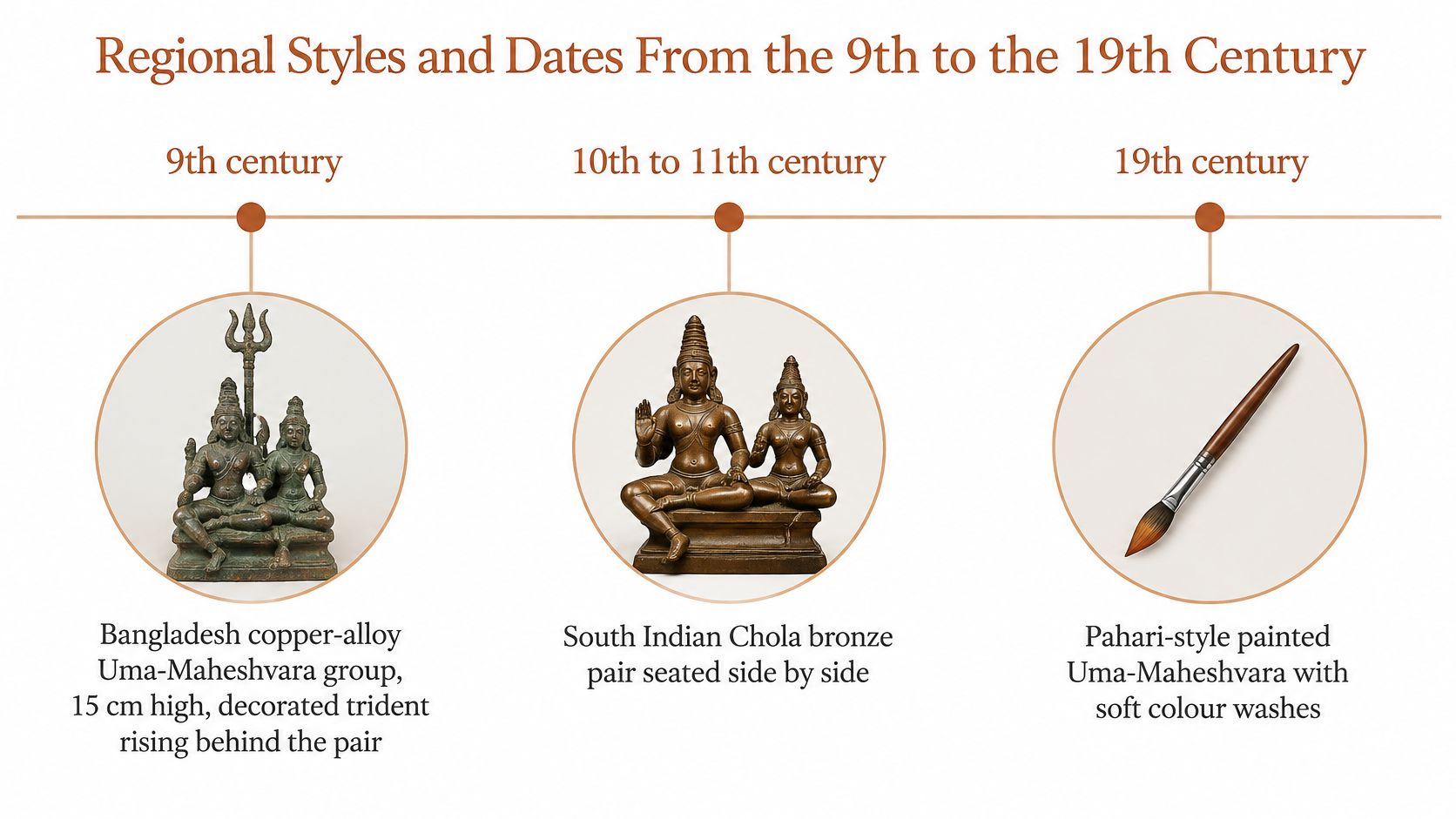
Compare dated objects rather than assuming a linear evolution
Dated UK museum examples, 9th to 19th century
| Date | Region | Example | Form |
|---|---|---|---|
| 9th century | Bangladesh | V&A copper-alloy group, 15 cm high | Uma-Maheshvara |
| 9th century | Kumaon, Uttar Pradesh | V&A stone relief, 44 cm high | Shiva as Vyakhyana-Dakshinamurti with Parvati |
| 10th century | Nepal | Gilt-copper sculpture | Uma-Maheshvara in lalitasana |
| Early 11th century | South India | British Museum copper-alloy sculpture | Kalyanasundara, the marriage |
| c. 15th century | East Java | V&A Majapahit-style, four-armed Parvati | Parvati alone |
| 1750–1825 | South India | V&A bronze | Shiva and Parvati with axe, antelope, abhaya gesture and lotus |
The table works like a map rather than a staircase. The early rows already carry different emphases. In Bangladesh, the trident organises a crowded divine group; in Kumaon, Shiva appears as Vyakhyana-Dakshinamurti, a teacher of sacred knowledge, while Parvati gestures towards Kartikeya; the Nepalese work combines physical intimacy with gestures associated with intellectual discussion.
The last row matters for the same reason. Centuries after the earliest examples, a South Indian bronze can still carry the axe, antelope, abhaya gesture and lotus familiar from much older images. Attributes survive long after styles shift, so they can confirm the subject while saying very little about age.
The V&A's East Javanese Parvati record introduces another interpretive possibility: its four-armed figure holds a closed lotus bud, stands on a lotus platform and sits within a flame-patterned frame, and may represent a deceased East Javanese queen. The museum identifies another upper-hand object only tentatively, so a confident modern label should leave that uncertainty in place.
Use regional comparisons cautiously
The history of Shiva iconography in Southeast Asia gives an East Javanese image its own local context, showing how regional patrons and artists could give a familiar deity a distinctive local role.
For an unknown piece, compare pose, regional attribution and material together, then examine casting, carving, surface and documented history. When a seller cites an early regional style, ask which dated example anchors that claim and whether the description refers to the piece's age or only its appearance.
A stylistic resemblance is a starting point rather than a date certificate. A contemporary work can deliberately follow an early model, so keep the date of manufacture separate from the historical style it follows.
Stories Behind the Couple and Their Family
A marriage image captures an event; a seated partnership presents a relationship. That distinction is visible in the British Museum's early 11th-century South Indian Kalyanasundara sculpture, where Shiva and Parvati stand with their arms around each other.
The marriage theme isn't merely a more upright version of Uma-Maheshvara. It asks the viewer to recognise a particular narrative moment, whereas the settled seated arrangement can express enduring closeness.
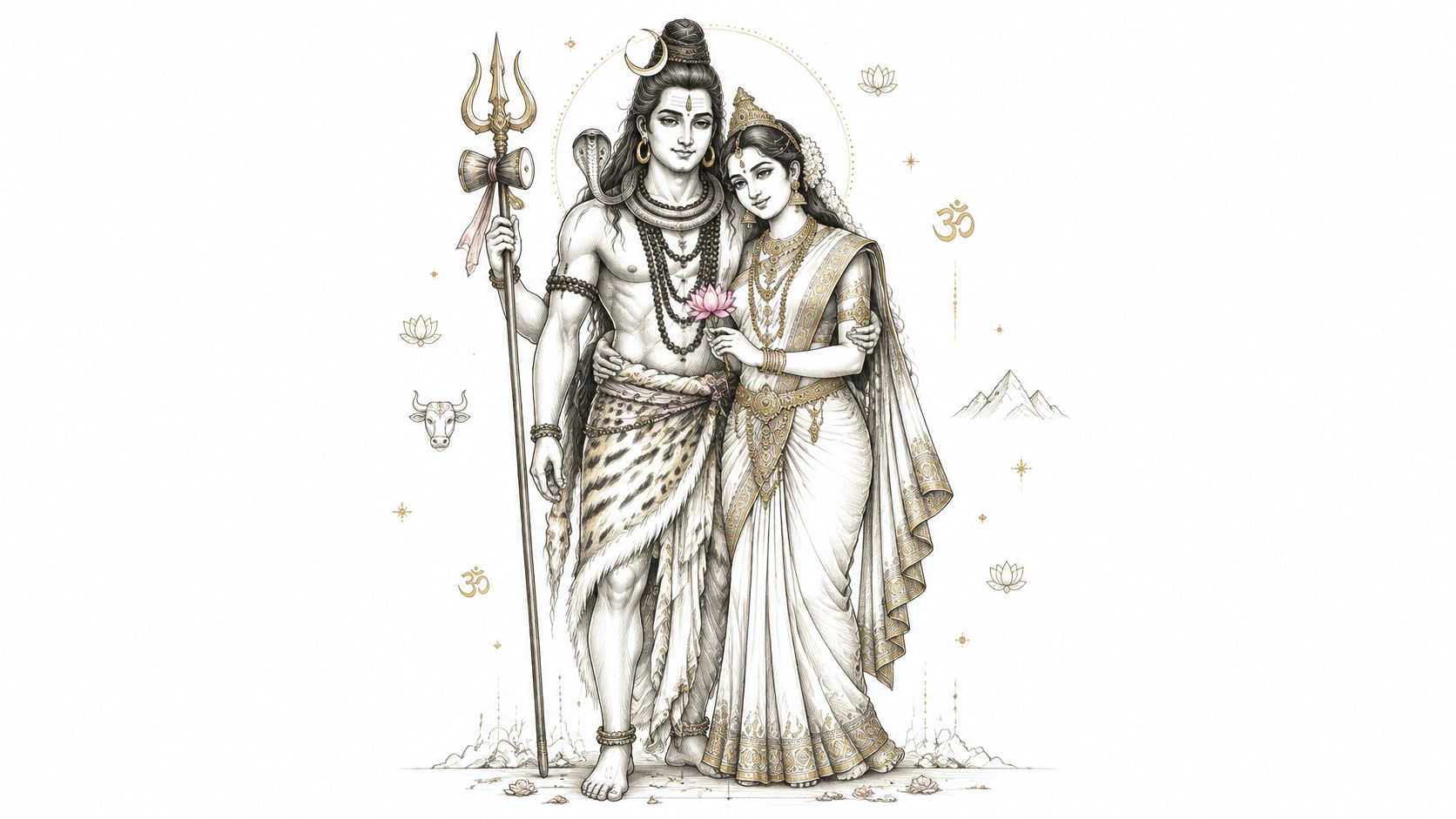
From partnership to a divine household
A useful analogy is a family photograph album. A wedding photograph, a seated portrait and a picture with children all concern the same family, but none tells its whole story.
Ganesha and Karttikeya turn attention towards the divine household. In a teaching composition, Parvati's gesture towards their son can connect the family relationship with the transmission of sacred knowledge.
The guide to Parvati as divine mother and Shiva's consort offers context for reading her as an active presence rather than a decorative companion. Her position, gesture and attributes deserve the same scrutiny as Shiva's.
Choose the story you want to contemplate, not just the outline that fits the room.
Match the narrative to your purpose
- Marriage and partnership: Consider Kalyanasundara for the marriage event, or a seated Uma-Maheshvara for sustained companionship.
- Protection and household blessing: Look for a clearly legible protective gesture within a couple or family composition. Treat blessing as devotional meaning, not a promise attached to a purchase.
- Teaching and family lineage: A Dakshinamurti-related group or an identifiable family scene gives these relationships greater prominence.
An image can express several themes simultaneously. A protective hand doesn't cancel an embrace, and the presence of children doesn't remove Shiva's ascetic identity.
Before choosing, write a short sentence explaining what draws you to the piece. If that sentence concerns family but the work is a composite Ardhanarishvara, revisit the identification rather than forcing the image into your preferred story.
Ardhanarishvara and Respectful Ways to Read the Image
The common mistake is to describe every Shiva-Parvati representation as an ideal romantic couple. That wording becomes especially misleading for Ardhanarishvara, a single figure divided vertically, with Shiva on one side and Parvati on the other. The subject is a composite divine form, not a portrait of two separate partners standing together.
Because the two halves share one body, viewers often read the image as a statement about the balance of male and female principles, and the form holds longstanding associations with hijra communities in South Asia. A gender-balance reading can be meaningful. It still explains only one layer. The same carving may also speak to family, fertility, authority and ascetic power, and a label that fixes on a single modern theme flattens all of that.
Separate interpretation from universal claims
Complex groups may also include multiple heads, halos, children and attendants. Reducing such a work to romance overlooks those relationships entirely. Use this framework when preparing an altar, exhibition label or interior scheme:
- Distinguish devotion from decoration. A personal altar supports religious practice; a secular display presents an object for viewing. The same arrangement rarely serves both purposes well.
- Describe the particular work. Name its form, attributed region and documented date rather than presenting your reading as a universal Hindu position.
- Separate provenance from style. Provenance is documented ownership history. A Khmer-style description identifies an artistic reference, not necessarily where the piece was made or who has owned it.
- Keep gender readings open. Equality and complementarity may be relevant, but avoid treating a religious image as a ready-made statement about every contemporary debate.
Choose wording that preserves complexity
Labels and listings do quiet damage when they compress a specific object into a slogan. The swaps below keep descriptions accurate:
| Avoid | Prefer |
|---|---|
| The perfect Hindu couple | A Shiva and Parvati group in an embracing seated pose |
| A romantic half-man, half-woman statue | Ardhanarishvara, a composite form combining Shiva and Parvati |
| An ancient Khmer sculpture | A Khmer-style sculpture, unless its age and origin are documented |
| This means the same thing to all Hindus | This interpretation relates to the particular form and context |
The guide to Ardhanarishvara as Shiva and Parvati in one form helps distinguish composite imagery from paired figures, which is the distinction most often lost in casual listings. For questions of devotional suitability, consult the practitioner or community who will use the space rather than treating a commercial description as religious authority.
Before placing a work in a public or commercial setting, request its stated form, date basis and provenance. Keep those records with the display documentation, including any uncertainties.
Choosing Material, Size and Setting for Your Space
Start with the setting, not the finish. A sculpture that works inside a cabinet may be unsuitable for a frequently handled altar, while a substantial stone piece needs more than an attractive empty corner.
Sculpture material and setting guide
| Material | Visual character | Best setting |
|---|---|---|
| Bronze | Crisp detail, warm metallic presence, developing patina | Altar, shrine or display cabinet |
| Stone | Architectural, grounded, heavy | Hall, niche or garden room |
| Wood or composite | Warm grain or softer surface character, according to construction | Meditation room or quiet corner |
| Painted or gilt | Rich colour and fine surface detail | Glazed cabinet or protected collector's shelf |
Judge the surface in useful light
Bronze can make fine modelling easy to read, but a dark photograph may conceal joins, repairs or surface coatings. Inspect it under raking light, directed across rather than straight at the surface, and compare the seller's detail photographs with the overall view.
Stone often suits an architectural setting because its mass and texture relate well to walls and niches. A garden room should still be a controlled indoor environment unless the object's materials and condition have been assessed for outdoor exposure.
Wood and composite construction require attention to joints and added materials. Painted and gilt works benefit from protection against accidental contact, but a glazed cabinet doesn't automatically control humidity or sunlight.
Measure the whole display
Treat size bands as planning aids rather than conservation standards. A hypothetical sculpture under 15 cm might fit a small altar or desk; one between 15 and 40 cm might suit a sideboard; a piece above 40 cm may need a dedicated cabinet or plinth.
Measure the footprint as well as the height. Allow clearance around projecting hands, tridents and back panels, and check the support's load capacity against the actual weight.
For a secular arrangement, Gorins Furniture & Mattress's guide to how to style shelves is useful for thinking about spacing and visual balance. Apply those design principles without crowding a sacred figure among objects that obscure its identity.
Display test: Where will it stand, who will see it, and will anyone handle it?
A devotional display needs stable access for the intended practice. A collector's cabinet prioritises protected viewing, while a hall display must account for passing traffic, children and pets.
Keeping the Image Safe on Display
Keep relative humidity as stable as possible. The UK National Archives' guidance for mixed collections recommends an ideal range of 40% to 65%, with humidity below 65% to reduce mould risk, especially relevant where an object includes wood, textiles, pigments or organic mounts.
Treat that guidance as a starting point for a mixed-material display, not a substitute for object-specific conservation advice. An unstable or actively corroding metal object may need different treatment from a sound stone sculpture.
Choose a stable location
- Avoid local heat. Don't place the work beside a radiator, direct heat vent or frequently used fireplace.
- Avoid moisture swings. Kitchens and bathrooms expose objects to changing conditions even when the room feels comfortable.
- Avoid unregulated conservatories. Strong sunlight and changing temperatures make these difficult display environments.
- Use a raised support. Keep portable works away from floor-cleaning water, bins and areas where someone might knock them.
- Choose a clear viewing position. A pooja-room shelf, meditation corner or entrance table can work if it provides a secure base and suitable access.
For a large stone sculpture, a purpose-built floor-standing plinth may be appropriate. The aim is protection from impact and cleaning activity, not an inflexible rule about height.
Measure conditions rather than guessing
Place a temperature and humidity data logger at the intended display height before installing a sensitive piece. A practical trial lasting a couple of weeks can reveal daily fluctuations and the effects of heating, cooking or opening windows; repeat observations when seasonal conditions change.
Inspect the surroundings as well as the screen. Condensation, damp walls and direct sun patches are reasons to reconsider the location even before you interpret the logger's readings.
Control illumination for the most light-sensitive component. Stone's resistance to light doesn't protect paint, gilding preparations, textiles or an organic mount associated with it.
For online photographs, use neutral, diffuse light and a colour reference so the image preserves distinctions between bronze, stone, paint and patina. Don't use dramatic colour grading to disguise condition, or stage a photograph as evidence of an object's original ritual setting.
A devotional shelf and a collector's cabinet need the same attention to environmental stability. Their arrangements and purposes differ, but neither protects an object merely by being called sacred or museum-style.
Confirm the Form and Placement Before You Buy
A useful shortlist begins with a named form and a measured space. Don't let an appealing photograph settle questions that the description leaves unanswered.
Run a purchase check
- Name the form. Match the overall composition to a seated partnership, marriage, teaching group, family scene or composite figure.
- Check the visible evidence. Confirm the posture, hands and attributes through clear photographs, including any missing or restored elements.
- Establish the material. Distinguish solid material from coatings, added paint, gilding and composite construction.
- Check dimensions and weight. Compare the listed centimetres and inches with your available height, width and depth. Make sure the support can safely carry the object.
- Assess the location. Consider heat, moisture, sunlight, passing traffic and access for cleaning before committing.
- State the intended use. Decide whether the work is for worship, study, collecting or an interior scheme, and evaluate it accordingly.
Read the description as carefully as the photographs
Check whether the stated date refers to manufacture or to the style being followed. Ask what supports the regional attribution, and request clarification of provenance, condition and restoration rather than filling gaps with assumptions.
At HD Asian Art, we offer Shiva statues to collectors in the UK and ship many bronze Shiva sculptures to the US and other countries. Apply the same identification, condition and placement checks to our listings as you would to any seller's.
Keep the listing, photographs and correspondence with your purchase records. For an object described as antique, retain the documentation supporting that description.
Shortlist a small group of pieces that match both your preferred form and your available space. Compare material, condition and documentation side by side, then choose the work whose identity you can explain clearly and whose care requirements you can meet.
HD Asian Art offers Hindu sculpture, including Shiva and Parvati-related forms, for devotional spaces, collections and private interiors. Visit HD Asian Art to compare suitable pieces, then check each candidate's form, material, dimensions and condition against the space you've prepared.
