



How to Choose a Buddha Statue for Your Home Altar
How to Choose a Buddha Statue for Your Home Altar
Table of Contents
- Start With Intention: What Your Home Altar Is For
- Buddha Statue Mudra Meanings and Which Posture to Choose
- Materials and Finishes: Bronze, Wood, and Gold-Plated
- Buddhist Altar Placement Best Practices for Your Space
- Sizing Your Statue: Scale, Proportion, and Visual Focus
- Authenticity, Craftsmanship, and Ethical Sourcing
- Caring for Your Buddha Statue and Adding Bodhisattvas
- Frequently Asked Questions
Start With Intention: What Your Home Altar Is For
Choosing a Buddha statue for your home altar starts with one question: what do you want this space to do? A Buddha statue is a physical focal point for mindfulness, a reminder of calm and compassion in a busy home. The right piece can turn a corner shelf into a genuine meditation space.
A few common intentions and what they call for:
- Daily meditation: a seated figure in a calm, still posture
- Devotional practice: a traditional form with offerings and incense
- Aesthetic calm: clean lines and a finish that suits your room
- A meaningful gift: a smaller, well-crafted piece with clear symbolism
Buddha Statue Mudra Meanings and Which Posture to Choose
Buddha statue mudra meanings come down to the hand position, and the hand position tells you the story. The mudra is the gesture the figure holds, and it signals the statue's central message. Two postures cover most home altars.
Dhyana Mudra: Meditation and Inner Peace
The Dhyana mudra shows both hands resting in the lap, palms up, right hand over left. This is the gesture of meditation itself. Choose it if your altar is a place for quiet sitting and inner peace.
Bhumisparsha Mudra: Grounding and Determination
The Bhumisparsha mudra shows the right hand reaching down to touch the earth. It represents steadiness and resolve. Pick this one if you want a grounding presence, a reminder to stay rooted through a hard season.
A quick way to decide:
| Mudra | Meaning | Best For |
|---|---|---|
| Dhyana | Meditation, inner peace | Daily sitting practice |
| Bhumisparsha | Grounding, determination | Steadiness and focus |
| Abhaya | Protection, reassurance | Spaces needing calm safety |
| Varada | Generosity, compassion | Devotional setups |
Materials and Finishes: Bronze, Wood, and Gold-Plated
The material changes how a statue feels in the room, how it ages, and how much attention it needs. Three finishes dominate home altars, and each carries a distinct set of trade-offs.
Bronze
Bronze is an alloy of copper and tin, cast in a mold and finished by hand. It is dense and heavy, so a 10-inch bronze figure can weigh several pounds, enough that you should check your shelf's weight rating before placing one. Bronze develops a patina over time, a surface layer that deepens with exposure to air and handling.
Wood Carving
Wood is lighter than bronze and warmer to the touch. Common carving woods include sandalwood, teak, and camphor, each with a distinct grain and natural scent. Wood expands and contracts with humidity, so it is more sensitive to swings in moisture than metal. A wood statue in a dry, heated room can develop small cracks over time; a wood statue in a damp room can warp.
Gold-Plated
Gold-plated statues are typically cast in a base metal such as brass or copper, then finished with a thin layer of gold. The plating catches light and reads as formal and bright. The trade-off is that plating can wear thin on high-touch areas, the hands, the base, the face, if handled often. Gold-plated pieces are best for a dedicated shrine where they are seen more than touched.
How to Decide
| Material | Weight | Aging | Care Needs | Best Setting |
|---|---|---|---|---|
| Bronze | Heavy | Develops patina | Dust dry, keep dry | Permanent altar |
| Wood | Light | Can crack or warp | Control humidity | Natural, understated room |
| Gold-plated | Medium | Plating can wear | Handle rarely, avoid sun | Dedicated shrine |
Think about where the piece will sit. A dark corner swallows dark wood. A bright window washes out gold. Match the finish to the light, not to a catalog image. If you are unsure, bronze is the safest default, it reads well in most lighting and needs the least fuss.
Buddhist Altar Placement Best Practices for Your Space
Buddhist altar placement best practices follow a few simple rules. Place the altar in a quiet, clean spot where you won't be disturbed. Set the statue at or slightly above eye level when seated, so it becomes your visual focus. Face it toward the room, not a wall.
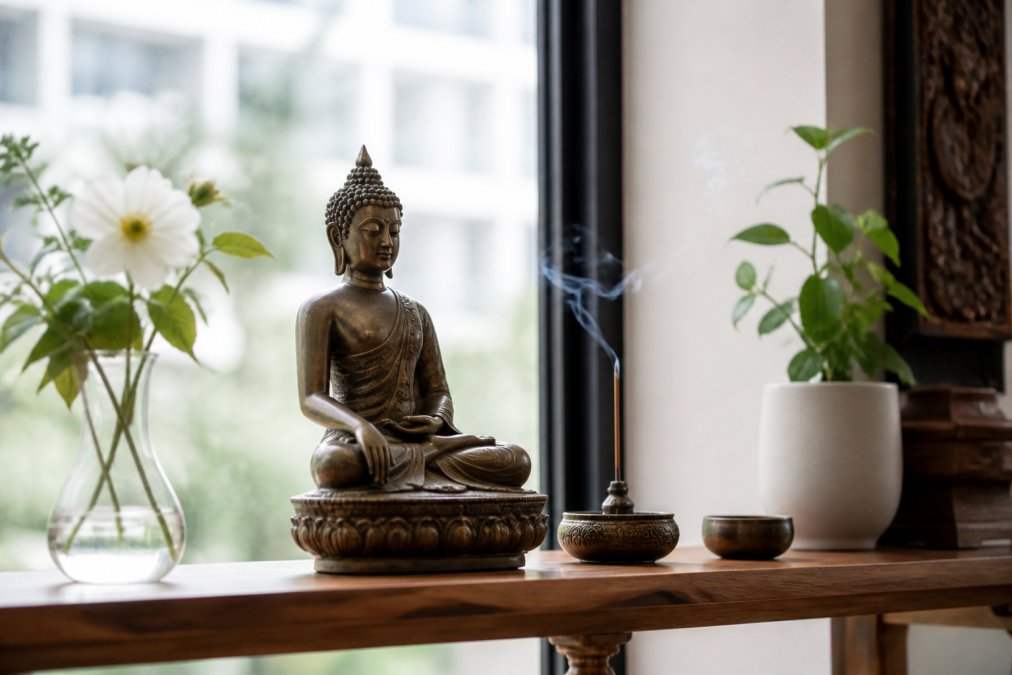
- The statue as the center point
- A small offering, such as fresh flowers or a bowl of water
- An incense holder, kept clear of anything flammable
- A cushion if you sit facing the altar
Small-Space and Apartment Altar Solutions
You don't need a whole room. A single wall shelf, a corner of a desk, or the top of a low bookcase all work. The key is that the spot stays clean and dedicated.
For tight spaces:
- Use a wall-mounted shelf at seated eye level
- Choose a smaller statue, roughly 6-10 inches tall
- Skip bulky offerings and keep one simple item
- Add a small light or candle for warmth
Sizing Your Statue: Scale, Proportion, and Visual Focus
The right size is the one that fits the space and holds your attention without dominating it. Sizing is not about picking the biggest statue you can afford, it is about matching the figure to the surface, the room, and your seated eye line.
Start With Your Seated Eye Level
Sit where you will actually practice. Look straight ahead. That line is your reference point. A statue placed at or slightly above that line becomes the visual focus without forcing you to crane your neck. If the statue sits well below eye level, you will look down at it, which reads as casual rather than devotional.
Match Size to Surface
| Surface | Typical Statue Height | Notes |
|---|---|---|
| Wall shelf | 6-10 inches | Leave 2-3 inches clearance above |
| Desk or low bookcase | 8-12 inches | Check depth for a seated figure |
| Dedicated altar table | 12-18 inches | Room for offerings in front |
| Floor altar or large room | 18 inches or taller | Needs a deeper base and more clearance |
Measure before you buy. Check the height of your shelf, the depth of the surface, and the space above. Leave room for offerings and a little breathing space around the figure. A statue that fills the entire shelf feels cramped; one with a few inches of clearance feels calm.
Proportion, Not Just Height
Proportion is the other half. A tall, slender figure suits a narrow shelf. A wide, seated figure needs a deeper surface. A standing Buddha takes more vertical space than a seated one of the same height, because the base and posture change the footprint.
The Room Sets the Scale
A small statue in a large, empty room disappears. A large statue in a small room overwhelms everything else. The goal is a figure that reads as the center of attention without crowding the space around it. In a small apartment, a 6-10 inch statue on a wall shelf often reads better than a 20-inch piece crammed into a corner. Scale matters more than size.
Authenticity, Craftsmanship, and Ethical Sourcing
What to check:
- Craftsmanship: clean lines, balanced proportions, no rushed detail
- Provenance: a clear story of where the piece came from
- Sourcing: how the maker works with the artisans who create it
- Materials: honest descriptions, not vague claims
Vague provenance is the biggest red flag. If a seller can't explain where a piece came from or who made it, treat the "authentic" label with caution. You may pay a premium for a story that doesn't hold up.
Budget-friendly and investment-grade pieces both exist. A well-made contemporary statue can be beautiful. An antique piece carries history. Decide which matters more to you, then buy within that lane.
Caring for Your Buddha Statue and Adding Bodhisattvas
Care is simple: dust gently and keep the statue dry. Use a soft, dry cloth for bronze and wood. Avoid harsh cleaners, which can strip a finish or dull a patina. Keep the piece out of direct sun and away from damp spots.
- Keep the Buddha as the central, highest figure
- Place bodhisattvas slightly lower or to the side
- Match the materials so the altar feels unified
- Add figures slowly, as your practice deepens
Frequently Asked Questions
What type of Buddha statue is best for a home altar?
The best Buddha statue for a home altar depends on your intention. Shakyamuni Buddha in the Dhyana mudra (hands resting in the lap) is a common choice for meditation spaces because it represents inner peace and focus. If you want a statue that encourages compassion, a Bodhisattva figure like Avalokiteshvara works well. Consider the mood you want your altar to evoke, then choose a posture and expression that supports that feeling.
Does the material of a Buddha statue matter for an altar?
Material affects both the visual weight and the care requirements of your statue. Bronze develops a natural patina over time and feels substantial on an altar shelf. Wood carving offers warmth and lighter weight, which suits smaller spaces. Gold-plated finishes add a luminous quality that reflects candlelight and incense smoke. Each material carries a different presence, so choose one that aligns with your altar's aesthetic harmony and how much maintenance you want.
How do I choose a Buddha statue that fits my meditation practice?
Match the statue's mudra to your practice. Dhyana mudra supports silent sitting and breath awareness. Bhumisparsha mudra, with the right hand touching the earth, suits practitioners working with determination and grounding. If your practice centers on compassion, a Bodhisattva figure may resonate more. The statue should serve as a visual focus that settles your attention, not a decorative afterthought, so let your meditation goals guide the choice.
Is it good or bad to have a Buddha statue at home?
Having a Buddha statue at home is a personal decision rooted in your spiritual practice and aesthetic preferences. For practitioners, a statue serves as a devotional focal point that supports mindfulness and serenity. For others, it may be a piece of spiritual sculpture appreciated for its craftsmanship and cultural significance. There is no universal rule against it. What matters is that you place it with respect and intention, whether on a dedicated altar or as part of a sacred space.
Building a home altar takes care, and finding a statue that matches your intention, space, and values is the hardest part. HD Asian Art curates Buddhist and Hindu statues, including Khmer and Southeast Asian sculptures, with handpicked antique and contemporary pieces.
Every order ships free, and each piece is chosen to bring peace and artistry to your personal sanctuary. Browse the collection and find the figure that belongs on your altar.
