






Ganesh Elephant God: Why Ganesha Has an Elephant Head
Ganesh Elephant God: Why Ganesha Has an Elephant Head
If you stop in front of a statue of Ganesh, the elephant god, in a British museum or a neighbourhood shop window, you'll likely hear the same quick explanation: he's the Hindu god of good luck, and the elephant head came from a famous accident. Yet does a single five-second summary really tell you what you're looking at?
Probably not. Ask five classical Indian texts how Ganesha received his elephant head and you won't get one neat story. Look closely at two sculptures from different centuries and you'll notice the arm count changes, the missing tusk switches sides, and the objects in his hands shift completely. Treating the image as a generic charm hides a visual language built over millennia.
Instead of memorising one fixed meaning, think of the elephant head as a readable sign whose details change with the myth, the historical period, and the community honouring him. Once you know how to read those clues, you can look at any carving, bronze, or print and test what it is showing.
Table of Contents
- Why Ganesha Has an Elephant Head in Brief
- The Stories That Explain the Elephant Head
- What Each Feature of the Elephant Head Means
- How Ganesha's Form Changed Across the Centuries
- Where Ganesha Is Honoured in Worship and Festivals
- Three Museum Ganesha Images and What They Show
- Choosing and Placing a Ganesha Statue Respectfully
Why Ganesha Has an Elephant Head in Brief
Ganesha has an elephant head because, in the most widely told story, his original head was lost and replaced with that of an elephant, turning a moment of crisis into a recognisable sacred form. There isn't a single origin story, though. The Puranas, a vast body of ancient Sanskrit narratives, offer several distinct accounts, so the explanation you hear depends on the tradition telling it.
He's known as the son of Shiva and Parvati, honoured as the remover of obstacles, and invoked before weddings, journeys, housewarmings, and new business ventures. Rather than picturing the elephant head as an animal disguise, read it like a visual signature or emblem. Every curve and proportion communicates qualities such as discernment, steadiness, and the capacity to clear a blocked road.
Naming often trips newcomers up, too. Ganesh and Ganesha refer to the exact same deity, reflecting regional pronunciation differences in India and across the diaspora. You'll also see Ganapati, meaning lord of the ganas (Shiva's attendants), which is the title frequently recorded in Victoria and Albert Museum catalogues. Nor is reverence for him limited to Hindu homes; some Jains and Buddhists also honour Ganesha within their own devotional lives.
Ganesha in contemporary Britain
For readers in Britain, Ganesha isn't a distant museum curiosity. According to the Office for National Statistics 2021 Census bulletin for England and Wales, approximately 1.0 million people identified as Hindu, representing 1.7% of the population. That marked a rise of roughly 182,000 people, or about 22%, from around 818,000 (1.5%) in 2011, with particularly strong concentrations in London (5.1%), Harrow (25.8%), and Leicester (17.9%).
Still, a national census records religious affiliation rather than private devotion. It doesn't tell us how many households keep a Ganesha statue on an altar, pray to him daily, or join seasonal festivals. What those figures confirm is a large, growing community in which Ganesha sits naturally at the threshold of family and cultural life, even as individual beliefs and customs vary widely.
The elephant head is a story told in form: a lost head replaced, a promise to clear the path, and a mind that listens.
The Stories That Explain the Elephant Head
Line up the major Sanskrit accounts side by side and a surprising pattern appears. The texts don't argue over whether Ganesha's form is sacred; they differ over how it came to be, because each tradition shaped the narrative around its own theology.
| Story | Main source | Core event | What the feature signals |
|---|---|---|---|
| Shiva beheads Ganesha by mistake | Shiva Purana | Parvati shapes him from turmeric paste; Shiva, unaware, cuts off his head; the head of the first creature found, an elephant, is fixed on his body | A loss turned into a lasting new form |
| Shani's gaze burns the head | Brahmavaivarta Purana | Shani's glance destroys Ganesha's head, and an elephant's head is attached in its place | Misfortune's power checked, with the body surviving |
| Parashurama breaks the tusk | Shiva-centred Puranic tellings | Ganesha blocks Parashurama's way to Shiva, and Parashurama's axe breaks one tusk | The one-tusked form, Ekadanta, honours a vow |
| Scribe of the Mahabharata | Mahabharata tradition | Ganesha writes down the epic as Vyasa dictates, breaking a tusk to use as a pen | Wisdom, scholarship and the written word |
Why the versions diverge
The Shiva Purana supplies the version many hear first. Parvati wants privacy while bathing, so she moulds a boy from turmeric paste, breathes life into him, and posts him at the door. When Shiva returns home, the boy refuses to let him enter. Unaware that the child is Parvati's son, Shiva severs his head in the ensuing clash, then restores him with an elephant's head to appease Parvati's grief and places him to be worshipped before every other deity.
By contrast, the Brahmavaivarta Purana removes any fault from Shiva. In this Vaishnava-leaning telling, the gods gather to bless the newborn, and Parvati urges Shani (Saturn) to look at her child despite Shani's destructive curse. Shani's glance destroys the infant's head, and Vishnu flies on Garuda to fetch an elephant's head to restore the boy. Other texts, such as the Linga Purana and Padma Purana, drop the accident altogether and present the elephant head as intentional divine design from birth.
How the broken tusk enters the story
Two different traditions account for Ganesha's signature missing tusk. In Shiva-centred Puranic episodes, the warrior-sage Parashurama arrives to see Shiva while Ganesha is guarding the entrance. When Parashurama hurls his axe, which Shiva himself had gifted him, Ganesha chooses not to let his father's weapon fail and takes the blow on one tusk, earning the epithet Ekadanta (one-tusked).
A separate literary tradition links Ganesha to the Mahabharata. When the sage Vyasa needs a scribe fast enough to record the vast epic without pausing, Ganesha agrees on the condition that Vyasa never stops reciting. When Ganesha's stylus snaps mid-verse, he breaks off his own tusk to keep writing, turning the chipped ivory into an emblem of scholarship and steady focus.
The stories disagree sharply on cause, yet they converge on outcome: a sudden loss transformed into an enduring sign of wisdom and protection.
Treat any single myth as one thread in a wider conversation rather than an official biography. Knowing that multiple tellings coexist helps you avoid forcing one rigid story onto an image carved by a completely different regional school.
What Each Feature of the Elephant Head Means
Read a sculpture of Ganesh, the elephant god, the way a botanist reads a plant: no single leaf tells the whole species, so you examine the parts together. A curved trunk beside a raised goad sends a much clearer message than either element viewed in isolation.
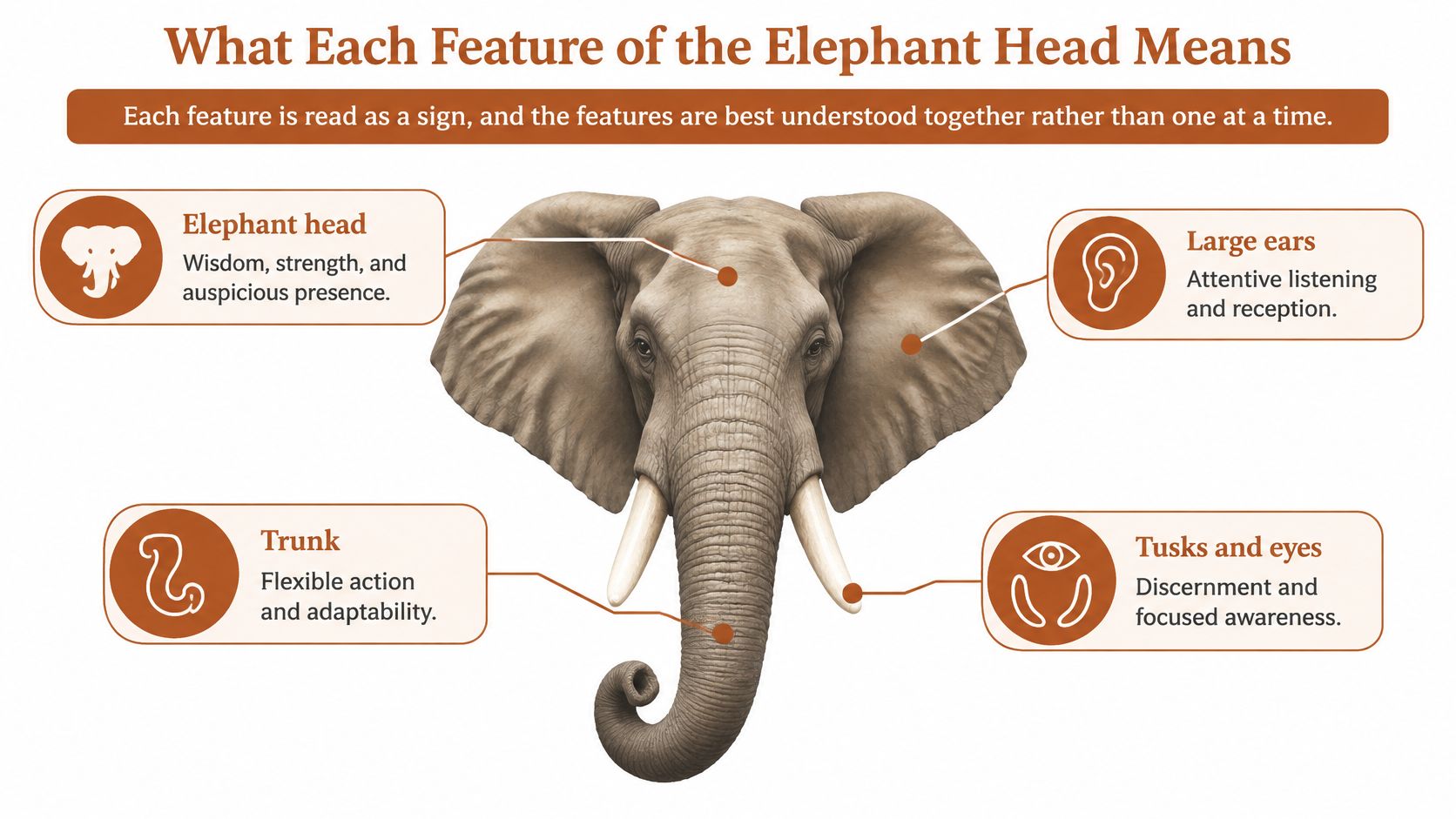
Start with the two features viewers spot from across a room: the trunk and the broken tusk. In object-level cataloguing of a standing sculpture at the Victoria and Albert Museum, the curved trunk symbolises the removal of obstacles, while the missing tusk marks the established Ekadanta ("one-tusked") form. Because an elephant's trunk can uproot a tree or lift a single grain of rice, it visually pairs immense strength with delicate control.
Reading the body and held tools together
Look down from the head to the torso and upper hands, where ritual function becomes explicit. In that same museum catalogue entry, the V&A notes that Ganesha is worshipped as Ganapati at the beginning of rituals or journeys, and that his rounded belly represents the containment of the universe. In his upper hands, the elephant goad (ankusha) communicates controlled guidance, while the probable noose (pasha) signifies the restraint or overcoming of impediments.
Lower down, near his feet, you'll often spot a small rodent. As the British Museum biographical record for Ganesha notes, he's a deity of beginnings who both places and removes obstacles, accompanied by a rat or bandicoot vehicle. Devotional commentary frequently reads this tiny mount as restless desire brought under steady command, proving that sheer size doesn't define mastery.
| Attribute | Meaning | Where it appears | Source reading |
|---|---|---|---|
| Elephant head | Wisdom and discernment | Whole head | Standard Ganesha iconography |
| Large ears | Listening and receptiveness | Either side of the head | Standard reading |
| Curved trunk | Removal of obstacles | Trunk turned to one side, often holding a sweet | V&A ritual interpretation |
| Broken tusk | The one-tusked Ekadanta form | One tusk missing | Puranic stories and V&A |
| Large belly | Containment of the universe | Rounded body | V&A ritual interpretation |
| Goad (ankusha) | Guidance and control | Upper hand | V&A sculpture identification |
| Noose (pasha) | Restraint of impediments | Upper hand | V&A sculpture identification |
| Sweets (modaka) | Rewards of spiritual effort | Hand | Standard iconography |
| Mouse or rat vehicle | Desire brought under control | Beneath the feet | British Museum account |
Separating iconography from artistic style
New collectors often ask whether a subtle twist of the trunk or a sharper eyebrow carries a secret hidden code. Use a straightforward rule of thumb instead: a feature tied to a named attribute (such as the goad, noose, broken tusk, or bowl of modaka sweets) acts as a deliberate religious signal, whereas minor variations in drapery, jewellery, or facial contour usually reflect the workshop's local style.
Check the complete cluster of attributes before drawing conclusions about a figure. A four-armed sculpture clutching a goad, a noose, a broken tusk tip, and a sweet presents a balanced ritual portrait of guidance, restraint, sacrifice, and reward working in concert.
How Ganesha's Form Changed Across the Centuries
Was Ganesha always shown in the same way? Museum collections suggest a more flexible history. According to the British Museum's "Ancient India: living traditions" exhibition guide, Ganesha belongs to a religious and artistic history spanning more than 2,000 years, with traditions that remain part of daily life for almost two billion people worldwide.
Early associations place Ganesha with crossroads and thresholds, with possible roots in earlier yaksha nature spirit traditions. That background helps explain why his image can still mark entrances and boundaries. British museum collections also hold early recognisable Ganesha sculptures in stone and metal, showing how established his visual language became.
Read the elephant head like a sign that changes with its setting. The head stays recognisable, yet the number of arms, the missing tusk, and the objects held can shift from one period to another. A useful analogy is a family name carried across countries: the name remains, while pronunciation, dress, and customs change.
Comparing the Sanskrit blueprints
Ancient iconographic manuals do not prescribe one single design. An analysis of Ganesha iconography published by University College London's South Asian Archaeology programme contrasts two key Sanskrit texts and matches them against surviving archaeological pieces.
| Source or period | Documented form | What it tells the reader |
|---|---|---|
| Brhat-Samhita early text | Two arms, elephant face, pot belly, hatchet and radish, one tusk | An early prescription, with a single tusk part of the form |
| Visnudharmottara later text | Four arms, pike, rosary, sweets vessel and hatchet, left tusk absent | A later prescription with a different arm count and tusk |
| Images from the 4th to 7th centuries | Mostly two-armed | Early images rarely show four arms |
| Later images | Four-armed forms become more prevalent | A four-armed figure is more likely from a later period |
The Brhat-Samhita describes a compact, two-armed, pot-bellied figure holding a hatchet and a radish, already with one tusk. The Visnudharmottara gives a four-armed figure carrying a pike, rosary, sweets vessel, and hatchet, with the left tusk absent. Surviving early Ganesha figures from the 4th to 7th centuries are mostly two-armed, while four-armed forms become more common later.
Running a practical attribution test
Use three checks when looking at an image. First, count the arms. A sturdy two-armed stone figure with one tusk and simple attributes fits early prescriptions and early sculpture. A four-armed figure holding a rosary, pike, or sweets bowl points towards later conventions.
Second, look at the handheld objects. They work like labels on a museum display, giving the figure a specific ritual role. The hatchet, radish, pike, rosary, and sweets vessel each help place the image within a documented type.
Third, allow for regional style. Local workshops in Bengal, Orissa, Java, and Tamil Nadu adapted crowns, postures, and emblems. Later South Indian examples include the Chola dynasty Ganesha icons, where courtly refinement and temple tradition shape the image.
This checklist prevents a common mistake. A modern decorative cast may echo an old form, yet its iconography can belong to a much later, blended tradition. Ganesha's changed form is therefore a historical record, not a random set of artistic choices.
Where Ganesha Is Honoured in Worship and Festivals
Picture a late summer evening in north London. Inside a semi-detached house near Neasden, a family lights a small brass lamp before an elephant-headed figure on a clean wooden shelf, offering fresh marigold petals and a sweet before their eldest daughter starts university. A few miles away, community volunteers prepare garlands and drums for a public gathering that will draw neighbours from across the capital.
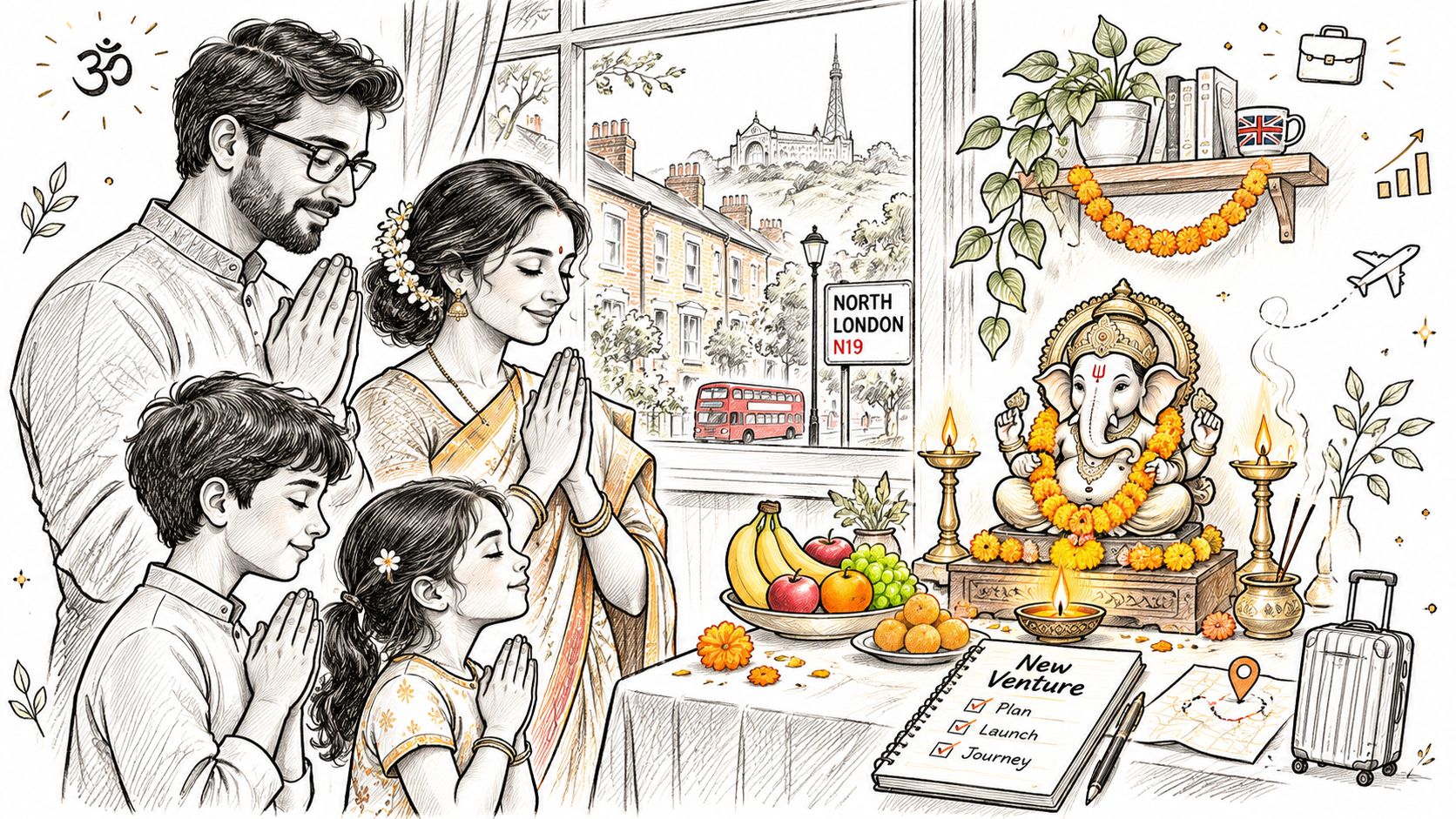
Across Britain, Ganesha's place in worship reflects a well-established community. In 2024, the House of Commons Library reported that 2% of people across Great Britain identified as Hindu in Census 2021 and 2022 data. Within Hindu devotional practice, Ganesha is typically invoked first at the opening of ceremonies, journeys, and business ventures so that proceedings unfold smoothly.
Ganesh Chaturthi and public celebrations
His most visible annual celebration is Ganesh Chaturthi. As noted in the University of Warwick guide to Hinduism, this festival honours Ganesha as the remover of obstacles and falls in August to September each year, alongside Britain's broader temple scene that includes landmarks such as the Shri Swaminarayan Mandir in Neasden, north London.
Because the Hindu lunar calendar shifts annually against the Gregorian calendar, exact celebration days move from year to year; checking when Ganesh Chaturthi takes place early helps families and visitors plan around temple events. Public gatherings in the UK can be substantial: in 2024, the Indian Diaspora in the UK (IDUK) Group reported that more than 3,000 devotees attended its three-day Ganesh Visarjan celebration in London, the ceremonial immersion that marks the close of the festival.
Quiet devotion inside the home
Public processions represent only half the picture. In its overview of the 2025 exhibition featuring more than 180 objects, the British Museum stresses that these are "living traditions" and notes that a small Ganesha bronze resembles the kind kept in homes, where someone might pause for a brief morning prayer.
Home devotion differs sharply from festival pomp. One household may perform an elaborate puja (ritual offering) with incense and chants, while another bows before leaving for work. Neither practice is tracked by national census forms, and neither follows a single rigid script.
- Verify festival dates each year: Lunar timings shift every autumn, so check the current year's calendar before arranging visits or gifts.
- Ask local temples for event timings: Community aarti (lamp-offering ceremonies) and immersion schedules vary by borough and temple committee.
- Respect household custom: Placement, offerings, and ritual etiquette belong to the family's own regional tradition rather than one universal handbook.
Three Museum Ganesha Images and What They Show
Reading textbook rules is helpful, yet nothing trains your eye faster than examining documented museum sculptures side by side. Applying the same four-part reading order to every piece, posture, held objects, markings, and scale and setting, reveals how dramatically an image's purpose shapes its appearance.
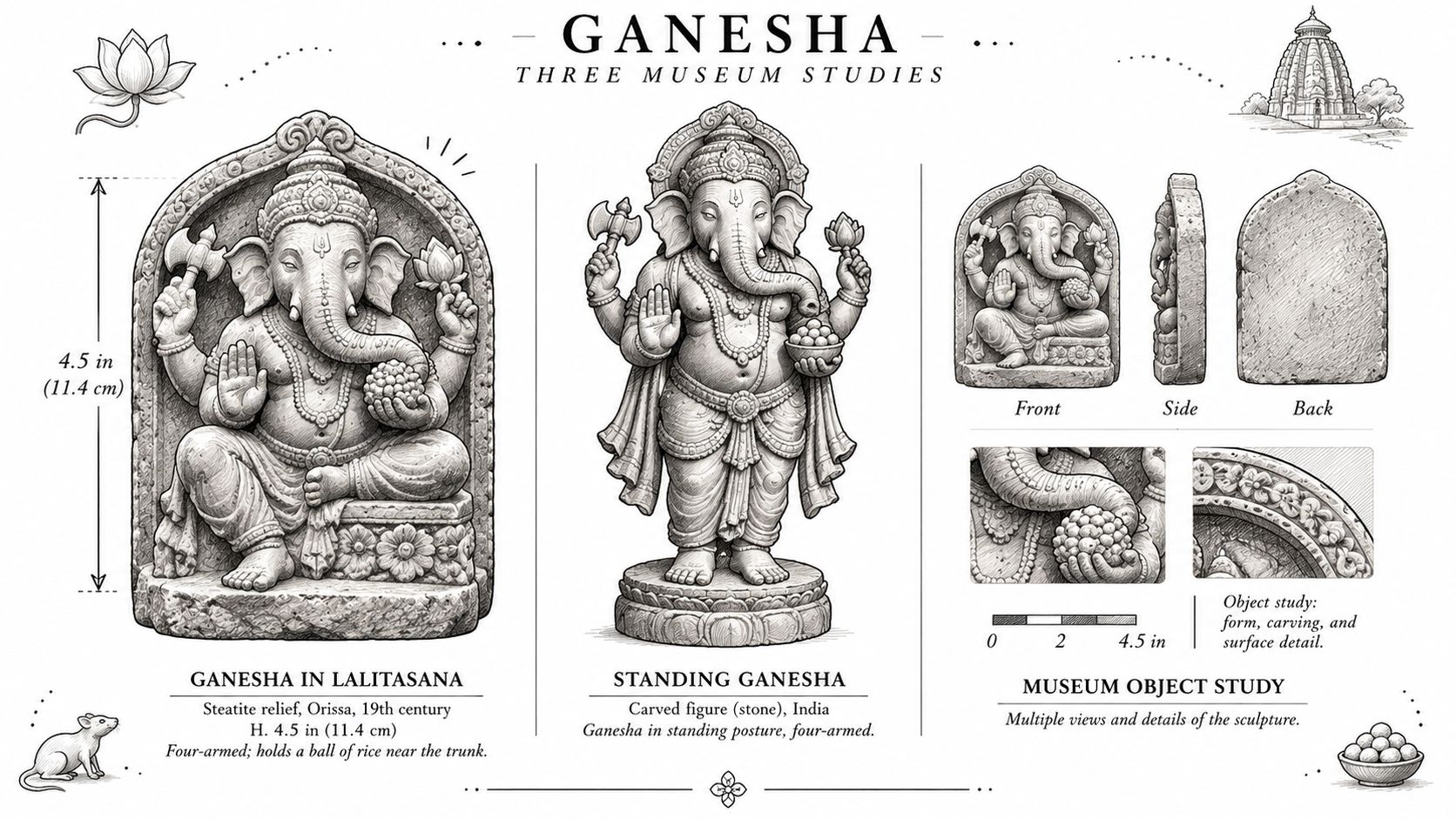
1. The 19th-century Orissa steatite relief
First is a compact steatite relief from Orissa documented in the Victoria and Albert Museum collection and presented to the museum by the Royal Asiatic Society of London.
- Posture: The four-armed deity sits comfortably in lalitasana, a relaxed royal posture with one leg tucked and the other pendant.
- Held objects: Beneath his curving trunk, he holds a ball of rice alongside his tusk, while his raised rear hands grip a noose and a goad.
- Markings: Traces of red and white pigment survive, along with triple transverse Shaivite marks (tripundra) across his forehead and chest, visually tying him to Shiva's lineage.
- Scale and setting: Measuring just 4.5 inches high, 3.625 inches wide, and 1.375 inches deep, this intimate stone carving suited close, personal viewing rather than a crowded temple hall.
2. The 11th to 12th century Tanjavur bronze
Shift south to Tamil Nadu and the role changes completely. A Chola-period copper-alloy Ganesha from Tanjavur, catalogued in the V&A South and South East Asia collection after being purchased from a London seller in 1950, shows what ceremonial mobility requires.
In posture and held objects, the cast metal silhouette is crisp and balanced so it reads clearly from a distance, reflecting Ganesha's role as the deity propitiated before any new venture. Instead of delicate painted markings meant for inches-away inspection, the sculptor relies on bold cast contours that catch torchlight and sunlight outdoors. Its scale and setting seal the story: standing 31 cm high, 18 cm wide, and 13 cm deep, this portable figure accompanied Shiva and Parvati during temple parades, carried separately on its own palanquin.
3. The 13th-century standing copper figure from Tamil Nadu
A slightly later standing four-armed copper figure from Tamil Nadu, possibly Coimbatore, entered the Victoria and Albert Museum in 1924 after being sold by the widow of Herbert Bradley, a former colonial administrator and member of the Legislative Council of Madras.
Here, the posture is upright and formal rather than seated at ease, signalling ceremonial dignity as the elephant-headed son of Shiva associated with wisdom, prudence, and the removal of obstacles. The four-armed frame balances his held objects symmetrically around a vertical axis, while cast metalwork replaces surface paint for lasting markings. Its museum provenance and sturdy copper casting place its scale and setting firmly within South Indian sacred bronze workshops whose works later travelled into British collections.
Museum rule of thumb: Posture, held objects, surface markings, and physical dimensions are primary evidence. Always let the sculpture's observable features verify a gallery tag or seller's label, never the other way around.
Choosing and Placing a Ganesha Statue Respectfully
Start with purpose, not appearance. A Ganesha bought for quiet display, daily home worship, or as a gift for a new venture asks different questions: how formal should the iconography be, how much handling will it receive, and does the household treat the figure as art, as a sacred presence, or both? A decorative sculpture is not automatically a consecrated murti (a sacred image installed through ritual), yet both deserve clean placement and gentle handling.
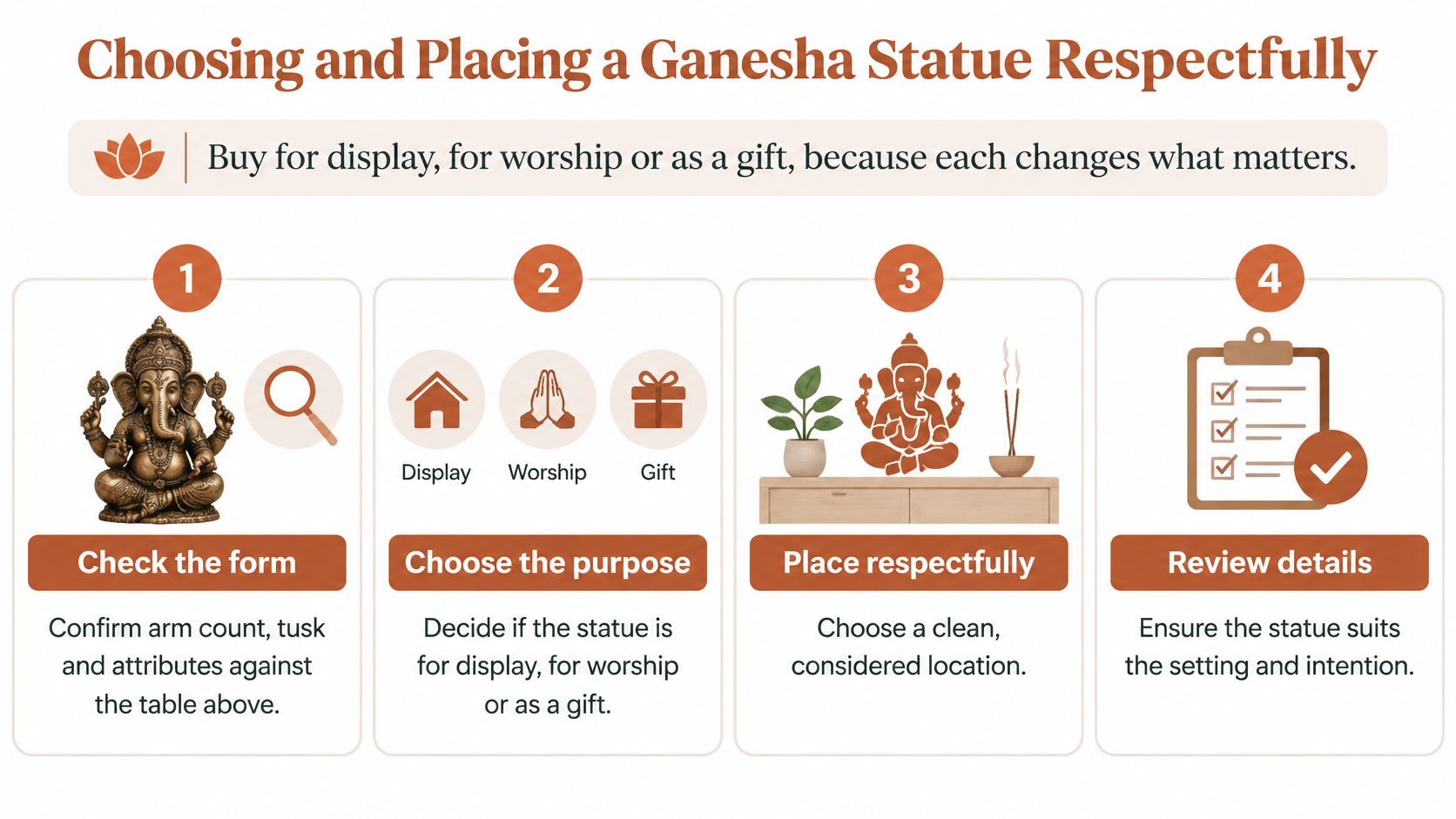
A five-point buyer's checklist
Run every piece through five concrete checks before committing:
- Test the iconography: Count the arms, check which tusk is broken, and list every held object against historical conventions. If a seller calls a modern resin figure an "early temple bronze", the mismatch in attributes and surface finish will give it away.
- Measure the scale against the room: Tape out the height, width, and depth on your actual shelf or plinth. Size and material also shape value on the secondary market; in 2025, Olympia Auctions in the UK sold a 57-centimetre-high Javanese andesite figure of Ganesha for £1,500, illustrating how period, stone, and monumental scale interact.
- Check provenance and honest dating: Look for clear regional descriptions such as Khmer, Javanese, or South Indian Chola style, plus transparent notes on age rather than vague buzzwords.
- Inspect material and finish: Bronze, brass, carved wood, and stone each age differently and suit different humidity levels.
- Read packing and returns policies: Heavy bronze and carved stone travel safely only with purpose-built crating and clear transit cover.
HD Asian Art suggests Ganesha for new beginnings and wisdom, alongside a meditation Buddha for a calm room or altar, Shiva for transformation, Vishnu for protection, and Lakshmi for abundance. Its catalogue describes Hindu sculpture by deity, region, posture, material and dimensions, which makes it easier to compare a figure's details with the conventions this article has outlined.
Placement and day-to-day care
Choose a clean, calm spot raised off the floor, such as a dedicated altar shelf, a quiet study console, or a tidy entryway if that suits your household. Avoid bathrooms, laundry hampers, rubbish bins, and floor-level spots where shoes pass. For a deeper room-by-room breakdown, read the practical guide on where a Ganesh statue should be placed.
If the statue will live outdoors, treat the setting as part of the object. Check sightlines, planting, drainage and lifting clearances before moving heavy stone; a quick layout made with ai for garden design can help you judge proportion and approach routes before placement.
Keep routine maintenance gentle. Dust bronze, stone and wood with a soft, dry microfibre cloth rather than abrasive polishes that strip natural patina. If the statue is intended for worship, or as a gift for a practising Hindu household, ask the family or a local temple priest whether a brief blessing or formal installation fits their custom.
One straightforward next step is enough: run the five-point checklist on any figure you are considering, then compare measurements, iconography and provenance side by side before ordering.
HD Asian Art curates antique and contemporary Hindu and Buddhist sculptures from across South and Southeast Asia, including bronze, brass and wood Ganesha figures documented by region, posture and dimensions. Whether you are choosing a piece for a quiet home altar, a thoughtful gift for a new venture, or a museum-grade collection, clear listing details help you apply what you have learned here. Explore the full collection and regional guides at HD Asian Art.
