



Devi Hindu Goddess: Forms, Meaning and Iconography
Devi Hindu Goddess: Forms, Meaning and Iconography
If a statue is labelled Devi, Hindu goddess, have you identified the figure, or only begun to ask who she is? A lion, lotus or sword can change the answer, and so can the companions standing beside her. Those details matter whether you're choosing an image for worship, documenting an inherited bronze or reading a museum label.
Devi is best understood as a category to decode, not a single appearance to memorise. Recognising her particular manifestation helps you understand the image's meaning and make informed decisions about its care, display and devotional use.
Table of Contents
- Devi at a Glance and Her Meaning in Shaktism
- Weapons, Mounts and Poses
- The Bengali Durga Tableau
- How to Identify a Devi Image in Five Steps
- Living Worship, Museums and Respectful Display
- Choosing a Devi Statue for Your Home
Devi at a Glance and Her Meaning in Shaktism
Principal forms of Devi and their core roles
| Form | Core role | Where it is most often honoured |
|---|---|---|
| Mahadevi | The Great Goddess, universal feminine power (shakti) | Shaktism, philosophical teaching and temple worship |
| Durga | Warrior protector who defeats the buffalo demon Mahishasura | Durga Puja and public festivals in Bengal and UK communities |
| Kali | Fierce form who destroys ego and ignorance | Shakta temples, Bengali devotion and tantric traditions |
| Lakshmi | Goddess of wealth, prosperity and good fortune | Home altars and Diwali worship |
| Saraswati | Goddess of learning, music and the arts | Schools, students and Vasant Panchami |
| Parvati | Consort of Shiva, embodying devotion and marriage | Shiva temples and household shrines |
| Lalita-Tripurasundari | Supreme sovereign of the cosmos in Sri Vidya | South Indian and Shakta temples |
These names aren't interchangeable labels for the same statue. They identify different ways of approaching the feminine divine, with particular stories, visual attributes and devotional relationships. A household welcoming Lakshmi during Diwali isn't necessarily following the same ritual tradition as a community worshipping Kali.
Shaktism places the feminine divine at the centre of worship. The British Museum's Feminine Power exhibition guide describes Mahadevi as the Great Goddess and the embodiment of universal feminine energy. Shakti is that animating power, not merely a synonym for physical strength.
One power, distinct manifestations
Think of a river whose current continues under different names as it passes through different places. In a comparable way, devotees may approach divine power through Durga in Bengal, Lalita in southern traditions or Kali in tantric circles. The analogy explains continuity, but it doesn't erase the particular character of each manifestation.
Within Shakta understandings, these forms can be faces of one power rather than rival goddesses. Other Hindu traditions may explain their relationships differently, especially through associations with Shiva or Vishnu. There isn't a single theological formula that every Hindu household must use.
The distinction between the underlying power and its named expressions is useful when exploring Shakti as the divine feminine power in Hinduism. For a devotee, the chosen form may shape prayer and ritual; for a curator, it shapes identification and interpretation.
Why the particular name matters
The British Museum's Bengali devotional print cycle presents ten aspects of the divine mother, including Kali, Tara, Shodashi, Bhuvaneshvari, Bhairavi, Chhinnamasta, Dhumavati, Bagalamukhi, Matangi and Kamala. Their differentiated names and appearances show why a generic label can conceal important information. Each form carries its own associations rather than functioning as another spelling of Devi.
A collector should therefore preserve the specific manifestation, regional context and textual tradition wherever these are known. If the evidence is incomplete, a qualified description is better than a confident but unsupported name. “Female Hindu deity, possibly Lakshmi” tells the reader what remains uncertain.
First question: Which manifestation does this image represent, and what evidence supports that identification?
In a domestic shrine, you might meet Lakshmi or Parvati; in a Bengali festival setting, Durga's surrounding group becomes especially important. In a museum, any of these forms may appear outside its original setting. Begin with the particular image before drawing conclusions about its meaning.
Weapons, Mounts and Poses
Durga pulls the buffalo demon's neck backwards, exposes his throat and drives a trident into it. That deliberate action appears in an eighth-century sandstone sculpture from Odisha, catalogued as Orissa, in the British Museum. The exposed throat, weapon and buffalo belong to the story of Mahishasura's defeat, not to an arbitrary arrangement of dramatic details.
Read such an image as a scene rather than a collection of ornaments. Ask what the goddess is doing, what receives her attention and how the surrounding figures participate. The action may identify her more securely than her face or jewellery.
Attributes and the forms they signal
| Attribute | What it signals | Where you see it |
|---|---|---|
| Lion | Durga's mount, or vahana, and sovereign courage | Durga images and Bengali Puja tableaux |
| Buffalo demon under the goddess's foot or spear | Victory over Mahishasura, interpreted as the defeat of evil and ego | Durga sculptures and Mahishasura episodes |
| Owl | Lakshmi's mount, associated with wakeful prosperity | Bengali tableaux showing Lakshmi with Durga |
| Swan | Saraswati's mount, associated with discernment | Bengali tableaux and images of learning |
| Lotus | Lakshmi's seat and a symbol of purity | Lakshmi images and altar offerings |
| Multiple arms | Several powers and weapons held at once | Durga and Kali images |
| Skull garland | Destruction of ego and impermanence | Kali images |
Read combinations, not isolated symbols
Attributes work like words within a sentence. A lotus alone leaves several possibilities open; an owl accompanying a goddess in a Bengali Durga group gives a more specific context. Look for at least two agreeing clues, such as a mount and weapon, or a mount and accompanying figures.
Multiple arms communicate capacities that an ordinary human body couldn't display simultaneously. Don't assume that every Durga image must have an identical arm arrangement, or reject an attribution because it differs from a familiar example. A discussion of Durga's weapons and multiple arms can help you distinguish symbolic purpose from a rigid identification formula.
Recognising Kali without reducing her to violence
Kali's familiar imagery includes a raised sword, a severed head, a lolling tongue and a dark body, alongside a garland of heads or skulls. Her dark, stripped-down appearance conveys elemental ferocity; the sword and severed head can express the cutting away of ignorance and the false self. These symbols shouldn't be read as evidence that devotees celebrate cruelty.
Match the details with one another and with the devotional setting. Tantric context may help, while a stated Sri Vidya connection calls for more specific investigation rather than an automatic identification as Kali.
For an uncertain sculpture, record posture, weapon, demon, material and place of production separately. Missing hands, worn surfaces or detached companions may have removed the very clues needed to name the form.
The Bengali Durga Tableau
Durga's return home offers a different starting point from the battlefield. In a British Museum painting of Uma, also called Devi Agamani, she travels from Mount Kailash to her parents' home, riding her lion and carrying Ganesha in her lap. Here, the goddess is both divine presence and returning daughter.
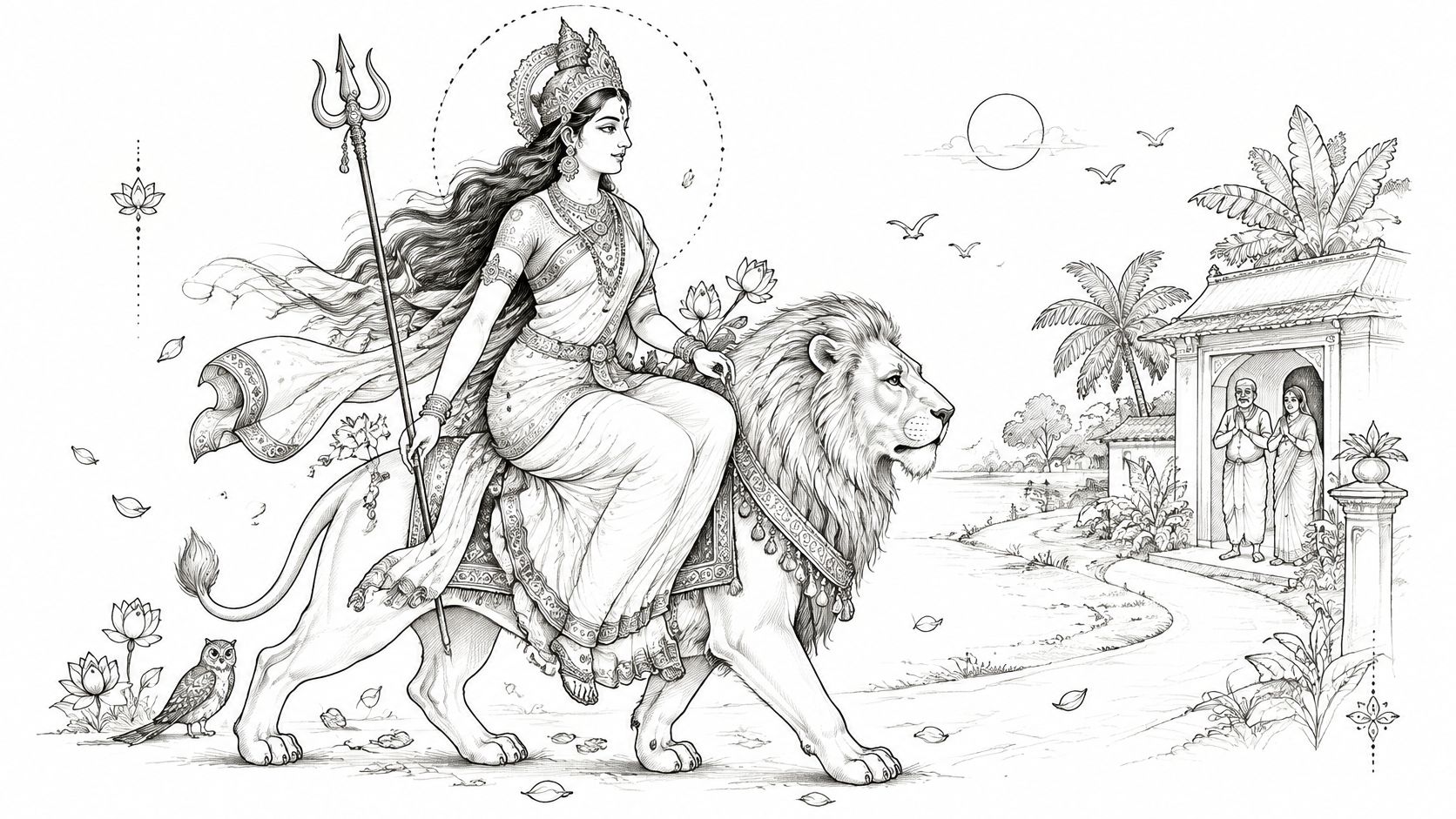
Her father, Himavant, her mother and attendants participate in the welcome. Garlanded auspicious pots, plantain plants, mango leaves and a conch establish a setting of reception and celebration. These details tell you how to read the scene, much as decorations and gathered relatives distinguish a homecoming from an ordinary journey.
Lakshmi descends on an owl, Saraswati on a swan and Karttikeya on a peacock to join the puja. With Ganesha, they form the accompanying group familiar in Bengali Durga tableaux. Their presence isn't a way to fill empty space around the principal figure.
A regional arrangement, not a universal family tree
The group composition is a Bengali convention. A viewer who recognises the companions can identify the regional setting more confidently than someone looking only at Durga's crown or clothing. The arrangement also explains why an apparently separate goddess might originally have belonged to a larger ensemble.
For a collector, that possibility changes the questions to ask. Does the figure retain a base that once connected to another component? Does the seller have photographs of associated pieces, or any record of the group before it was separated?
Keep the ensemble's history with the object whenever possible. A companion figure loses interpretive context when its relationship to the larger scene disappears from the record.
Why clay belongs to the story
The British Museum's record of a painted clay disc, or sara, explains that Bengal has abundant clay but little suitable stone, making clay especially prominent in images of the goddess. The documented disc shows Durga killing Mahishasura, with Karttikeya and Saraswati on one side and Lakshmi and Ganesha on the other. Material, geography and festival practice belong together here.
A temporary clay image shouldn't be judged as an unsuccessful version of a permanent bronze. Its intended lifecycle and communal use may be central to its meaning. Equally, the Bengali family arrangement shouldn't be imposed on every Hindu tradition, since Lakshmi and Saraswati aren't generally treated as Durga's children elsewhere.
The London Durgotsav Committee, a Bengali Hindu charitable organisation, gives this tradition an organised London presence. For UK viewers, the tableau therefore belongs both to museum interpretation and to living community worship, not to a distant regional past.
How to Identify a Devi Image in Five Steps
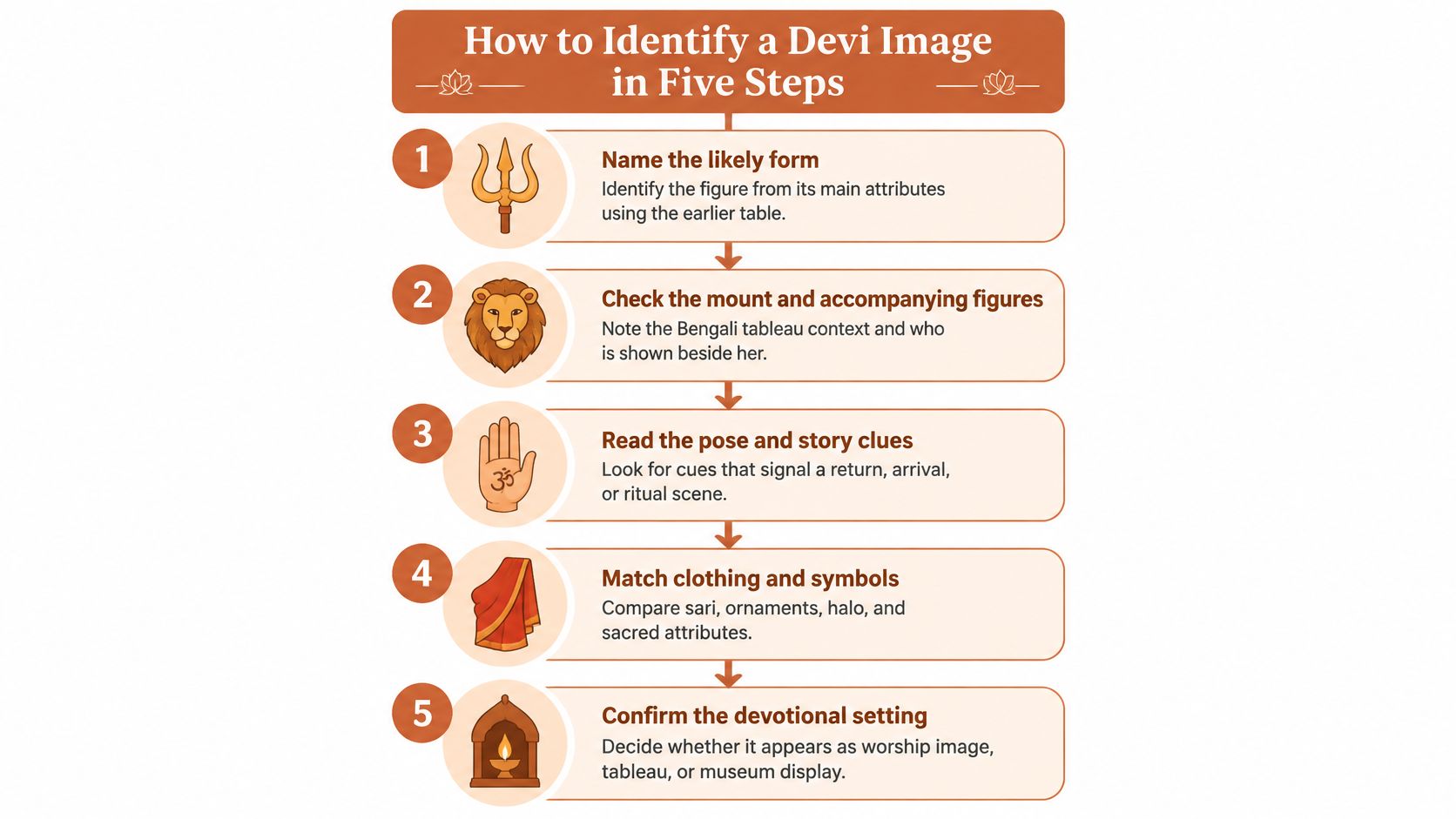
A useful identification method separates what you can see from what someone has claimed. Begin with observable details, then test the proposed name against regional context, material evidence and relationships with other deities. Keep photographs and notes together so another person can follow your reasoning.
Build an identification from evidence
- Name the likely form. Use the most distinctive surviving attributes to propose an identity, not to declare one immediately. Write “possibly” where necessary, especially if the hands or base are missing.
- Check the mount and accompanying figures. Photograph the entire composition, including small figures near the feet. In a Bengali tableau, the surrounding group may establish a context that an isolated close-up would conceal.
- Count the arms and read the posture and weapons. Note what each surviving hand holds and whether the body is standing, seated, advancing or attacking. A raised sword or trident is more useful when connected to a recognisable action or story.
- Verify material, period and place separately. Fine workmanship doesn't prove an early date, and bronze doesn't establish a South Indian origin. Compare clothing, ornaments, halo and sacred symbols, while treating the seller's attribution as a claim requiring support.
- Test the associated deity and devotional setting. A partner or companion can strengthen an identification, but establish whether the figures belonged together. Distinguish a worship image, a festival tableau and a later display arrangement rather than assuming the current presentation is original.
A worked example in bronze
The British Museum identifies a Chola-period bronze Sridevi, made in Tamil Nadu and dated to approximately 1000 CE, as Shri Lakshmi. Its interpretation connects her with good fortune, beauty, prosperity and Vishnu. That association is theological, linking prosperity and fertility with royal duty, rather than merely placing a decorative companion beside a male deity.
The lesson is to assemble an object record whose parts support one another. For this example, the record should preserve Sridevi or Shri Lakshmi, the South Indian attribution, approximate date, bronze medium and Vishnu association. Replacing all that with “Devi” would discard information needed for meaningful interpretation.
For your own object, distinguish documentary evidence from visual inference. An acquisition receipt can support ownership history; it doesn't necessarily prove the deity's identity or the claimed production date. Likewise, a resemblance to a museum bronze isn't enough to transfer that museum object's dating to yours.
Identification threshold: Seek at least three agreeing clues before treating a name as confident, and record any evidence that doesn't fit.
This is a practical checking method, not a guarantee of attribution. If important clues conflict, retain the uncertainty and seek specialist assessment before buying, insuring or relabelling the sculpture.
Living Worship, Museums and Respectful Display
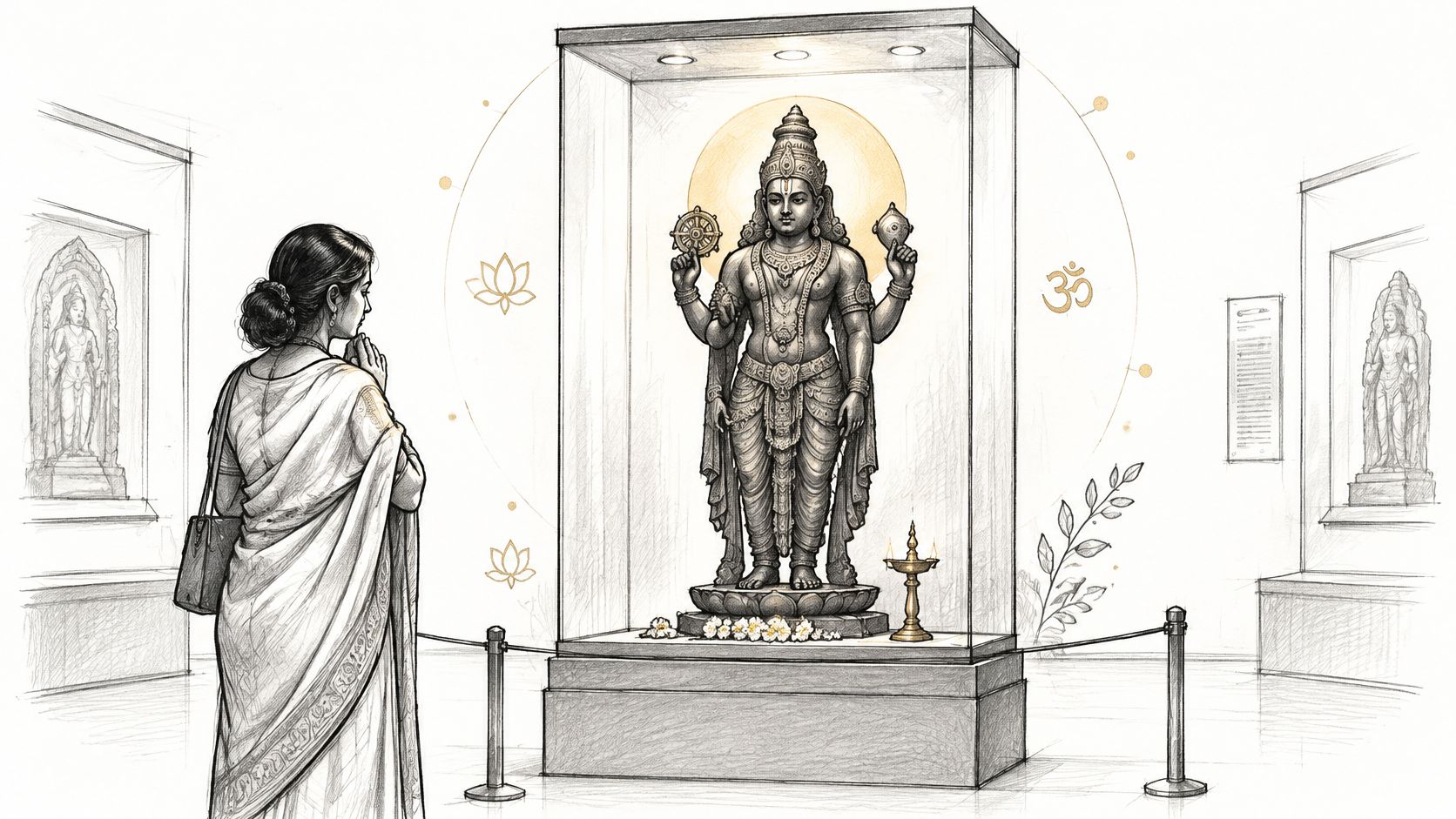
A museum may describe a sculpture through material, style and ownership history. A devotee may encounter the same figure as a sacred presence. Neither perspective should be allowed to make the other invisible.
Many devotees understand a murti, particularly a consecrated image, as a living manifestation of the divine rather than an artefact. In 2025, the British Museum described consulting ten London-based practising Hindus, Buddhists and Jains to bring lived experience into its interpretation. Its discussion emphasises care, dignity and contextual sensitivity towards sacred images, including those held in museums.
Translate respect into practical care
At home, choose a clean, calm, raised position, such as a dedicated shelf or pooja room, away from bathrooms, bins and clutter. This is a respectful starting point, not a substitute for the guidance of the household's own tradition. Don't assume that an image acquired as art has been consecrated, or that its ritual status is obvious from its appearance.
- Handling: Use clean, dry hands and support the base and body together. Don't lift a sculpture by a projecting arm, crown or weapon.
- Cleaning: Check regularly for dust and use a soft, dry brush only where the surface is stable. Avoid metal polish, soaking and household cleaners on painted, gilded, patinated or fragile objects.
- Photography: Ask permission in temples and private shrines, and follow museum rules. Avoid staging the image as a comic prop or an accessory for casual poses.
Devotional care can include adornment and offerings, but conservation needs may limit what an older object can safely receive. Oil, water, flowers and incense residues can affect surfaces. Where worship and preservation requirements conflict, consult both a religious adviser and a conservator.
Ritual history changes the responsibilities
When passing on or selling an image, disclose provenance and any known ritual use in writing. Say clearly when that history is unknown. Don't suggest that age, patina or a high price guarantees devotional suitability.
A fine antique may be better suited to a museum case than an active altar. Conversely, a contemporary image may fulfil a household's devotional purpose without antiquarian importance. Festival traditions such as Navaratri and the celebration of goddess energy also remind owners that sacred images can participate in recurring practices rather than remain static displays.
Many Bengali families return temporary clay images to water through ritual immersion instead of treating them as ordinary rubbish. In the UK, arrange an appropriate local practice with community organisers and check environmental requirements rather than placing painted material into a waterway yourself. Respect, informed by the object and its tradition, should guide treatment rather than rules alone.
Choosing a Devi Statue for Your Home
Start with purpose. A devotional image for an altar and a collected antique for a display case call for different decisions about material, scale and handling. Neither purpose excuses an uncertain identification, but they may lead you towards different objects.
A shrine image needs to suit the household's intended practice. A collected sculpture needs a clear account of its identity, condition and attribution. For placement and ritual-history responsibilities, use the principles in Living Worship, Museums and Respectful Display.
Buying criteria that make the choice clearer
- Form: Decide which manifestation you want before comparing finishes or prices. Choose for the deity's meaning and your intended relationship with the image, not for an attractive silhouette.
- Material: Bronze can offer crisp detail and a warm metallic presence; stone can feel grounded and architectural. Check the actual surface and condition rather than assuming every example behaves alike.
- Size and support: Measure the shelf or niche, including depth, and allow breathing space around projecting attributes. Confirm the statue's dimensions and weight, the support's capacity and access for UK delivery.
- Documentation: Obtain provenance, condition information and any known ritual history in writing. For an antique, ask what supports the stated date and regional attribution.
- Purchase terms: Confirm the seller's return terms before committing, including how a substantial or fragile sculpture would be returned.
At HD Asian Art, we sell Hindu statues including Devi, Durga, Lakshmi and Parvati, alongside Brahma, Ganesha, Hanuman, Krishna, Murugan, Shiva, Vishnu and Erawan. We help customers choose when they share photographs, measurements of their space and preferences such as deity, material or style.
The same checks support a responsible choice for a home shrine, meditation room or interior. Decide the form, prepare the space, then send the details so the conversation begins with the image's purpose rather than appearance alone.
HD Asian Art offers Hindu goddess sculptures for devotional spaces and collections, including Devi, Durga, Lakshmi and Parvati. Visit HD Asian Art to explore the selection, then share photographs, space measurements and your preferred deity, material or style for help choosing an appropriate statue.
