



Sri Lankan Buddha Statues: Anuradhapura & Polonnaruwa
Sri Lankan Buddha Statues: Anuradhapura & Polonnaruwa
Most collectors drawn to a Sri Lankan Buddha statue know they are looking at something different from Thai or Cambodian work, but they cannot always say exactly why. The answer lies in two ancient royal capitals and the distinct sculptural traditions each one produced.
Anuradhapura, Sri Lanka's first great capital, generated a school of carving defined by restraint, stone mastery, and close alignment with early Theravada doctrine. Polonnaruwa, the medieval capital that replaced it after the 11th century CE, brought a more monumental ambition, rock-cut engineering on a vast scale, and subtle cosmopolitan influences layered over that same Theravada core. Understanding both traditions makes you a significantly more informed collector, practitioner, or decorator.
Table of Contents
- Quick Takeaways
- The Anuradhapura Tradition: Stone, Restraint, and Early Theravada Form
- The Polonnaruwa Tradition: Rock-Cut Ambition and Monumental Scale
- Reading the Iconography: Mudras, Postures, and Robe Treatment
- Anuradhapura vs. Polonnaruwa: A Direct Comparison
- Collecting Sri Lankan Buddhist Sculpture: What to Look For
- Frequently Asked Questions
- References
Quick Takeaways
|
Key Insight |
Explanation |
|---|---|
|
Anuradhapura preferred dolomite and granite |
Local stone from Sri Lanka's dry zone shaped the surface quality and scale of early Sinhalese sculpture, producing a refined, body-revealing finish distinct from Southeast Asian bronze traditions. |
|
The Samadhi statue is the defining Anuradhapura benchmark |
Carved in dolomite marble and standing 7 feet 3 inches high, this 3rd or 4th century seated figure in Dhyana Mudra sets the standard for Anuradhapura-period proportion, facial expression, and robe treatment. |
|
Polonnaruwa's Gal Vihara is rock-cut on a monumental scale |
Four Buddha images, including a reclining figure and a 7-metre standing figure, were carved directly into a single granite gneiss rockface during the 12th century CE under King Parakramabahu I. |
|
The robe is the quickest diagnostic tool |
In authentic Sinhalese sculpture, the right shoulder is bare and robe folds are subtle, body-revealing rather than decorative. Heavy drapery or symmetrical folds suggest a different regional tradition entirely. |
|
The flame ushnisha distinguishes Sri Lankan work from the rest |
The cranial protuberance in Sri Lankan Buddhas often takes a distinctive flame shape, a feature that spread from southern India and is not found in Burmese, Thai, or Cambodian iconographic traditions in the same form. |
|
Polonnaruwa Buddhas show more cosmopolitan influences |
After the Chola occupation and subsequent political contact with South India, Polonnaruwa-period sculpture absorbed some South Indian formal elements while retaining its Theravada doctrinal framework. |
|
Mudra precedes posture when reading a Sri Lankan statue |
The hand gesture communicates what the Buddha is doing spiritually; the posture indicates when in his teaching life that moment occurs. Read the mudra first, then the posture, for a complete iconographic reading. |
The Anuradhapura Tradition: Stone, Restraint, and Early Theravada Form
Anuradhapura served as Sri Lanka's capital for roughly a thousand years, from around the 4th century BCE into the early 11th century CE. It was here that Theravada Buddhism took institutional root on the island, and the sculptural tradition that emerged from this period reflects that doctrinal seriousness in every formal decision a sculptor made.
The material base of Anuradhapura sculpture is stone, specifically dolomite marble, limestone, and granite, all sourced locally from Sri Lanka's dry zone. Bronze casting existed but was secondary. This is not a minor technical footnote. Stone dictated scale, surface quality, and the character of the finished work in ways that bronze never does. The Anuradhapura tradition is therefore fundamentally a carver's tradition, not a founder's tradition, and that distinction matters when you are comparing Sri Lankan pieces with Burmese or Thai examples where bronze dominates.
The Samadhi Statue: The Standard-Setter
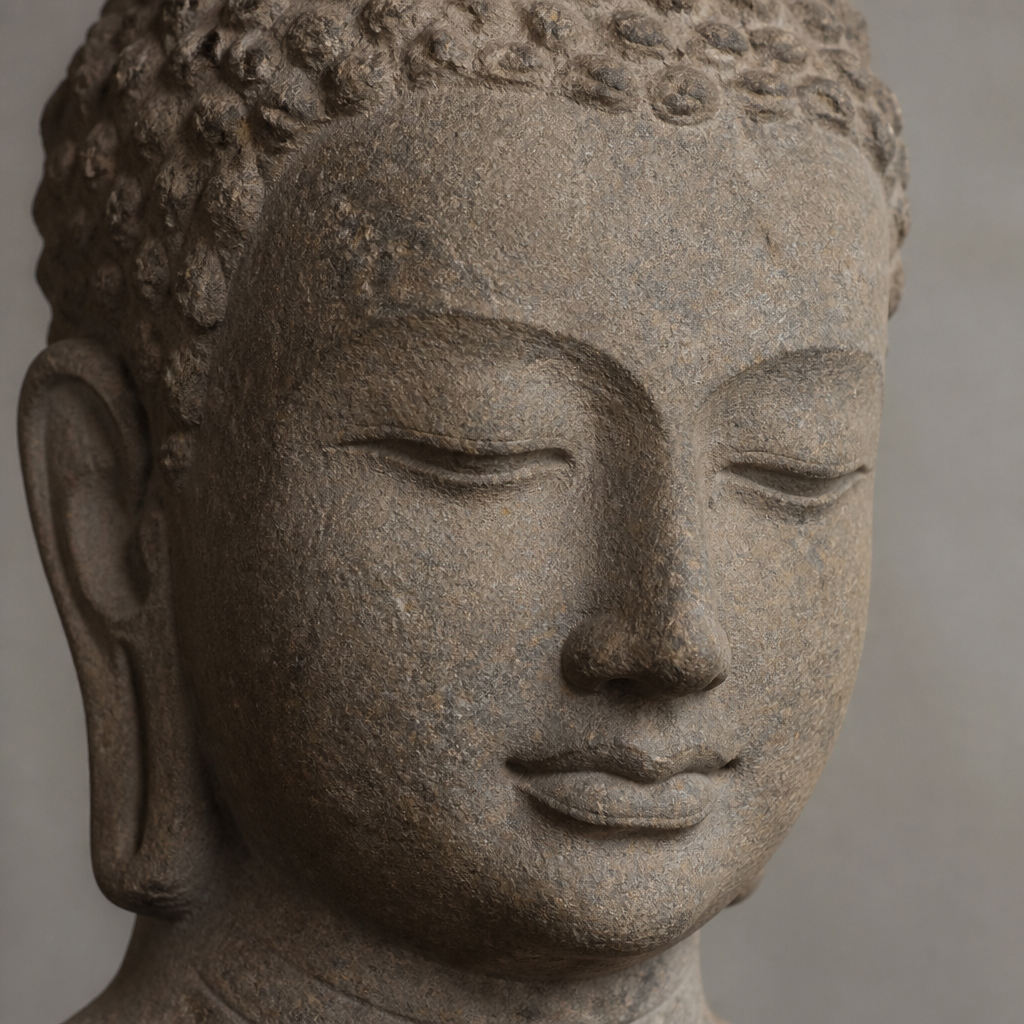
The Samadhi Buddha, located at Mahamevnawa Park in Anuradhapura, is the clearest single expression of what this tradition produced at its peak. Believed to date to the 3rd or 4th century CE, it is carved from dolomite marble and stands 7 feet 3 inches (approximately 2.21 metres) high. The Buddha is depicted in Dhyana Mudra, both hands resting in the lap in the meditation gesture associated with his enlightenment. The posture is perfect padmasana. The face carries the characteristic Anuradhapura expression: a downward composed gaze, a barely perceptible serenity, and a stillness that reads as inward rather than performed.
The robe in this and comparable Anuradhapura pieces is handled with extraordinary technical precision. It adheres to the body like a second skin, leaving the right shoulder bare and describing the form beneath it through the most minimal of surface traces. This diaphanous treatment derives partly from the Amaravati-Nagarjunakonda school of Andhra, southern India, which strongly influenced early Sinhalese sculptors. The tradition of carving standing Buddha statues imitating that Amaravati-Nagarjunakonda style continued for centuries in Sri Lanka, with sculptors in local stone maintaining features such as the diaphanous robe in regular schematic folds and the right hand raised in Abhaya Mudra.
The Avukana Buddha: Standing Scale in the Anuradhapura Period
The Avukana (also spelled Aukana) statue, a standing figure near Kekirawa in North Central Sri Lanka, shows the Anuradhapura tradition working at monumental scale. Standing at more than 14 metres high and carved from a granite boulder, it depicts the Buddha with a raised right hand in a variation of Abhaya Mudra. The statue is generally associated with the reign of King Dhatusena in the 5th century CE, though its precise date remains debated among scholars. What is beyond debate is its technical achievement: carving a single block of granite at this scale without fracturing it requires a command of the material that took generations to develop.
The Toluvila statue, a seated granite figure discovered in Anuradhapura in 1900 and now housed at the National Museum of Colombo, provides another reference point. Dating to the 4th or 5th century CE, it shows affinities with the Mathura School of northern India alongside the characteristically Sinhalese robe treatment, demonstrating that Anuradhapura sculptors absorbed multiple Indian influences without surrendering their local formal language.
The Polonnaruwa Tradition: Rock-Cut Ambition and Monumental Scale
When the Chola dynasty from South India occupied Anuradhapura in 1017 CE, the Sinhalese Buddhist kingdom relocated its capital to Polonnaruwa, situated in the North Central Province of Sri Lanka in the country's dry zone. What followed over the next two centuries was a period of remarkable artistic production, one that retained the Theravada doctrinal core of the Anuradhapura tradition while bringing new ambitions in scale and a more complex relationship with South Indian artistic currents.
The Polonnaruwa period is most associated with the reign of King Parakramabahu I in the 12th century CE, who undertook major building and sculptural programmes across the capital. The sculptures from this period show some significant formal differences from their Anuradhapura predecessors, including a greater emphasis on architectural setting, a tendency toward larger scale, and occasionally more elaborate surface treatment.
Gal Vihara: The Defining Achievement
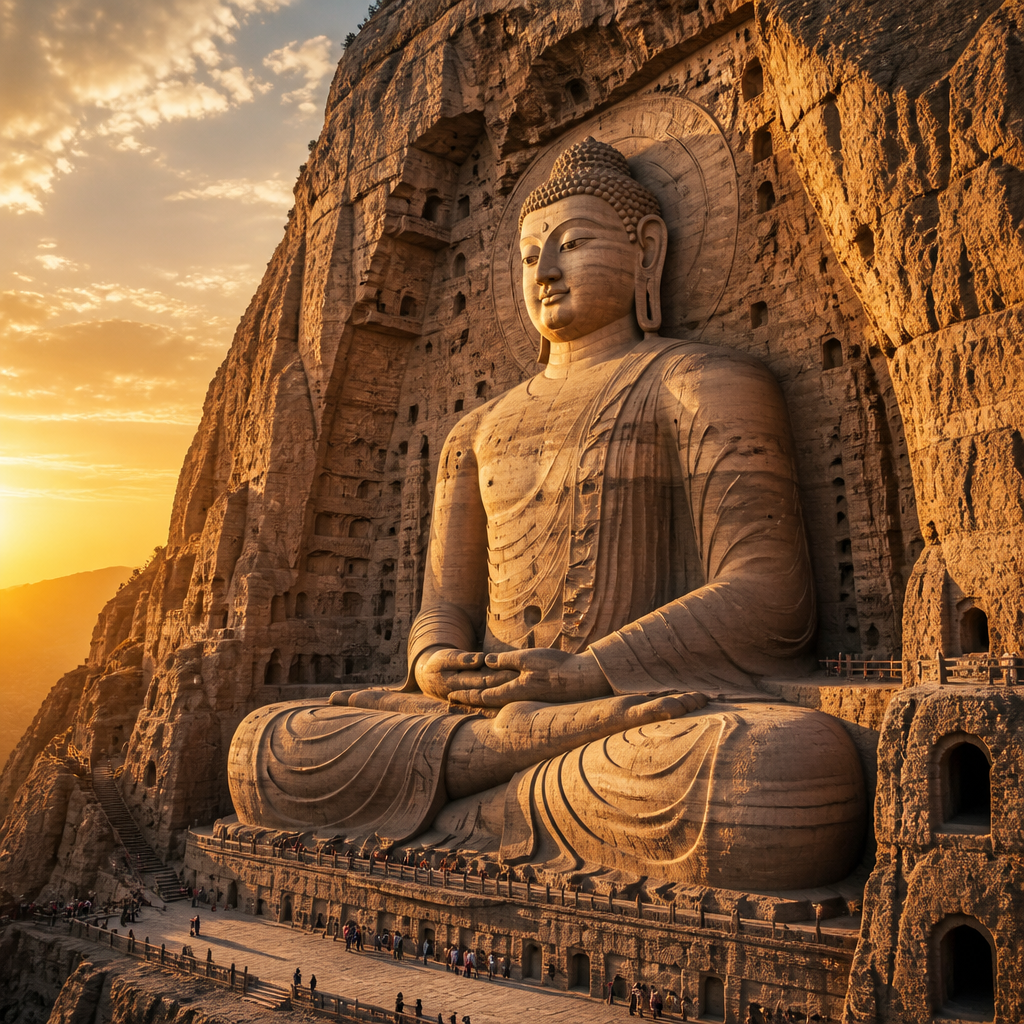
The Gal Vihara complex is the high-water mark of Polonnaruwa-period sculpture and one of the finest achievements in all of Asian Buddhist art. The central feature is four rock-relief statues of the Buddha carved into the face of a single large granite gneiss rock during the 12th century CE. The four images consist of a large seated figure, a smaller seated figure inside an artificial cavern, a standing figure, and a reclining figure. They are considered among the finest examples of ancient Sinhalese carving arts.
The standing figure at Gal Vihara is approximately 7 metres tall and has been called the finest of the series. Its unusual mudra, arms crossed over the chest, has generated scholarly debate. Popular interpretation long identified this figure as Ananda, the Buddha's disciple, grieving over the Parinirvana. Scholarly analysis suggests instead that the mudra represents the Buddha paying homage to the Bodhi tree during the third week after his enlightenment, making it a devotional rather than funerary gesture. This interpretive precision matters for collectors: iconographic details that look like stylistic choices frequently carry specific doctrinal content.
Differences from the Anuradhapura Style
The Polonnaruwa images follow a different style from the Anuradhapura period, and the differences are visible to a trained eye. The surface modelling in Polonnaruwa work tends toward greater volume and plasticity. The figures occupy space with a more assertive physical presence. Where Anuradhapura sculpture often achieves its effect through refined surface minimalism, Polonnaruwa work achieves it through architectural scale and the drama of rock-cut setting. The doctrinal content remains firmly Theravada, but the formal vocabulary has expanded.
The Polonnaruwa tradition did not abandon the Theravada restraint of Anuradhapura. It rehoused it in a larger architectural ambition, proving that devotional seriousness and monumental scale are not contradictions in Buddhist sculpture.
The Polonnaruwa period also produced significant bronze work, particularly images of Hindu deities such as Siva-Nataraj and Ganesha, reflecting the cosmopolitan character of the medieval capital. For collectors of Buddhist sculpture specifically, the stone-carved Buddha images remain the defining Polonnaruwa achievement.
Reading the Iconography: Mudras, Postures, and Robe Treatment
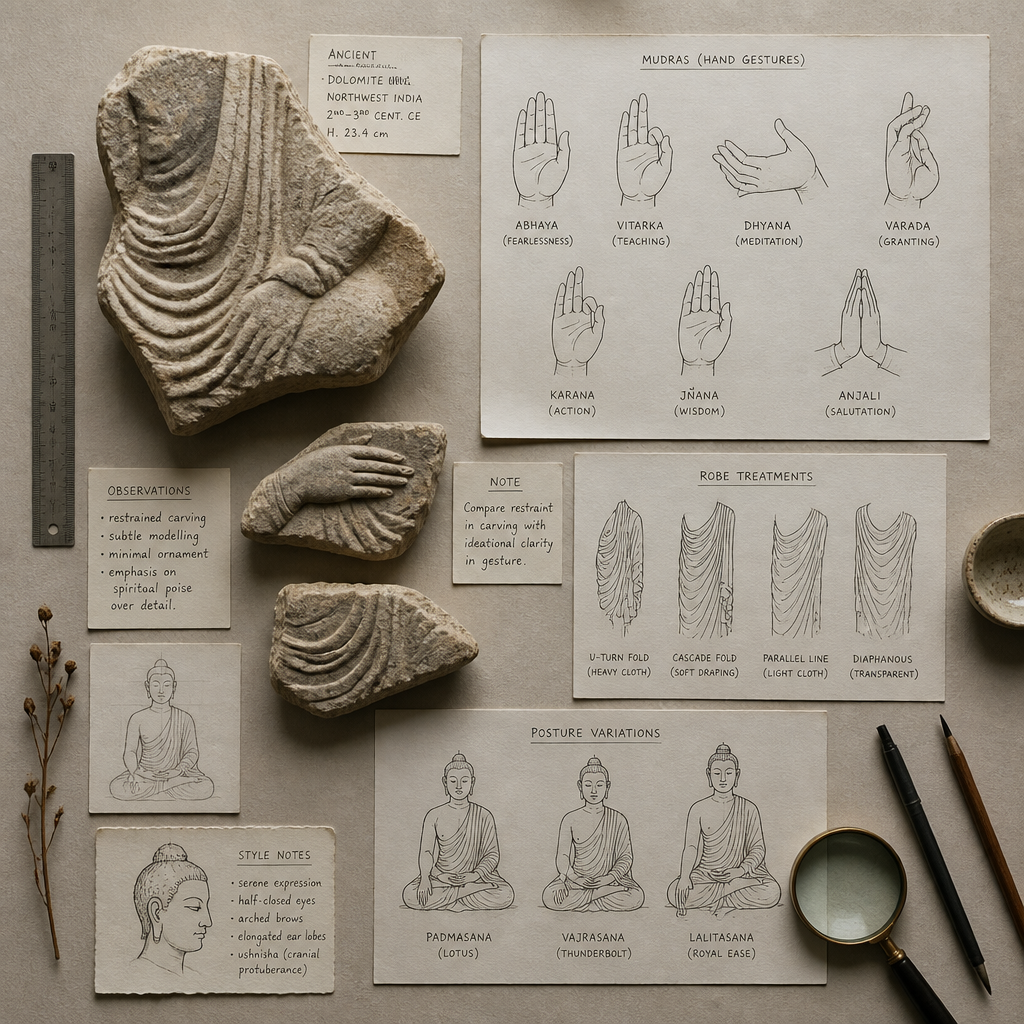
Sri Lankan Buddhist sculpture operates according to a visual grammar that is both strict and layered. Once you know how to read it, any authentic piece from either period becomes legible as a doctrinal statement, not merely a decorative object. The grammar has three primary components: mudra, posture, and robe treatment.
Mudras in Sinhalese Sculpture
Dhyana Mudra, both hands resting in the lap, appears prominently in seated Sinhalese Buddhas across both periods, as the Samadhi figure demonstrates. It communicates withdrawal into enlightened stillness and is the most contemplative of the major gestures. Abhaya Mudra, the right hand raised with the palm facing outward, is characteristic of major standing works including the Avukana, communicating protection, reassurance, and fearlessness. Vitarka Mudra, the preaching gesture with the index finger and thumb forming a circle, appears in earlier bronze work, including the Badulla Preaching Buddha, a 6th-century hollow-cast bronze now held at the National Museum of Colombo.
The practical rule is this: read the mudra first, then the posture. The mudra tells you what the Buddha is doing spiritually. The posture tells you when in his life or teaching cycle that moment occurs. A standing figure with Abhaya Mudra communicates active, present protection. A seated figure with Dhyana Mudra communicates withdrawal into enlightened stillness. These are not interchangeable messages.
Pro tip: When identifying a Sri Lankan Buddha statue, begin with the hand gesture before assessing anything else. If the mudra is inconsistent with the posture, for instance a reclining figure in Abhaya Mudra or a standing figure in Dhyana Mudra, you are almost certainly looking at a modern production that has misunderstood the doctrinal grammar.
Robe Treatment as a Diagnostic Tool
The robe in authentic Sinhalese sculpture is handled with consistent rules across both periods. The right shoulder is bare. The fabric folds are subtle and body-revealing rather than decorative or heavy. This diaphanous treatment, inherited from the Amaravati tradition, stands in clear contrast to the more elaborate drapery conventions of Gandharan or Chinese sculpture. When evaluating any piece attributed to the Sri Lankan tradition, the robe is your most reliable first checkpoint.
Pro tip: Examine the robe folds in raking light on any Sri Lankan Buddha statue you are considering for a collection. Authentic stone pieces from both the Anuradhapura and Polonnaruwa traditions show folds that are minimal, regular, and schematic, barely interrupting the body's surface. If the folds are deep, decorative, or asymmetric in a way that draws attention to themselves, the piece sits outside the Sinhalese formal tradition.
The Flame Ushnisha
The ushnisha, the cranial protuberance symbolizing the Buddha's wisdom and advanced spiritual state, takes a distinctive flame shape in Sri Lankan work. This feature, which spread from southern India to Sri Lanka, is not found in the same form in Burmese, Thai, or Cambodian iconographic traditions. For collectors building a geographically diverse collection of Asian Buddhist sculpture, the Sri Lankan flame ushnisha is one of the clearest single markers of regional identity. A gilt-copper figure of Shakyamuni Buddha from the Sri Lankan tradition is typically distinguished by a flaming ushnisha atop a composition of square shoulders and perfectly balanced, serene stillness.
Anuradhapura vs. Polonnaruwa: A Direct Comparison
|
Feature |
Anuradhapura Period (c. 3rd century BCE to 11th century CE) |
Polonnaruwa Period (11th to 13th century CE) |
|---|---|---|
|
Primary material |
Dolomite marble, limestone, granite; some bronze |
Granite gneiss for major rock-cut works; bronze for Hindu and smaller Buddhist images |
|
Characteristic scale |
Ranges from intimate (the Badulla bronze at 54.5 cm) to large (Avukana at over 14 m), but typically conceived as freestanding individual objects |
Tends toward monumental; the Gal Vihara figures are integrated into a continuous rockface as an architectural ensemble |
|
Formal character |
Refined surface minimalism, diaphanous robe treatment, introspective facial expression, strong Amaravati-Nagarjunakonda influence |
Greater volume and plasticity, more assertive physical presence, rock-cut architectural drama, some additional South Indian formal influence |
|
Dominant mudras |
Dhyana Mudra in seated figures, Abhaya Mudra in standing figures, Vitarka Mudra in bronze work |
Same core mudra vocabulary, with the addition of the unusual crossed-arm posture at Gal Vihara (standing figure) |
|
Doctrinal orientation |
Firmly Theravada; centred on the historic Shakyamuni Buddha in his roles as meditator, protector, and teacher |
Theravada core maintained; greater proximity to South Indian artistic currents through Chola contact and trade |
|
Key surviving examples |
Samadhi statue, Avukana statue, Toluvila statue, Badulla Preaching Buddha bronze |
Gal Vihara complex (four rock-cut figures); Polonnaruwa bronze Hindu deity images |
Collecting Sri Lankan Buddhist Sculpture: What to Look For
Understanding the Anuradhapura and Polonnaruwa traditions is not purely academic. It shapes how you evaluate every piece of Sri Lankan Buddhist art you encounter, whether at an auction, a specialist gallery, or through a dedicated retailer. The two traditions give you reference points for assessing proportion, material, iconographic accuracy, and formal quality in later Sri Lankan work, including Kandyan-period pieces that followed both of them.
How the Traditions Inform Later Sri Lankan Work
The Kandyan period (roughly 16th to 19th century CE) built on both the Anuradhapura and Polonnaruwa foundations while adding new elements: a distinctive flame ushnisha carved from a single piece of jak wood continuous with the head, gilded lacquer surfaces applied in multiple layers, and a padmasana seated posture with Dhyana Mudra as the dominant form. The iconographic continuity with the earlier traditions is clear in the robe treatment and mudra vocabulary, but the material and finish are completely different. Collectors who know the earlier traditions can immediately identify where the Kandyan tradition diverges and where it maintains fidelity to the Theravada formal grammar established over the previous thousand years.
Placing Sri Lankan Sculpture in a Broader Collection
Sri Lankan Buddhist sculpture occupies a specific and underrepresented niche in collections of Asian religious art. Collectors who build primarily around Thai, Cambodian, or Burmese work often find that adding a Sri Lankan piece, particularly one with clear Anuradhapura formal characteristics, creates a useful contrast. The Sri Lankan tradition demonstrates how Theravada doctrine expressed itself in a South Asian stone-carving tradition rather than a mainland Southeast Asian bronze-casting tradition. That distinction is artistically significant and documentable through the formal features described above.
HD Asian Art's collection of Sri Lankan Buddha statues covers multiple periods and iconographic types, sourced with the provenance and documentation that serious collectors require. When comparing pieces across the collection, apply the Anuradhapura and Polonnaruwa frameworks described in this article. The robe treatment, mudra choice, ushnisha form, and material all become meaningful data points rather than vague aesthetic impressions.
For collectors whose interest extends to the broader Theravada world, comparing a Sri Lankan statue with Thai Buddhist sculpture or Burmese Buddhist art reveals how the same doctrinal tradition expressed itself through fundamentally different material cultures and formal conventions. Sri Lanka's stone-carving tradition, shaped by the Anuradhapura and Polonnaruwa periods, is the foundation of that comparison.
Pro tip: When placing a Sri Lankan Buddha statue in a home altar or dedicated display space, resist the impulse to mix it with pieces from traditions that use contrasting formal vocabularies without acknowledging the difference. A Sri Lankan Anuradhapura-style seated figure in Dhyana Mudra works beautifully alongside Cambodian or Thai seated Buddhas in the same gesture, where the regional formal differences become instructive rather than jarring. Placing it next to an elaborate gilded Tibetan piece risks flattening both objects into generic "Asian art."
Frequently Asked Questions
What makes a Sri Lankan Buddha statue different from a Thai or Cambodian one?
The most immediate difference is material and robe treatment. Sinhalese sculpture is rooted in a stone-carving tradition using dolomite, limestone, and granite. The robe is diaphanous, body-revealing, and leaves the right shoulder bare. Thai and Cambodian traditions developed primarily in bronze, with different robe conventions and distinct ushnisha forms. The flame ushnisha in Sri Lankan work is specifically southern Indian in origin and differs from the tiered or conical ushnisha forms found in mainland Southeast Asian traditions.
What is the Anuradhapura period, and when did it end?
The Anuradhapura period refers to the era when Anuradhapura served as the capital of the Sinhalese Buddhist kingdom, from roughly the 4th century BCE through the early 11th century CE. It ended when the Chola dynasty from South India occupied the city in 1017 CE, forcing the Sinhalese court to relocate to Polonnaruwa. The sculptural tradition of the Anuradhapura period continued to influence Sri Lankan art long after the capital shifted.
What are the most important surviving sculptures from the Polonnaruwa period?
The Gal Vihara complex is the most important surviving achievement of Polonnaruwa-period sculpture. It comprises four Buddha images carved directly into a granite gneiss rockface during the 12th century CE under King Parakramabahu I. The images include a large seated figure, a smaller seated figure in an artificial cavern, a standing figure approximately 7 metres tall, and a reclining figure. They are considered among the finest examples of ancient Sinhalese carving and are a UNESCO World Heritage Site component.
How do I identify the Dhyana Mudra in a Sri Lankan Buddha statue?
In the Dhyana Mudra, both hands rest in the lap, one on top of the other with palms facing upward. The gesture is associated with deep meditation and with the moment of the Buddha's enlightenment. It is the dominant hand gesture in seated Anuradhapura-period figures, most clearly exemplified by the Samadhi statue. In Sinhalese sculpture, the Dhyana Mudra is almost always paired with a seated posture, typically padmasana with legs fully crossed.
Is Theravada Buddhism the only tradition represented in Sri Lankan Buddhist sculpture?
Theravada Buddhism is the dominant doctrinal tradition in Sri Lankan Buddhist sculpture, particularly in the Anuradhapura and later Kandyan periods. However, the Polonnaruwa period shows the presence of Mahayana and Hindu influences in the same royal capital, reflected in significant bronze images of Siva-Nataraj, Ganesha, and Siva-Parvati produced alongside the Theravada Buddha images. Sri Lanka's position as a trading island meant its medieval capital absorbed multiple religious and artistic currents, though the Theravada tradition remained institutionally and artistically dominant.
Can the Anuradhapura and Polonnaruwa traditions inform the purchase of a modern reproduction?
Yes, directly. The formal features of both traditions, robe treatment, mudra accuracy, ushnisha form, body proportion, and facial expression, provide a checklist for evaluating whether a piece attributed to the Sri Lankan tradition is iconographically coherent. A reproduction that assigns the wrong mudra to a posture, uses decorative robe folds, or combines features from incompatible regional traditions fails on documentary grounds regardless of its surface finish. Knowing these traditions helps you distinguish pieces that honour the original formal logic from those that approximate it superficially.
Have you encountered a Sri Lankan Buddha statue that left you uncertain about its period or formal tradition? Share your questions or observations below and let us know what prompted them.
References
