



Meditation Statue Placement for Your Home Office
Meditation Statue Placement for Your Home Office
Meditation Statue Placement for Your Home Office
Table of Contents
- Why Meditation Statue Placement Matters in a Home Office
- The Best Directions for Your Meditation Statue: North, Northeast, and East
- Feng Shui Office Desk Layout: Where the Statue Fits
- Creating a Meditation Corner in a Home Office
- Do's and Don'ts of Meditation Statue Placement
- Mudras, Materials, and Cultural Etiquette: Getting the Details Right
- Conclusion
- Frequently Asked Questions
Why Meditation Statue Placement Matters in a Home Office
The best meditation statue placement for a home office puts the figure at or near eye level, in the north, northeast, or east part of the room, facing into the space rather than toward a wall. Get that right and the statue stops being decor and starts doing a job.
That job is focus. A home office blurs work and rest, and a small, deliberate anchor helps you switch between them. This guide from HD Asian Art walks through directions, height, desk layout, and the etiquette that keeps the practice respectful.
Most advice treats statues as decoration.
The Best Directions for Your Meditation Statue: North, Northeast, and East
Northeast is the classic placement for a meditation statue. In Feng Shui and Vastu Shastra, that corner carries stillness and spiritual clarity. East suits morning practice, since it catches early light. North supports calm, steady focus.
Should Your Statue Face East or West?
A meditating Buddha traditionally faces east. East is the direction of sunrise and awakening, so a figure in Dhyana Mudra facing that way reads as intentional rather than accidental.
Placement Relative to Your Main Entrance
Keep the statue out of the direct path from your door. A figure standing in the entry line gets treated as an obstacle, and it collects bags, keys, and clutter.
Feng Shui Office Desk Layout: Where the Statue Fits
Feng shui office desk layout treats the desk as the command position: you sit facing the door with a wall behind you. The statue supports that setup rather than competing with it. But the command position is only half the equation, the other half is whether the placement actually survives contact with a real desk, monitor, and cable run.
Working Around Monitors, Cables, and Clutter
The desk surface is the hardest place to keep a statue. A monitor takes the center, a keyboard takes the front edge, and the remaining real estate fills with a mug, a phone, and a charging cable within a week.
What to avoid on the desk:
- Directly behind the monitor, where it is invisible from your seat
- In front of the keyboard, where it becomes an obstacle
- Anywhere a cable run passes, since cables migrate and drag objects with them
- The same tray as pens, chargers, or mail
Small-Space and Standing-Desk Solutions
A wall shelf mounted above the desk is the most reliable answer for tight rooms. It lifts the statue to eye level, frees the desk surface entirely, and keeps the figure out of the cable zone. Mount it so the base sits roughly at your seated eye line, for most people that lands between 42 and 48 inches from the floor, depending on chair height and monitor position.
- Put the statue on a separate, fixed shelf to the side of the desk, outside the desk's travel path
- Use a small floating shelf mounted high enough that the raised desk clears it by several inches
The Command Position, Applied
In the classic command position you face the door with a solid wall behind you. The statue belongs in your field of view but not in the entry path, the far corner, a side shelf, or the wall you face. It should read as part of the room's structure, not as an object you have to step around.
Height and Elevation: Above Desk Level, at or Near Eye Level
Raise the statue above desk height, ideally at or near your eye level when seated. A figure at floor level reads as discarded, and one below your keyboard reads as clutter.
- Floor or low stool: avoid
- Desk surface: workable but crowded
- Shelf at seated eye level: ideal
- Above head height: avoid, it dominates the room
Creating a Meditation Corner in a Home Office
Creating a meditation corner in a home office needs three things: a clear surface, a seat, and a few feet of quiet. You do not need a spare room.
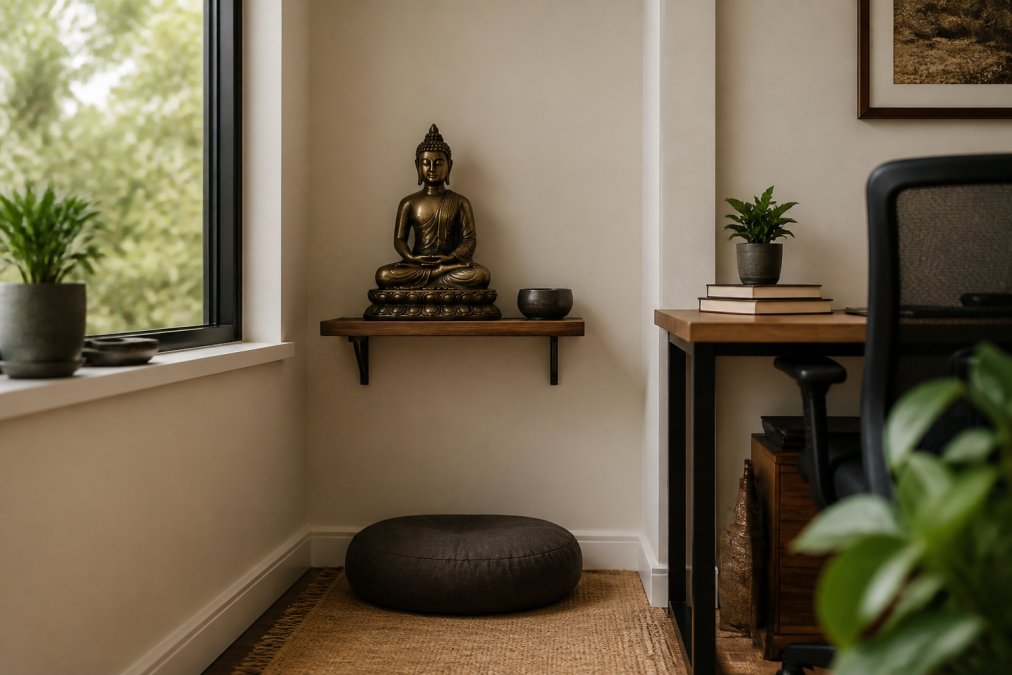
Choosing the Right Statue Size for a Small Corner
Scale the statue to the shelf, not to the room. A piece between 6 and 10 inches tall suits most apartment corners and bookshelf displays. Larger pieces need a dedicated stand, or they look crowded.
| Space Available | Statue Height | Placement Surface |
|---|---|---|
| Small shelf or windowsill | 6-8 inches | Wall shelf |
| Standard bookshelf | 8-10 inches | Shelf at eye level |
| Dedicated corner stand | 12-18 inches | Low cabinet or plinth |
| Full meditation room | 18+ inches | Floor stand or altar |
Do's and Don'ts of Meditation Statue Placement
The do's and don'ts come down to respect and practicality. Treat the statue as a focal point, not a paperweight, and the rest follows.
Do:
- Place it at or near eye level
- Face it into the room, toward your seat
- Keep the surface clean and uncluttered
- Choose north, northeast, or east when you can
- Dust it gently with a soft dry cloth
Don't:
- Put it on the floor or near a waste bin
- Place it in the direct line from your door
- Store keys, cables, or mail on the same surface
- Point it at a blank wall
- Treat it as a shelf for other decor
Mudras, Materials, and Cultural Etiquette: Getting the Details Right
The hand position tells you what the statue is for. A mudra is a symbolic hand gesture in Buddhist and Hindu art, and each one carries a specific meaning. Choosing a statue without knowing its mudra is like hanging a sign in a language you do not read.
Cultural Etiquette: Treating the Statue as More Than Decor
A Buddha or deity figure is a devotional object in its tradition of origin, not a decorative accent. That distinction shapes a few practical habits:
- Handle the statue by its base, never by the head or hands
- Keep the surface beneath it clean and free of everyday clutter
- Do not place it at floor level, near a waste bin, or in a bathroom
- Avoid using the statue as a prop for keys, cables, or mail
- If you move it, lift it deliberately rather than sliding it across a shelf
Lighting and Ambiance: The Overlooked Variable
Lighting does more for a statue's presence than almost any other placement decision, and most guides ignore it entirely. The goal is soft, indirect light that reveals the form without flattening it.
- Task lighting, a small adjustable lamp aimed at the statue from the side, creates shadow and depth, which makes the figure read as a focal point rather than a shelf object.
- Ambient light, a window with diffused daylight, keeps the surface cool and even, and suits stone and wood especially well.
- Direct sun, avoid it. It fades patina, dries wood, and can yellow resin over time.
Material-Specific Care in an Office Environment
Office air is dry, dusty, and often climate-controlled, which affects materials differently.
-
Bronze and other metals develop a natural patina over time. That is a feature, not damage. Dust weekly with a dry microfiber cloth and avoid polishes unless the maker specifies one.
-
Stone holds up well but is porous. Keep it away from damp air and wipe with a dry cloth rather than a wet one.
-
Wood is the most sensitive to office conditions. Keep it out of direct sun and away from heating vents, which dry and crack the surface.
-
Resin is durable but can soften or discolor with heat and prolonged sun exposure. A shelf away from the window is the safe choice.
-
Dust weekly with a dry cloth
-
Keep out of direct sun and damp air
-
Handle by the base, never the head or hands
-
Skip harsh cleaners entirely
Conclusion
Getting meditation statue placement right is less about rules and more about attention. Direction, height, and a clean surface do most of the work.
Frequently Asked Questions
Where should I not place a Buddha statue in my home office?
Avoid placing a Buddha statue on the floor, in a bathroom, directly under a desk, or facing a wall. Do not position it where your feet point toward it while sitting, and keep it away from cluttered or high-traffic areas. Placing a statue in a spot that feels disrespectful or chaotic undermines the sense of inner calm and intentional placement you want. A stable, elevated surface in a quiet corner works best.
Should a meditation statue face the door or the desk?
Traditional guidance favors having the statue face the room's entrance so it greets positive energy, but not directly in line with the door. For a home office, positioning the statue so it faces you while you sit at your desk supports focus and mindfulness. If possible, orient it toward the east or northeast and avoid having its back to a window or mirror.
Can a meditation statue help reduce stress in a workspace?
A meditation statue serves as a visual anchor for mindfulness and clarity during the workday. Glancing at a serene figure can prompt a brief pause, a breath, and a reset. While the statue itself does not eliminate stress, the intentional placement and the ritual of caring for it create a calmer environment. Pairing it with an uncluttered desk arrangement and good lighting amplifies the effect.
What are the most common mistakes when placing statues in a home office?
Common mistakes include placing the statue too low (below desk level), putting it in a cluttered or noisy area, facing it toward a wall, and treating it as purely decorative without regard for cultural etiquette. Another frequent error is choosing a statue that is too small for the space, making it feel lost. Measure your shelf or desk area first, and select a piece that fits proportionally.
