



Khmer Sculpture: A Collector's Guide to Angkor-Era Art
Khmer Sculpture: A Collector's Guide to Angkor-Era Art
Most collectors who discover Khmer sculpture do so by accident, picking up a sandstone head or a bronze Bodhisattva and realising they are holding something made during one of the most sophisticated artistic periods in human history.
The Angkor era, spanning roughly the 9th to the 15th century CE, produced Cambodian Buddhist art of extraordinary technical and spiritual depth. Yet acquiring it well requires specific knowledge that generic art guides simply do not provide. This article gives you that foundation.
Table of Contents
Quick Takeaways
|
Key Insight |
Explanation |
|---|---|
|
Angkor-era art spans multiple distinct styles |
Collectors should learn to distinguish Baphuon, Bayon, and Angkor Wat styles, each with specific facial and body proportions that affect both historical attribution and market value. |
|
Sandstone and bronze are the two primary materials |
Sandstone carvings dominated architectural sculpture, while bronze pieces were produced for temple interiors and royal patronage. Each requires different care and provenance assessment. |
|
Iconography determines the deity, not guesswork |
Hand gestures (mudras), attributes, and headdress types are the reliable identifiers. Misidentifying a Lokeshvara as a Buddha, for example, is a common and costly error. |
|
Angkor-era statues blend Hindu and Buddhist imagery |
The Khmer court shifted between Shaivism, Vaishnavism, and Mahayana Buddhism. Many sculptures reflect syncretism, which is a feature, not a defect. |
|
Reproduction sculptures carry legitimate collector value |
Museum-quality reproductions sourced from skilled Cambodian and regional artisans represent an ethical and legally sound collecting path, particularly post-1970 UNESCO convention. |
|
Condition assessment differs from other art categories |
Surface weathering on sandstone is expected and desirable. Missing hands or faces on Angkor-era statues often reflect deliberate historical damage, not neglect. |
|
Regional stylistic crossover is common |
Khmer artistic influence spread to Thailand, Laos, and Vietnam. Pieces described as Thai or Lao may reflect Khmer prototypes, which affects how you interpret them. |
What Defines Khmer Sculpture
The term Khmer sculpture refers specifically to art produced in the Khmer Empire, centred in what is now northwestern Cambodia, primarily between 802 CE and 1431 CE. This is not a loose geographical label. It refers to a coherent visual culture shaped by royal patronage, temple construction on a monumental scale, and a theology that treated the king as a divine intermediary between the human world and the gods.
In practice, the most recognisable characteristic of Khmer sculpture is the face. The so-called Khmer smile, a serene, inward-looking expression with slightly downcast eyes and a gentle upturn at the corners of the mouth, appears across centuries of production. It is not a generic Asian aesthetic. It is a deliberate spiritual expression designed to communicate transcendence, and it reaches its fullest development in the Bayon style of the late 12th and early 13th centuries.
A common mistake among new collectors is treating Khmer art as a single uniform tradition. It is not. Over six centuries, royal capitals shifted, theological priorities changed, and artistic conventions evolved substantially. A piece from the Preah Ko period (9th century) looks markedly different from a Bayon-period head (late 12th century), even though both are unmistakably Khmer.
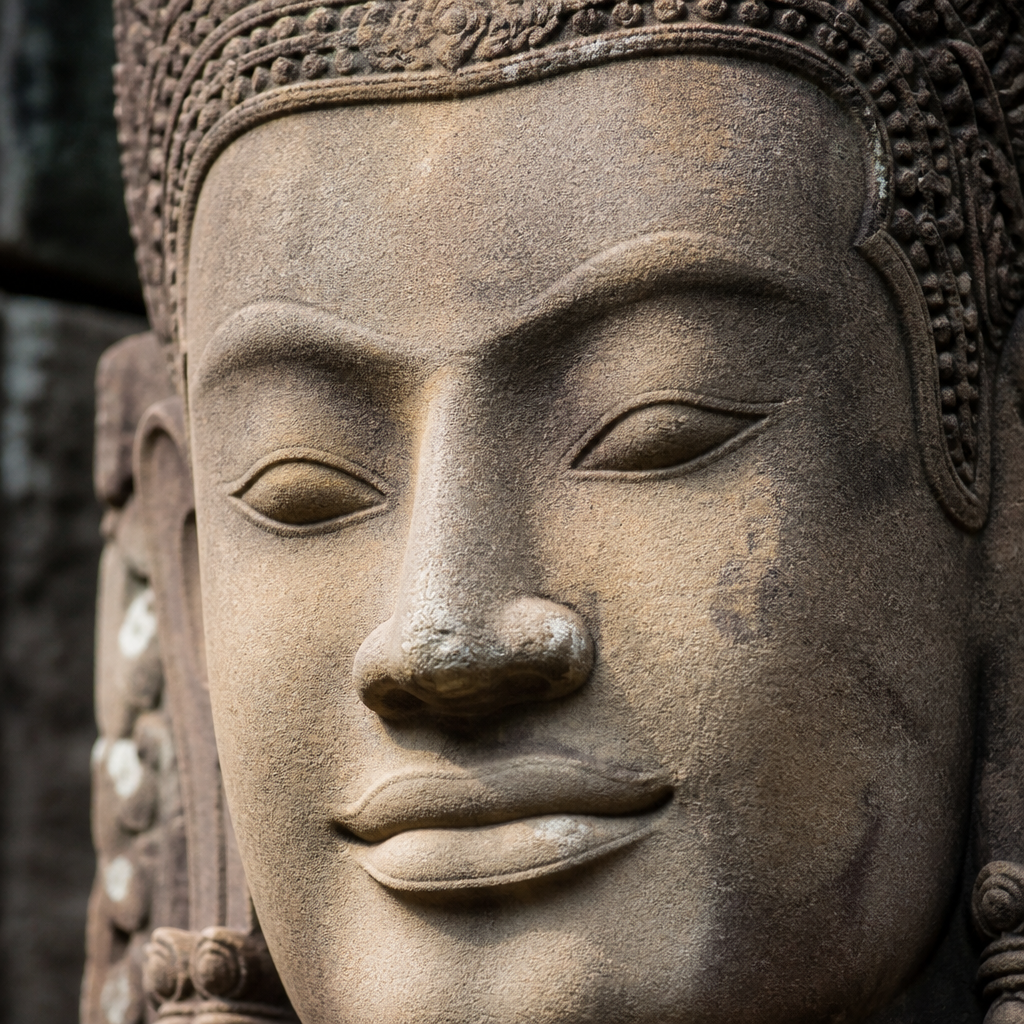
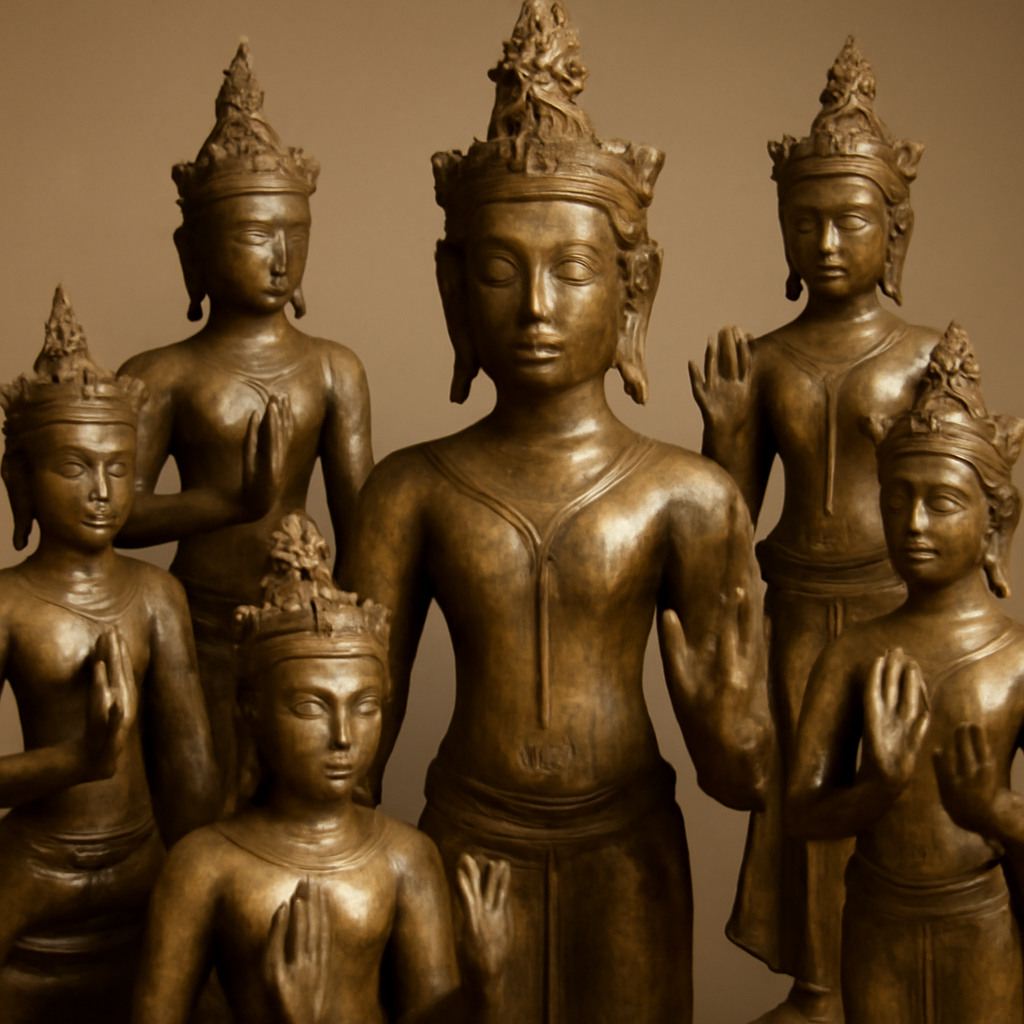
Pro tip: When examining any piece described as Khmer, look first at the treatment of the eyes and the shape of the ushnisha (the cranial protrusion on Buddha figures). These two features are the fastest stylistic dating indicators available to a non-specialist collector.
Major Periods and Styles of Angkor-Era Statues
Khmer art history is organised into named periods corresponding to the dominant temple complexes of each era. The Metropolitan Museum of Art identifies at least twelve distinct Khmer stylistic periods. For collectors, four are essential to understand.
Baphuon Style (1010 to 1080 CE)
Baphuon-period figures are characterised by rounded, full bodies, a smooth treatment of the torso, and a benign facial expression that is warmer and more approachable than later Bayon work. Male figures in this period often have a slight forward lean that gives them an unusually naturalistic quality for religious sculpture of the era.
Angkor Wat Style (1100 to 1175 CE)
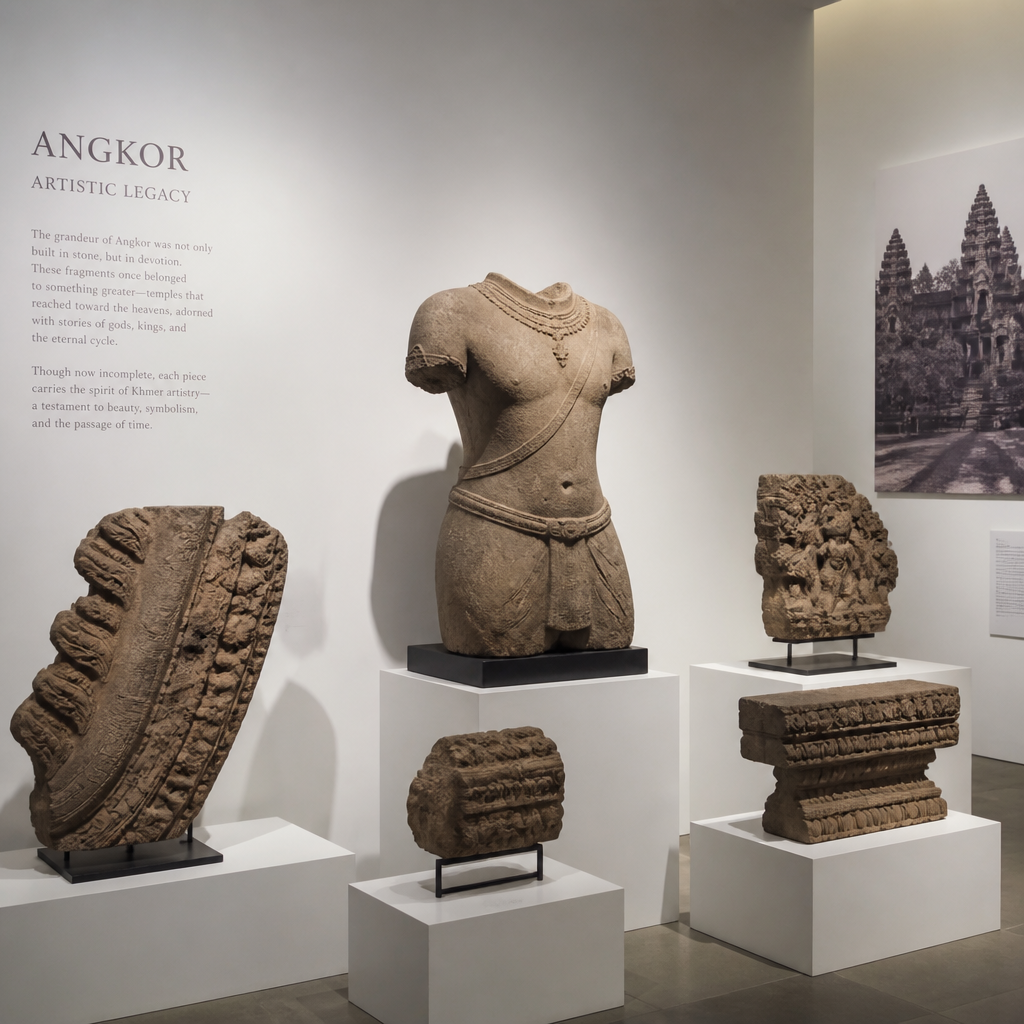
The peak of Khmer imperial confidence produced sculpture with greater formality and rigidity. Facial features become more precisely defined, the bodies more idealised and less naturalistic. Angkor era statues from this period frequently appear on the market because the temple complex itself was so extensively decorated, producing a large volume of fragments and portable pieces over centuries of regional conflict and looting.
Bayon Style (1175 to 1230 CE)
This is the period most collectors associate with the Khmer smile. Under Jayavarman VII, the most prolific builder in Khmer history, sculpture shifted toward a more meditative, almost withdrawn facial expression. Bodies are softer, surfaces less linear. Bodhisattva Avalokiteshvara figures became prominent, reflecting the shift to Mahayana Buddhism under Jayavarman VII's patronage.
Post-Bayon Decline and Transition (13th to 15th Century)
After Jayavarman VII, Khmer sculptural production declined in volume and ambition. Theravada Buddhism gradually displaced Mahayana influence, and artistic production shifted toward wooden temple objects and smaller bronze works. Pieces from this transitional period show clear Thai and Sri Lankan stylistic influence, reflecting the political and cultural changes reshaping mainland Southeast Asia.
"The art of the Khmers constitutes one of mankind's great artistic achievements. At its best, it attained a perfection which has been reached only rarely in the history of world art." - Gilberte de Coral Remusat, French art historian, as cited in studies of Southeast Asian sculptural traditions.
Iconography Every Collector Must Know
Cambodian Buddhist art does not separate spiritual symbolism from aesthetic choice. Every element of a Khmer sculpture carries specific meaning, and knowing that system protects you from misidentification and mispricing.
Buddha Figures and Mudras
The most commonly encountered Cambodian Buddhist art figure is the seated Buddha in bhumisparsha mudra, the earth-touching gesture where the right hand points downward toward the ground. This records the moment of the Buddha's enlightenment and is the most reproduced gesture in all of Southeast Asian Buddhist art. A standing Buddha with both hands raised, palms outward, is in the abhaya mudra of protection. These distinctions affect how a collector understands and presents a piece.
Bodhisattva Lokeshvara
Jayavarman VII's patronage of Mahayana Buddhism made Lokeshvara (Avalokiteshvara) the defining deity of the Bayon period. Lokeshvara figures typically feature a small seated Buddha image in the crown or headdress. This single identifying detail distinguishes Lokeshvara from other male royal or divine figures and is non-negotiable as an identification criterion.
Hindu Deities in the Khmer Collection
Because the Khmer court was predominantly Shaivite before Jayavarman VII's Buddhist turn, a significant proportion of surviving sculpture represents Shiva, Vishnu, and their associated figures. Vishnu in Khmer art is typically shown with four arms holding the conch, discus, mace, and lotus. Shiva is often represented by the linga (a cylindrical abstract form) rather than anthropomorphically. Collectors approaching HD Asian Art's collection of Hindu deity statues will find this Khmer-Hindu overlap directly relevant to how they read South and Southeast Asian religious art more broadly.
Materials and Craftsmanship in Cambodian Buddhist Art
The material a Khmer sculpture is made from is not a secondary detail. It determines where the piece originated within the temple complex, how it was used, and what collecting challenges it presents.
Sandstone
The majority of monumental Khmer sculpture was carved from grey-green sandstone quarried at Phnom Kulen, north of Angkor. Sandstone was ideal for the humid Cambodian climate, resistant to moisture damage in ways that limestone was not. In practice, genuine ancient sandstone pieces show specific weathering patterns: surface pitting, mineral deposits in recessed areas, and a granular texture that is difficult to replicate convincingly in modern reproductions. The weight of sandstone is also considerably greater than most collectors expect.
Bronze
Bronze casting in the Khmer tradition used the lost-wax process, producing pieces of remarkable precision for their era. Bronze was reserved for temple interiors and royal gifts. Bronze Khmer figures tend to be smaller than their sandstone counterparts and show more precise surface detail. Patination on genuine ancient bronzes develops over centuries into a stable green or reddish-brown surface that is chemically distinct from artificially induced patinas.
Contemporary Museum-Quality Reproductions
For collectors who want the aesthetic and spiritual experience of Khmer art without the legal and ethical complications of ancient pieces, contemporary museum-quality reproductions made by skilled regional artisans are the straightforward answer. HD Asian Art's Cambodian sculptures follow this model, offering pieces that reflect Angkor-era iconography and craftsmanship standards without provenance uncertainty.
Pro tip: When evaluating any bronze described as ancient, request a thermoluminescence or XRF analysis report. These are standard museum-grade assessments and any reputable dealer should be able to facilitate access to them. If they cannot, treat that as a clear signal.
Comparing Major Khmer Sculptural Styles
The three most commonly encountered Khmer styles on the collector market each have distinct visual signatures and different levels of scholarly documentation. Understanding where a piece fits within this framework determines how you assess its authenticity, attribution, and appropriate display context.
|
Style |
Key Visual Characteristics |
Primary Deity Types Produced |
|---|---|---|
|
Baphuon (1010 to 1080 CE) |
Full rounded bodies, naturalistic forward lean, warmer facial expression, smooth torso treatment, arched eyebrows meeting at the bridge of the nose |
Vishnu, Shiva, early Buddhist figures, male royal portraits |
|
Angkor Wat (1100 to 1175 CE) |
Greater formality, idealised and rigid posture, precisely defined facial features, strong linear treatment of garments and jewellery |
Vishnu in multiple-arm forms, narrative relief figures, apsara dancers |
|
Bayon (1175 to 1230 CE) |
The canonical Khmer smile, softer and more withdrawn facial expression, meditative quality, fuller lips, prominently modelled eyelids |
Buddha, Bodhisattva Lokeshvara, Prajnaparamita, royal portrait figures |
Collecting Angkor-Era Statues: Authenticity and Ethics
The legal and ethical landscape around ancient Cambodian art changed permanently after Cambodia ratified the 1970 UNESCO Convention on the Means of Prohibiting and Preventing the Illicit Import, Export and Transfer of Ownership of Cultural Property. Any piece without documented provenance predating 1970 faces serious questions under international law, and major auction houses now routinely decline to sell Cambodian antiquities without clear pre-1970 documentation.
This is not a theoretical concern. The Metropolitan Museum of Art returned a Khmer piece to Cambodia in 2013 after the Cambodian government documented its illegal removal. Sotheby's faced significant legal and reputational pressure over Khmer works in the same period. The market has shifted, and collectors who ignore provenance documentation are taking a risk that extends beyond ethics into legal liability.
The practical alternative that serious collectors increasingly adopt is acquiring contemporary pieces produced within Cambodia and the surrounding region by artisans working directly within the Khmer stylistic tradition. These pieces carry no provenance complications, their quality can be directly assessed, and they represent a living continuation of a sculptural tradition rather than the extraction of a finite historical resource.
HD Asian Art's approach to Cambodian and broader Southeast Asian Buddhist sculpture reflects this reality. The collection draws from Burma, Cambodia, Thailand, and other regional traditions, offering pieces that connect collectors and spiritual practitioners to the visual vocabulary of Angkor-era art without the legal exposure that comes with the antiquities market.
Displaying and Caring for Khmer Sculpture
Khmer sculpture, whether ancient or contemporary museum-quality, has specific display requirements that differ from European ceramics or Chinese porcelain. Getting this wrong does not just damage the piece. It changes how you experience it.
Placement and Light
Sandstone and bronze Khmer figures were designed for low, warm light. Temple interiors in Cambodia were lit by oil lamps and filtered sunlight through narrow apertures. Direct bright overhead lighting, particularly modern LED spotlights, flattens the surface modelling that makes Khmer faces so expressive. Warm-toned side lighting, positioned at roughly 30 to 45 degrees from the figure, is standard museum practice and for good reason. It creates the raking light that reveals the full depth of facial carving.
Pedestals and Orientation
Sacred figures in the Khmer tradition were always elevated. Displaying a Buddha or Bodhisattva at floor level, or worse, in a position lower than the viewer's eye level, contradicts the devotional logic built into the piece's proportions. Figures were carved to be viewed from slightly below, which is why the eyes are often cast slightly downward toward the devotee. A solid stone or dark hardwood pedestal that brings the figure to approximately chest height respects both the iconography and the viewing experience.
Cleaning and Maintenance
Sandstone should not be cleaned with water-based products. Moisture penetrates the stone's porous surface and, over time, can promote salt crystallisation that damages the surface. A soft natural-bristle brush is the correct tool for dust removal. Bronze pieces with natural patina should never be polished. Polishing removes the patina permanently and significantly reduces both the aesthetic and market value of the piece.
Frequently Asked Questions
What is the difference between Khmer and Thai Buddhist sculpture?
Khmer sculpture predates and directly influenced Thai Buddhist art, particularly during the Lopburi period in Thailand (11th to 13th centuries). Thai Buddhist figures tend to have a taller, more elongated flame-shaped ushnisha (the protrusion on the top of the head), and the facial features are generally finer and more linear than the broader, fuller Khmer face. In regions bordering Cambodia, the overlap is substantial enough that attribution requires specialist assessment.
Is it legal to buy Cambodian sculpture?
Buying contemporary reproductions and newly produced sculptures made within Cambodia or by regional artisans is entirely legal. Purchasing pieces described as ancient Cambodian artefacts without documented pre-1970 provenance creates serious legal risk under the 1970 UNESCO Convention, which Cambodia and most major importing countries have ratified. Any seller who cannot provide clear provenance documentation for an ancient piece should be treated with significant caution.
How do I identify a genuine Bayon-period sculpture?
Genuine Bayon-period pieces display the characteristic broad face with prominent cheekbones, the specific downward-cast eye with a heavy upper lid, and the gentle but unmistakable upward curve at the corners of the mouth. The nose is broad and flat, the lips full. Thermoluminescence testing for terracotta and ceramic pieces, or XRF analysis for bronzes, provides scientific confirmation. Visual assessment alone, even by experienced collectors, can be misleading for pieces of uncertain provenance.
What should a beginner collector prioritise when starting with Cambodian Buddhist art?
Start by learning the iconography before you spend money. Being able to identify a mudra, recognise the attributes of Vishnu versus Lokeshvara, and understand the basic stylistic differences between Angkor-era periods gives you a framework that no amount of market research replaces. Museum collections with strong Southeast Asian holdings, particularly the Metropolitan Museum of Art and the Guimet Museum in Paris, provide accessible reference material. Then focus on acquiring one strong piece rather than several mediocre ones.
Are museum-quality reproductions of Khmer sculpture worth collecting?
Yes, and the argument for them has become stronger as the antiquities market faces increasing legal and ethical scrutiny. A well-made museum-quality reproduction captures the iconographic precision, material character, and devotional function of the original tradition without the provenance complications of the antiquities trade. For spiritual practitioners using a figure as part of an altar practice, the distinction between an ancient piece and a high-quality contemporary one is largely irrelevant. For collectors focused on display and cultural connection, the quality of the piece matters far more than its age.
Why do so many Khmer statues have missing heads or hands?
Deliberate decapitation and the removal of hands from Khmer statues occurred during several periods of religious iconoclasm within the empire itself, particularly during transitions between Shaivite and Buddhist royal patronage. Later damage occurred during the civil conflict of the 20th century and, significantly, as a result of systematic looting for the international antiquities market in the 1970s and 1980s. Heads and hands are the most commonly separated elements because they were the most portable and the most commercially desirable parts of large stone figures.
We would love to hear from collectors and practitioners about which aspects of Khmer sculptural tradition drew you to this art form and what questions you are still working through as you build your collection.
We would love your feedback and any insights you would share with others. What perspective would you add?
References
