



Indonesian Hindu-Buddhist Sculpture: Majapahit, East Javanese Style Guide
Indonesian Hindu-Buddhist Sculpture: Majapahit, East Javanese Style Guide
Roughly 500 Buddha statues survive at Borobudur in Java, the figure given in the BBC's A History of the World entry for a Borobudur Buddha head, which places the monument's sculpture in a broad period of about AD 600–1200 and the head itself at approximately AD 750–850. Hold that number beside the images sold today as Majapahit style and the chronology sharpens fast.
East Java's Hindu-Buddhist imagery is the late, dense, courtly chapter of a tradition that had already carved hundreds of monumental figures in stone. Reading Indonesian Hindu-Buddhist sculpture in the Majapahit and East Javanese style means working outward from dated objects: which pieces carry a published date, what volcanic stone and copper alloy were each made to do, how a deity is identified from attributes, and where the evidence thins into claims nobody has yet documented.
Table of Contents
- Majapahit Style at a Glance Through Dated Objects
- Stone and Bronze Side by Side for Identification
- Subramanya Names Symbols and Attributes
- How Subramanya Is Shown in Sculpture
- What East Javanese Shaiva Imagery Reveals
- Confirm Provenance Before You Buy or Display
Majapahit Style at a Glance Through Dated Objects
The quickest way to test a date is to set the piece beside objects whose dates are already published. The five below give you a working frame, running from a Buddhist figure carved before Majapahit's political rise to fifteenth-century stone and bronze.
| Object | Date | Material | Key feature |
|---|---|---|---|
| Buddhist Māmakī, Candi Jago | 1268–1280 | Volcanic stone, c. 50 cm high, 35.5 kg | Buddhist figure, late thirteenth century |
| Javanese Ganesha (British Museum) | c. AD 1000–1200 | Volcanic stone | Skulls, joined feet, empty bowl |
| Majapahit guardian (V&A) | 15th century | Coarse volcanic stone, monolithic | Full relief carved from a single mass |
| Parvati from Blitar (V&A) | c. 15th century | Monolithic stone | Four arms, faceted crown, flame-pattern border |
| Majapahit Kala relief (V&A) | Majapahit period | Cast bronze, 14.5 cm wide | Projecting eyes, vegetal surround |
What the dates actually tell you
The Māmakī is the anchor. The British Museum's record of the Māmakī associated with Candi Jago dates the figure to 1268–1280, carved from volcanic stone at approximately 50 cm high, 34 cm wide and 32 cm deep, weighing 35.5 kg. Candi Jago was built in the late thirteenth century for King Wisnuwardhana, whose reign preceded Majapahit's political dominance. A Buddhist image in fully formed East Javanese manner, complete with lotus-throne symbolism, therefore exists before Majapahit controlled the region.
That single date changes how you read a label. The museum record is explicit that Majapahit style shouldn't be treated as an isolated period: its visual language grew from earlier East Javanese religious art and continued through related temple traditions. The fifteenth-century guardian and the Parvati in the table above mark the later end of that continuity, and the wider golden age of Majapahit art shows how courtly patronage held the vocabulary together.
Three markers that do most of the work
- Volcanic stone for monumental work. Guardian figures, temple deities and large reliefs carve from locally available rock.
- Copper alloy for the small and portable. Ritual and devotional objects are cast rather than carved.
- Dense regalia framing the figure. Multi-tiered crowns, jewellery in defined bands, flame borders and lotus platforms.
Before you accept a label, match the object to its nearest row in the table. If nothing there supports the date you've been given, the date is a guess.
Stone and Bronze Side by Side for Identification
Two Majapahit pieces can share a date and a patron and still demand completely different examinations. The comparison below is the one to run first on an unlabelled object.
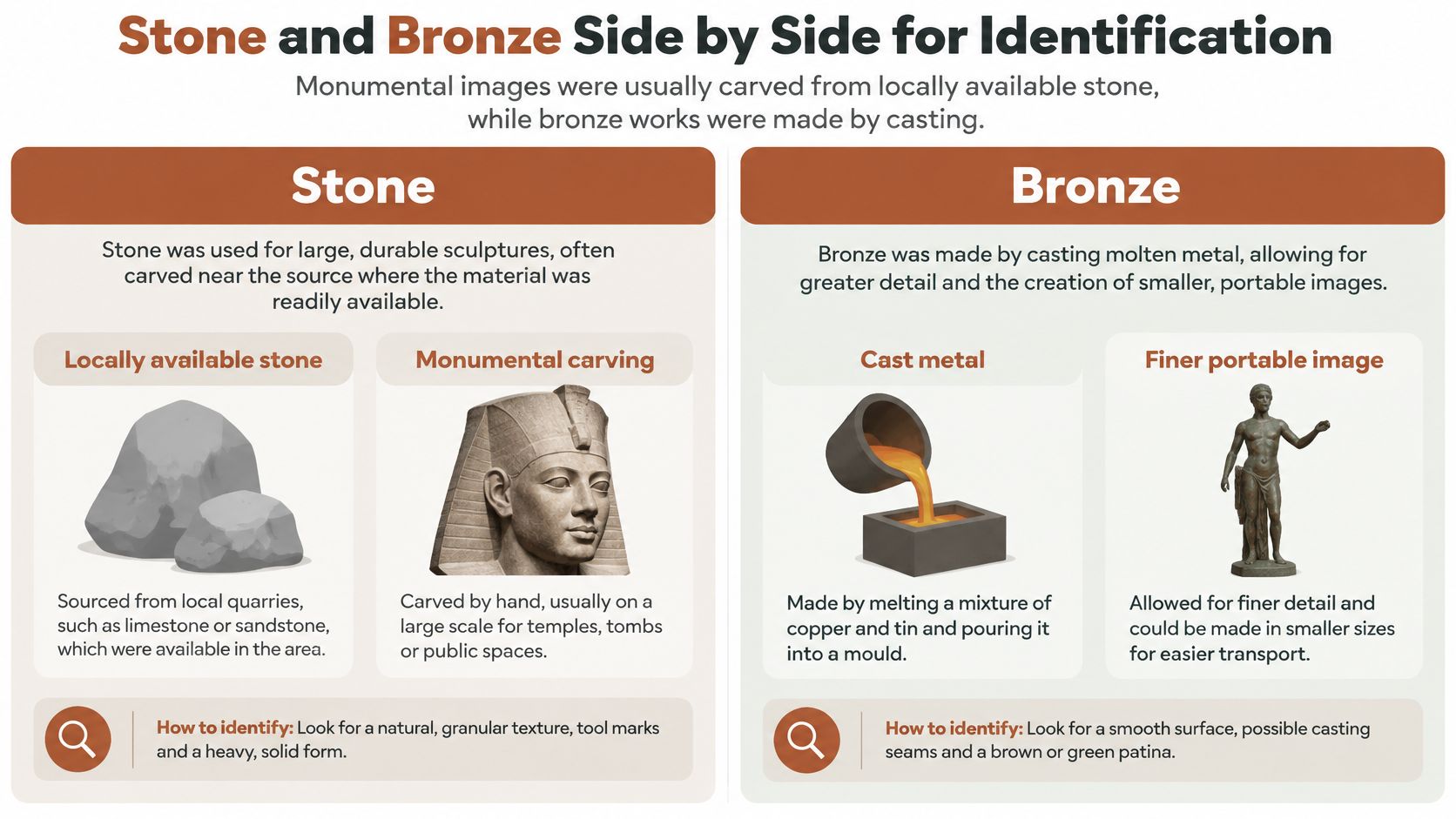
The V&A's record of a 15th-century Majapahit guardian describes a monolithic figure carved in coarse volcanic stone and executed in full relief. That phrasing matters. The sculptor worked directly from a single mass, so the silhouette, the depth and every undercut were decisions made inside one block rather than assembled from separately made parts.
A Majapahit-period Kala relief in the same collection is cast metal, measuring 14.5 cm wide, with projecting eyes, a tooth-filled mouth and a curling vegetal surround. Casting bought the maker forms that coarse volcanic rock resists: thin, projecting ornament snaps in stone and survives in bronze.
| Feature | Monumental stone | Cast bronze or copper alloy |
|---|---|---|
| Typical subject | Monumental images and guardians | Smaller ritual and devotional objects |
| Documented example | 15th-century Majapahit guardian; Parvati from Blitar | Majapahit Kala relief, 14.5 cm wide |
| Construction | Carved from a single mass in full relief | Lost-wax casting |
| Signs to examine | Tool marks, mineral weathering, granular loss, repairs | Casting seams, surface porosity, corrosion products |
| Base | Solid carved plinth; look for breaks, fills and old repairs | Open cavity may hold a consecratory deposit |
| Handling risk | Granular loss from rough treatment | Cleaning or re-seating can damage a sealed base or deposit |
Why the base matters before anything else
The V&A also documents an East Javanese Buddha made by lost-wax casting in copper alloy, with an open cavity beneath the base that probably held a consecratory deposit. A hollow or deliberately sealed base is part of the object's religious function, not a manufacturing leftover, and it changes how the piece should be mounted and stored.
Read a stone base differently. Breaks, fills and repairs concentrate at the plinth, where the figure met the ground and where granular loss begins.
Don't clean, drill or re-seat the base of a bronze until the cavity and anything inside it have been photographed, measured and written into the condition record.
The same discipline applies to stone. Abrasive cleaning across tool marks and weathered surfaces removes the very evidence that dates a piece, and a scrubbed surface can't be put back.
Subramanya Names Symbols and Attributes
Subramanya is a son of Shiva and Parvati, commander of the divine army, and a deity associated with wisdom and victory. He's a distinct figure within the Shaiva family, not a form of Shiva, and blurring the two is the most common misreading in dealer descriptions and auction entries.
The name changes with language and region, and an inscription will use whichever form was local to the workshop or the patron.
One deity, five names
| Name | Main tradition | Meaning or origin |
|---|---|---|
| Subramanya / Subrahmanya | Sanskrit and South Indian Shaiva usage | Varying spellings of the same deity |
| Murugan | Tamil devotional tradition | Associated with beauty, youth and hill shrines of Tamil Nadu |
| Skanda | Puranic literature | Warrior-commander, leader of the divine army |
| Kartikeya | Northern Indian usage | Raised by the Krittikas, the star group of the Pleiades |
| Kumara | General Sanskrit usage | Means young prince or youth |
A Tamil bronze labelled Murugan, a Puranic text referring to Skanda and a northern Indian image called Kartikeya can describe the same figure. Compare the same deity across regions and the naming layer shows how far he travelled: a Sanskrit name root becomes a Tamil devotional name, then a Puranic title in temple litanies, while the iconography barely shifts. The sculpture stayed recognisable while the label moved, which is why attribute reading beats name reading every time.
Ranking the attributes
Identification works by weight of evidence, not by a single clue. Ranked from strongest to weakest:
- The vel. A spear is his signature weapon and the most common identifier in South Indian bronzes and temple images. A leaf-shaped spearhead on a shaft in the right hand is where to start.
- The peacock. His mount, shown beneath him or supporting him as he stands or sits, filling the lower register of the composition.
- The rooster. Usually perched on a banner and linked to vigilance. It supports an identification but rarely carries one on its own.
- The six faces. The Shanmukha form, unlike the single or multiple faces of most Shiva images. Count heads, not halo panels.
- The consorts. Valli and Devasena, common in Tamil and northern compositions. Strong confirmation, weak as an opening clue.
A vel alone can belong to other deities, and a peacock alone belongs to more than one tradition. The strongest combination is a peacock with a vel and a multi-faced head. When all three agree, the identification holds without an inscription.
Count the faces, find the vel, check the mount. Three checks, in that order, and most mislabelled pieces resolve themselves.
How Subramanya Is Shown in Sculpture
Pose tells you what an image was made for before any attribute does.
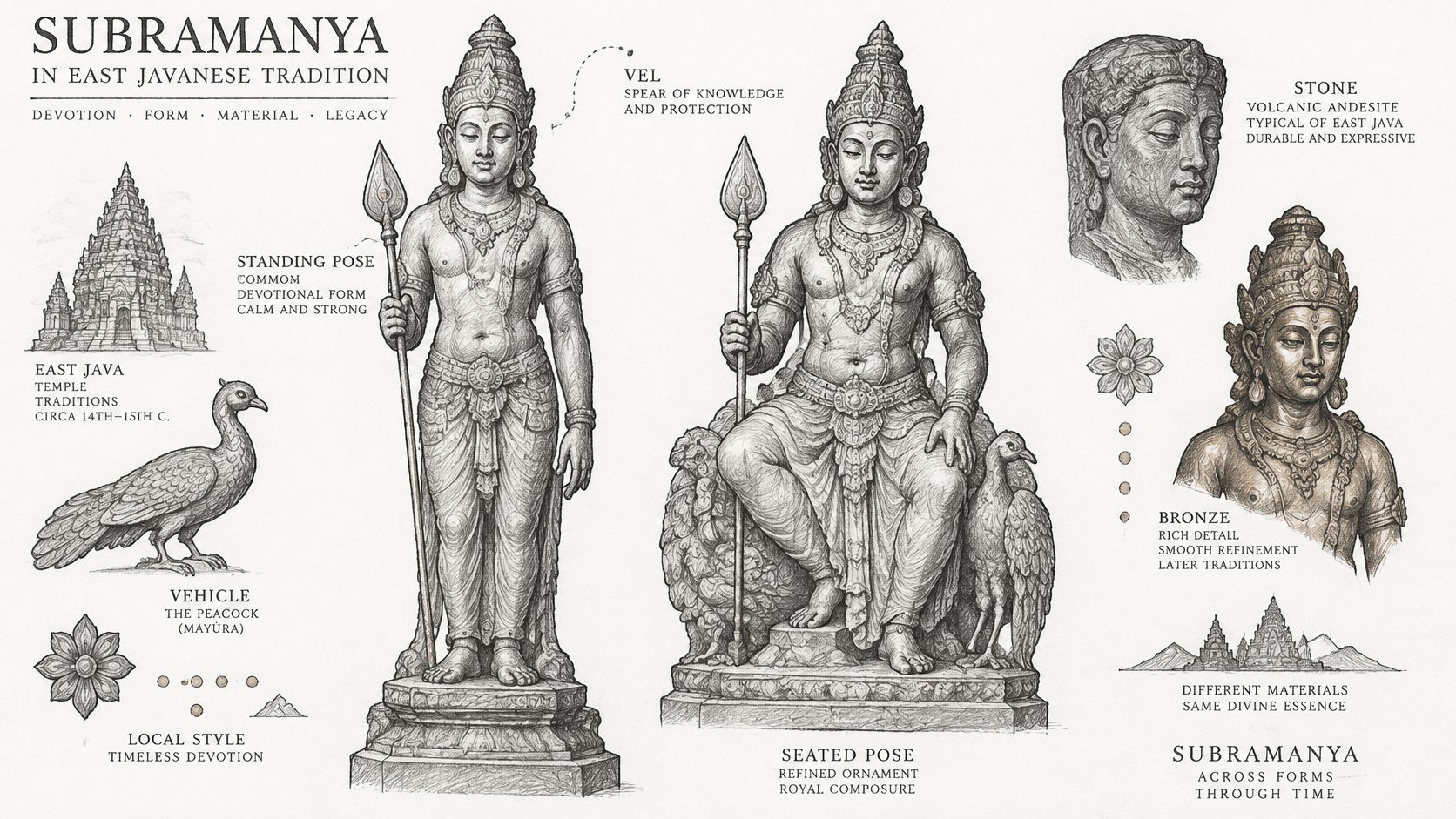
Three poses cover most surviving images. The standing figure holds the vel with an even weight and a frontal stance, made for a shrine niche where it would be seen straight on. The figure with the peacock places the bird at his feet or under him, giving the composition a heavy base. The processional bronze is smaller, cast with a tang or integral fittings so it can be lashed to a palanquin and carried in festival.
Material follows the same logic. South Indian bronzes are typically lost-wax cast and light enough to move. Stone images are carved and usually fixed within a shrine or set into a temple wall, so they were never intended to travel.
A reading method that works across the region
- Identify by attributes and hand gestures. The vel first, then the mount, then the faces.
- Judge the ensemble. Crown geometry, jewellery density, flame border and throne should cohere as one regional system rather than reading as isolated decorative additions.
- Record material and base. Cast or carved, sealed or open, repaired or intact.
The V&A's Parvati from Blitar, dated approximately to the 15th century, shows why the second step does the essential work. It's monolithic and richly jewelled, with a faceted crown, diadem, four arms, lotus bud, fly-whisk, clasped lower hands, flame-pattern border, lotus platform and flanking flower vases. The value of that description isn't the goddess. It's that every element can be checked against the others. A crown belonging to a different regional type, or a flame border that stops abruptly at one shoulder, tells you the piece has been assembled, restored or made for sale.
Related Majapahit altar reliefs could serve as the back of a divine seat, the sanggar agung, symbolising Mount Meru, and their stylised figures connect to later East Javanese shadow-puppet conventions. That's the register worth recording for any piece: material, relief depth, attributes, throne architecture and provenance.
Where the evidence stops
No Majapahit-era image of Subramanya is documented in the material available here. South Indian and Tamil evidence for this deity is abundant; Javanese evidence for this specific figure is not. Any comparison between a Subramanya bronze and East Javanese sculpture therefore has to be presented as an open question rather than a confirmed example. A Javanese origin isn't impossible. It remains undocumented until someone produces a dated find with a site.
For the iconography that is documented, the images of Murugan gathered in this reference set show how pose, spear and mount vary between regional workshops. You can now describe any Subramanya figure by pose, attributes, mount and material, which is the whole of a first catalogue entry.
What East Javanese Shaiva Imagery Reveals
Start with a Ganesha. The British Museum's Javanese Ganesha, carved from volcanic stone and dated approximately AD 1000–1200, keeps the broken tusk, axe and prayer beads that identify the deity anywhere in Asia. Then it departs from the model. Javanese artists gave him skulls, joined his feet and placed an empty bowl where Indian representations show a bowl of sweets.
Those departures aren't errors or provincial misunderstandings. They're choices, and they show sculptors adapting a shared iconography to local religious taste rather than copying a prototype. East Javanese work belongs to its own tradition. It was discussed in coverage of the British Museum's exhibition "Ancient India: Living Traditions", which ran in London until 19 October 2025.
Three checks before you compare a piece with an Indian model
- Which attributes changed. Name the differences out loud, item by item, rather than feeling that the piece looks "a bit different".
- Whether the changes run through the regalia. One oddity can be a repair. A consistent system of crowns, borders and thrones is regional style.
- Whether the material matches regional practice. Volcanic stone, or a copper alloy with a consecratory cavity, not sandstone.
The same adaptation logic runs through the whole family. Shiva, Parvati and Ganesha appear across the region's temple sculpture, and the V&A notes that Javanese rulers were customarily identified with cult deities and that its Parvati may represent a deceased East Javanese queen. That makes some images mortuary and political documents as much as devotional ones. A seller calling such a piece "a Parvati" isn't wrong, just incomplete.
Apply the three checks to Subramanya too. The Java evidence in this material concerns Ganesha and Parvati, above all. A claimed Javanese Subramanya needs dated documentation before it enters a catalogue under that name.
Confirm Provenance Before You Buy or Display
Dating and material get you halfway. The rest is history, and it's the part a seller can't improvise.
The British Museum's record of a Ganesha drawing from Candi Singasari anchors that history. Nicolaus Engelhard began visiting the site in 1802, and the artist Wardenaar was instructed in 1805 to produce drawings of East Javanese scenery and historical monuments. The museum dates one drawing of a seated Ganesha from the site to approximately 1805–1815 and another to approximately 1811–1816. Engelhard shipped statues from Candi Singasari to the Netherlands, and Stamford Raffles later collected or documented Java antiquities.
The consequence for a buyer is direct. A great many East Javanese pieces left their sites in the nineteenth century, so what's known about them often rests on drawings, removal records and catalogue entries rather than on a temple still standing.
Trowulan in Mojokerto Regency is widely identified with Wilwatikta, the Majapahit capital, and the archaeological complex at Trowulan covers roughly 100 square kilometres, taking in the Bajang Ratu and Wringin Lawang gateways, Candi Tikus's sunken bathing complex, Candi Brahu and the Segaran Pool, with the Trowulan Museum holding inscriptions, statues and excavated artefacts. A piece with a documented find context there is stronger than one without, because the site gives its date and function a home.
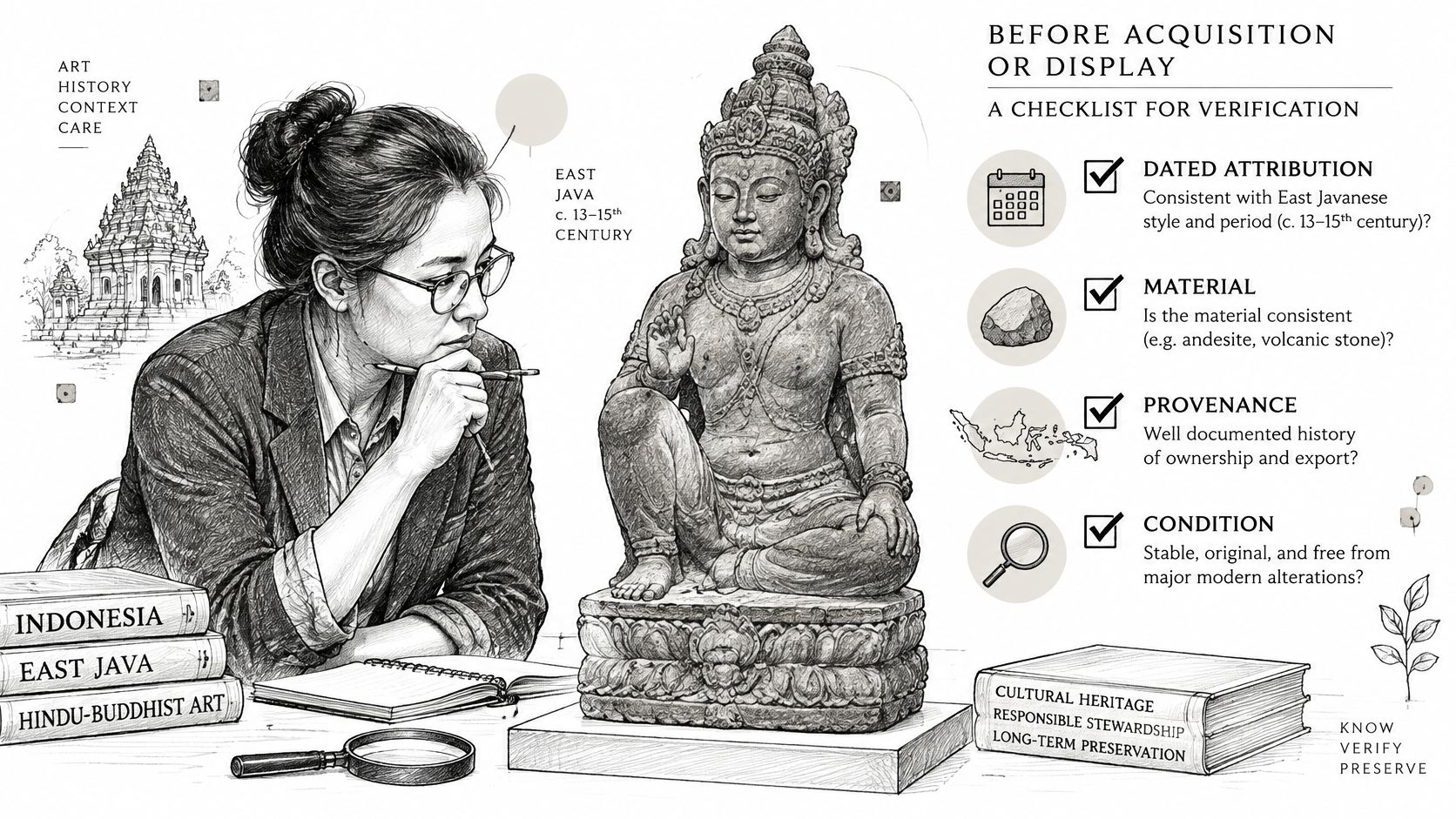
A five-point checklist to send before a deposit
- A dated attribution with its stated basis. Style, material or a published record, named.
- Material confirmed against the markers. Stone checked for tool marks and granular loss, bronze for seams and porosity.
- The base inspected. Consecration cavity, sealed deposit, drilled mounting hole or old repair.
- A provenance history. Prior owners, collections, auction records and any export documentation.
- High-resolution images. Face, hands, base, casting detail and patina, in raking light.
We can supply the fifth item directly. HD Asian Art can provide high-resolution images of a statue's surface, face, hand, base, casting detail or area of patina on request, which is often enough to settle a question about a recut edge or a repolished crown. The provenance research guide sets out the record types worth asking for.
Walk away from any piece whose dating can't be stated plainly in one sentence. Then ask the seller for the checklist documentation before you pay a deposit.
HD Asian Art works with collectors who want the dating and material evidence to hold up, and our Indonesian and Majapahit-style pieces are described by style, material and period rather than by a decorative label. If you're choosing a sculpture for a shrine, a collection or a designed interior, send us photographs of the space, its measurements and your preferences on deity, material or style, and we'll help you narrow the options to pieces that suit it. Start with the collection at HD Asian Art.
