



Indonesian Buddhist Sculpture: Majapahit & Srivijaya Legacy
Indonesian Buddhist Sculpture: Majapahit & Srivijaya Legacy
Few sculptural traditions in Asia match the ambition and spiritual depth of classical Indonesian art. The Indonesian Buddhist sculpture produced under the Srivijaya empire and the later Majapahit kingdom represents a civilizational peak that most Western collectors barely know exists.
These works are not regional curiosities. They are among the finest religious sculptures ever created, and understanding their origins, iconography, and material culture is the difference between buying a beautiful object and acquiring something that carries genuine historical weight.
Table of Contents
Quick Takeaways
|
Key Insight |
Explanation |
|---|---|
|
Srivijaya was a Buddhist maritime empire |
Based in Sumatra from the 7th to 13th centuries, Srivijaya sponsored a Mahayana Buddhist sculptural tradition directly influenced by the Gupta style of India. |
|
Majapahit art blended Hindu and Buddhist iconography |
The Majapahit kingdom (1293-1527 CE) in East Java produced sculptures that fused Shaivite Hindu imagery with Tantric Buddhist elements, a combination unique in world art history. |
|
Balinese Hindu statues preserve Majapahit forms |
When Majapahit fell to Islamic expansion, its court culture migrated to Bali. Balinese Hindu statue traditions are a living continuation of 14th-century East Javanese aesthetics. |
|
Bronze was the prestige medium in both empires |
Major ritual sculptures were cast in bronze using the lost-wax method, with gilding applied to the most important deity figures, particularly Avalokiteshvara and Shiva. |
|
Stone statues carry specific regional signatures |
Andesite volcanic stone was the dominant medium in Central and East Java, giving Majapahit sculptures a dark, dense surface quality that distinguishes them from Cambodian or Thai work. |
|
The kala-makara motif is a diagnostic marker |
The demon face (kala) above temple doorways and the makara sea creature flanking stairways are recurring decorative elements that identify Indonesian religious sculpture from other Southeast Asian traditions. |
|
Srivijaya bronzes appear in multiple museum collections |
Major examples are held at the National Museum of Indonesia in Jakarta, the Museum of Asian Art in San Francisco, and the British Museum, providing reliable reference points for attribution. |
The Srivijaya Empire and Its Buddhist Art
The Srivijaya empire controlled the Strait of Malacca and the maritime trade routes between India and China from roughly 650 CE to 1275 CE. Its capital was near modern Palembang in South Sumatra. This geographic position made Srivijaya the wealthiest polity in Southeast Asia for six centuries, and that wealth funded an extraordinary program of religious art.
Srivijayan Buddhism was primarily Mahayana and Vajrayana. The ruling elite patronized elaborate bronze casting programs producing images of Avalokiteshvara, Prajnaparamita, Tara, and the Dhyani Buddhas. The Chinese monk Yijing visited Srivijaya in 671 CE and reported over a thousand Buddhist monks in residence at Palembang, a population large enough to require significant cult statuary.
Srivijaya art is directly traceable to Indian Gupta and Pala stylistic influence. The elongated figures, the thin transparent garments rendered in stone or bronze, the triple-bent tribhanga posture, and the elaborate crown types all derive from Nalanda monastery workshops in Bihar. Srivijayan patrons appear to have imported Indian craftsmen or sent Sumatran artists to train in India, because the formal correspondences are too precise to be indirect.
"The Srivijayan bronzes represent one of the great flowerings of Buddhist art in Asia. Their technical quality equals anything produced in India or China during the same period." - John Guy, Senior Curator of South and Southeast Asian Art, Metropolitan Museum of Art
A common mistake collectors make is confusing Srivijayan bronzes with contemporary Thai or Burmese work. The face type is the diagnostic difference: Srivijayan figures have broader, rounder faces with a particular heaviness to the lower jaw, reflecting Malay ethnic physiognomy rather than the more angular features found in Mon or Khmer-influenced work.
Pro tip: If you are sourcing an Indonesian Buddhist sculpture attributed to the Srivijaya period, compare the crown type carefully against examples in the National Museum Jakarta's documented collection. The Srivijayan kiritamukuta crown has a distinctive layered structure that differs from both Cambodian and South Indian equivalents.
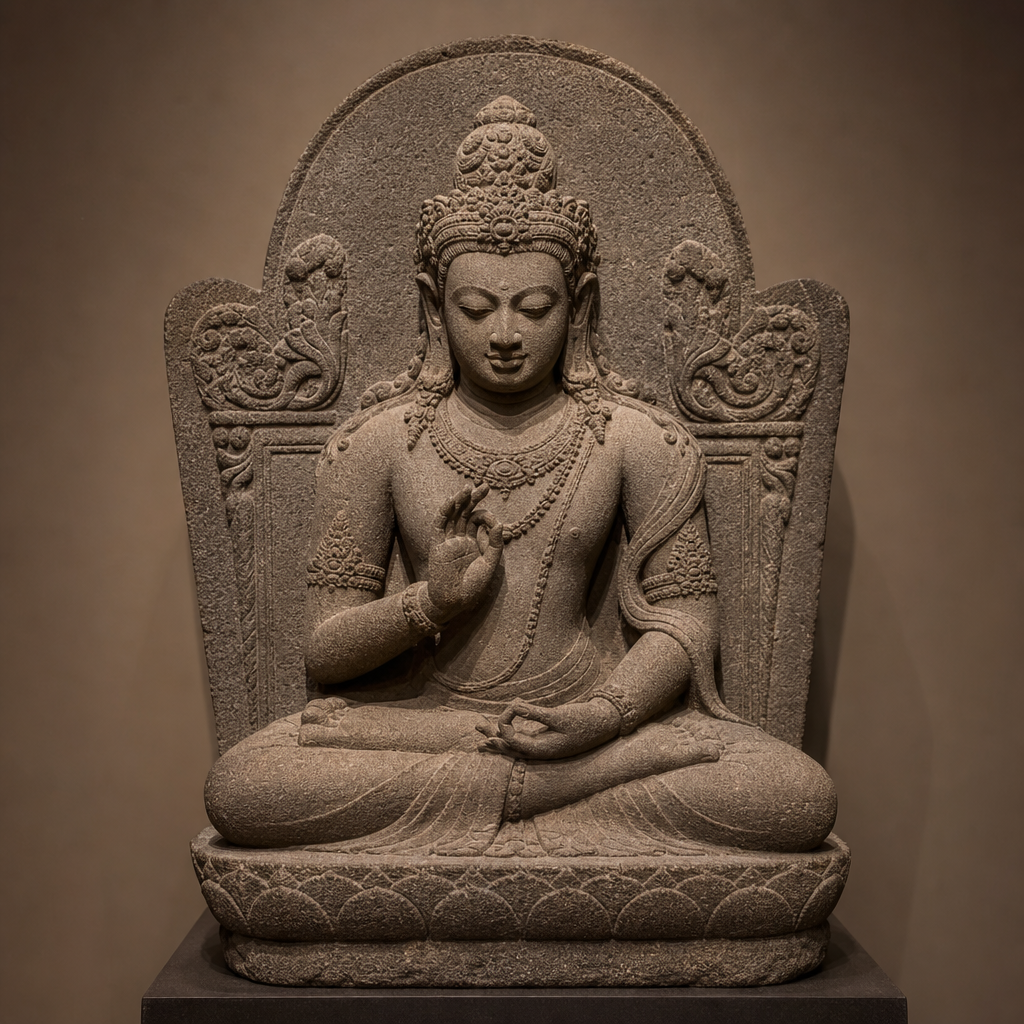
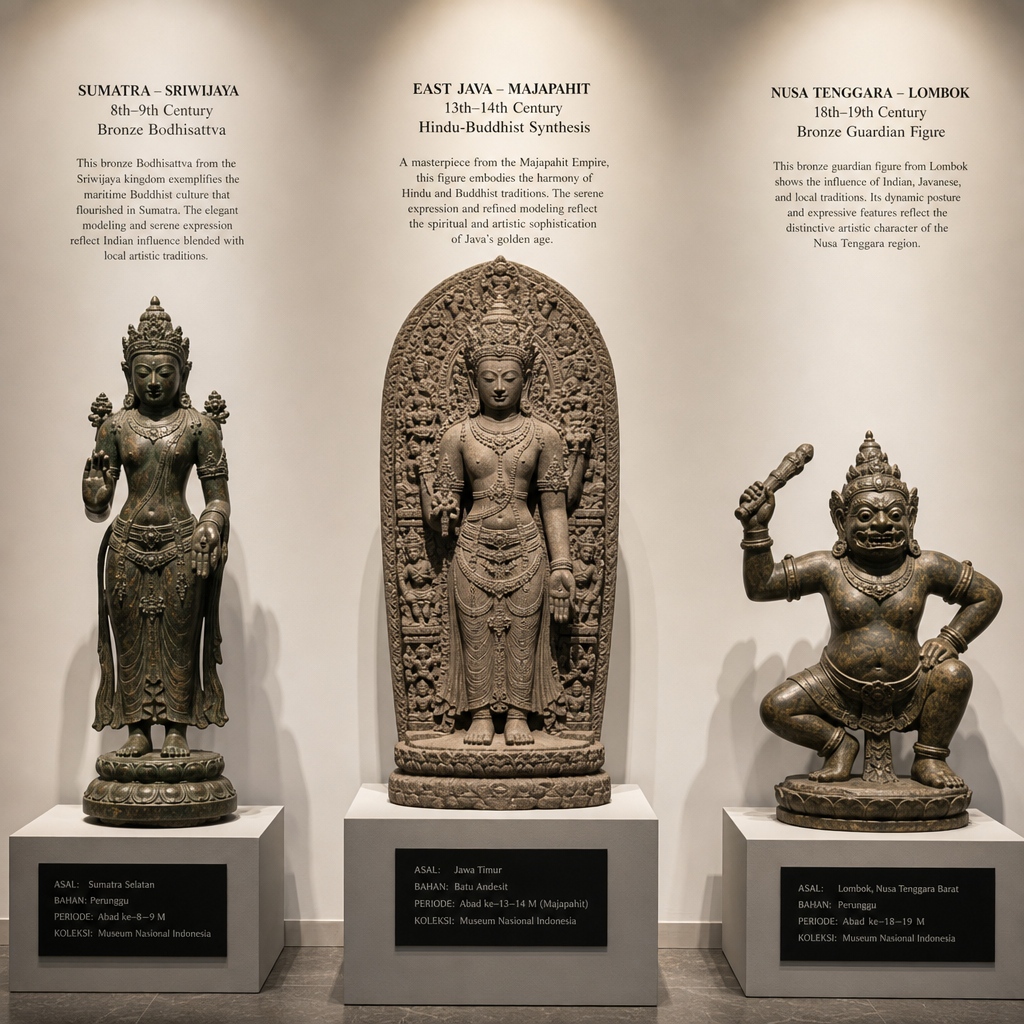
Majapahit Art and the Hindu-Buddhist Synthesis
The Majapahit kingdom (1293 to approximately 1527 CE) was the last great Hindu-Buddhist empire of Java and the largest polity in Indonesian history, controlling territories that correspond to modern Indonesia, parts of Malaysia, and Brunei. Its capital was near present-day Trowulan in East Java, and archaeological excavations there continue to yield sculpture, terracotta, and architectural fragments of the highest quality.
Majapahit art is defined by a deliberate synthesis. The kingdom's state religion recognized both Shaivite Hinduism and Tantric Buddhism as equally valid paths, and its sculptures reflect that theological position. A single image might show a deity with attributes from both traditions. The great prime minister Gajah Mada, who served from 1336 to 1364 CE, presided over the political and cultural height of the empire, and the sculptural programs from this period are the most sophisticated.
East Javanese Figure Style
Majapahit figure sculpture is immediately recognizable by its flat-relief decorative surfaces, the elaborate floral and vegetal patterns covering garments and thrones, and a characteristic facial type with wide eyes, a strong nose, and a slightly archaic smile. The figures are often shown in strict frontality against elaborate flame or lotus halos that are carved as separate structural elements.
The most important surviving Majapahit sculpture is the portrait statue of King Airlangga depicted as Vishnu riding Garuda, now in the Mojokerto Museum. This work, dating to approximately 1042 CE, establishes the iconographic template that Majapahit sculptors worked within for the next three centuries. The fusing of royal portraiture with divine iconography is a specifically Javanese contribution to Asian art history.
Terracotta and the Trowulan Finds
While bronze and stone receive the most scholarly attention, Majapahit produced enormous quantities of terracotta sculpture that is equally significant. Roof finials, water spouts, decorative tiles, and small devotional figures were mass-produced in terracotta workshops around Trowulan. The female terracotta heads found there, with their elaborate hairstyles and jewelry, give a vivid picture of Majapahit aristocratic culture that stone sculpture alone cannot provide.
In practice, terracotta Majapahit pieces are more accessible to private collectors than major bronzes or stone sculptures, because they were produced in sufficient quantity that examples do appear on the legitimate market. Collectors should look for the characteristic red-orange clay body and the precise, slightly formal quality of the modeling.
Pro tip: Majapahit-style relief panels showing narrative scenes from the Ramayana or Mahabharata can be identified by the wayang puppet stylization of the figures, a deliberate artistic choice that links the sculptural program to Javanese performance traditions. This flat, profile-dominated aesthetic is distinct from the more volumetric approach of Cambodian or Indian narrative relief.
The Balinese Hindu Statue Tradition
When Majapahit collapsed under pressure from Islamic sultanates in the early 16th century, significant portions of the Javanese Hindu-Buddhist court, including priests, artists, and nobles, relocated to Bali. This migration preserved and transformed the Majapahit artistic tradition into what we now recognize as Balinese religious art, a living tradition that continues today.
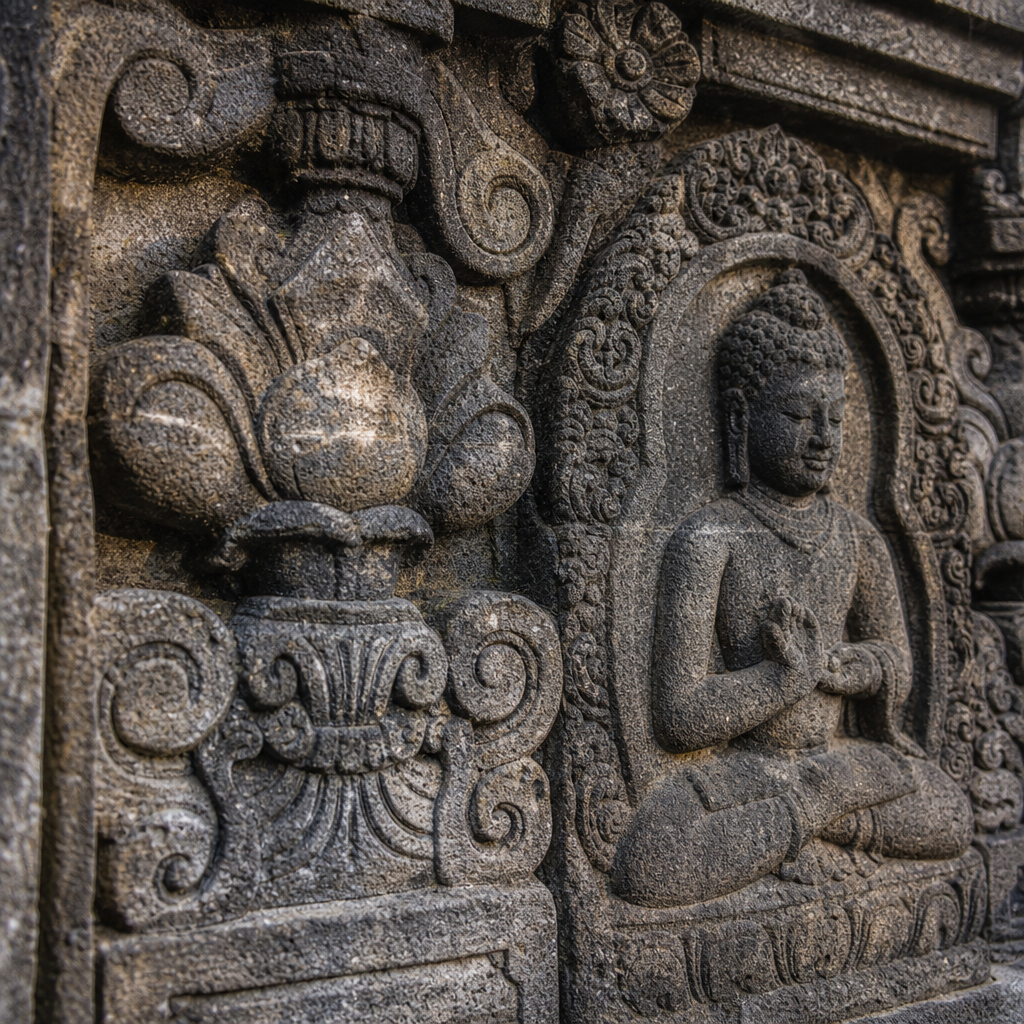
The Balinese Hindu statue tradition is not simply a survival of Majapahit forms. It is a creative evolution rooted in those forms. Balinese sculptors working in volcanic paras stone, black volcanic sandstone, and wood developed a decorative vocabulary that is denser and more exuberant than anything in the Majapahit record. The profusion of vegetation, the elaborate headdresses of deity figures, and the dynamic postures of protective demon figures (bhoma) are distinctly Balinese developments.
The Role of Sekala and Niskala
Balinese religion operates on the principle of sekala (the visible world) and niskala (the invisible, spiritual world). Sculpture is not decorative in this context. It is a technology for making niskala visible and manageable. A Balinese temple statue is a residence for a deity or ancestor spirit, and its formal qualities, the correct mudra, the accurate attributes, the appropriate materials, are necessary conditions for that spiritual function.
This theological context explains why Balinese sculpture maintains such formal conservatism even when produced by contemporary craftsmen. Artistic innovation is not the point. Correct spiritual function is the point. Collectors who understand this distinction approach Balinese Hindu statues differently from how they approach purely aesthetic objects.
Major Deities in the Balinese Canon
The core Balinese Hindu pantheon includes Shiva as the supreme deity, flanked by Vishnu and Brahma in the Hindu Trimurti. Ganesha is present in almost every temple as the remover of obstacles. Dewi Sri, the rice goddess, is a specifically Indonesian deity with no direct Indian counterpart, representing the indigenization of Hindu theology in the archipelago.
Statues of Kala, the time-demon, appear above doorways in carved relief, a direct continuation of the kala-makara motif from the Majapahit temple tradition. Garuda, Vishnu's mount, is a national symbol of Indonesia and one of the most frequently depicted subjects in both classical and contemporary Balinese sculpture.
Iconography and Identification: Reading Indonesian Sculptures
Reading an Indonesian sculpture correctly requires familiarity with both the pan-Asian Buddhist and Hindu iconographic systems and the specific local modifications that Indonesian artists applied to those systems. The mistakes happen when collectors apply Cambodian or Thai iconographic rules to Indonesian material.
In the Buddhist canon relevant to Indonesian art, the most important bodhisattva is Avalokiteshvara (called Lokesvara or Padmapani in Javanese inscriptions). Srivijayan images of Avalokiteshvara typically show him in an elaborate crown containing a small seated Amitabha Buddha, holding a lotus flower, and displaying the gesture of gift-bestowing (varada mudra). The four-armed and eight-armed versions are more common in Indonesian Buddhist sculpture than the simpler two-armed version.
For Hindu iconography, the key identification markers in Majapahit and Balinese sculpture follow Indian conventions but with specific regional variations. Shiva in the Indonesian tradition is frequently depicted as Mahaguru, the supreme teacher, shown seated in meditation with a third eye on the forehead, a crescent moon in the matted hair (jatamukuta), and holding a fly whisk and water vessel. This seated Mahaguru type is specifically Javanese and distinguishes East Javanese Shiva sculpture from South Indian or Cambodian equivalents.
A common mistake is identifying Prajnaparamita statues as generic Buddha or Bodhisattva figures. The great Prajnaparamita from Singhasari temple (now in the National Museum of the Netherlands in Leiden) is the canonical example: a female figure seated in meditation, holding a palm-leaf manuscript representing the Prajnaparamita Sutra, with an elaborate lotus throne. She is the deification of the wisdom text itself, and her identification requires reading the object she holds.
Comparison of Regional Indonesian Sculptural Styles
|
Characteristic |
Srivijaya (Sumatra, 7th-13th c.) |
Majapahit (East Java, 13th-16th c.) |
Balinese (16th c.-present) |
|---|---|---|---|
|
Primary medium |
Bronze, with some stone |
Andesite stone, bronze, terracotta |
Paras (volcanic tuff) stone, wood |
|
Primary religion |
Mahayana and Vajrayana Buddhism |
Hindu-Buddhist synthesis (Shivabuddha) |
Agama Hindu Dharma (Balinese Hinduism) |
|
Indian stylistic source |
Gupta and Pala (Bihar, Bengal) |
Late Pala and local Javanese development |
Majapahit tradition with local elaboration |
|
Figure type |
Slender, tribhanga, soft modelling |
Frontal, flat relief ornamentation, wayang influence |
Dense decoration, dynamic postures, expressive faces |
|
Key deities |
Avalokiteshvara, Tara, Prajnaparamita |
Shiva as Mahaguru, Vishnu, Ganesha, Prajnaparamita |
Shiva, Ganesha, Dewi Sri, Garuda, Bhoma |
|
Collector accessibility |
Museum-grade bronzes, rare on market |
Terracotta and small bronzes more accessible |
Contemporary and mid-20th century work available |
Collecting Indonesian Sculpture: What Matters Most
The Indonesian sculpture market rewards knowledge more directly than almost any other area of Asian art collecting. Pieces are frequently misattributed, and the visual overlap between genuine Majapahit work, later Balinese production, and 20th-century tourist-market copies requires careful attention to material, technique, and provenance.
For collectors serious about Majapahit art, the most reliable entry point is documented terracotta. Genuine Majapahit terracotta from the Trowulan region has a distinctive clay composition that has been studied by Indonesian archaeologists at Balai Pelestarian Cagar Budaya (the Indonesian Cultural Heritage Conservation Board), and thermoluminescence dating is a practical option for pieces where age is contested.
What Sets Museum-Quality Indonesian Pieces Apart
Museum-quality Indonesian sculpture, whether Buddhist or Hindu, shares several characteristics regardless of period. The hand modeling or stone carving shows consistent understanding of the underlying anatomy beneath the ornamentation. Surface treatment is deliberate and controlled. Iconographic details, the correct number of arms, the accurate weapons or symbolic objects, the proper throne or mount, are handled with the precision that only comes from direct involvement in living ritual culture.
At HD Asian Art, the Indonesian sculpture collection is sourced from across the archipelago with specific attention to this quality threshold. The difference between a piece that meets museum standards and one that does not is visible in the carving of secondary elements: the treatment of the lotus petals on a throne base, the clarity of the flame halo behind a bodhisattva figure, the precision of the sacred thread (yajnopavita) crossing a deity's chest. These details are the practitioner's test.
Collectors building a home altar around Indonesian Buddhist or Hindu sculpture should understand that these traditions are functionally oriented. A Balinese Ganesha or a Javanese Prajnaparamita carries specific spiritual associations tied to their iconographic correctness. Collectors at HD Asian Art's target audience, whether approaching from an art historical, spiritual, or aesthetic angle, benefit from the same underlying precision.
Pro tip: When comparing Indonesian Buddhist sculpture from different retailers, ask specifically about the sourcing region and the carving tradition. A piece described simply as "Indonesian Buddha" without specification of whether it follows Javanese, Balinese, or Sumatran formal conventions is a piece whose seller does not understand what they are selling. HD Asian Art's Indonesia collection specifies these distinctions because they matter to the piece's meaning and value.
The broader HD Asian Art collection includes Buddhist and Hindu sculptures from Burma, Cambodia, India, Thailand, and other Asian traditions. Understanding Indonesian work in comparative context, against Khmer or Indian originals, deepens appreciation of what the Javanese and Sumatran artists borrowed, what they transformed, and what they invented.
Frequently Asked Questions
What is the difference between Srivijaya art and Majapahit art?
Srivijaya art is primarily Buddhist, produced in Sumatra between the 7th and 13th centuries, and shows strong Indian Gupta and Pala influence. Majapahit art is primarily Hindu-Buddhist, produced in East Java between the 13th and 16th centuries, and displays a distinctly Javanese aesthetic with flat relief ornamentation and wayang puppet stylization. Srivijayan work is predominantly bronze; Majapahit work uses andesite stone, bronze, and terracotta. The two traditions are related but belong to different geographic, religious, and temporal contexts.
Are Balinese Hindu statues made today authentic works of art?
Yes, with qualification. Contemporary Balinese sculpture produced by craftsmen working within the traditional iconographic canon and using traditional materials (paras stone, wood, silver) is authentic Balinese religious art. It is not ancient, but age is not what makes Balinese sculpture significant. What matters is whether the piece correctly represents the iconographic tradition it belongs to and whether it is produced with the technical and spiritual seriousness that tradition demands. Tourist-market mass production in inferior materials is a different category entirely.
Which deities were most commonly depicted in Indonesian Buddhist sculpture?
Avalokiteshvara was the most frequently depicted bodhisattva in both Srivijayan and Javanese Buddhist art, appearing in two-armed, four-armed, and eight-armed forms. The female bodhisattva Tara was also common in Srivijayan bronzes. Prajnaparamita, the personification of wisdom, achieved particular importance in Singhasari and early Majapahit sculpture. The Dhyani Buddhas, particularly Amitabha and Akshobhya, appear in both architectural programs and portable bronzes across both traditions.
What materials were used in Majapahit sculpture?
Andesite, a dense dark volcanic stone quarried in East Java, was the primary medium for monumental Majapahit sculpture. Bronze was used for portable cult images and royal portrait figures. Terracotta was used extensively for architectural decoration and smaller devotional objects. Gold was applied as gilding to the most important bronze images. Wood was used for some portable images but has survived poorly given Indonesia's tropical climate.
How can I identify a genuine Indonesian Buddhist sculpture versus a reproduction?
Genuine older Indonesian Buddhist sculpture shows specific aging patterns consistent with its material and burial or display history. Andesite stone develops a distinctive weathering and root-mark patterning. Bronze acquires patination that follows the casting seams and tool marks in characteristic ways. Thermoluminescence testing is available for terracotta. Beyond technical testing, iconographic accuracy is a strong secondary marker: reproduction makers frequently get details wrong because they are copying photographs rather than working within a living iconographic tradition. Sourcing from specialists who can document a piece's provenance and provide iconographic attribution is the most reliable protection.
How does Indonesian sculpture relate to other Buddhist traditions like Thai or Cambodian art?
Indonesian Buddhist sculpture shares pan-Asian iconographic foundations with Thai and Cambodian work but represents an independent regional development. All three traditions drew on Indian Buddhist iconographic models, but through different Indian source schools and at different periods. Cambodian Khmer art was primarily influenced by South Indian Pallava and Gupta traditions; Srivijayan art drew more heavily on Pala-period Bengal and Bihar. Thai Buddhist sculpture developed under direct Srivijayan, Mon, and Khmer influence, making it a synthesis of traditions that Indonesian work largely bypasses. The formal vocabularies are related but distinct, and confusing them leads to misattribution.
If you collect Indonesian Buddhist or Hindu sculpture, or are considering your first acquisition, share what drew you to this tradition and what questions remain unanswered for you.
References
