



How to Style a Minimalist Pooja Corner at Home
How to Style a Minimalist Pooja Corner at Home
Quick Summary
A minimalist pooja corner is a small, uncluttered sacred space built around one central statue, a single light source, and a restrained palette of natural materials. Start by measuring the wall and marking the footprint with painter's tape, then choose one focal statue, one lamp or diya, and one incense holder. Keep only what supports worship or calm, and store the rest out of view.
- Mark the footprint on the floor with painter's tape and live with the outline for a day before buying anything.
- Choose one of three layouts: corner units, wall-mounted mandirs, or fold-away shelves for studio apartments.
- Use a single shallow drawer under the shelf, divided into four fixed zones for supplies.
- Place lamps at least a foot from fabric, curtains, and wooden shelf backs, and never tuck a diya inside a closed cabinet.
- Pick one wood tone and one metal finish and repeat them, since mixing three finishes loses the minimalist look.
Table of Contents
- Start With Pooja Room Placement and a Clear Floor Plan
- Small Pooja Room Design That Feels Intentional, Not Cramped
- Minimalist Styling Principles: What to Keep and What to Remove
- Compact Pooja Room Storage for Oils, Incense, and Offerings
- Pooja Room Lighting Ideas for Warmth and Safety
- Materials, Finishes, and Budget Tiers for a Minimalist Corner
- Choosing a Focal Statue for Your Minimalist Pooja Corner
- Frequently Asked Questions
Start With Pooja Room Placement and a Clear Floor Plan
A minimalist pooja corner begins with one decision: where it lives. Get the placement right and everything else, the shelf, the light, the statue, falls into line. Get it wrong and no amount of styling rescues the space.
The ones who measured first end up with calm, balanced corners. The ones who bought a statue before finding its home are the ones rearranging furniture a month later.
Choosing the Right Wall and Direction
Traditional practice favors the northeast corner of a home, with the deity facing east or north. Many families treat this as a starting point rather than a hard rule.
Before you commit to a footprint, it helps to check how to position a Ganesh idol for good luck at home, and if your space is tight, this guide to Ganesha statue size for small spaces can help you consider the corner's proportions.
Mapping the Footprint Before You Buy Anything
Measure the wall, the depth you can spare, and the height you want the focal point to sit at. Then mark it on the floor with painter's tape. Live with that outline for a day.
A common mistake is buying the statue first and the furniture second. Do it the other way around. The shelf defines the space; the statue completes it.
Small Pooja Room Design That Feels Intentional, Not Cramped
Small does not mean sparse. A compact pooja room works when every object earns its place and the eye has somewhere to rest. The goal is a corner that reads as deliberate, not squeezed.
Corner Units, Wall-Mounted Mandirs, and Fold-Away Shelves
Three layouts cover most apartments:
- Corner units: a triangular or L-shaped shelf that tucks into the angle of two walls. Best for floors with no spare width.
- Wall-mounted mandirs: a shallow cabinet fixed at chest height. Keeps the floor clear and the sacred zone above daily clutter.
- Fold-away shelves: a hinged unit that closes flat. Useful in studio apartments where the corner doubles as living space.
For tighter rooms, our guide to arranging idols in a small apartment walks through shelf order and spacing in detail.
Minimalist Styling Principles: What to Keep and What to Remove
Minimalism in a pooja corner is not about emptiness. It is about removing anything that competes with the focal point.
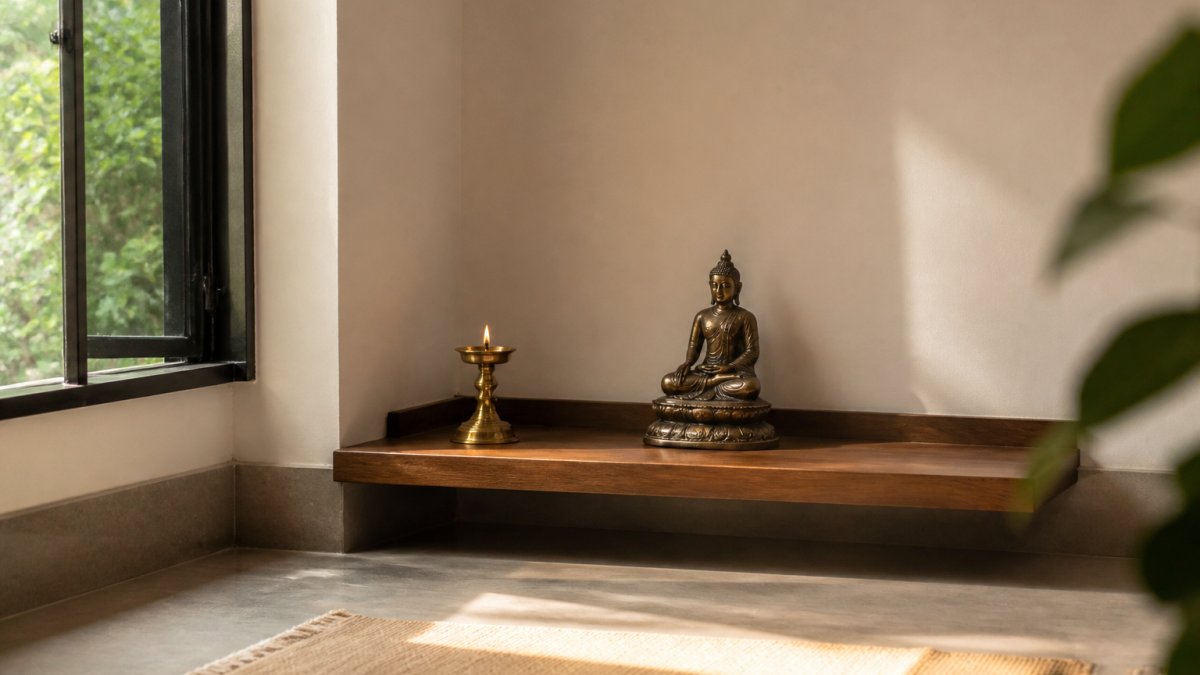
Keep these:
- One focal statue, sized to the shelf
- One lamp or diya
- One incense holder
Remove these:
- Crowded photo frames and multiple deity prints
- Plastic storage bins left in view
- Scented candles that clash with incense
The test is simple. If an object does not support worship or calm, it belongs in a drawer, not on the altar.
Compact Pooja Room Storage for Oils, Incense, and Offerings
Storage is where most compact pooja room designs fall apart. Supplies pile up because nothing has a home, and the corner starts to read as a utility shelf instead of a sacred space. The fix is not more storage; it is storage that disappears.
The One-Drawer Rule
A single shallow drawer mounted directly under the shelf can hold supplies for a daily practice. Deeper drawers invite clutter because items sink to the bottom and get forgotten. A shallow drawer encourages you to keep only what you actually use. Maintaining this level of intentionality extends beyond the drawer to the surrounding display, where you can learn to style your shelves with the same disciplined focus on balance and clarity.
Divide the Drawer Into Zones
A plain drawer becomes a jumble within a week. Divide it into four fixed zones so your hand knows where to go without looking:
- Front left: lamp oil in a small bottle with a screw cap, plus a folded cloth for wiping the lamp
- Front right: matches or a lighter, kept in a small tin
- Back left: incense sticks in a closed holder, laid flat so they do not snap
Keep the Countertop Clear
Everything that lives on the shelf should be part of the ritual, not part of the storage. The lamp, the incense holder, the offering tray, and the focal statue stay out. Everything else goes in the drawer. If a supply does not fit in the drawer, that is a signal to use it up before buying more, not to add a second container.
Rotate Festival Supplies
Festival items, extra lamps, and seasonal decorations do not need to live in the corner year-round. Store them elsewhere in the home and bring them out only for the occasion. This keeps the daily setup minimal and gives festival days a visible change of pace.
Pooja Room Lighting Ideas for Warmth and Safety
Light sets the mood more than any object in the corner. Warm, low, and indirect beats bright and overhead every time. A single brass lamp or a small diya does more than a full ceiling fixture.
Ventilation and Safe Placement of Lamps and Incense
Open flame needs air and distance. Place lamps at least a foot from fabric, curtains, and wooden shelf backs. Never tuck a diya inside a closed cabinet.
Watch out: an incense stick placed directly under a shelf will scorch the underside within weeks. Keep the holder forward, near the shelf edge, and let smoke rise into open air.
A small battery-operated candle is a sensible swap in homes with children or pets.
Materials, Finishes, and Budget Tiers for a Minimalist Corner
Material choice decides whether the corner feels temple-like or temporary. Wood, brass, and stone age well and grow calmer with use. Painted MDF and glossy laminate fight the calm you are trying to build, because their surfaces reflect light and draw the eye away from the focal statue.
Compare the Three Core Materials
Each material brings a different trade-off between warmth, weight, and upkeep:
- Wood: the most forgiving choice for a shelf or mandir. Teak and sheesham are dense and stable; pine and rubberwood are lighter and less expensive but dent more easily. Wood warms a corner and softens the light around it. The trade-off is that it needs to stay away from direct flame and damp walls.
- Brass: the natural companion to a lamp and a traditional diya. Brass develops a patina over time, which many families prefer to a polished shine. The trade-off is weight, so a brass lamp needs a shelf that can carry it without flexing.
- Stone: steady, cool, and visually grounding for a focal statue. Stone is heavy and should sit on a shelf rated for the load, ideally with a felt pad underneath to protect the surface. The trade-off is that it is less forgiving if knocked.
A simple rule: pick one wood tone and one metal finish and repeat them. Mixing three finishes is the fastest way to lose the minimalist look.
Match the Finish to the Light
A corner lit by warm, low light reads best with matte and satin finishes. High-gloss surfaces bounce the light back and create hotspots that pull attention away from the statue. If your shelf sits near a window, a matte finish also hides dust and fingerprints better than a polished one.
Set a Budget Tier Before You Shop
Pricing depends on size, material, and craftsmanship, so check our collection for current details. Instead of shopping by price, shop by tier and let the tier guide what you look at:
| Tier | What It Looks Like | Best For |
|---|---|---|
| Simple | Wooden shelf, brass diya, one small statue | Renters and first setups |
| Mid | Wall-mounted wooden mandir, brass lamp, stone statue | Apartments with a fixed corner |
| Refined | Teak or sheesham unit, antique brass, hand-carved sculpture | Dedicated pooja rooms |
Within each tier, spend the most on the focal statue and the least on the shelf. The statue is what the eye rests on; the shelf is support. A modest shelf with a well-chosen statue reads more intentional than an expensive unit with a crowded top.
Plan for Upkeep From Day One
Minimalist corners stay minimal when upkeep is easy.
Choosing a Focal Statue for Your Minimalist Pooja Corner
The statue carries the corner. Everything else is support. Choose one piece that fits the shelf height, the household's practice, and the light in the room.
At HD Asian Art, our curated collection of Buddhist and Hindu statues includes handpicked antique and contemporary pieces, with a specialization in Khmer and Southeast Asian sculptures.
Before you buy, read our guide to choosing a Buddha statue for your home altar for criteria on proportion, expression, and material.
A few practical checks:
- Measure the shelf height before you fall for a statue
- Match the finish to your lamp and shelf
- Pick a size that leaves breathing room on both sides
- Confirm the base sits flat and stable
Frequently Asked Questions
What should I keep in a minimalist pooja corner?
Keep only what your daily practice uses: one focal statue or image, a lamp, an incense holder, and a small offering dish. A minimalist pooja corner works because every object earns its place, so remove decorative extras, dried flowers, and anything you have not used in months. The goal is a calm, organized space that invites you to sit down, not a display shelf.
How can I create a pooja corner in a small space?
Use the vertical space you already have. A wall-mounted mandir or a narrow corner shelf takes up less than a square foot of floor and keeps the room feeling open. Choose a compact pooja room storage box that doubles as a base, and pick one statue sized to the shelf rather than the room. Fold-away shelves and slim partitions can define the sacred zone during prayer and disappear afterward, which matters in apartments where the living room serves several purposes.
Does a pooja corner need ventilation?
Yes. Lamps, incense, and oil diyas produce smoke and heat, and a closed corner traps both. Place your pooja corner near a window that opens, or add a small exhaust fan if the space allows. Keep incense and flames at least a few inches from walls, fabric, and wooden shelf edges, and never leave a burning lamp unattended. Good airflow also keeps statues and wooden mandirs free of soot buildup, which protects their finish over time.
Where should I place a pooja corner at home?
Traditional guidance favors the northeast or east side of a home, facing east or north. In practice, pick a wall that is quiet, well lit, and not in a walkway. Pooja room placement matters most for how the space feels: you want a spot where you can sit without traffic passing behind you.
A minimalist pooja corner rewards patience. Measure first, strip back to what matters, and let one well-chosen statue anchor the space. That is where HD Asian Art can help: our temple-inspired decor is selected to bring peace and artistry to a personal sanctuary, we offer free shipping, and every piece is chosen with altar and meditation use in mind. Browse our collection and find the focal statue your corner has been waiting for.

