


How to Read Asian Religious Sculpture Inscriptions
How to Read Asian Religious Sculpture Inscriptions
Inscriptions on Asian religious sculptures are defined as deliberate textual elements carved, cast, or painted onto Buddhist and Hindu artifacts to record donors, consecrate objects, and establish religious authority. To read asian religious sculpture inscriptions effectively, you must analyze three layers simultaneously: the language and script, the physical placement on the object, and the cultural purpose the text was meant to serve.
Epigraphy, the scholarly discipline for studying inscriptions, provides the formal framework. This guide applies that framework to Buddhist and Hindu sculpture, making it accessible to both art enthusiasts and scholars working with pieces from Cambodia, Thailand, Sri Lanka, Indonesia, and beyond.
What languages and scripts appear on Asian religious sculpture inscriptions?
The languages found on Asian religious sculptures span a wide geographic and chronological range. Sanskrit and Pali dominate Buddhist inscriptions across South and Southeast Asia. Old Khmer, Old Javanese, Sinhala, and Classical Chinese appear on regional pieces, each tied to specific dynasties and trade networks. Prakrit, an early vernacular of Sanskrit, appears on some of the oldest surviving Buddhist inscriptions.
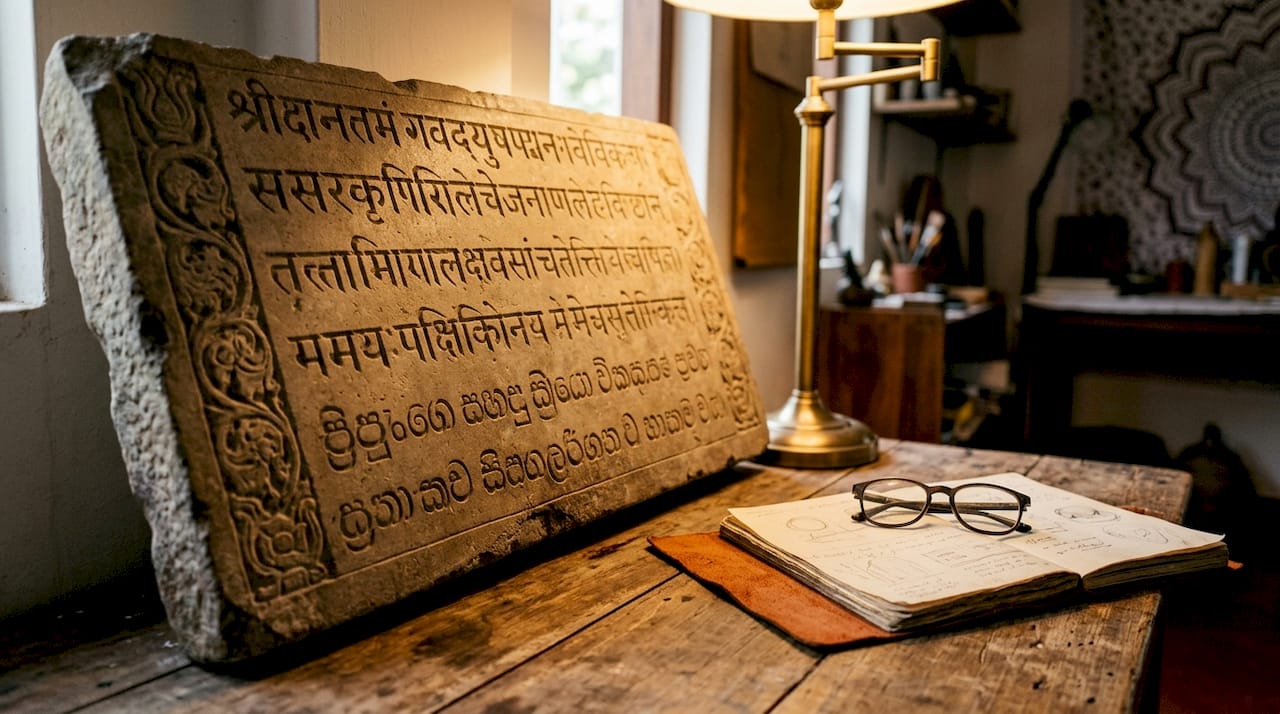
Script types vary just as much as languages. Brahmi is the ancestor script for most South and Southeast Asian writing systems. Regional descendants include Grantha in South India, Khmer script in Cambodia, and Mon script in Myanmar. Recognizing the script family narrows the geographic origin and date of a piece before you even attempt a translation.
Two inscriptions illustrate the range well:
- The Grahi inscription (1183 CE): Found in southern Thailand, it contains 5 lines of Old Malay text in a Khmer-influenced script. It records a royal command to cast a Buddha image, making it both a political and religious document.
- The Loriyan Tangai Buddha inscription (143 CE): One of the earliest dated Buddhist sculptures, it uses Kharosthi script and Gandhari Prakrit, placing it firmly in the Gandharan tradition of northwestern South Asia.
- Kammavācā manuscripts from Burma: Written on lacquered palm leaf or ivory in a distinctive angular script, these sacred ritual texts show how inscription traditions extended beyond stone into portable sacred objects.
- Sanskrit dedicatory formulae: These appear across Hindu bronze sculptures from Tamil Nadu to Bali, often naming the deity, the donor, and the ritual occasion in standardized verse.
Script and language together act as a geographic fingerprint. A piece bearing Sinhala script and Pali text almost certainly originates from Sri Lanka or a Sri Lankan Buddhist community abroad. Pairing this knowledge with Theravada sculptural traditions sharpens attribution considerably.
Pro Tip: When you encounter an unfamiliar script, compare the letterforms to a Brahmi script chart first. Most South and Southeast Asian scripts share structural roots with Brahmi, so identifying even a few shared characters can confirm the script family within minutes.
How does physical placement shape the meaning of an inscription?
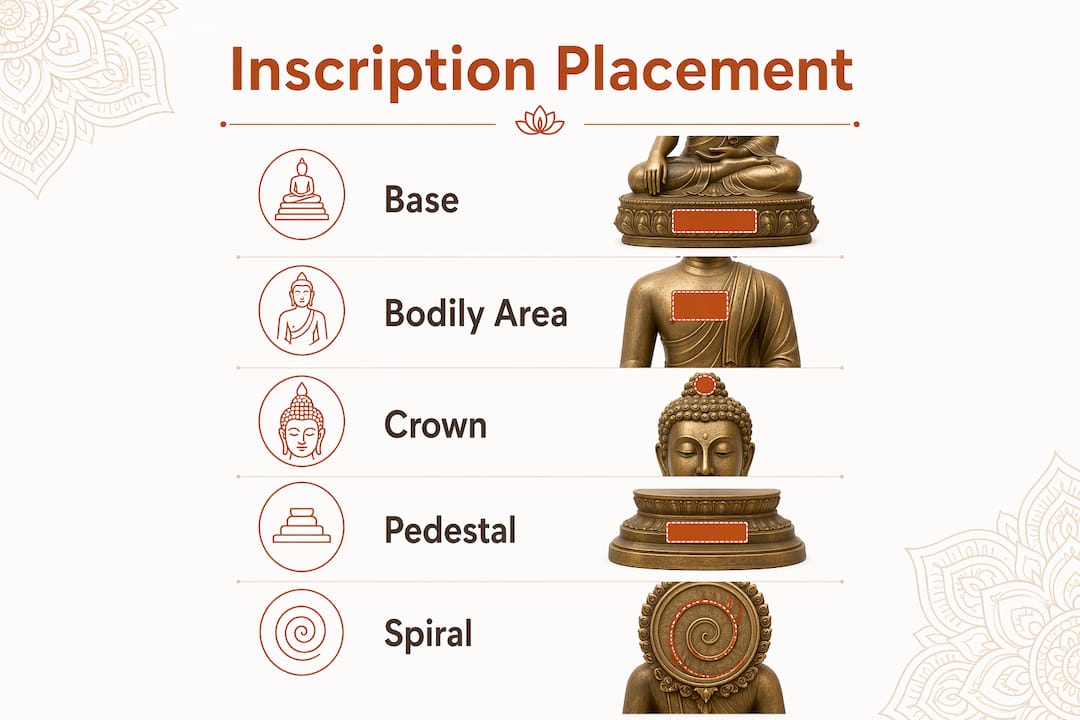
Multimodal analysis treats inscriptions as objects in space, not just strings of text. Where a text sits on a sculpture determines who reads it, when they read it, and what authority it carries. A dedication carved on the base of a Buddha image faces worshippers during circumambulation. A text cast into the back pillar of a bronze figure may have been intended for the deity alone, or for the craftsman who finished the piece.
The 7th-century Mahakuta Pillar in Karnataka demonstrates how complex placement can become. The pillar stands 14.5 feet tall with 16 lines of text wrapped spirally around its facets. The pillar measures 22 inches in diameter, and the inscribed band runs 38 inches in length. Reading it requires physically moving around the object, which mirrors the ritual act of pradakshina, or clockwise circumambulation. The reading order is not linear from top to bottom. It follows the spiral, and misreading the sequence produces a garbled text.
The table below summarizes common placement types and their typical purposes:
| Placement location | Typical purpose | Reading direction |
|---|---|---|
| Base or pedestal | Donor record, date, dedication | Left to right, horizontal |
| Back pillar or strut | Consecration formula, craftsman mark | Vertical, top to bottom |
| Body of figure | Protective mantra, deity name | Varies by tradition |
| Halo or nimbus | Royal or divine authority claim | Circular or radial |
| Spiral around pillar | Narrative or royal proclamation | Follows spiral path |
Inscriptions work with sculpture to achieve political or religious goals, not as afterthoughts. A donor who commissioned a bronze Ganesha and had his name inscribed on the base was not simply labeling his gift. He was embedding his identity into a sacred object, claiming merit and social legitimacy through the act of giving.
Pro Tip: Before attempting to read any inscription, photograph the entire sculpture from multiple angles. Placement patterns often become clear only when you compare the front, back, and base views together.
How do you decipher worn or complex inscriptions step by step?
Physical degradation is the primary obstacle when examining Asian inscriptions. Stone erodes, bronze oxidizes, and lacquer flakes. Ink rubbings taken from stone remain the most reliable low-tech method for recovering faded text. The process involves laying thin paper over the surface and applying ink or graphite to transfer the relief of the letters onto the paper. The British Library holds one of the largest rubbing archives in the world, including a 1916 Shan State rubbing that captures 33 lines of text from a single monument.
Follow this sequence when approaching a difficult inscription:
- Document the object first. Photograph under raking light, which means a light source held at a low angle to the surface. This technique casts shadows into carved grooves and makes faint letters visible.
- Identify the script family. Match letterforms to a reference chart for Brahmi, Kharosthi, or the relevant regional script. Even partial identification helps.
- Determine the reading order. Check whether the text runs left to right, right to left, or in a non-linear path such as the spiral pattern of the Mahakuta Pillar. Reading order is often non-linear and misreading the sequence changes the meaning entirely.
- Look for formulaic phrases. Buddhist inscriptions frequently open with “namo buddhaya” (homage to the Buddha) or close with a merit-transfer formula. Hindu dedicatory texts often name the deity in the dative case. Recognizing these patterns fills gaps in damaged sections.
- Cross-reference with dated parallels. Compare letterforms and formulae with published corpora such as the Corpus Inscriptionum Indicarum or regional epigraphic journals. Dated parallels allow you to estimate the period of an undated piece.
- Use digital enhancement when available. Reflectance Transformation Imaging (RTI) captures surface detail beyond what the naked eye sees. Many university epigraphy labs offer RTI processing for submitted photographs.
Pro Tip: Donor formulae are your best shortcut. Most Buddhist dedicatory inscriptions follow a predictable structure: name of donor, object donated, deity addressed, and merit-transfer wish. If you can identify one element, the others fall into place around it.
What historical and spiritual insights do inscriptions reveal?
Inscriptions transform a sculpture from an art object into a historical document. The most direct insight they provide is donor identity. The Sanchi Stupa inscriptions record 90 bhikkhus and 84 bhikkhunīs among the contributors to the monument. That data proves that ordained women held significant economic and religious agency in early Indian Buddhism, a fact invisible from the sculpture alone.
Inscriptions also date sculptures with precision unavailable through stylistic analysis alone. An inscribed regnal year, a named king, or a dated astronomical event anchors a piece to a specific moment in history. The Grahi inscription’s date of 1183 CE places it within the reign of a specific Srivijayan-era ruler, connecting the Buddha image to a documented political act.
The spiritual insights are equally concrete:
- Consecration records confirm that a sculpture underwent the rituals required to make it a living deity, not merely a representation. The role of consecration in Buddhist statues is often encoded directly in the inscription text.
- Mantra inscriptions on the interior or base of hollow bronze figures show that the object was treated as a container for sacred power, not just a visual symbol.
- Lineage claims in Hindu temple bronzes connect a specific image to a deity’s mythological biography, establishing the correct ritual protocols for worship.
- Merit-transfer formulae reveal the theological framework of the donor’s community, showing whether they followed Theravada, Mahayana, or Vajrayana doctrinal lines.
“Inscriptions are not secondary notes added to finished sculptures. They are integral to the object’s meaning, often serving as the primary vehicle for political or religious validation. Reading the text and the image together is the only way to understand either fully.”
The significance of religious sculptures multiplies when you read them as complete systems. The spiritual energy of a piece is not just visual. It is encoded in every layer, including the text.
Key Takeaways
Reading Asian religious sculpture inscriptions requires combining linguistic identification, physical context analysis, and knowledge of donor and ritual formulae to extract historical and spiritual meaning.
| Point | Details |
|---|---|
| Script identification comes first | Match letterforms to Brahmi or regional script charts before attempting translation. |
| Placement determines purpose | Base inscriptions record donors; back-pillar texts often carry consecration formulae. |
| Reading order is not always linear | Spiral and vertical arrangements, like the Mahakuta Pillar, require physical movement around the object. |
| Donor records are historically precise | Sanchi Stupa inscriptions name 90 bhikkhus and 84 bhikkhunīs, proving ordained women’s economic agency. |
| Rubbings and RTI recover lost text | Ink rubbings and Reflectance Transformation Imaging restore legibility on eroded stone and bronze. |
Why inscription reading demands more than language skills
I have spent years examining Buddhist and Hindu sculptures, and the single most common mistake I see from scholars entering this field is treating inscription reading as a translation problem. It is not. Translation is the last step, not the first.
The real work is contextual. A Sanskrit text on the base of a Cambodian bronze reads differently from the same Sanskrit text on a Tamil Nadu temple figure. The script variant, the casting technique, the iconographic program of the figure, and the regional ritual tradition all shape what the words mean in practice. Stone type and surface condition affect legibility in ways that change which letters you can recover at all.
What I find most underappreciated is the preservation crisis. Burmese Kammavācā manuscripts are endangered. Regional script traditions that produced these inscriptions are no longer taught in many communities. When the last person who can read a script dies without training a successor, every inscription in that script becomes permanently harder to interpret. Documentation is not archival housekeeping. It is urgent cultural work.
My advice to art enthusiasts and scholars alike: treat every inscription as a primary source, not a label. Photograph it, record its placement, note the script family, and compare it to published corpora. Even partial documentation contributes to the collective record. The inscription you photograph today may be the clearest surviving example of its type in twenty years.
— James, HDAsianArt.com
Authentic inscribed sculptures at HDAsianArt
Scholars and collectors who want to study inscriptions firsthand benefit from working with authenticated pieces that carry documented provenance and expert descriptions.

HDAsianArt offers a curated selection of antique Buddhist and Hindu sculptures from Cambodia, Thailand, Indonesia, Sri Lanka, and Vietnam. Each piece is individually researched and described by specialists, with attention to iconographic detail, material, and any surviving textual or epigraphic features. For collectors interested in Southeast Asian Buddhist traditions, the antique Javanese bronze Buddha and the Laos-style bronze Buddha are strong examples of the casting traditions that produced inscribed devotional art across the region. Worldwide insured shipping is available on all pieces.
FAQ
What scripts are most common on Buddhist sculpture inscriptions?
Brahmi and its regional descendants, including Khmer, Mon, and Sinhala scripts, are the most common scripts on Buddhist sculptures across South and Southeast Asia. Kharosthi appears on early Gandharan pieces from the northwestern subcontinent.
How do I identify the age of a sculpture from its inscription?
Inscribed regnal years, named rulers, or dated astronomical events allow precise dating. Letterform comparison with published epigraphic corpora provides a date range when no explicit year appears.
What does a donor inscription on a Buddhist sculpture typically say?
Most Buddhist donor inscriptions follow a standard structure: the donor’s name and title, the object donated, the deity or monument addressed, and a merit-transfer wish for the donor’s family or community.
Why is reading order important when examining Asian inscriptions?
Reading order on Asian inscriptions is often non-linear. Spiral arrangements like the Mahakuta Pillar and vertical axis texts require the reader to follow the physical path of the inscription rather than reading left to right, or the meaning becomes garbled.
How can I recover text from a worn or eroded inscription?
Ink rubbings and Reflectance Transformation Imaging are the two primary methods. Rubbings transfer the relief of carved letters onto paper. RTI uses multiple light angles to reveal surface detail invisible under standard lighting conditions.
