



Gods of India: A Practical Guide to Major Hindu Deities
Gods of India: A Practical Guide to Major Hindu Deities
What are the gods of India really, a list of names, or a visual language you can learn to read? If you've ever stood in front of a Hindu sculpture and felt unsure whether you were looking at Shiva, Vishnu, Durga, or someone else entirely, the answer is usually in the details, not the label. Hands, mounts, colours, weapons, posture, and even the base the figure stands on all tell a story.
In England and Wales, the 2021 Census recorded about 1.0 million people identifying as Hindu, or 1.7% of the population, up from 818,000 in 2011 ONS census religion by age and sex. That matters because these figures describe a living community, not only museum heritage. The same census also reminds us that religion data measures identity, not every person's private practice, so a sculpture label should never pretend otherwise.
If you want a useful comparison for how people work through organised meaning, how Tarot Chats organizes readings shows a familiar principle, grouping complex material into readable categories rather than dumping it all into one pile. Hindu sculpture works the same way. Once you know the system, the figures stop looking interchangeable.
Table of Contents
- What We Really Mean by the Gods of India
- The Trimurti and Their Cosmic Roles
- Devi as One Goddess With Many Forms
- Beloved Devotional Figures You Will Recognise
- How Regional Styles Shape the Same Deity
- A Practical Identification Checklist
- Living With Hindu Deities in UK Homes and Collections
What We Really Mean by the Gods of India
A recognition system, not a checklist
The first mistake many readers make is assuming the gods of India are separate, fixed beings who always mean the same thing in every context. In practice, Hindu traditions speak through Vaishnavism, Shaivism, and Shaktism, and the same divine figure can be understood as supreme, symbolic, local, or one form of a larger reality. That is why a gallery label, a home shrine, or a family explanation can sound different while still referring to the same deity.
A better way to think about them is as a recognition system. You look for visual cues, then test them against theology, region, and ritual use. A figure with a trident, matted hair, and a calm, seated body points you one way, while a blue-skinned flute player points you another.
Practical rule: never start with the name alone. Start with the body, then the objects, then the setting.
That approach also keeps you from flattening Hinduism into one generic style. The 2021 Census counted 1,020,533 Hindus in England and Wales, or 1.7% of the population, so these images sit inside a real British religious setting, not a distant abstraction ONS religion bulletin. Census religion is identity data, not proof of ritual frequency, so it should be read as a demographic indicator, not a count of active shrine users. That distinction matters when you label an object for a museum, a shop, or a home altar.
The Trimurti and Their Cosmic Roles
Three roles, not three rivals
What do a creator, a preserver, and a transformer look like when they appear together in Hindu art? The answer is the Trimurti, the trio of Brahma, Vishnu, and Shiva. A Victoria and Albert Museum record treats them as a single theological grouping with distinct visual markers, so the clearest reading is not competition but division of labour V&A Trimurti record. Brahma creates, Vishnu preserves, and Shiva transforms through destruction.
Brahma is the easiest to identify when he appears with four heads. The museum record links him to the Vedas, which suits a figure of knowledge as much as origin. Vishnu is described there as blue and as the preserver of creation. Shiva, by contrast, stands for destruction, yet in Hindu thought that often means ending, release, and renewal rather than simple ruin.
Reading the consorts and the lotus
The same record names the consorts too, and those pairings do real visual work. Saraswati belongs with Brahma, Lakshmi with Vishnu, and Parvati with Shiva. Each divine couple sits on a lotus. The record identifies the lotus as an ancient Indian sign of purity and spiritual power, and the form itself makes the idea easy to grasp. A deity seated cross-legged on a full-blown lotus pedestal, or padmapitha, almost always signals an auspicious, benevolent presence.
That is why the lotus matters to the eye before it matters to the text. It rises cleanly from muddy water, yet stays unmarked, so it becomes a natural image for purity without withdrawal from the world.
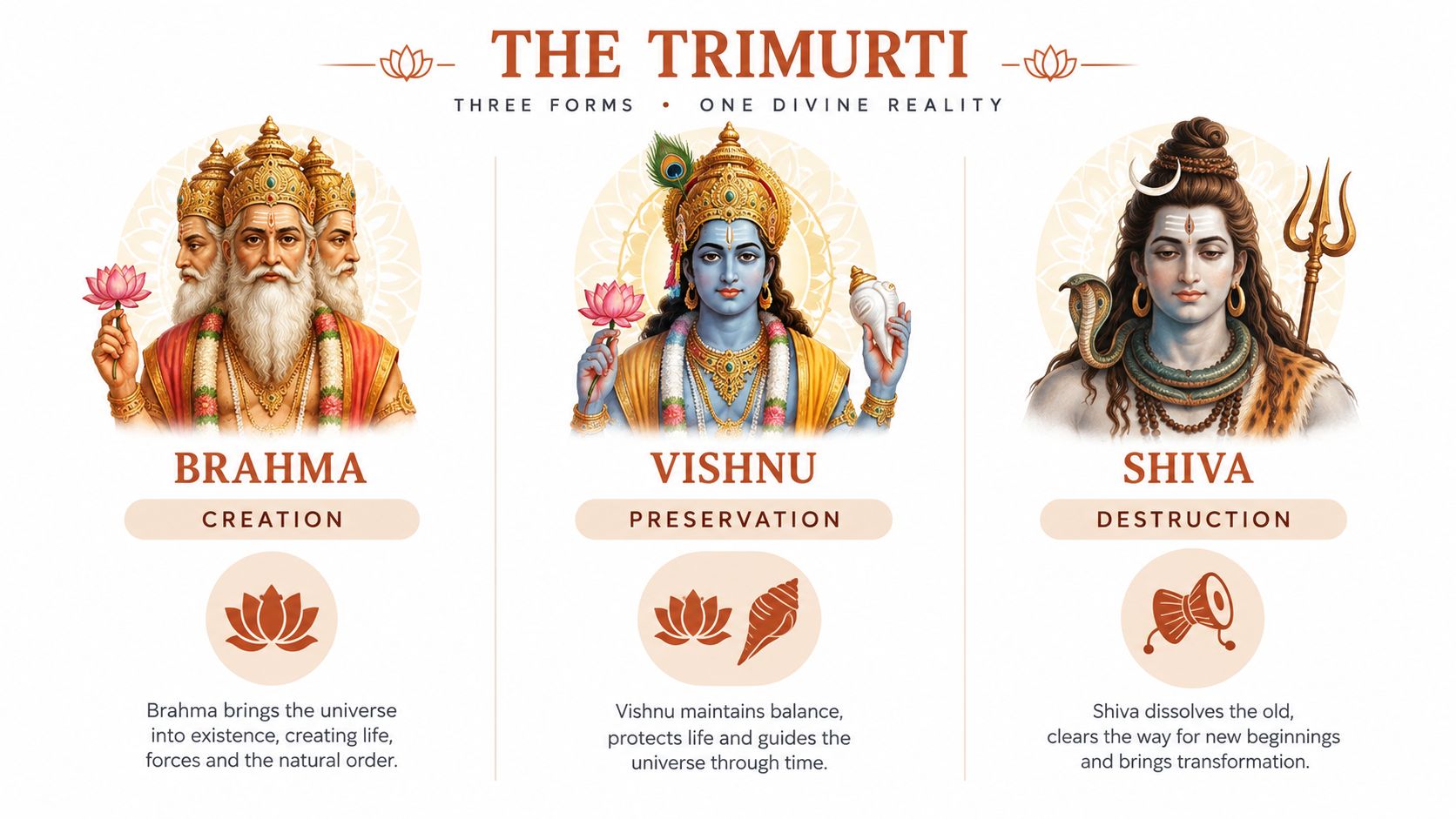
A sculpted Trimurti works like a theological diagram in human form. A head count, a skin colour, a book, a lotus, or a trident can matter more than a long label. For a fuller art-historical reading, HD Asian Art's Hindu Trimurti guide adds useful detail on how the trio is presented in sculpture and painting.
For readers comparing symbolism across traditions, career and marriage kundli insights offers a parallel way to see how Hindu systems organise identity through signs and relationships. The logic is similar. Meaning sits in the relationship between figure, attributes, and placement, not in a single name alone.
Devi as One Goddess With Many Forms
Shakti behind the names
If the male figures of the pantheon can be read as functions, Devi is often best read as power itself. In Shaktism, the goddess is not just one character among many, she is Shakti, divine energy expressed through multiple forms. That is why Durga, Parvati, and Lakshmi can feel distinct in sculpture while still belonging to one wider goddess reality.
The easiest way to separate them is by visual behaviour. Durga often appears armed, alert, and mounted on a lion or tiger. Lakshmi is usually calm, frontal, and associated with a lotus, abundance, and grace. Parvati tends to look more intimate and domestic, with a mountain or family association and a gentler posture.
How to stop calling every goddess “just goddess”
Auction listings and décor catalogues often flatten these figures into “female deity” or “Hindu goddess”, which strips away the meaning collectors need. A better description starts with attributes. If you see multiple weapons, a combat stance, and a lion mount, you are likely looking at Durga rather than Lakshmi. If you see a relaxed, blessing figure with lotuses and little martial energy, Lakshmi is the stronger reading.
That distinction matters in a home setting too. A statue chosen for prosperity imagery should not be labelled the same way as a battle goddess. The theological difference changes the room's mood, the language used in a catalogue, and the respect shown in a shrine or display case. For a fuller devotional frame, Shakti and the divine feminine in Hinduism gives a helpful companion reading.
Practical rule: weapons suggest protection or victory, lotuses suggest auspiciousness, and a softer posture often signals domestic or benevolent power.
The deeper point is that Devi is not a single static form. She is a family of meanings, and the sculpture tells you which one you're seeing if you slow down and read the attributes carefully.
Beloved Devotional Figures You Will Recognise
The figures most people meet first
Outside specialist galleries, four figures tend to appear again and again, Ganesha, Krishna, Hanuman, and Murugan. They are popular because they are easy to recognise once you know the shorthand. Ganesha has an elephant head and broken tusk. Krishna is usually blue-skinned and often holds a flute. Hanuman is marked by strength, devotion, and the mace. Murugan carries the vel spear and is often linked with the peacock.
| Deity | Most Recognisable Attribute | Vehicle or Mount | Typical Gesture |
|---|---|---|---|
| Ganesha | Elephant head, broken tusk | Mouse | Blessing, blessing-with-sweetmeat imagery |
| Krishna | Flute, blue skin | Cow, or no fixed mount | Graceful, playful, flute-playing |
| Hanuman | Mace, muscular body, open chest | None fixed, often shown in devotional stance | Devotional pose, folded hands or active protection |
| Murugan | Vel spear | Peacock | Upright, warrior-like, blessing or poised stance |
Ganesha is often placed first because he is associated with beginnings and obstacle removal, so he appears at thresholds, entrances, and the start of rituals. Hanuman is frequently shown face-on and steady, which suits his role as a guardian figure. Krishna's posture usually feels lighter and more musical, while Murugan's spear immediately shifts the mood towards martial elegance and youth.
Common mistakes buyers make
The most common error is confusing any elephant-headed figure with a random decorative symbol. Ganesha's iconography is specific, and his presence changes how a room is read. Another mistake is treating Krishna and Rama as visually interchangeable. They are not. Krishna's blue skin and flute are a different visual language from Rama's royal bearing.
If you're comparing home pieces, HD Asian Art's Ganesha guide is a useful reference point for the way specialists describe one deity's features clearly. The same habit of looking for the object, posture, and mount will help with the others too.
Practical rule: when the mount is obvious, let it do some of the work. Mouse, cow, peacock, or no mount at all can narrow the identification fast.
For collectors, these four figures are often the first step into a broader visual tradition. Once you can spot them reliably, many other divine forms become much easier to place.
How Regional Styles Shape the Same Deity
Style tells you where the object comes from
The same deity can look strikingly different depending on where and when the image was made. South Indian bronzes often feel fluid and elegant because they were shaped through lost-wax casting, while North Indian stone figures can look more weight-bearing, architectural, and still. Himalayan pieces may bring in different proportions, local dress, or repoussé effects that change how the divine body sits in space.
A curator reads those differences as more than style. Ornament density, facial shape, stance, pedestal type, and the way fabric is cut into the body all help suggest region and workshop tradition. A figure with crisp bronze contours and active posture may feel very different from a heavy carved stone deity even when both represent the same god.
Why provenance labels matter in the UK
That matters in UK collections because a label that only says “Hindu deity” throws away useful information. A sculpture described as South Indian bronze gives a viewer one set of expectations, while a northern carved stone piece suggests another. In practice, that means collectors and interior designers should ask for deity name, material, provenance, date or stylistic period, and intended use whenever possible.
Practical rule: read style before you read value. A well-placed provenance note can be as important as the deity's name.
For display, regional variety also prevents the false impression that all Indian sacred art belongs to one visual language. A Tamil bronze, a north Indian stone image, and a Himalayan adaptation can all show the same god, yet each carries a different relationship to ritual movement, touch, and space. That is why catalogue language should stay precise rather than decorative.
A Practical Identification Checklist
Four cues to check every time
The fastest way to identify a Hindu figure is to check four things in order, hands, attributes, vehicle, and posture. Hands tell you whether the figure is blessing, holding a weapon, or playing a role tied to ritual. Attributes tell you the deity's job. A lotus usually points one way, a trident another, a flute another again.
- Hands first: count them and notice what they're doing. A calm open hand suggests blessing, while multiple arms usually indicate divine power, protection, or a complex role.
- Held objects next: look for the object that defines the deity, such as the flute, mace, trident, lotus, or vel. One object can settle the reading quickly.
- Then the vehicle: the mouse, lion, peacock, cow, or a plain absence of mount can all narrow the name.
- Finally the posture: seated, standing, dancing, or striding changes the meaning, even when the face looks similar.
A useful way to work is to start with the obvious and rule out the rest. If you see an elephant head and a mouse, think Ganesha. If you see a blue figure with a flute, think Krishna. If you see a warrior goddess with a lion, think Durga. If you see a calm, lotus-bearing goddess, think Lakshmi before anything else.
A quick worked example
A bronze figure on a low base, with one hand raised in blessing, another holding a small object, and a very rounded, benevolent body could easily be misread by a casual viewer. If the head is elephant-like and the mount is a mouse, the identification becomes far more secure. The point is not to guess from mood, but to read the whole visual sentence.
For collectors, that habit reduces mislabelling. For shrine keepers, it helps with placement and respect. For interior designers, it means the object can be described accurately without overclaiming. The more precise the reading, the more confidently the piece can be used.
Living With Hindu Deities in UK Homes and Collections
Respect changes the label
A statue may be a devotional murti or a decorative object, and the difference is more than wording. A murti is treated as present, addressed, and cared for. A decorative piece is read as representation. In a home, museum, or public room, the responsible choice is to state plainly which role the piece serves.
That means a catalogue entry should name the deity, material, region, and intended context, rather than flattening everything into generic “Asian décor”. It also means school settings and shared spaces should not treat sacred imagery as if all Hindu forms were interchangeable. If a visitor from a Hindu background enters the room, the label should already be accurate.
Placement, consultation, and regional sensitivity
Hindu populations in England and Wales are not evenly spread, with strong concentration in particular communities, especially in London, so local consultation can make a real difference. The same deity may carry different associations depending on family, language, or temple tradition. A statue chosen for a hallway, a meditation room, or a reception area should be selected with more than visual taste in mind.
If you're designing a room with devotional or Asian-inspired elements, the Interiors by DeX bedroom guide is a useful reminder that placement, palette, and atmosphere shape how a sacred object is received. A respectful display keeps the image legible, gives it space, and avoids crowding it with unrelated objects.
HD Asian Art works in this same practical space, with Hindu deity sculptures, museum-oriented curation, and online guidance for collectors, institutions, and private interiors. For a piece that fits a home shrine, a design project, or a collection, browse by deity and use the visual cues already established, such as posture, mount, and held objects, to narrow the search with confidence.
