


Common Symbols in Antique Buddhist Iconography
Common Symbols in Antique Buddhist Iconography
Table of Contents
- Why Symbols Carry the Meaning in Antique Buddhist Iconography
- The Eight Auspicious Symbols in Buddhism and Where They Appear
- The Lotus Symbol in Buddhist Art: Purity Rising From Mud
- Dharma Wheel Meaning and the Turning of the Teaching
- Buddha Footprint Symbolism and the Absence That Speaks
- Stupas, Thrones, and Pillars: Supporting Emblems on Antique Pieces
- How Regional Traditions Reshape Common Symbols in Antique Buddhist Iconography
- Conclusion: What the Symbols Ask of a Collector
- Frequently Asked Questions
Why Symbols Carry the Meaning in Antique Buddhist Iconography
Antique Buddhist iconography communicates through symbols before it communicates through figures. Long before artists carved the Buddha in human form, they expressed the teaching through wheels, trees, footprints, and empty seats. Those early conventions never disappeared. They were layered into later sculpture, which is why a bronze Buddha seated on a lotus throne is really a stack of symbols, each one carrying a specific meaning.
At HD Asian Art, we offer a carefully curated collection of Khmer and Southeast Asian sculptures. This guide covers the symbols you will encounter most often, what each one means, and how to read them as a set rather than a checklist.
The symbols below are not decoration. They are the argument of the piece.
The Eight Auspicious Symbols in Buddhism and Where They Appear
The Eight Auspicious Symbols are a fixed set of emblems: the parasol, the pair of golden fish, the treasure vase, the lotus, the conch shell, the endless knot, the victory banner, and the Dharma wheel. In antique Buddhist iconography, these eight appear most often as a group, and their placement follows convention.
You will find them carved along the base of a statue, stamped into the hem of a robe, incised on the underside of a throne, or arranged around the rim of a ritual vessel. On some pieces they are worked into the halo or the backplate rather than the body.
Reading the Group as a Set, Not a Checklist
A common mistake is treating the eight as a menu the artist picked from. They function as a complete statement. When all eight are present, the piece is making a claim about the completeness of the teaching. When only some appear, the omissions are usually deliberate and tied to the specific figure or regional convention.
Look at how the eight are spaced. Tight, even spacing suggests a workshop following a template. Irregular spacing, or a symbol that sits slightly off-axis, often points to hand-carving rather than a mold.
The Lotus Symbol in Buddhist Art: Purity Rising From Mud
The lotus is the most portable symbol in the entire tradition. It grows in mud, rises through water, and opens clean above the surface. That sequence is the whole meaning: purity that is not the absence of difficulty but the product of it.
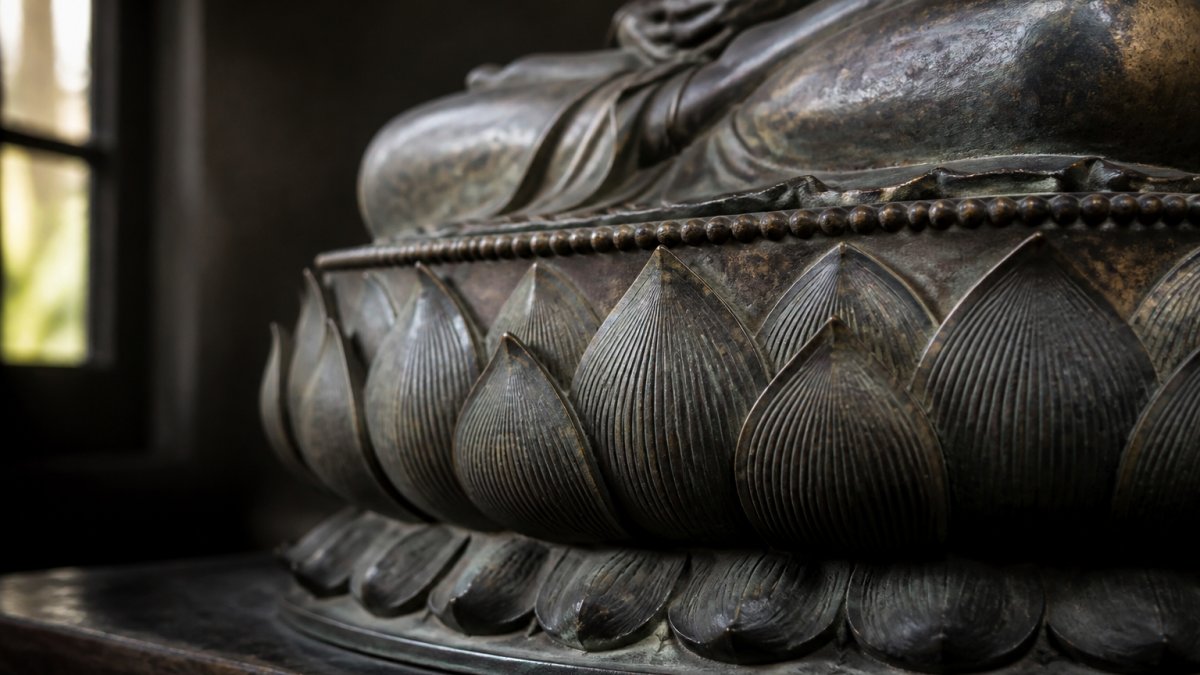
In sculpture, the lotus almost always appears as the throne, the seat beneath the figure. Count the petals. A single row of open petals reads differently from a double row with a closed bud beneath, and the layered form tends to appear on later and more elaborate pieces. The bud represents potential; the open flower represents realization.
The lotus also appears held in the hand, most often as a blue lotus in the palm of a bodhisattva. When you see it there rather than under the figure, the piece is emphasizing compassion in action rather than attainment.
Dharma Wheel Meaning and the Turning of the Teaching
The Dharma wheel meaning centers on motion. The wheel represents the teaching set in motion, and its eight spokes correspond to the Eightfold Path. A wheel with eight spokes is the standard form; variations in spoke count usually signal a different regional or sectarian convention rather than a mistake.
Wheels appear in three places you should check first:
- Above the figure, held in a hand or resting on a lotus, where it signals the act of teaching
- On the palms and soles, where it marks a Buddha's physical signs
- On the base or backplate, where it frames the whole piece as a teaching scene
A wheel shown upright and still reads as the teaching itself. A wheel shown tilted or being turned reads as the moment of the first sermon. That distinction matters when you are trying to place a piece within a narrative sequence rather than just identifying the figure.
Buddha Footprint Symbolism and the Absence That Speaks
Buddha footprint symbolism marks the period before the Buddha was depicted in human form. The footprint was the presence that stood in for a figure who could not be shown. It is, in a sense, the oldest symbol in this guide.
Footprints are usually carved with the wheel at the center of the sole, surrounded by smaller auspicious marks. They appear on stone slabs, on the lids of relic containers, and occasionally on the pedestal of a later statue, where they anchor the figure to that earlier aniconic tradition.
The academic study of Buddhist iconography from the Indira Gandhi National Centre for the Arts traces symbols like the lotus throne and the fiery pillar back to earlier traditions that predate Buddhist use of them. That lineage is worth keeping in mind: many of these marks were inherited, not invented, and their earlier meanings sometimes sit underneath the Buddhist one.
Stupas, Thrones, and Pillars: Supporting Emblems on Antique Pieces
Supporting emblems are the symbols that frame a figure rather than define it. They are easy to overlook and often the most useful for dating.
The stupa appears as a small architectural form, sometimes held in the hand, sometimes worked into the background. The throne can be a simple platform or an elaborate structure with lions at the corners. The pillar, often flaming at the top, rises behind or beside the figure and marks the moment of enlightenment.
Shivangi Dwivedi's study of iconography in Buddhist traditions examines how Buddhist imagery moved from aniconic representation to anthropomorphic form, and how regional workshops adapted the same symbols differently. That adaptation is exactly what you see in these supporting emblems. A Khmer piece and a Thai piece can carry the same figure and the same core symbols while handling the throne and the pillar in visibly different ways.
When supporting emblems are inconsistent with the main figure, that is a signal worth investigating.
How Regional Traditions Reshape Common Symbols in Antique Buddhist Iconography
The same symbol can look like a different object depending on where the piece was made. This is the single biggest source of confusion for collectors moving between regional styles.
A conch shell carved in one tradition sits plain and rounded. In another, it is bound with ribbons and topped with a flame. The lotus goes from a tight, geometric rosette to a loose, naturalistic bloom. The wheel gains or loses spokes, and the spokes themselves shift from straight to curved.
Three practical habits help here:
- Compare within a region first. Judge a Khmer piece against other Khmer pieces before comparing it to anything else.
- Track one symbol across styles. Pick the lotus and follow it through several regional traditions. The differences will teach you more than studying whole pieces.
- Expect the base to differ most. Regional workshops varied the pedestal and the backplate far more freely than the figure itself.
None of this requires expertise in any single tradition. It requires patience and a willingness to look at the same element repeatedly.
Conclusion: What the Symbols Ask of a Collector
Reading symbols is not a party trick for identifying a piece. It is the difference between owning an object and understanding one. The marks on a statue tell you what the maker believed, what the workshop knew, and what the piece was made to do.
That is the standard we hold pieces to at HD Asian Art. Our collection of Buddhist and Hindu statues, including Khmer and Southeast Asian sculptures, is chosen for exactly this reason: so the iconography holds up when you look closely. Every piece ships free, and each one is selected to work in a meditation corner or a larger space.
Browse the collection and see which symbols you recognize now.
Frequently Asked Questions
What are the most common symbols in Buddhist art?
The recurring set includes the lotus, the Dharma wheel, the Eight Auspicious Symbols, the stupa, the throne, and the footprint. Research from the Indira Gandhi National Centre for the Arts traces several of these, including the lotus throne and fiery pillar, back to earlier Indian traditions that Buddhist artists adapted. On antique pieces these emblems usually appear together rather than alone, so a lotus base often sits beneath a figure while a wheel is stamped into the pedestal rim.
What does the lotus symbolize in Buddhist iconography?
The lotus stands for purity and awakening, because the flower rises clean out of muddy water. In antique sculpture it is most often the seat itself: a figure sits or stands on an open blossom, which signals enlightenment rather than decoration. The number of petals and whether the bloom is open or closed varies by region and period. When you examine a piece, look at how the petals are carved, since crisp, deep cutting usually points to earlier workshop practice.
What does the Dharma wheel represent?
The Dharma wheel represents the Buddha's teaching and its continuous turning. Its eight spokes are commonly read as the Noble Eightfold Path, and the rim and hub complete the image of a moving wheel rather than a static disc. On antique bronzes and stone reliefs the wheel appears on pedestals, palms, and soles. A wheel shown between two deer marks the first sermon, a detail worth noting when you are trying to place a piece within a tradition.
How do Buddhist symbols vary across artistic traditions?
Research on iconography in Buddhist traditions describes a shift from early aniconic imagery, where the Buddha was suggested through footprints, wheels, and empty thrones, to later anthropomorphic figures. Regional workshops then adapted the same symbols differently: Southeast Asian pieces often emphasize the lotus base and stupa form, while Himalayan work layers in additional emblems. For collectors, that variation is useful, because the combination of symbols on a piece often narrows down where and when it was made.
