



How to Choose a Calming Sculpture for Your Reception Area
How to Choose a Calming Sculpture for Your Reception Area
A single medium-to-large sculpture in a natural material — bronze, stone, or wood — is the most reliable way to anchor a reception area’s sightlines while keeping circulation clear and the atmosphere calm. Three principles drive that recommendation: natural materials carry inherent tactile warmth and patina that reduce physiological stress; medium-to-large scale provides visual presence without fragmenting the space; and open or negative-space forms keep large pieces feeling light rather than imposing.
The practical starting point: measure your entrance sightline, confirm a moderate circulation buffer, and identify your lighting anchor before specifying a piece. For curated, provenance-backed options in bronze, stone, and wood, HDAsianArt offers authenticated pieces with condition reports and insured worldwide shipping.
- Choose one focal sculpture, not a cluster.
- Prioritize natural materials with matte or patinated finishes.
- Scale to the ceiling height and lobby depth, not just floor area.
- Leave clear ADA-compliant circulation on all sides.
- Request provenance documentation and a condition report before purchase.
Table of Contents
What should you check on-site before buying a reception sculpture?
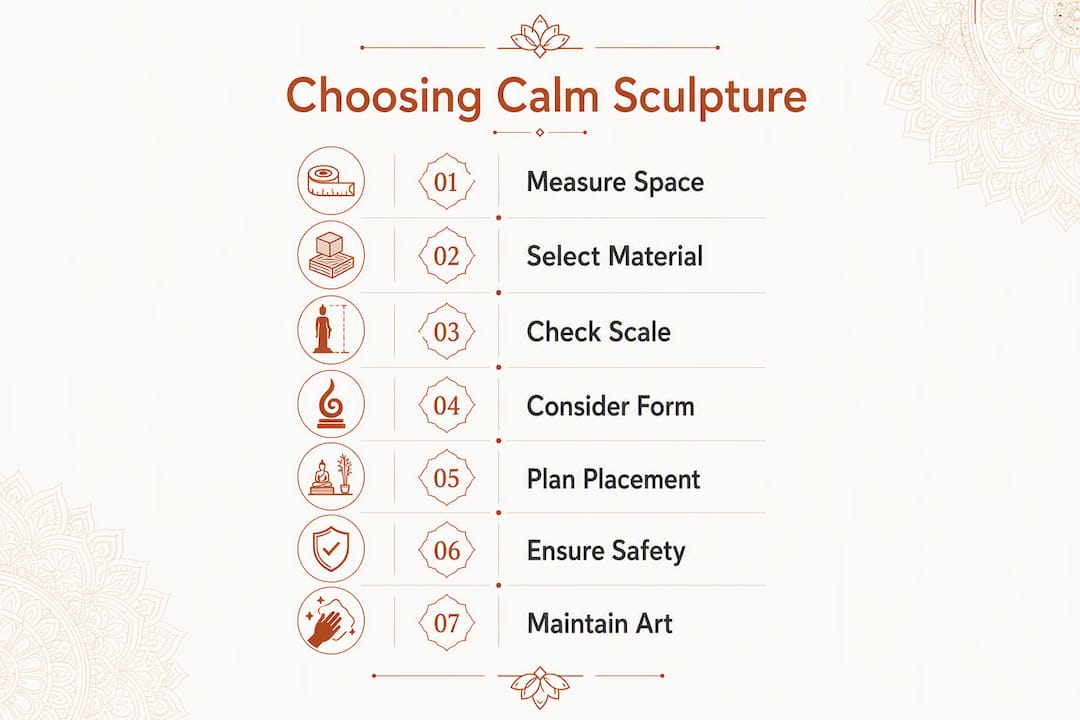
Run these six checks during your site visit or client meeting before committing to a piece.
- Sightline alignment. Stand at the main entrance and identify the natural focal point. A sculpture placed directly on that axis reads immediately; one placed off-axis creates visual confusion.
- Clearance and codes. Measure the available footprint. ADA guidelines require a minimum 36-inch clear path; allow 3–6 ft of buffer around the sculpture depending on peak traffic volume.
- Scale vs. ceiling and furniture. A piece that reaches one-third to one-half the ceiling height typically reads as intentional. Tabletop pieces suit smaller waiting rooms where desk or shelf space is the display surface.
- Material and finish. Confirm the ambient light quality. Matte natural finishes (patinated bronze, honed stone, oiled wood) absorb light evenly. High-gloss or reflective finishes create hot spots under standard office lighting.
- Lighting and mounting options. Identify existing electrical circuits for accent lighting. Check whether the floor or plinth surface can accept anchor bolts for floor-standing pieces.
- Maintenance and insurance needs. Confirm the facility team’s cleaning protocol and whether the building’s art insurance policy covers three-dimensional works.
Pro Tip: Stand at the entry, then move to the seating cluster, then to the receptionist’s desk. If the sculpture reads clearly and calmly from all three positions, the placement works. Photograph each vantage point and send the images to your supplier with the room dimensions — it saves a return visit.
Document measurements and photograph the intended sightlines before contacting any gallery. Suppliers can advise on scale and plinth height far more precisely when they have actual room photos.
Which materials and finishes actually promote calm?
Natural materials support calm through what Japanese design theory calls shizen — naturalness. Bronze, stone, and wood each carry visible evidence of time: patina, grain, and texture. That honesty signals permanence and stability to visitors, which is the opposite of the visual agitation produced by high-gloss painted resin or mirror-polished stainless steel under uncontrolled lighting.
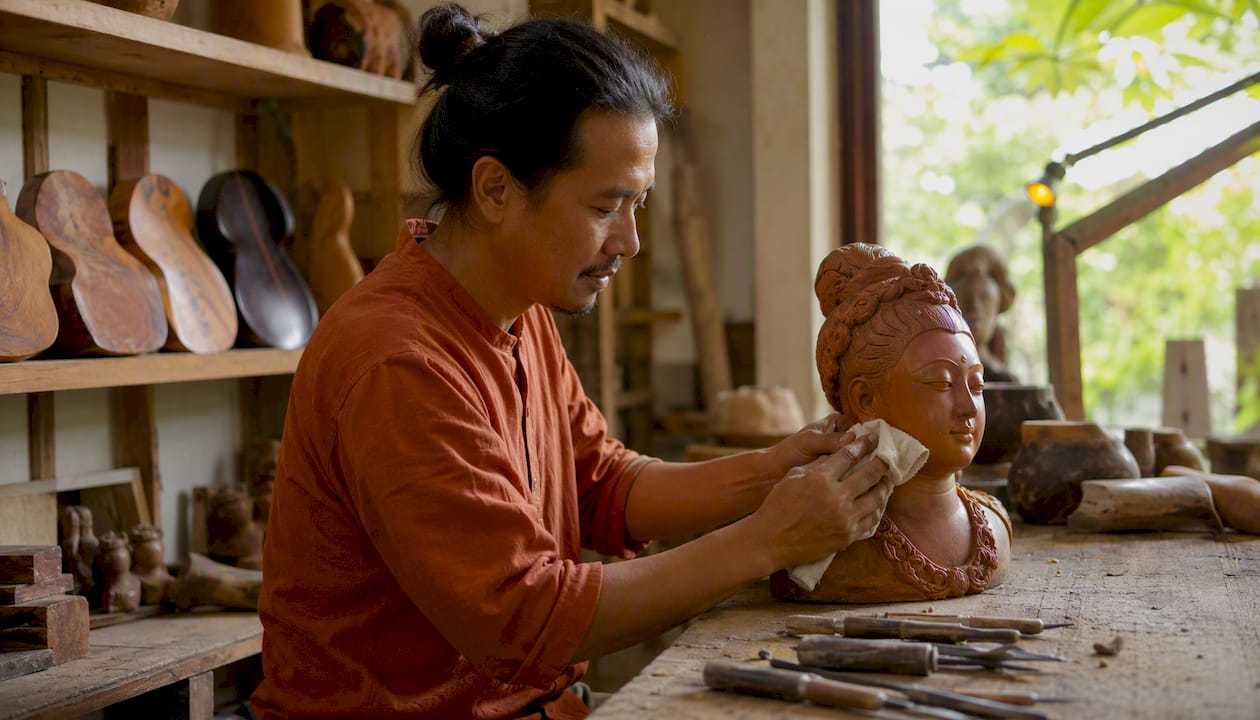
Zen design principles reinforce this: kanso (simplicity) and shizen favor fewer pieces in natural-finish materials — weathered bronze, honed stone, unpainted timber — with breathing space around each object. The earthy tones and patinated surfaces common in traditional Asian sculpture align directly with these principles.
| Material | Visual effect | Public-space durability | Maintenance intensity | Provenance accessibility |
|---|---|---|---|---|
| Patinated bronze | Warm, grounding, timeless | Very high | Low (annual wax) | High — documented casting records |
| Honed/carved stone | Cool, stable, weighty | Very high | Low (dry dusting) | Medium — origin traceable |
| Oiled/sealed wood | Warm, organic, tactile | Medium | Medium (re-oiling) | Medium — species and source traceable |
| High-gloss resin | Bright, contemporary | Medium | High (scratch-prone) | Low — often mass-produced |
| Mirror-polished stainless | Striking, reflective | High | High (fingerprints) | Low |
Finishes to avoid in calming reception areas:
- High-gloss painted or resin surfaces in saturated colors — they read as loud and demand attention rather than inviting rest.
- Mirror-polished stainless steel without controlled directional lighting — ambient office light creates moving highlights that generate visual agitation.
- Heavy gilt or high-contrast metallic accents — they compete with the architecture rather than settling into it.
On sustainability: reclaimed wood and responsibly sourced stone are worth specifying when a facility has a documented sustainability policy or LEED certification target. Museum-grade patina on bronze (no synthetic lacquers) also matters for facilities that plan long-term conservation.
What scale and placement rules work best in reception spaces?
Scale is the single most common error in reception sculpture selection. A piece that looks substantial in a gallery photograph can disappear in a double-height lobby, or overwhelm a compact waiting room.
| Size band | Dimension range | Best application |
|---|---|---|
| Tabletop | 8–15 inches | Small waiting rooms; desk or shelf display |
| Medium | 24–48 inches | Versatile reception use; most standard lobbies |
| Large | 48–72 inches | Major lobbies, atriums, double-height entries |
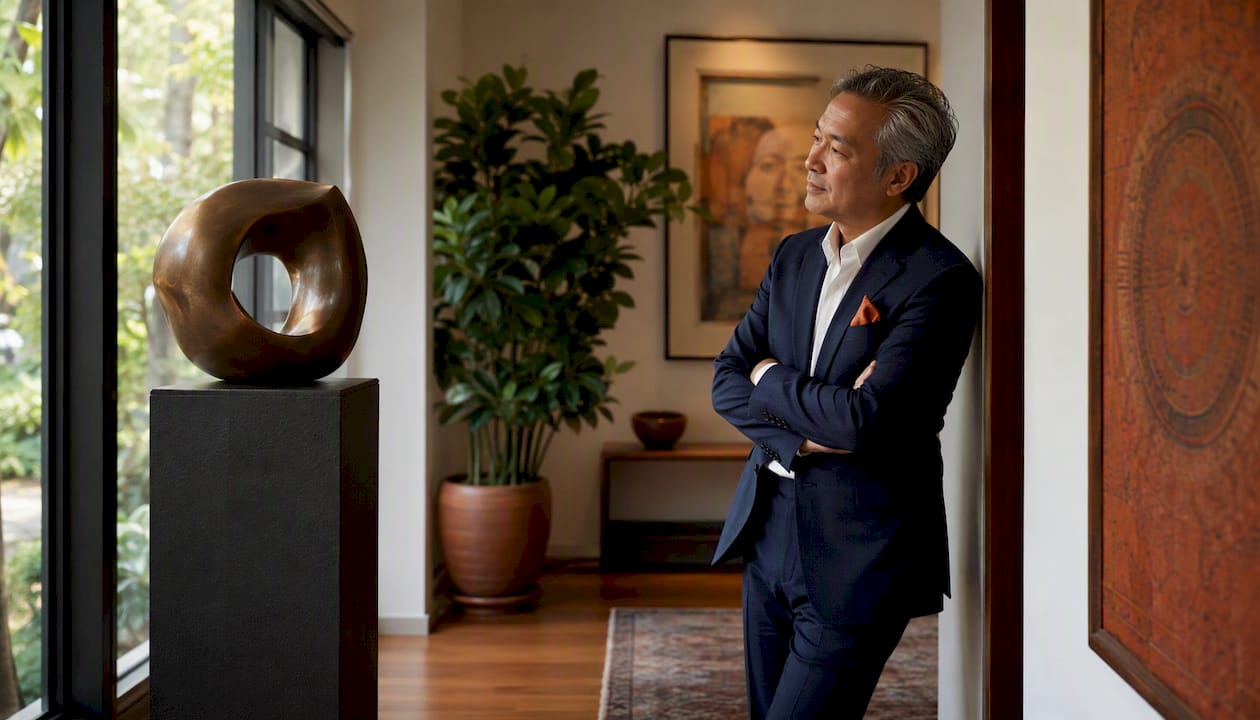
Medium pieces (24–48 inches) suit most standard reception contexts because they provide visual weight without dominating the room. Large pieces (48–72 inches) belong in atriums or double-height entries where a smaller work would simply disappear. Tabletop sizes (8–15 inches) work well in compact waiting rooms where desk or shelf space is the only viable display surface.
Silhouette and negative space. Prefer open forms or voids — sculptures with hollow passages or cut-through sections allow light and background architecture to pass through, reducing perceived mass. A clear, readable silhouette that registers at a glance is more calming than a dense, complex form that requires close inspection to understand.
Placement rules:
- Anchor the piece opposite the main entrance or at a lateral visual pause (the edge of a seating cluster or the end of a reception desk).
- Maintain a a moderate circulation buffer on all sides, scaled to peak traffic volume.
- Never obstruct ADA-compliant paths — the clear route must remain unbroken.
- Avoid placing the sculpture directly under HVAC diffusers (dust accumulation) or in direct sunlight without UV-protective glazing.
To evaluate placement before installation, stand at the entry, walk to the seating area, and check from the receptionist’s position. Record measurements and photograph each sightline to share with your supplier.
How do form and subject affect calm in a waiting area?
The choice between abstract and figurative sculpture is not purely aesthetic — it has measurable psychological consequences for visitors who see the piece repeatedly.
Abstract vs. figurative:
- Abstract forms promote openness and quiet reflection. They do not demand interpretation, so visitors can rest their attention on the piece without cognitive effort. Geometric abstraction signals clarity and order; organic abstraction signals balance and calm.
- Figurative pieces — particularly seated figures, meditative poses, or gentle standing forms — signal stability and safety. A seated Buddha or a serene Hindu deity communicates composure directly, which can be particularly effective in healthcare, legal, or financial reception contexts where visitors arrive with elevated anxiety.
Reception sculpture communicates organizational character: organic shapes imply calm and balance; geometric abstraction suggests innovation and precision. That distinction matters when briefing clients — the sculpture is not just décor, it is a nonverbal message to every visitor.
Nature motifs — lotus forms, flowing water references, leaf or branch structures — work well because they engage the parasympathetic nervous system. Slow-motion implied forms (a figure in stillness, a wave frozen mid-curl) and rhythmic repetition (repeated petal layers, stacked rings) encourage quiet contemplation rather than active engagement.
On kinetic and interactive elements: slow-kinetic features — a gently rotating element, a water-integrated base — can enhance calm when the movement is minimal and predictable. Avoid interactive art that invites touching or manipulation in high-traffic receptions; it creates wear, liability, and the opposite of a serene atmosphere. The role of statues in stress relief is best served by pieces that invite contemplation, not participation.
What lighting, mounting, and safety steps protect visitors and the sculpture?
Lighting and mounting are where calming design intentions either hold or collapse. Poor lighting turns a beautiful bronze into a shadowy obstacle; an unsecured floor piece is a liability.
Lighting:
- Use warm accent lighting in the 2700–3000K range. Cooler temperatures (4000K+) read as clinical and undercut the warmth of natural materials.
- Position accent fixtures to graze the sculpture’s surface at a low angle — this reveals texture and patina without creating harsh shadows.
- Avoid moving highlights from rotating or tracking fixtures; predictable, static light is calmer.
- For integrated uplighting in a plinth, use recessed LED strips with a diffuser to prevent direct glare.
Safety and mounting:
| Element | Requirement | Notes |
|---|---|---|
| Floor-standing pieces | Anchor bolts or weighted base | Verify floor load capacity for stone |
| Tabletop pieces | Anti-tip fixing or museum putty | Especially near high-traffic desks |
| Plinth surface | Slip-resistant material | Rubber or felt pads under plinth feet |
| Edges near circulation | Rounded or chamfered | No sharp projections at head height |
| ADA clearance | 36-inch minimum clear path | Measure after plinth is in position |
Insurance and code documentation:
- Obtain a written condition report from the supplier before installation.
- Include material notes (bronze, stone, wood) in the building’s fire code documentation — stone and bronze are non-combustible; treated wood may require a fire-retardant note.
- Share the condition report and installation checklist with the building’s insurer. Provenance documentation supports valuation for fine art coverage.
How do you maintain reception sculptures in a public space?
A neglected sculpture does the opposite of what it was installed to do. Dust, fingerprints, and surface damage signal disorder, which raises ambient anxiety rather than reducing it.
| Task | Frequency | Responsible party |
|---|---|---|
| Visual condition check | Daily | Facilities staff |
| Dry dusting (microfiber) | Weekly | Facilities staff |
| Material-specific cleaning | Monthly | Facilities staff (trained) |
| Conservation review | Annual | Conservator or gallery |
| Insurance valuation update | Every 3 years | Facilities manager + insurer |
Material-specific cleaning notes:
- Bronze: Dust with a dry microfiber cloth. Apply a thin coat of Renaissance Wax or a museum-grade paste wax annually to preserve patina. Never use abrasive cleaners or water on unprotected bronze.
- Stone: Dry dusting only for honed or carved surfaces. Use a pH-neutral stone cleaner for stubborn marks; avoid acidic products (vinegar, citrus) that etch the surface.
- Sealed wood: Wipe with a barely damp cloth; re-oil with the manufacturer’s specified oil annually. Unfinished wood in high-humidity lobbies may require more frequent treatment.
- High-touch zones: If the sculpture is within arm’s reach of seating, consider a low-profile protective plinth with a slight setback, or an invisible barrier (a floor inlay or a change in flooring material) to discourage contact without signage.
For high-traffic receptions with limited conservation budgets, a quality cast replica with a protective coating is a practical alternative to placing an irreplaceable original in a public zone. Originals with documented provenance are better suited to controlled environments or display cases.
What budget and procurement timeline should you plan for?
Budget planning for reception sculpture covers acquisition, installation, and ongoing maintenance. The table below reflects typical U.S. market ranges; antique pieces with documented provenance sit at the higher end.
| Tier | Typical acquisition range | Maintenance/insurance (annual) | Lead time |
|---|---|---|---|
| Entry-level (local/commissioned) | $500 | 5% of purchase price | 4 weeks |
| Mid-range (gallery-sourced) | $3,000 | 3% of purchase price | 2–8 weeks |
| High-end antique with provenance | $15,000 | 1–3% of purchase price | 2–6 weeks (shipping) |
Procurement timeline:
- Brief and RFP (1–2 weeks): document room dimensions, sightline photos, material preferences, and budget ceiling.
- Sourcing and shortlisting (1–3 weeks): contact galleries, review condition reports and provenance documents.
- Condition and provenance check (1 week): verify authenticity, review shipping and insurance options.
- Shipping and installation (1–4 weeks): confirm insured shipping method, arrange plinth fabrication and local installer.
- Post-installation sign-off (1 day): photograph final placement, file condition report with insurer.
Seller questions checklist:
- Can you provide a written provenance document and condition report?
- What packing method is used, and is worldwide insured shipping available?
- What is the return or exchange policy if the piece does not suit the space?
- Do you offer installation guidance or remote condition assessment?
- Is the piece covered under a gallery guarantee or authenticity certificate?
Specialist galleries typically include provenance research, professional photography, condition reports, and insured shipping — reducing procurement risk considerably compared to auction or general retail sourcing.
How does HDAsianArt handle sourcing and installation for reception pieces?
The procurement workflow at HDAsianArt illustrates what a well-managed gallery process looks like in practice — and gives designers a checklist they can apply to any vetted supplier.
Selection and provenance: When sourcing a bronze or carved wood piece for a reception context, the process begins with region and period identification — Cambodia, Thailand, Indonesia, Sri Lanka, or Vietnam — followed by a material and condition assessment. Each piece is individually photographed in detail, with close-up images of casting marks, patina, and any restoration. Provenance documentation covers origin, estimated period, and any prior collection history.
Condition reporting: Before shipping, a written condition report records surface condition, structural integrity, and any conservation notes. This document travels with the piece and is filed with the receiving facility’s insurer.
Installation workflow:
- Confirm site measurements and sightline photographs with the designer or facility manager.
- Specify plinth dimensions, material, and anchor requirements based on the sculpture’s weight and base geometry.
- Arrange insured DHL worldwide shipping with full packing documentation.
- Coordinate with the local installer for anchor bolt placement and plinth positioning.
- Complete a post-installation condition sign-off, photographing the piece in its final position.
- File the condition report, provenance document, and installation record with the facility’s insurer.
Trust signals to request from any supplier:
- Photographed condition report (pre-shipping and post-installation)
- Written provenance documentation
- Insured shipping confirmation (carrier, coverage amount, transit tracking)
- Option for remote condition assessment or video consultation
- Authenticity certificate or gallery guarantee
The spiritual energy and cultural symbolism carried by traditional Asian bronze and wood pieces adds a layer of meaning that purely decorative sculpture cannot replicate — a consideration worth raising with clients who want a reception space that communicates depth as well as calm.
Common placement challenges: acoustics, flow, and troubleshooting
Even well-chosen sculptures create problems when placement decisions are made from floor plans rather than site visits.
Visitor flow disruption is the most common issue. A sculpture placed at the natural convergence of entry, elevator, and reception desk forces visitors to navigate around it, which raises stress rather than reducing it. The fix: place the piece at a visual pause point — the end of a desk run, a recessed alcove, or a corner that visitors face while seated — rather than at a circulation intersection.
Acoustic interference is less obvious but real. Dense stone or large bronze pieces placed in hard-surfaced lobbies can reflect sound and increase ambient noise levels. In acoustically live spaces, consider a wood sculpture (which absorbs some sound) or pair the piece with soft furnishings nearby. Alternatively, a plinth with a felt or cork base reduces vibration transmission from foot traffic.
Sightline conflicts with architecture occur when a sculpture competes with a strong architectural feature — a feature wall, a staircase, or a large window. The sculpture should complement the dominant architectural element, not compete with it. If natural light floods the space from one direction, position the piece so the light grazes its surface rather than silhouetting it into a dark mass.
Scale errors after installation are harder to fix than they sound. A piece that looked right in the showroom can read as too small once installed against a double-height wall. The practical safeguard: use a cardboard or foam mock-up at the specified dimensions before the actual piece arrives. Photograph it from all three sightline positions (entry, seating, desk) and review with the client.
Maintenance neglect is a slow-moving placement problem. A sculpture in a high-traffic zone that the facilities team cannot easily clean will deteriorate visually within months. If access is restricted — a piece in a recessed niche, for example — build a cleaning protocol into the installation specification and confirm it with the facilities manager before sign-off.
Key Takeaways
A single medium-to-large sculpture in a natural material, placed on the main sightline with a a moderate circulation buffer and warm accent lighting, is the most reliable formula for a calming reception space.
| Point | Details |
|---|---|
| Material choice | Bronze, stone, and wood with matte or patinated finishes support calm; avoid high-gloss or mirror-polished surfaces. |
| Scale bands | Tabletop: 8–15 in; medium: 24–48 in; large: 48–72 in — match to ceiling height and lobby depth, not just floor area. |
| Placement rule | Anchor opposite the main entrance or at a lateral visual pause; maintain a moderate circulation buffer and clear ADA paths. |
| Lighting and safety | Use 2700–3000K warm accent lighting; secure all floor pieces with anchor bolts or weighted bases; obtain a condition report before installation. |
| HDAsianArt sourcing | HDAsianArt offers authenticated bronze, stone, and wood pieces with provenance documentation, condition reports, and insured worldwide DHL shipping. |
Why the “one strong piece” rule is harder to follow than it looks
The conventional advice to keep reception art simple is correct — but it is routinely ignored, usually because clients and designers both feel that a single sculpture looks unfinished until the last week before opening. The instinct to add a second piece, a decorative vessel, or a wall panel “for balance” is almost always a mistake. Each addition fragments the sightline and reduces the calming effect of the anchor piece.
The deeper issue is that a single well-chosen sculpture requires more confidence in the selection than a cluster does. A cluster is forgiving — individual pieces can be swapped without disrupting the whole. A single focal piece has to be right: right scale, right material, right subject, right placement. That is a higher standard, and it is why provenance and condition documentation matter so much. A piece with a clear history and a verified condition report is a piece you can commit to.
Traditional Asian bronze and carved wood sculpture — the kind sourced through specialist galleries like HDAsianArt — tends to perform particularly well in this role. The weight of cultural meaning, the visible evidence of age and craft, and the matte warmth of patinated surfaces all work together to create the kind of quiet authority that a reception space needs. A Cambodian bronze seated figure or a Thai carved wood panel does not need to be explained to a visitor. It simply reads as calm.
HDAsianArt: authenticated sculptures for reception spaces
Designers and facility managers who need a single, provenance-backed focal piece for a reception or waiting area have a direct route through HDAsianArt’s curated gallery. The collection covers authenticated bronze, stone, and wood sculptures from Cambodia, Thailand, Indonesia, Sri Lanka, and Vietnam — each individually researched, photographed, and described by specialists. Every piece ships worldwide via insured DHL with a condition report and provenance documentation included.
Before contacting the gallery, prepare: room dimensions (floor plan and ceiling height), sightline photographs from the entry and seating positions, your material preference, and a budget range. That information allows the team to recommend specific pieces and advise on plinth height, anchor requirements, and lighting placement.
Browse the authenticated collection to review available bronze, stone, and wood pieces suited to reception contexts, or request a condition report and provenance document for any piece that fits your brief.
Useful sources and further reading
| Source | Type | Notes |
|---|---|---|
| HDAsianArt — Antique Asian Art, Buddhist Statues, Hindu Sculptures | Internal (HDAsianArt) | Primary gallery; provenance, condition reports, insured shipping |
| Earthy Tones in Asian Sculpture: Interior Design Guide | Internal (HDAsianArt) | Color palettes and finishes for Asian sculpture in interiors |
| Why Asian Sculpture Adds Spiritual Energy to Your Space | Internal (HDAsianArt) | Cultural symbolism and calming intent in figurative pieces |
| How to Choose a Buddha Statue for Your Yoga Studio | Internal (HDAsianArt) | Figurative sculpture selection for wellness reception zones |
| Role of statues in stress relief — Root & Still | Partner | Psychology-backed guidance on statues and stress reduction |
| Zen garden sculptures for calm spaces — Giant Sculptures | External | Kanso and shizen principles applied to sculpture selection |
| Best sculptures for office spaces — ET Woodcrafts | External | Practitioner guidance on form, subject, and repeated viewing |
| Scale guidance for lobbies — NexSculpture | External | Size band recommendations for medium and large reception spaces |
| Tabletop sculpture decor ideas — Rossetti Art | External | Tabletop size guidance (8–15 in) for smaller waiting areas |
| Open-form bronze sculpture — Finest Sculpture | External | Negative space and open-form principles for lighter visual presence |
| Zen relaxation fountain — Buddhive | External | Nature-inspired forms and cortisol reduction in calming spaces |
