



Buddhist Home Altar Setup: A Step-by-Step Beginner Guide
Buddhist Home Altar Setup: A Step-by-Step Beginner Guide
Most people who want to create a Buddhist home altar spend weeks second-guessing themselves into inaction. They worry about doing it wrong, offending tradition, or buying the wrong statue. The truth is, there is a clear, practical process that works across Theravada, Mahayana, and Tibetan traditions, and the basics are more consistent than you might expect.
This guide walks you through every step, from choosing the right location to selecting an appropriate Buddha statue, so you can move forward with confidence rather than paralysis.
Table of Contents
Why a Home Altar Matters More Than People Realise
A Buddhist home altar is not decoration. It is a dedicated space that anchors your daily practice, giving you a physical point of return each morning. Research from the University of California, Berkeley's Greater Good Science Center has documented that consistent ritual spaces reduce decision fatigue and strengthen habit formation, which is precisely why monasteries have used fixed altars for centuries.
The altar works because it removes ambiguity. When you walk past a well-placed shrine, you are reminded to pause, bow, and breathe. That micro-moment of mindfulness accumulates. Without a fixed space, practice tends to drift.
Quick Takeaways
|
Key Insight |
Explanation |
|---|---|
|
Elevation matters |
The Buddha statue must always be placed higher than eye level when you are seated in meditation. Placing it on the floor is considered disrespectful across all major traditions. |
|
East or north-facing is preferred |
Most Theravada and East Asian traditions recommend orienting the statue to face east or north. South-facing is avoided in many lineages. |
|
Clean space, clean mind |
The altar area must be kept dust-free and tidy. A cluttered altar signals a neglected practice, not a devoted one. |
|
One quality statue beats a crowd of cheap ones |
A single museum-quality sculpture from a country like Burma, Thailand, or Cambodia carries more presence than a shelf full of resin trinkets. |
|
Offerings are refreshed regularly |
Water offerings should be changed daily. Flowers, incense, and food offerings should never be left to decay on the altar. |
|
The mudra communicates intent |
The hand gesture (mudra) of your Buddha statue is not aesthetic. Bhumisparsha mudra (earth-touching) represents enlightenment; Dhyana mudra (meditation) supports a calm practice environment. |
|
Avoid placing the altar in the bedroom or bathroom |
Traditional Buddhist practice considers these rooms inappropriate for a shrine due to their association with sleep and bodily functions. |
Choosing the Right Location for Your Altar
The single most common mistake beginners make is treating altar placement as an afterthought. They find a spare shelf and set a statue on it. In practice, location determines whether the altar becomes a living part of your day or an ornament you walk past without seeing.
Rooms That Work and Rooms That Do Not
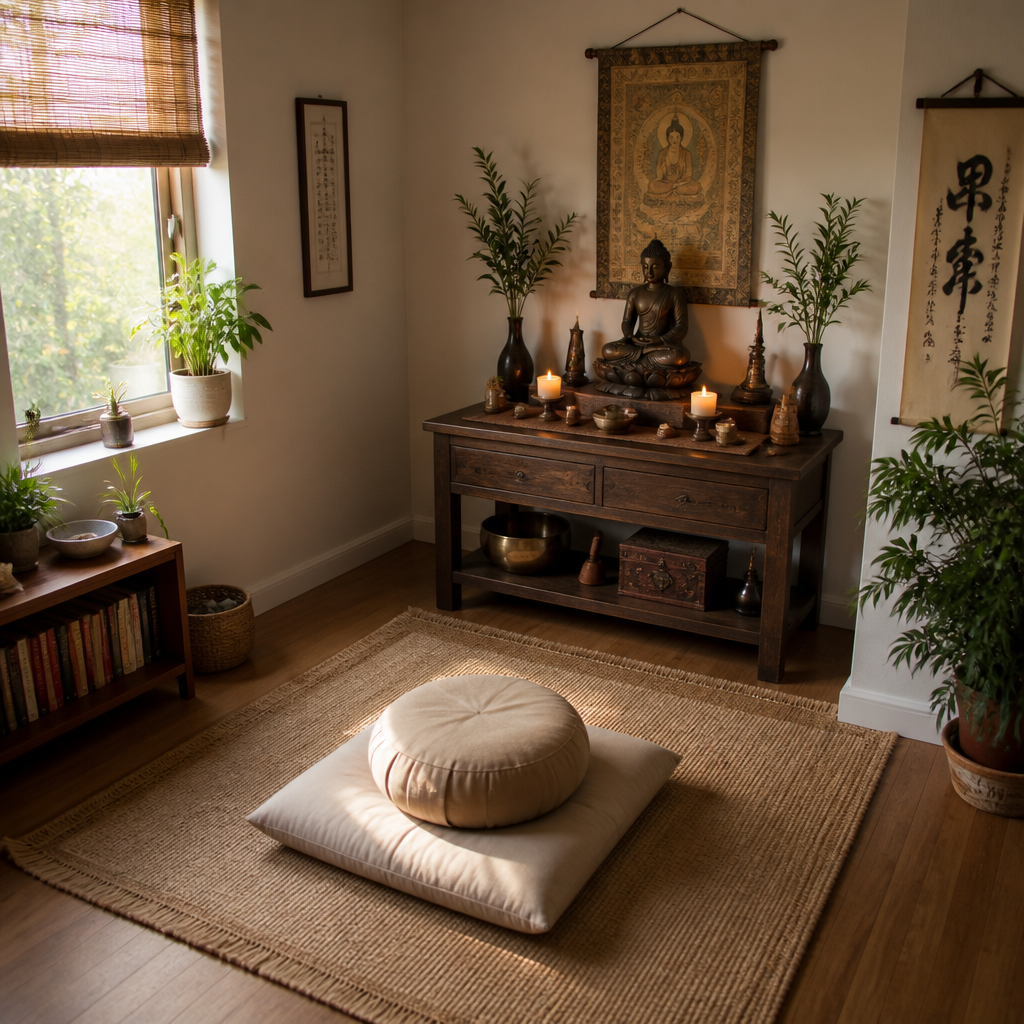
The living room or a dedicated meditation room are the best choices for a Buddhist home altar. These spaces carry daily foot traffic, making it natural to pause and acknowledge the shrine. A quiet corner of a home office can also work if your work carries a contemplative quality.
Avoid the bedroom for two reasons. First, the Buddha should not look over sleeping bodies according to most Southeast Asian traditions. Second, the bedroom is a space for rest and intimacy, not formal practice. The bathroom is completely off-limits in every tradition. The kitchen is borderline acceptable in Japanese Pure Land practice but is generally not recommended for beginners.
Height and Orientation
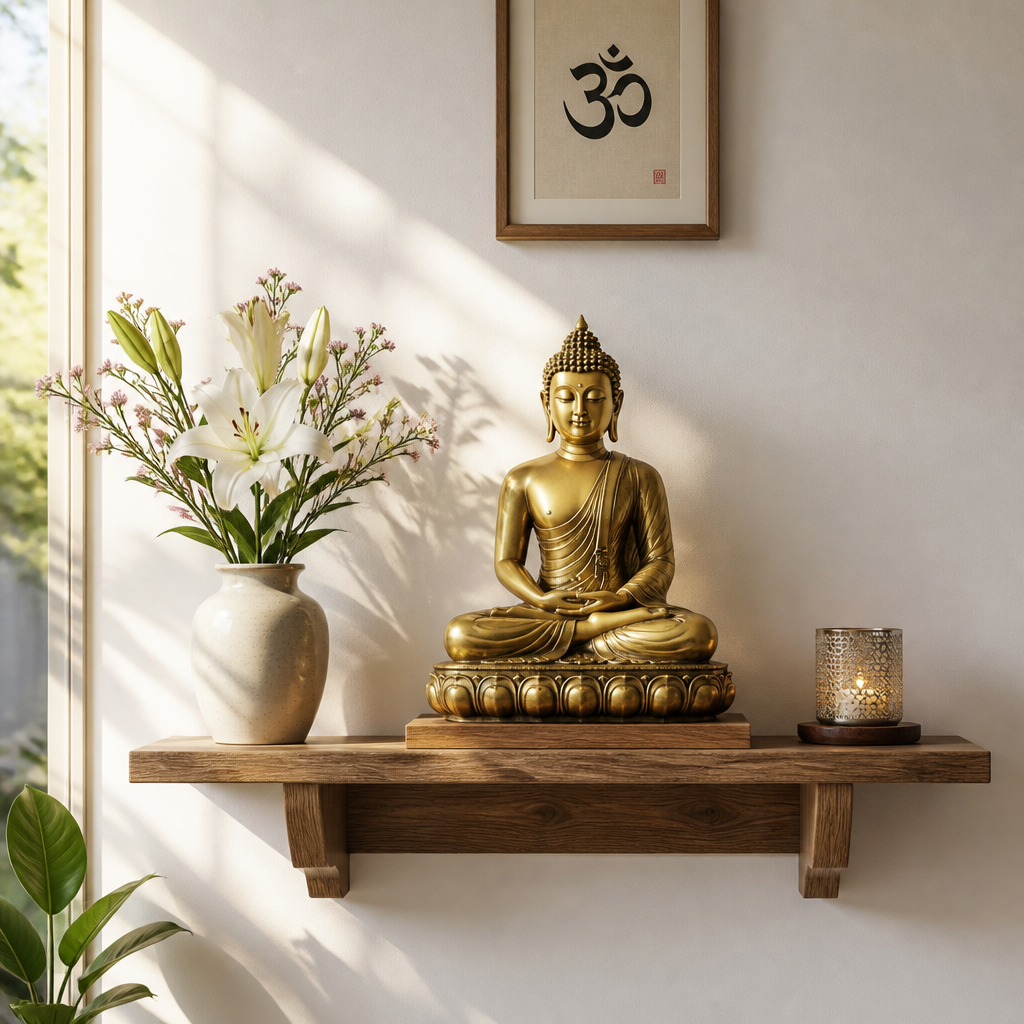
The altar surface should sit high enough that the statue's face is at or above your eye level when you are kneeling or seated. A dedicated shelf, a small cabinet, or a purpose-built altar table all work well. Avoid placing statues directly on the floor under any circumstances.
For orientation, east-facing is the traditional preference across Theravada Buddhism, because the Buddha attained enlightenment facing east. North-facing is also accepted in many Chinese and Tibetan traditions. What matters is that you choose deliberately and consistently. Pick one direction and keep it.
Pro tip: Before committing to a location, sit on the floor in your intended meditation posture and look at the empty shelf for five minutes. If the space feels right, set the altar there. If it feels awkward or distracting, move it. Your body's response to the space is useful information.
Selecting Your Buddha Statue
The Buddha statue is the centrepiece of your altar, and choosing it deserves serious thought. This is not simply a matter of aesthetics. The style, mudra, material, and cultural origin of the statue all carry meaning that will shape your daily experience of the space.
Understanding Mudras Before You Buy
The mudra is the most practical criterion for selection. For a home meditation altar, Dhyana mudra (both hands resting in the lap, palms facing upward) creates a calm, inward atmosphere. Bhumisparsha mudra (right hand touching the earth, left hand in the lap) commemorates the moment of enlightenment and is one of the most widely recognised poses in Theravada Buddhism from Thailand, Burma, and Sri Lanka.
Abhaya mudra (right hand raised, palm outward) represents protection and is common in Thai and Burmese statues. This is an excellent choice if you want the altar to carry a sense of security for the household. Vitarka mudra (hand raised with fingers pointing up, thumb and index finger touching) is associated with teaching and is frequently seen in Chinese and Japanese bronze figures.
Matching the Statue Style to Your Practice Tradition
If you practise Theravada Buddhism, a Burmese alabaster statue or a Thai gilded bronze will feel immediately at home. If your practice leans toward Mahayana or Zen, a serene Chinese or Japanese figure in bronze, stone, or wood is more congruent. For Tibetan Vajrayana practitioners, the iconography is more specific: Shakyamuni, Amitabha, Avalokiteshvara (Chenrezig), or Manjushri are all appropriate central figures.
The material matters too. Stone and bronze statues carry a weight and permanence that reinforces the stability you want from a meditation space. High-quality resin can be acceptable if it is museum-quality and hand-finished, but the difference in presence between a genuine carved stone statue and a mass-produced resin piece is immediately felt when you sit in front of them.
"The image of the Buddha is not an idol to be worshipped as a god. It is a reminder of what a human being is capable of becoming." - Bhikkhu Bodhi, American Buddhist monk and scholar, founder of Buddhist Global Relief
Pro tip: When sourcing a statue from HD Asian Art, pay attention to the country of origin listed in the product description. A Burmese alabaster Mandalay-style Buddha and a Cambodian sandstone Khmer-style Buddha convey distinctly different aesthetic traditions. Choose the one that resonates with your lineage or with the visual language that moves you most.
Essential Altar Offerings and Their Meaning
Offerings on a Buddhist altar are not symbolic gestures for appearance. Each offering corresponds to a mental quality you are actively cultivating. Understanding this transforms the act of setting up offerings from a chore into a daily practice in itself.
The Seven Traditional Offerings
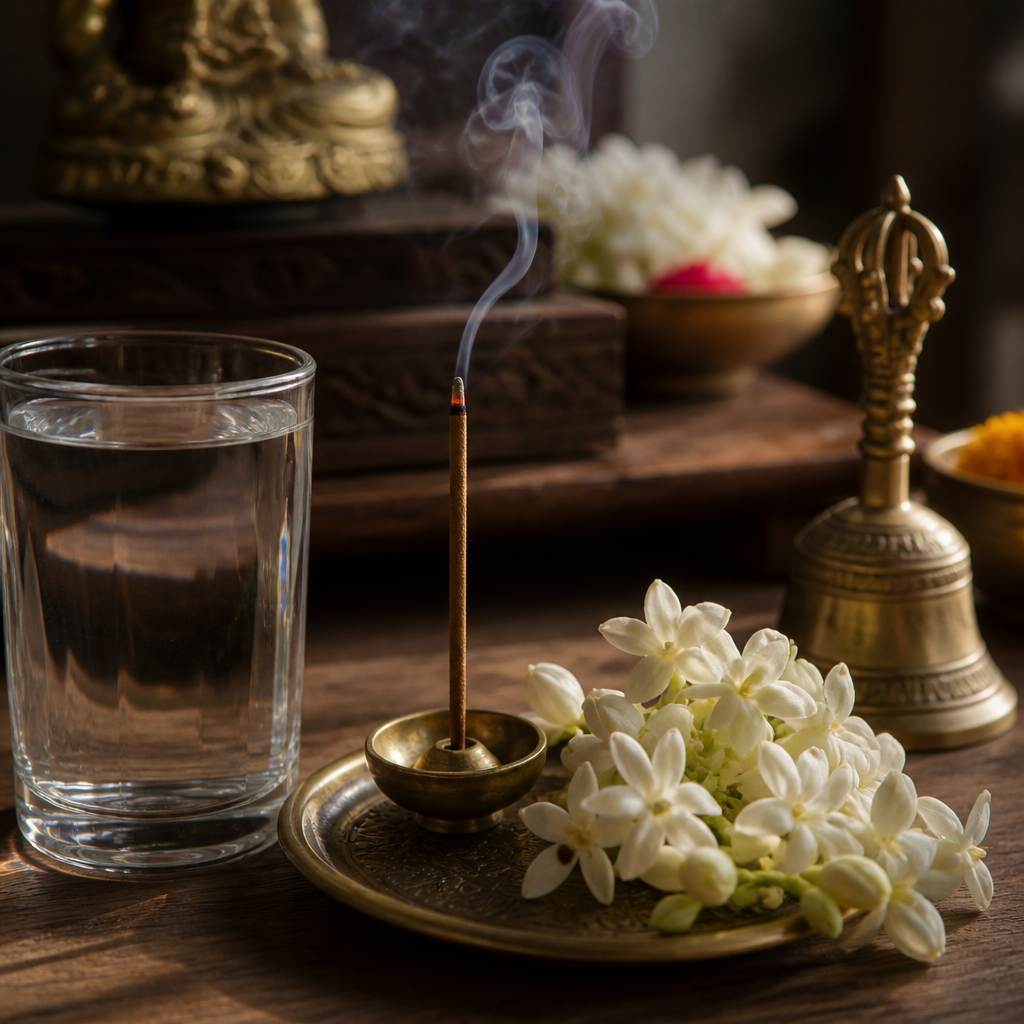
In Tibetan Buddhism, seven water bowls are arranged in a row, each representing a different offering: drinking water, washing water, flowers, incense, light, perfume, and food. In Theravada and East Asian traditions, the offerings are typically simplified: water, flowers, incense, a candle or lamp, and sometimes fruit or rice.
Water is the foundational offering because it is universally available, pure, and without attachment. Change the water daily, first thing in the morning. Flowers represent impermanence, which is why fresh flowers are preferred over artificial ones. Incense purifies the space and the senses. A single candle or oil lamp represents the light of wisdom dispelling ignorance.
What Not to Place on the Altar
Do not place photographs of living people on the altar. In most Buddhist traditions, photos of the deceased may be placed near (but not on the same level as) the Buddha statue for dedication of merit. Avoid placing non-Buddhist religious imagery on the same altar surface unless you have a specific syncretic practice with clear grounding in a tradition.
Food offerings should be simple and fresh. Meat is not appropriate for most Buddhist altar traditions. Fruit, rice, or small sweets are standard. Remove food offerings before they spoil.
Altar Setup Approaches Compared
There is no single universally correct way to set up a Buddhist altar, but there are three broadly identifiable approaches that beginners tend to adopt. Each has distinct trade-offs depending on your space, budget, and practice depth.
|
Approach |
Best For |
Key Considerations |
|---|---|---|
|
Minimalist single-statue altar |
Beginners, small spaces, secular or non-sectarian practitioners |
One quality statue, one incense holder, one candle or LED lamp. Easy to maintain. Lacks the iconographic depth of a fuller altar but is far superior to a cluttered shelf of mixed objects. |
|
Traditional Theravada altar |
Practitioners with a Theravada lineage connection (Thai, Burmese, Sri Lankan, Cambodian) |
Central Buddha statue in Bhumisparsha or Abhaya mudra, flanked by candles and flowers, incense holder in front. Photo of a respected teacher may be placed to the side. Requires daily maintenance of offerings. |
|
Tibetan/Vajrayana altar |
Practitioners with a Tibetan Buddhist lineage or tantric practice |
Seven water bowls, central deity figure (often Shakyamuni or Amitabha), thangka painting as backdrop, butter lamp, torma offerings on practice days. Higher maintenance commitment and requires instruction from a qualified teacher before setting up fully. |
How to Arrange Your Altar Step by Step
Follow these steps in order. Skipping steps leads to an altar that feels improvised rather than intentional, and that quality of intentionality is exactly what the space needs to serve its purpose.
Step 1: Prepare the Surface
Clean the shelf, table, or cabinet thoroughly. Use a clean cloth, ideally dedicated only to the altar. Place a simple cloth cover on the surface: white or gold silk is traditional in many East Asian homes, while red or saffron is common in Southeast Asian practice. The cloth prevents dust from accumulating on the wood and creates a defined sacred area.
Step 2: Position the Central Statue
Place the Buddha statue at the back-centre of the altar surface, elevated if possible on a small pedestal. The statue should face outward (facing you as you approach). If you have multiple statues, the main Buddha figure takes the central and highest position. Secondary figures such as Kuan Yin, Tara, or Ananda should be flanked to the left and right and slightly lower than the central figure.
Step 3: Add the Incense Holder
Place the incense holder directly in front of the statue. This is the functional and spiritual centre of the altar interaction. You will reach toward it every time you light incense, which is typically the opening act of any meditation or prayer session at the altar.
Step 4: Place Candles or a Lamp
Two candles, one on either side of the statue, is the standard arrangement for most Theravada and East Asian altars. A single oil lamp or ghee lamp is the standard for Tibetan altars. If you use candles, never leave them burning unattended. Battery-powered LED candles are an acceptable practical substitute for households with children or pets.
Step 5: Arrange Flowers and Water Offerings
Fresh flowers in a small vase go to the left side of the altar. A small glass or bowl of clean water goes to the right. Change both daily. The act of changing the water each morning is itself a practice: it requires you to approach the altar, acknowledge the image, and perform a simple, clean action before the demands of the day begin.
Step 6: Add a Bell if You Have One
A small singing bowl or bell is placed to the right of the incense holder. It is used to open and close meditation sessions. This is optional but adds a sensory anchor that helps the mind shift into practice mode more quickly over time.
Pro tip: Photograph your completed altar from your usual seated position on the floor. If the composition looks cluttered or asymmetrical in the photo, it will feel that way in practice. Remove anything that is not serving a clear function.
Maintaining Your Altar Over Time
An altar that is not maintained becomes a source of guilt rather than inspiration. The maintenance requirements are genuinely small once a routine is established, but skipping them has a compounding negative effect on how the space feels.
Daily Tasks
Change the water offering every morning. Light incense when you sit for meditation. Remove any wilted flowers. These three actions take under five minutes and constitute the minimum viable maintenance for a living altar.
Weekly Tasks
Dust the statue and altar surface with a clean, dry cloth. Wipe down the incense holder to remove ash build-up. Replace the altar cloth if it has accumulated incense residue. Replace flowers with fresh ones.
When to Reconsider Your Altar Setup
If you notice you are regularly walking past the altar without pausing, the problem is usually location, not motivation. Move the altar to a more prominent place in your daily path. If the offerings are consistently decaying before you change them, simplify: one water bowl is better than five rotting flowers.
In practice, a single high-quality statue that you genuinely love to look at will sustain your altar practice far better than a collection of objects assembled out of obligation. This is where sourcing matters. A genuinely beautiful Burmese alabaster figure or a bronze Cambodian Khmer Buddha from a specialist retailer carries a presence that makes sitting in front of the altar feel meaningful rather than obligatory.
Frequently Asked Questions
Can I set up a Buddhist home altar if I am not Buddhist?
Yes. Many people maintain a Buddhist altar as a meditation anchor, as part of a mindfulness practice, or simply because they find the imagery and atmosphere conducive to calm. The tradition does not require formal conversion or initiation to create a respectful shrine. What it does require is genuine respect for the imagery and traditions associated with it. Avoid treating the altar as purely decorative.
How do I choose between a Thai, Burmese, Chinese, or Japanese Buddha statue?
Choose based on which artistic tradition resonates with you visually and, if applicable, which aligns with your practice lineage. Theravada practitioners typically feel most at home with Thai, Burmese, Cambodian, or Sri Lankan figures. Zen practitioners often prefer the spare elegance of Chinese or Japanese bronze work. If you have no lineage affiliation, choose the statue that you find genuinely beautiful. You will be looking at it every day, and authentic appreciation is not a minor consideration.
What is the correct way to bow or show respect at the altar?
In most Theravada traditions, three full prostrations (forehead, palms, and knees touching the floor) are the standard form of respect. In Japanese Zen, a deep standing bow with palms pressed together is common. In Tibetan practice, full prostrations with the entire body extended on the floor are performed. If you are unsure, a simple standing bow with hands in anjali (prayer position) is respectful and accepted across all traditions.
Is it acceptable to have both Buddhist and Hindu statues on the same altar?
This is genuinely tradition-dependent. In much of Southeast Asia, particularly Bali and parts of Thailand, syncretic altars combining Buddhist and Hindu deities are culturally normal and have centuries of precedent. In more orthodox Theravada or Tibetan practice, mixing iconographies on the same altar is not recommended. If you are drawn to both Buddhist figures and Hindu deity statues such as Ganesh, Lakshmi, or Tara (who bridges both traditions), consider creating two separate, well-maintained shrine spaces rather than crowding one altar with mixed iconography.
Does the size of the Buddha statue matter?
Size matters in the sense that the statue should be proportionate to the altar space and to the room. A very small statue (under 10 cm) on a large shelf can appear lost and generate a sense of insignificance in the space. A very large statue (over 60 cm) in a small room can feel imposing rather than welcoming. For most home altars, a statue between 20 cm and 45 cm in height strikes the right balance of presence without overwhelming the space. Material quality and craftsmanship matter far more than size.
Where should I source a quality Buddha statue for my altar?
Source from a specialist retailer with transparent provenance information, clear descriptions of the country of origin, and statues that are genuinely crafted rather than mass-produced. HD Asian Art offers museum-quality Buddhist and Hindu sculptures sourced directly from Burma, Cambodia, Thailand, China, Japan, Sri Lanka, and other countries across Asia, with detailed descriptions that allow you to make an informed choice for your specific altar and practice context.
Share your altar setup experience in the comments below. What worked, what surprised you, and what would you tell someone starting from scratch?
References
