



Buddha Mudras Meaning: Complete Guide to Hand Gestures
Buddha Mudras Meaning: Complete Guide to Hand Gestures
Most people who buy a Buddha statue choose it for its beauty. But the position of the hands is not decorative. It is a precise language. Each hand gesture communicates something specific about the Buddha's state of mind, the moment in his life being depicted, and the spiritual energy the statue is meant to embody.
These gestures are called mudras, from the Sanskrit word meaning "seal" or "sign," and understanding them changes how you read every sculpture in a collection. This guide to Buddha mudras meaning covers the most important gestures found in Asian Buddhist art, where they come from, and what they tell you about any statue you are considering.
Table of Contents
What Is a Mudra?
|
Key Insight |
Explanation |
|---|---|
|
Mudra means "seal" in Sanskrit |
Each hand position locks in or expresses a specific spiritual state, intention, or moment in the Buddha's life. |
|
Bhumisparsha is the most widely recognized mudra |
The earth-touching gesture commemorates the exact moment of the Buddha's enlightenment and appears across Theravada, Mahayana, and Vajrayana sculpture. |
|
Abhaya signals protection, not greeting |
The raised open palm is commonly misread as a wave. It is a gesture of fearlessness, reassurance, and the offering of refuge from fear. |
|
Dhyana is the meditation mudra, not rest |
Both hands resting in the lap with palms up represents deep meditative absorption, not a casual seated posture. |
|
Varada means active giving, not passive receiving |
The downward-facing open palm indicates generosity and the granting of boons. It is the gesture of a Buddha who actively offers compassion. |
|
Mudras proliferated dramatically in Mahayana and Vajrayana traditions |
Early Buddhist art used a small set of gestures. As Mahayana and Vajrayana iconography developed, the number of mudras depicted in sculpture grew into the hundreds. |
|
The five fingers correspond to five levels of consciousness |
In Buddhist symbolic thought, each finger represents one of the five levels of consciousness required to reach enlightenment, giving every finger position cosmological weight. |
A mudra is far more than a stylistic pose. It is a complete communication system that predates written Buddhist texts as a way of preserving doctrine. When the Buddha sat under the Bodhi Tree and touched the earth to call the Earth Goddess as witness to his victory over the demon Mara, that single gesture became the Bhumisparsha mudra, one of the most reproduced hand positions in all of Asian art. The gesture did not need translation across language barriers. It carried meaning across centuries and across the full range of Buddhist traditions, from the Theravada monasteries of Sri Lanka and Burma to the Vajrayana tantric lineages of Tibet and Japan.
The foundational philosophy is that the hands function as a map of the universe. By touching specific fingers together or positioning the palm in a particular direction, a practitioner or sculptor "seals" a specific quality of awareness. This is what makes Buddhist hand gesture identification so important for anyone building a serious collection or designing a meaningful altar space.
The Most Important Buddha Mudras
The core mudras appear repeatedly across the countries represented in serious Asian art collections: Burma, Cambodia, China, India, Indonesia, Japan, Laos, Sri Lanka, and Thailand. Knowing these gestures means you can walk up to any statue and read its meaning without a label.
Bhumisparsha: The Earth-Touching Gesture
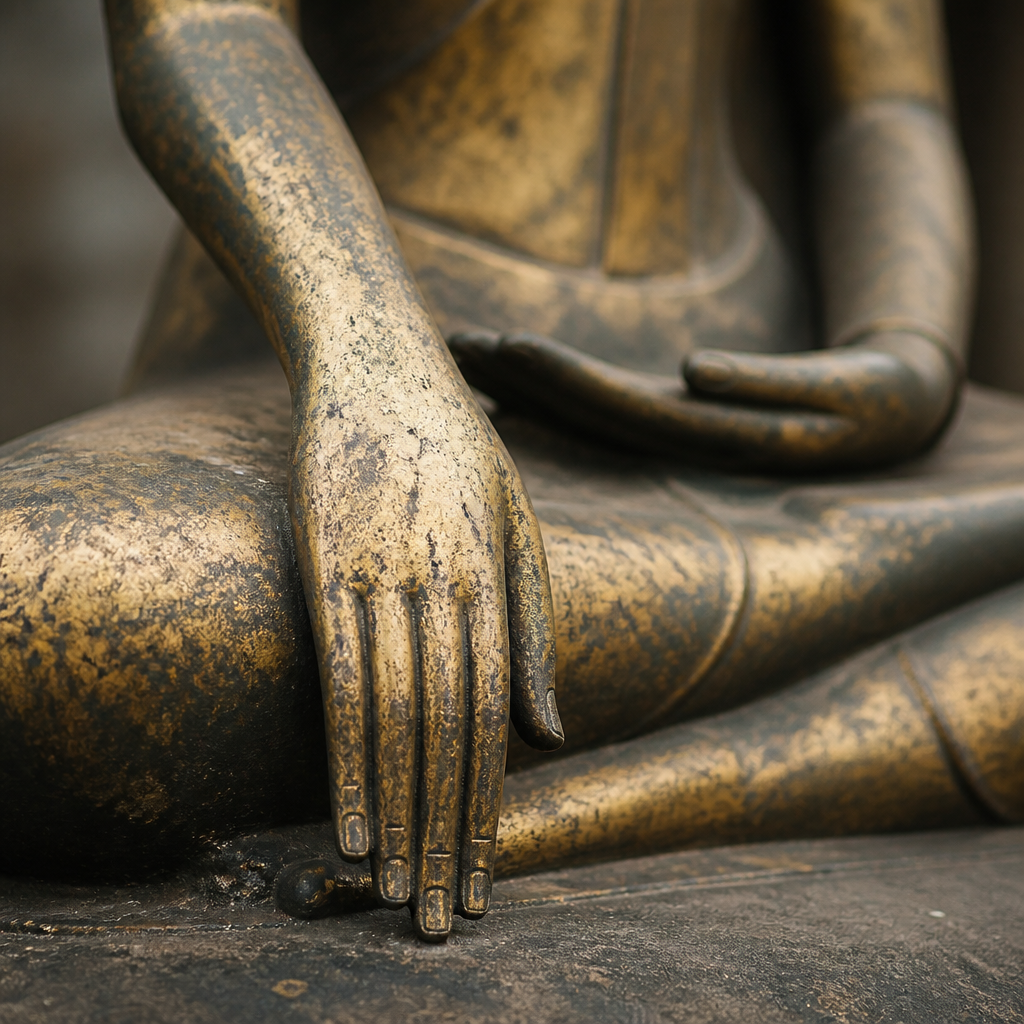
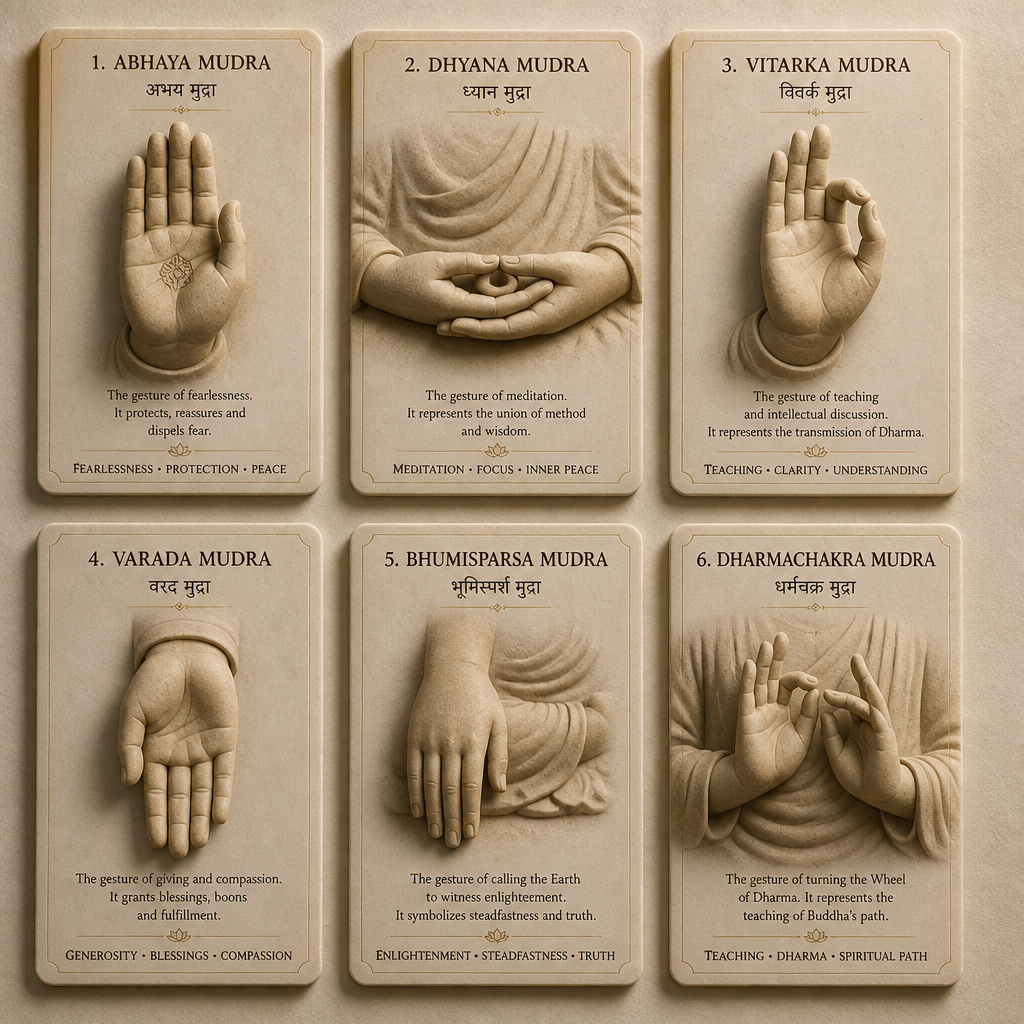
The Buddha sits with his right hand draped over his right knee, fingertips pointing downward and touching the earth. This is the Bhumisparsha mudra, and it depicts the precise moment of enlightenment beneath the Bodhi Tree. The left hand rests in the lap, palm upward. It is perhaps the most common mudra in Southeast Asian sculpture, particularly in Thai and Cambodian bronze work, and it carries enormous narrative weight: the Buddha is calling the Earth itself as witness to his spiritual victory.
A common mistake collectors make is confusing this gesture with Varada (the giving gesture) because both involve a downward-pointing hand. The distinction is posture and context. Bhumisparsha is always paired with a seated figure, with the right hand reaching over the knee toward the ground, not simply hanging at the side.
Dhyana: The Meditation Mudra
Both hands rest in the lap, one placed on top of the other, palms facing upward. This is the Dhyana mudra, the gesture of meditation and deep meditative absorption. Some traditions hold a bowl or an alms dish in this position, particularly in representations of Amitabha Buddha. The stillness this gesture communicates is intentional: it represents the complete calming of mental activity, not simply a comfortable seat.
Dhyana is one of the oldest mudras in Buddhist iconography and appears consistently across Theravada, Mahayana, and Vajrayana sculptural traditions. If you are choosing a statue for meditation practice or for an altar intended to support contemplative work, a figure in Dhyana is the most direct iconographic choice.
Abhaya: The Gesture of Fearlessness
The right hand is raised to shoulder height or higher, with the palm facing outward and the fingers pointing upward. This is the Abhaya mudra, and it means fearlessness, protection, and the granting of refuge from fear. It is one of the most popular hand gestures in Buddha statues across Asia. When this mudra appears alongside a standing Buddha figure (which is common in Thai and Burmese sculpture), the statue is actively offering reassurance and protection to anyone in its presence.
Pro tip: In Thai Buddhist sculpture, the walking Buddha (Phra Lila) almost always displays the Abhaya mudra with one raised hand. If you see a standing or walking figure with a raised palm, that is your identification key.
Varada: The Giving Gesture
The hand is lowered, with the palm facing outward and the fingers pointing downward. The Varada mudra represents generosity, charity, and the granting of boons. It is the gesture of a Buddha or bodhisattva who actively gives compassion and material or spiritual gifts. In many statues, particularly those from India and Sri Lanka, Varada appears on the left hand while Abhaya appears on the right, creating a pairing that simultaneously offers fearlessness and generosity.
Dharmachakra: The Wheel-Turning Gesture
Both hands are held at chest height, with the thumbs and index fingers of each hand touching to form circles. The right hand faces outward and the left faces inward. This is the Dharmachakra mudra, which commemorates the Buddha's first sermon in the deer park at Sarnath, the moment he set the Wheel of Dharma (Dhamma) in motion for the first time. The gesture is less common in standing or seated sculptures from Southeast Asia but appears frequently in Gandharan and North Indian sculpture, as well as in Japanese Buddhist art.
Vitarka: The Teaching Gesture
The hand is raised with the palm facing outward, but the thumb and index finger touch at the tips while the remaining three fingers extend upward. The Vitarka mudra is the gesture of discussion, instruction, and the transmission of teaching. It is sometimes confused with Abhaya because both involve a raised palm, but the touching of thumb and index finger is the defining detail. This gesture is common in Chinese and Japanese Buddhist statuary, where the intellectual transmission of doctrine is a central theme.
Regional Variations in Mudra Depiction
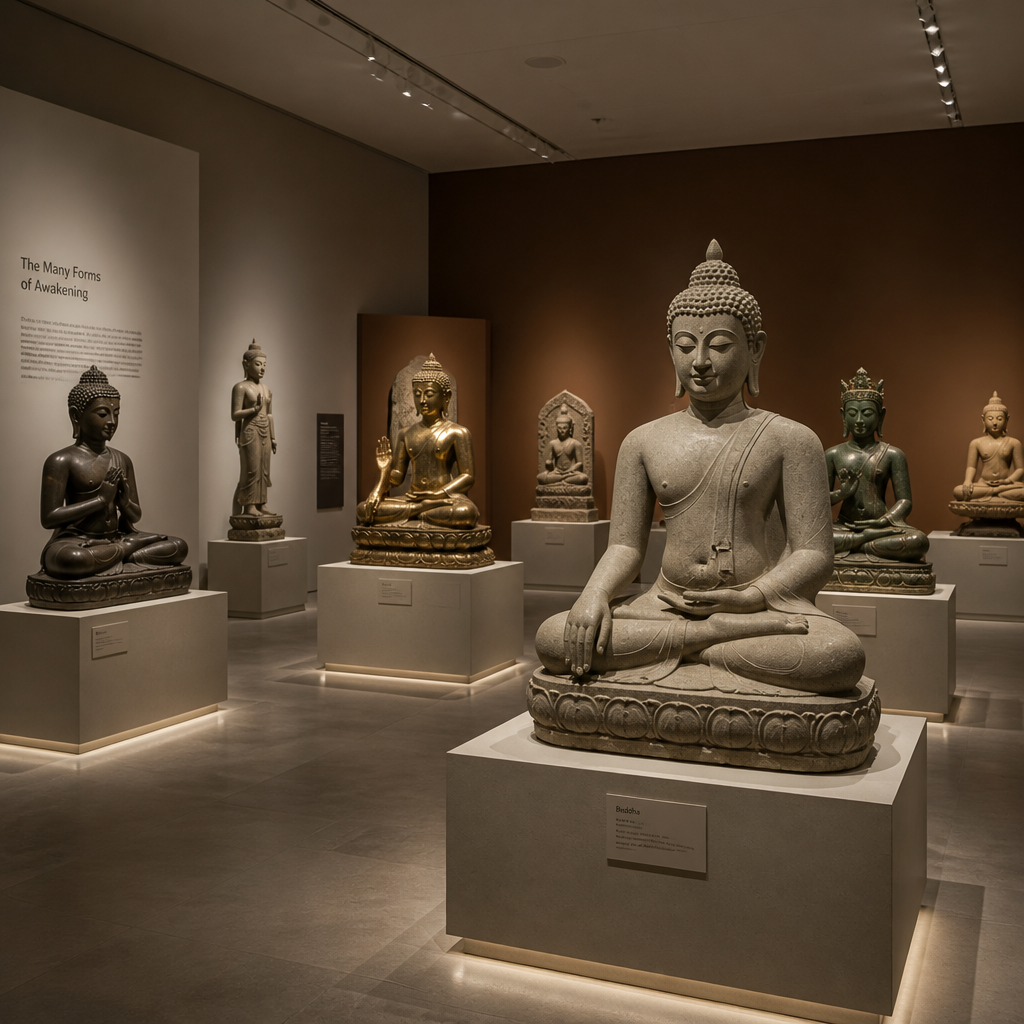
The same mudra can look markedly different depending on the country of origin and the period in which the sculpture was made. This is one of the most useful things to understand when building a collection of Asian Buddhist art, because regional style is as much a part of a statue's identity as the gesture itself.
Burmese and Thai Sculpture
Thai and Burmese sculptors were prolific in their depiction of Bhumisparsha and Abhaya. Thai bronzes often show an elongated, fluid hand with pronounced fingernails and extremely fine casting in the fingers. The earth-touching gesture in Burmese sculpture tends to show a more compact hand, with the right hand draped over a sharper knee angle. Both traditions favored the standing Buddha with raised hand, producing some of the most recognizable Abhaya figures in all of Asian sculpture.
Cambodian and Indonesian Sculpture
Khmer sculpture from Cambodia is remarkable for its restraint. Mudras in Khmer work are often less exaggerated, with the hand positions reading as calm and contained rather than dramatic. Indonesian Buddhist sculpture, particularly from the Sailendra period, shows clear Indian influence in mudra proportion and finger articulation, reflecting the movement of iconographic conventions along maritime trade routes.
Chinese and Japanese Sculpture
In Chinese and Japanese Buddhist art, the range of mudras expanded considerably, reflecting the greater complexity of Mahayana and Vajrayana iconography in these traditions. The Vitarka and Dharmachakra mudras appear more frequently here than in Southeast Asian work. Japanese esoteric Buddhist sculpture, in particular, introduced elaborate two-handed mudras not commonly seen in Theravada contexts. As the Encyclopedia of Buddhism notes, the development of Mahayana and Vajrayana iconography caused the number of mudras depicted in Buddhist art to proliferate until they numbered in the hundreds.
Understanding that each hand gesture in a Buddha statue is a complete statement, not a stylistic preference, changes the entire experience of looking at Asian religious sculpture. The hands are always saying something specific.
Comparing Mudras Across Buddhist Traditions
|
Mudra |
Primary Meaning |
Where It Appears Most Often |
|---|---|---|
|
Bhumisparsha (Earth-Touching) |
Enlightenment, calling the Earth as witness |
Thailand, Cambodia, Burma, India, Sri Lanka |
|
Dhyana (Meditation) |
Meditative absorption, inner stillness |
All traditions, particularly Theravada and Amitabha devotion |
|
Abhaya (Fearlessness) |
Protection, fearlessness, granting refuge |
Thailand, Burma, Japan, India, Laos |
|
Varada (Giving) |
Generosity, compassion, granting of boons |
India, Sri Lanka, China, Southeast Asia |
|
Dharmachakra (Wheel-Turning) |
First sermon, setting Dharma in motion |
India (Gandhara, Sarnath), Japan |
|
Vitarka (Teaching) |
Discussion, instruction, transmission of teaching |
China, Japan, Gandharan India |
How to Identify a Mudra on a Statue
Identifying a mudra correctly requires looking at several things at once: which hand is active, the direction the palm faces, which fingers (if any) are touching, and whether the gesture involves one or both hands. A single detail changes the mudra entirely.
Start with palm direction. A palm facing outward almost always signals either Abhaya (raised hand) or Varada (lowered hand). A palm facing inward or upward in the lap points toward Dhyana. Then check finger contact: touching thumb and index finger signals Vitarka or Dharmachakra. Then look at the position of the hand relative to the body: at the knee touching downward is Bhumisparsha; raised to chest height with both hands is Dharmachakra.
Pro tip: When examining a statue that may have Vitarka or Abhaya, photograph the hand from directly in front. The difference between an extended index finger (Abhaya) and a curved index finger touching the thumb (Vitarka) is not always obvious at an angle, but it is clear straight-on.
A common mistake is assuming that any seated figure with hands in the lap is in Dhyana. Check whether the hands are both palm-up and stacked, or whether one hand is actually touching the earth or resting in a different position. Lazy identification produces cataloguing errors that compound over time in a collection.
Choosing a Statue by Mudra for Your Space
The mudra should drive your choice of statue, not just the aesthetic finish or the country of origin. This is where understanding hand gestures in Buddha statues becomes genuinely practical rather than academic.
For a meditation space or home altar intended to support sitting practice, a figure in Dhyana mudra is the most iconographically coherent choice. It places a visual anchor of meditative stillness in exactly the environment where that quality is being cultivated. Bhumisparsha is equally powerful for a meditation altar: it anchors the space in the energy of awakening and the decisive moment of enlightenment.
For an entrance hall or a space intended to offer a sense of calm and welcome to anyone who enters, Abhaya is the right gesture. The raised palm actively offers protection and fearlessness. In many Asian homes and commercial spaces, a standing Buddha in Abhaya is placed specifically at the entrance for this reason.
For a space focused on generosity, giving, or healing, Varada is the clear choice. The open, downward-facing palm communicates active compassion. A figure combining Abhaya and Varada (one hand raised, one hand lowered with palm out) is common in Indian and Sri Lankan work and represents the full expression of both fearlessness and generosity simultaneously.
If you are assembling a collection that represents Buddhist history rather than optimizing for a single function, adding a Dharmachakra figure connects the collection to the founding moment of Buddhist teaching. It is a gesture that carries profound historical resonance across every branch of Buddhism.
Pro tip: At HD Asian Art, the provenance and regional origin of each piece is part of the description. Use the mudra as your first filter and the country of origin as your second. A Burmese Bhumisparsha figure and a Thai Bhumisparsha figure carry the same gesture but express it through entirely different sculptural traditions, and both belong in a serious collection.
Frequently Asked Questions
What does "mudra" mean and where does the word come from?
Mudra is a Sanskrit word meaning "seal" or "sign." In Buddhist context, it refers to the hand gestures used in ritual, meditation, and sculpture to express specific states of mind, moments in the Buddha's life, or spiritual qualities. The gesture "seals" a particular intention or meaning into a physical form.
How many Buddhist mudras exist?
The core mudras you will encounter in most Buddha statues number around five to twelve, but the total number depicted across all Buddhist art traditions is far larger. As Mahayana and Vajrayana iconography developed, the number of mudras represented in Buddhist sculpture grew into the hundreds, particularly in Japanese esoteric Buddhist art and Tibetan iconography.
Can a single Buddha statue display more than one mudra?
Yes, and it is common. Many figures combine gestures on each hand. The most frequent combination is Abhaya on the right hand (raised) and Varada on the left hand (lowered), appearing together on a single standing figure. This pairing simultaneously offers protection and generosity. In Vajrayana sculpture, elaborate two-handed mudras are standard, with each hand in a distinct position forming a single composite gesture.
Does the mudra change depending on which Buddha or bodhisattva is depicted?
Yes. Specific mudras are iconographically associated with specific Buddhas and bodhisattvas. Amitabha Buddha, for example, is frequently shown in Dhyana mudra, often holding an alms bowl. Shakyamuni (the historical Buddha) is commonly depicted in Bhumisparsha, referencing his enlightenment. In Mahayana and Vajrayana traditions, different Buddhas of the five-direction mandala each have their own signature mudra. Learning these associations helps identify which Buddha is depicted, particularly in Chinese and Japanese sculpture where physiognomy alone is often not enough.
Is there a difference between a mudra in sculpture and a mudra used in meditation practice?
The gesture is the same, but the context differs. In sculptural iconography, a mudra records a moment, state, or quality associated with the figure being depicted. In meditation practice, the same gesture is adopted by a practitioner to cultivate or align with that same quality. Dhyana mudra, for instance, appears on thousands of carved figures as a depiction of meditative absorption, and the same hand position is adopted by meditators to support their own practice. The sculpture and the practice reinforce each other.
Why do some Buddha statues have no clearly identifiable mudra?
Some sculptures, particularly older or fragmentary pieces, have damaged hands that make mudra identification difficult. In other cases, especially in very early Buddhist art before the tradition of anthropomorphic Buddha representation was established, the figure may use symbolic objects rather than hand gestures to convey meaning. In later periods, some regional workshops developed hybrid or locally specific gestures that do not map cleanly onto the canonical list. This is one reason why scholarly examination of the full sculptural context, including posture, iconographic attributes, and inscription, matters alongside the mudra itself.
If you have a Buddha statue whose mudra you find difficult to identify, share your experience in the comments. The details of hand position and country of origin go a long way toward a confident identification.
References
