



7 Rules for Balancing Ganesha Statues in Minimalist Rooms
7 Rules for Balancing Ganesha Statues in Minimalist Rooms
Quick Summary
Balancing ganesha statues in minimalist rooms means letting one sacred piece anchor the space with deliberate empty room around it. Place the statue on a clear surface at seated eye level, size it to roughly one-third of the surface width, and add only one supporting object.
- Keep at least a hand's width of empty space on each side of the statue.
- Let the statue occupy roughly one-third of the surface width and no more than half its depth.
- Aim for the statue's head to sit 40 to 48 inches off the floor.
- Limit a small apartment altar to three objects: statue, lamp, and offering bowl.
- Light the piece indirectly with a warm-white lamp around 2700K to 3000K.
Table of Contents
- Why a Ganesha Statue Belongs in a Minimalist Room
- Ganesha Statue Placement at Home: The Rules That Actually Matter
- Scale and Proportion: Sizing a Statue for a Sparse Room
- Ganesha Statue Display Ideas That Keep the Room Calm
- Minimalist Home Altar Ideas for Small Apartments
- Modern Ganpati Mandir Design Without the Clutter
- A Step-by-Step Method for Styling One Statue in a Minimalist Room
- Browse the Collection and Choose Your Piece
- Frequently Asked Questions
Why a Ganesha Statue Belongs in a Minimalist Room
Balancing ganesha statues with minimalist interior design starts with one idea: a single sacred object can anchor a quiet room better than a shelf full of decor, and ganesha statues prove it.
Minimalism strips a room down to what matters. That makes the object you keep more important, not less.
Below, we walk through seven rules for making that pairing work. They cover placement, scale, styling, small apartments, and a step-by-step method you can follow in an afternoon.
Ganesha Statue Placement at Home: The Rules That Actually Matter
Placement decides whether a statue reads as sacred art or clutter. Put it where the sightline lands first, keep it clear of daily traffic, and give it breathing room on every side.
Start with these rules:
- Choose a spot you see when you enter or sit down
- Keep the statue off the floor unless tradition calls for it
- Leave empty space around it, at least a hand's width on each side
If you want the full traditional guidance on direction and room choice, our guide to positioning a Ganesh idol for good luck at home covers it in detail.
Entrance, Living Room, or Meditation Corner?
The entrance suits a smaller statue that greets guests. The living room works for a larger piece on a console or low shelf. A meditation corner gives the statue its most personal setting.
Pick the room where you already pause. If a meditation corner is your choice, our guide to creating a zen meditation space at home walks through the full setup.
Scale and Proportion: Sizing a Statue for a Sparse Room
Scale is where most minimalist rooms go wrong. A statue that is too large crowds the empty space you worked to create. One that is too small disappears. The fix is not a single rule of thumb but a short measuring routine you run before you commit to a surface.
Measure the surface, then the sightline
Start with the surface the statue will sit on, not the statue itself. Write down three numbers: the width of the surface, its depth, and its height from the floor.
A workable default is to let the statue occupy roughly one-third of the surface width and no more than half its depth.
Height is a separate calculation. The top of the statue should land at or just below eye level when you are seated in the room's main chair or sofa, which for most adults puts the statue's head somewhere between 40 and 48 inches off the floor.
Match visual weight, not just inches
Two statues of identical height can carry very different visual weight. Dark bronze, dense stone, and high-contrast patinas pull the eye and feel heavier; pale clay, unfinished wood, and matte terracotta recede. In a white or cream room, a dark statue becomes the anchor and can be sized at the upper end of the range.
A quick test: photograph the surface with the statue in place, convert the photo to grayscale, and squint. If the statue is the darkest or lightest mass in the frame, it will read as the focal point.
Leave negative space on purpose
Minimalism is mostly a discipline of empty space. Aim for at least one statue-width of clear surface on each side and roughly one statue-height of bare wall above the piece. If the surface is shallower than the statue's base, the piece will look precarious no matter how good the styling is; choose a shallower statue or a deeper console rather than letting the base overhang.
For a closer look at matching statue size to a compact space, read our guide to choosing a Ganesha statue size for small spaces.
These are the measuring defaults the article gives for sizing a statue to its surface.
| Item | Value | Note |
|---|---|---|
| Share of surface width | Roughly one-third | Statue should occupy this much |
| Share of surface depth | No more than half | Keeps base from overhanging |
| Console 48 inches wide, 14 deep | Statue about 14 to 16 inches wide | Base no deeper than 7 inches |
| Floating shelf 24 inches wide | Piece around 7 to 8 inches wide | Keeps empty space intentional |
| Statue head height | 40 to 48 inches off the floor | At or just below seated eye level |
| Clear surface each side | At least one statue-width | Empty space on purpose |
| Bare wall above | Roughly one statue-height | Above the piece |
Ganesha Statue Display Ideas That Keep the Room Calm
Display comes down to restraint. One statue, one supporting object, and open space around both. That is the whole formula.
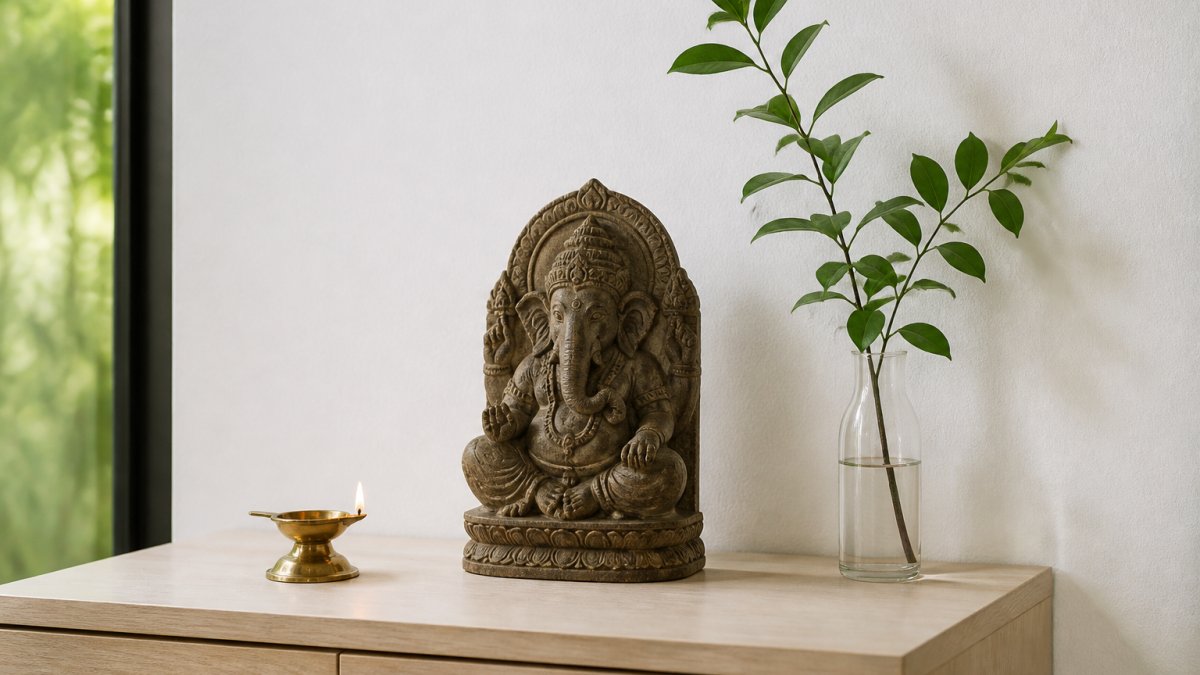
Try these display ideas:
- Set the statue alone on a console, with nothing behind it but wall
- Add one brass oil lamp or a single candle, never a cluster
- Use a plain stone or wood base instead of an ornate platform
Wall art and wall hangings can support the statue, but they compete with it when they multiply. A single line art print of Ganesha, spaced well away, works. A gallery wall does not.
Minimalist Home Altar Ideas for Small Apartments
A home altar in a small apartment needs a tight footprint and a clear purpose. A low shelf, a wall-mounted ledge, or the top of a slim cabinet can all serve.
Keep these minimalist home altar ideas in mind:
- Choose one surface and commit to it
- Limit the altar to three objects: statue, lamp, offering bowl
- Use a tray to define the edge of the sacred space
The tray trick matters more than it sounds. For a compact apartment layout that keeps idols calm and uncluttered, our guide to arranging idols in a small apartment has more room-by-room detail.
Modern Ganpati Mandir Design Without the Clutter
Modern Ganpati mandir design favors clean lines, warm materials, and a single focal point. The mandir, or shrine, does not need carved panels and heavy drapery to feel sacred.
Consider these approaches:
- A wall niche with a plain back and a small shelf
- A freestanding wooden cabinet with the doors kept open
- A concrete or stone ledge built into the wall
Natural textures do the work that ornament used to. Clay, wood, concrete, and terracotta all bring warmth without visual noise. Warm tones and a matte black surface both hold a room's calm.
A Step-by-Step Method for Styling One Statue in a Minimalist Room
Styling one statue is a short job if you follow a fixed order and check the result from where you will actually sit. Here is the method we would use, with the reasoning behind each step so you can adapt it to your room.
- Clear and clean the surface. Remove everything, dust the surface, and wipe it dry. You cannot judge empty space while other objects are still in frame.
- Mark the sightline. Sit in the chair or stand at the doorway from which you will most often see the statue. Note where your eye naturally lands. Place the statue so its face falls on or just below that line, not above it.
- Set the statue and step back six feet. Check the empty space on each side and above. If the statue feels crowded, the surface is too small, move to a wider one rather than shrinking the piece.
- Add exactly one supporting object. A single brass oil lamp, a low bowl, or one stem of greenery. Place it off-center so the statue stays the dominant mass. Two supporting objects is the ceiling; three is a collection.
- Light it softly and indirectly. A small warm-white lamp (around 2700K to 3000K) aimed at the wall behind the statue bounces light onto the figure without a hotspot. A harsh spotlight aimed at the face flattens the carving and casts hard shadows.
- Remove anything that pulls focus. Scan the frame for competing colors, reflections, or text. If your eye leaves the statue first, remove the object it landed on.
- Live with it for a week before adding more. A week of daily viewing tells you more than an hour of arranging. Most over-styling happens in the first ten minutes.
Diagnose the arrangement before you change it
If the corner still feels off after a week, the problem is usually one of three things, and each has a different fix:
- The statue feels lost. The backdrop is too busy or too close in tone. Try a plain wall, a darker paint behind the piece, or a slightly larger statue.
- The statue feels heavy or looming. The surface is too high or the piece too dark for the room. Lower the surface or shift to a lighter material.
- The corner feels unfinished. You are missing a boundary, not an object. A shallow tray under the statue and lamp defines the sacred space without adding visual noise.
Protect the surface and the piece
A few practical safeguards belong in the method, not after it. Felt pads under a stone or metal base prevent scratches on wood and stop the piece from sliding. Keep the statue out of direct sun, which can fade finishes and dry out wood or clay over time, and away from radiators, which do the same. If you burn candles or oil lamps, place them on a non-flammable tray and keep them at least a foot from the statue and any fabric.
Once the statue is set, the surrounding corner needs only a few essentials to feel complete. Our checklist of essential items for a zen meditation corner covers what to add and, just as usefully, what to skip.
Browse the Collection and Choose Your Piece
Choosing the right statue is the part that lasts. Material, size, and craftsmanship all shape how a piece settles into a minimalist room.
Our curated collection at HD Asian Art brings together Buddhist and Hindu statues, including handpicked antique and contemporary pieces and a specialization in Khmer and Southeast Asian sculptures.
A few things to weigh as you browse:
- Pick a material that matches your room's warmth, such as clay, wood, or bronze
- Confirm the height against your chosen surface before you buy
- Favor a single well-made piece over several smaller ones
The right Ganesha statue does not fight a minimalist room. It gives the room its center.
Frequently Asked Questions
Where should a Ganesha statue be placed in a minimalist home?
Pick one spot and commit to it. A low console in the living room, a shelf in a meditation corner, or a niche near the entrance all work, as long as the statue sits at or above waist height, faces into the room, and has clear space around it. Avoid tucking a Ganesha statue between books or behind a sofa. In a minimalist room the empty space around the piece is what makes it read as intentional rather than decorative clutter.
How do I know a Ganesha statue is authentic rather than a high-quality replica?
Ask for the piece's documented history before you buy, not after. A serious seller can tell you where a sculpture came from, how it was acquired, and what material it is carved or cast from, and will answer follow-up questions in plain language. Vague provenance claims are a warning sign. Compare the craftsmanship details in close-up photos, such as the finish on the trunk, hands, and base, against what arrives in person.
Will a large Ganesha statue look wrong in a small apartment?
Not if you size it to the wall, not the room. A statue roughly one-third the height of the surface it sits on usually reads as balanced. In a small apartment, a piece 30 to 45 centimeters tall on a narrow console often looks more deliberate than a large statue crowded into a corner. Give it one clear surface, keep the surrounding wall bare, and skip the cluster of small accessories.
What decor pairs well with a Ganesha statue in a modern room?
Few things, chosen well. Warm natural textures such as pale wood, unglazed clay, linen, and raw concrete sit comfortably beside carved stone or cast metal. Add one lighting source, a brass oil lamp or a single candle, and stop there. Skip colorful textiles, busy wall art, and shelves of small objects nearby. The goal is a quiet setting where the statue's form and finish carry the visual weight.
The hardest part of balancing a sacred statue with a sparse interior is finding a piece worthy of the space. HD Asian Art curates Buddhist and Hindu statues with temple-inspired character, offers free shipping, and selects pieces meant for altars and meditation corners. Browse the collection and choose the statue that becomes the quiet heart of your room.

