



How to Authenticate Hand Carved Southeast Asian Wooden Statues
How to Authenticate Hand Carved Southeast Asian Wooden Statues
Table of Contents
Why Authentication Matters for Hand Carved Wooden Statues
Distinguishing authentic hand carved southeast asian wooden statues from modern reproductions has become increasingly difficult as manufacturing techniques improve. For collectors, spiritual practitioners, and interior designers investing in these pieces, authentication determines whether you own a genuine cultural artifact with historical significance or an industrial copy. A verified antique can appreciate in value, carry authentic spiritual energy for meditation spaces, and represent genuine craftsmanship from artisans whose traditions span centuries. A skillfully made forgery looks identical on a shelf but lacks provenance, historical authenticity, and the cultural weight that makes these pieces meaningful.
At HD Asian Art, we understand that serious collectors need more than a seller's assurance. This guide walks you through the practical methods used by experienced collectors, appraisers, and museum professionals to authenticate hand carved southeast asian wooden statues. We'll cover visual inspection techniques, material analysis, provenance verification, and the regional stylistic variations that separate genuine pieces from modern reproductions.
The most common mistake collectors make is relying on a single indicator. Authentication requires cross-referencing multiple lines of evidence. A statue might show convincing patina, but machine-carved seams tell a different story. Think of it like detective work: three independent clues pointing the same direction confirm authenticity.
Visual Signs of Authentic Hand Carved vs Machine Carved Wood
Surface Texture and Tool Marks
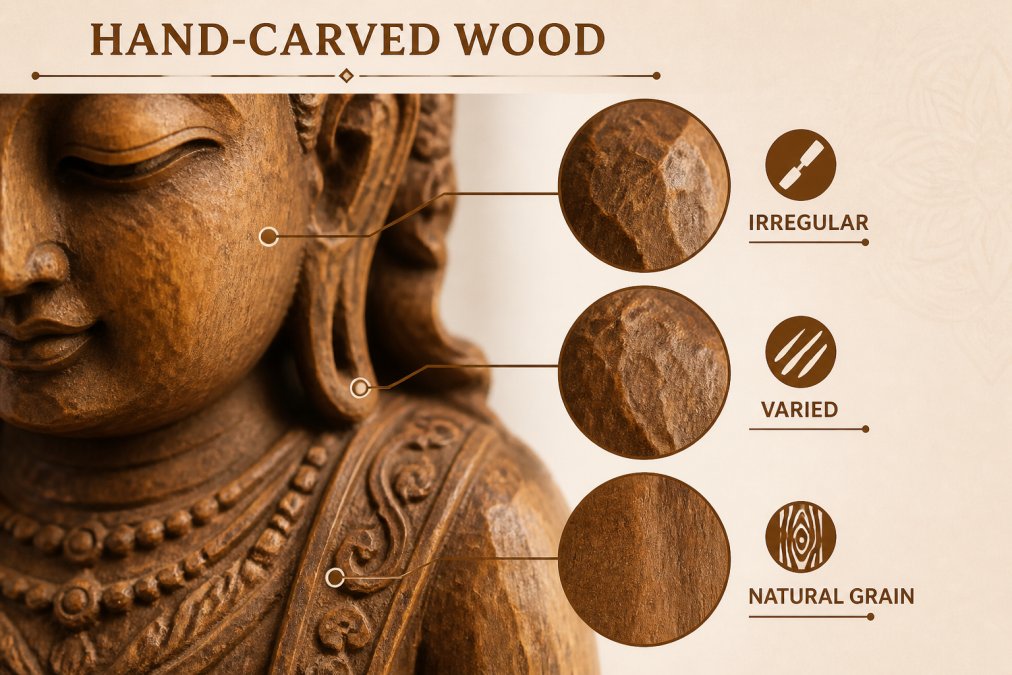
Hand carving creates slight variations in depth, pressure, and direction, evidence of the individual craftsperson's technique. Authentic hand-carved wood shows visible tool marks that vary in width, depth, and angle, following the design contours without repeating in perfect patterns. When examined closely with a magnifying glass, you feel and see minor inconsistencies. The chisel marks might be deeper on one side of a carved line than the other.
Machine-carved wood displays consistent, repetitive tool marks. CNC machines cut with mechanical precision, producing uniform grooves that repeat exactly. If you see identical spacing across multiple similar elements, like the folds in a robe or the lines of a face, that consistency points toward machine carving.
Asymmetries and Organic Variation
Authentic hand carved southeast asian wooden statues contain subtle asymmetries reflecting the natural variation inherent in hand work. A Buddha's face might be slightly asymmetrical. One hand gesture (mudra) might be positioned marginally differently from its counterpart. These variations are signatures of human craftsmanship.
Forgers often miss this detail. Machine tools or inexperienced carvers tend toward symmetry because it's easier to achieve. Modern reproductions might have perfectly balanced facial features or evenly spaced decorative elements. Genuine hand carving, especially from traditional Southeast Asian sculptors working without modern precision instruments, naturally produced slight variations.
Carved Details and Sculptural Depth
Authentic Southeast Asian sculptors carved details into the wood with chisels and gouges, creating genuine three-dimensional forms with real depth. Machine-carved pieces sometimes lack this depth, with shallow relief carving where details are only slightly recessed into the surface. When viewed from the side or at an angle, authentic hand-carved details show pronounced depth and undercuts.
Details in the eyes, fingers, and facial features reveal carving technique most clearly. In authentic pieces, the eyes are often carved with a slight hollow that creates a living quality. Fingers are individually articulated with visible separation. In machine-carved reproductions, these details are often more uniform and lack the subtle variation that makes hand-carved faces appear animated.
Material Composition and Wood Type Identification
Identifying the wood species used in a hand carved southeast asian wooden statue provides important authentication evidence. Traditional Southeast Asian sculptors worked with specific wood types available in their regions. Burmese carvers favored teak and rosewood. Thai artisans worked extensively with teakwood and jackfruit wood. Cambodian sculptors used various hardwoods suited to detailed carving.
Modern reproductions often use whatever wood is economically available, which may not match the historical wood types. A piece claimed to be 18th-century Burmese should be carved from teak or rosewood. If laboratory analysis reveals a wood species that wasn't commercially available in that region during that period, authentication is compromised.
Wood identification requires expert analysis of color, grain pattern, density, and microscopic cellular structure. Teak has a warm golden-brown color and distinctive grain; rosewood is darker with reddish tones; jackfruit wood is lighter and more uniform. Genuine antique wood shows age-appropriate changes: the surface develops patina, darkening from decades of exposure to air, dust, and handling. Old wood becomes more brittle and sometimes shows checking (small cracks) as it seasons over time. Modern wood, even if artificially aged or stained, lacks these genuine aging characteristics.
Detecting Oxidation, Patina, and Age Indicators
Patina is the visible surface change that occurs on wood over decades or centuries, a darkening and hardening of the wood's surface layer caused by oxidation, dust accumulation, and handling. Genuine patina on hand carved southeast asian wooden statues is one of the most reliable age indicators.
Authentic patina appears as subtle darkening, usually most pronounced on raised areas where hands and dust have contacted the wood repeatedly. The color deepens gradually, lighter on protected surfaces, darker on exposed areas. When examined in raking light, genuine patina creates subtle texture and color variation across the surface.
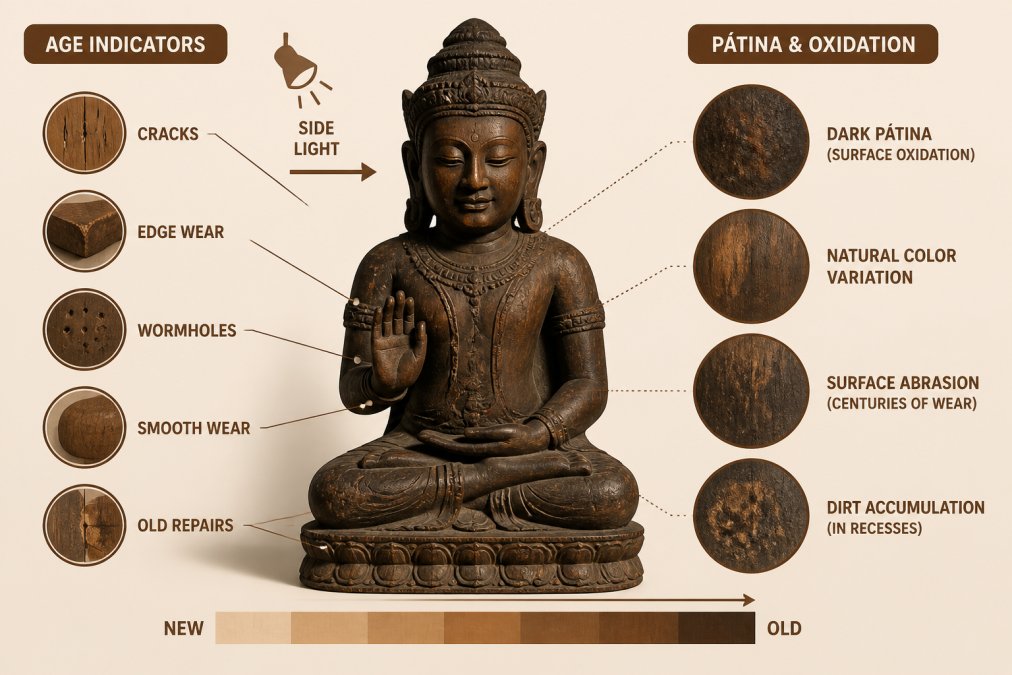
Modern reproductions often lack convincing patina. Artificial aging techniques can stain wood darker, but the stain sits on top rather than integrating into the surface. Artificially aged wood shows uniform coloring rather than the varied patina of authentic pieces.
Checking and cracks indicate age as well. Old wood dries and shrinks over time, sometimes causing small surface cracks as the outer layers shrink at different rates than the interior. These cracks follow the wood grain and appear naturally distributed. Look also for evidence of old repairs or restoration. Authentic antique statues sometimes have been repaired with wooden patches or adhesive. These repairs show their own age, with patina and wear.
Verifying Provenance and Historical Documentation
Provenance, the documented history of ownership and location, is critical for authentication. A hand carved southeast asian wooden statue with clear provenance is substantially more valuable and credible than an identical piece with no documented history.
Reliable provenance typically includes museum records, auction house documentation, or collector histories. If a piece was in a museum collection, that institution can provide documentation. Auction house catalogs from reputable firms create paper trails. Estate sales or collector records sometimes provide ownership history.
Be skeptical of vague provenance claims. Statements like "acquired from an estate" or "from a private collection" without specific details are red flags. Legitimate sellers can usually provide specifics: the name of the previous owner, when the piece was acquired, and whether it was ever exhibited or published.
For pieces claimed to be antique, documentation should align with the claimed age. A statue attributed to 18th-century Burma should ideally have documentation showing it was in a European or American collection by the 19th century or in a Burmese temple before that. Scientific dating methods like radiocarbon dating exist but are expensive and typically used only for museum acquisitions or disputed pieces.
How to Clean Antique Wooden Statues Without Damage
Cleaning an antique hand carved southeast asian wooden statue requires extreme caution. The goal is removing surface dust and grime while preserving the patina and wood integrity.
Start with dry cleaning using a soft brush with natural horsehair or soft synthetic bristles to gently remove dust from all surfaces. For crevices and carved areas, a soft toothbrush works well. For stubborn grime, use a barely damp cloth with distilled water. Gently wipe the surface, following the grain, and dry immediately. Never soak the wood or allow water to pool in crevices.
Avoid commercial furniture cleaners, polishes, and waxes, which can damage antique wood and obscure patina. Never use sandpaper, steel wool, or abrasive cleaners. If a statue has accumulated thick grime or old varnish, professional conservation is recommended.
Common Signs of Modern Reproductions and Forgeries
The most obvious indicator is perfect condition with claimed antiquity. A statue claimed to be 200 years old should show wear: cracks, dents, scratches, areas of loss, and repairs are normal on genuine antiques. A pristine piece labeled "antique" is likely a recent reproduction.
Machine carving marks are the clearest technical indicator. Repeated, uniform patterns in carved details, consistent spacing, or perfectly symmetrical elements suggest machine production. The wood itself reveals much. Reproductions often use inexpensive woods like pine or poplar rather than the historically appropriate hardwoods. Artificial aging that looks uniform and surface-level, rather than genuine patina, suggests modern aging techniques.
Anatomical inconsistencies appear in some reproductions. Proportions might be slightly off, iconography might be inaccurate for the claimed region or period, or hand gestures (mudras) might not match authentic representations. Experienced collectors recognize these subtle errors immediately.
Regional Stylistic Variations and Dating Techniques
Hand carved southeast asian wooden statues vary significantly by region and period. Burmese pieces differ from Thai, Cambodian, and Laotian work in proportions, iconographic details, carving style, and wood type. Burmese sculpture, particularly from the Mandalay period (19th century), features elongated proportions and intricate carving. Thai sculpture emphasizes the flame-like hair (ushnisha) of Buddhist figures and specific hand gestures. Cambodian work shows distinctive proportions reflecting Hindu and Buddhist synthesis.
Understanding these stylistic progressions helps date pieces and identify reproductions that get the style wrong. Iconographic accuracy matters as well. Buddhist hand gestures, symbolic objects, and the specific attributes of deities follow established traditions. A mudra should match the figure being depicted. Objects like lotus flowers, prayer beads, or ritual implements should be appropriate to the figure and region. Errors in iconography suggest a reproduction made by someone unfamiliar with authentic traditions.
Authentication of hand carved southeast asian wooden statues requires combining multiple lines of evidence: visual inspection of carving technique, wood type identification, patina assessment, provenance verification, and stylistic analysis. No single indicator is definitive, but convergent evidence creates confidence. When evaluating a piece for your meditation space or collection, trust your ability to observe carefully. Look closely at the carving marks, feel the surface texture, examine the wood color and grain, and ask detailed questions about provenance. Browse our collection knowing that each statue has been authenticated through rigorous evaluation and represents genuine craftsmanship and cultural heritage.
| Authentication Method | What It Reveals | Reliability | Effort Level |
|---|---|---|---|
| Visual carving analysis | Hand vs. machine work | High | Low |
| Wood type identification | Regional authenticity, period accuracy | High | Medium |
| Patina and surface aging | Genuine age vs. artificial aging | Medium | Low |
| Provenance documentation | Ownership history, legitimacy | High | Medium |
| Stylistic analysis | Regional origin, period dating | High | High |
| Wood sample testing | Definitive species identification | Very High | High |
Frequently Asked Questions
How do I identify a hand carved wooden Buddha statue from a machine-made reproduction?
Hand carved wooden statues show irregular surface textures, varied tool marks, and natural asymmetries that machines cannot replicate consistently. Machine-carved pieces display uniform grooves, perfectly symmetrical details, and repetitive patterns. Examine the carved lines closely, hand carving produces organic, flowing lines with slight variations in depth, while machine carving creates identical, mechanical precision. Check the underside and less visible areas; authentic hand carving shows the same craftsmanship throughout, whereas reproductions often have less detail in hidden sections.
What wood types are commonly used in authentic Southeast Asian Buddha wooden statues?
Traditional Southeast Asian carvings use hardwoods including teak, rosewood, sandalwood, and jackfruit wood. Teak is prized for its durability and natural resistance to decay. Sandalwood was favored for Buddhist and Hindu pieces due to its aromatic properties and spiritual significance. Examine the wood's color, grain pattern, and weight, authentic hardwoods are dense and heavier than softwoods or modern substitutes. Lighter, softer woods or uniform coloring may indicate modern reproductions or inferior materials.
How should I care for and maintain hand carved Buddha wooden statues?
Dust regularly with a soft, dry cloth to prevent buildup that traps moisture. Avoid direct sunlight, which causes fading and wood warping. Keep humidity levels stable between 40-60% to prevent cracking. Never use water, harsh chemicals, or commercial wood polishes on antique pieces. For deeper cleaning, use a barely damp cloth with distilled water only, then dry immediately. If the statue requires restoration, consult a professional conservator experienced with antique wood sculptures to avoid irreversible damage to the piece's authenticity and value.
What provenance documentation should I expect for an authentic hand carved Buddha statue?
Legitimate provenance includes documented ownership history, acquisition records, and ideally expert appraisal or museum cataloging. Ask for photographs of the piece in previous collections, auction house documentation, or certificates from recognized art dealers. Be cautious of vague claims like 'temple source' without specific details. Authentic pieces often have regional art historical analysis noting stylistic elements, iconography, and dating. Reputable dealers provide transparent sourcing information and can explain the statue's journey through collections, which demonstrates genuine authentication rather than generic claims.
