



Antique Buddhist Stupa Symbolism and Design Guide
Antique Buddhist Stupa Symbolism and Design Guide
Table of Contents
- Stupa Meaning and Purpose in Buddhist Practice
- Parts of a Buddhist Stupa: A Component-by-Component Guide
- The Five Elements in Stupa Design
- Types of Buddhist Stupas Across Regions and Traditions
- How Stupa Symbolism Changes by Tradition and Historical Period
- Materials, Construction, and What Survives in Antique Pieces
- Frequently Asked Questions
Stupa Meaning and Purpose in Buddhist Practice
A Buddhist stupa is a dome-shaped monument built to hold sacred relics and represent the enlightened mind of the Buddha.
The form is not decorative. Every curve and tier carries teaching.
At HD Asian Art, we offer a carefully curated collection of Buddhist and Hindu statues, alongside exquisite Khmer and Southeast Asian sculptures. The pieces that hold attention are those where the symbolism is legible, where you can trace the path from base to finial.
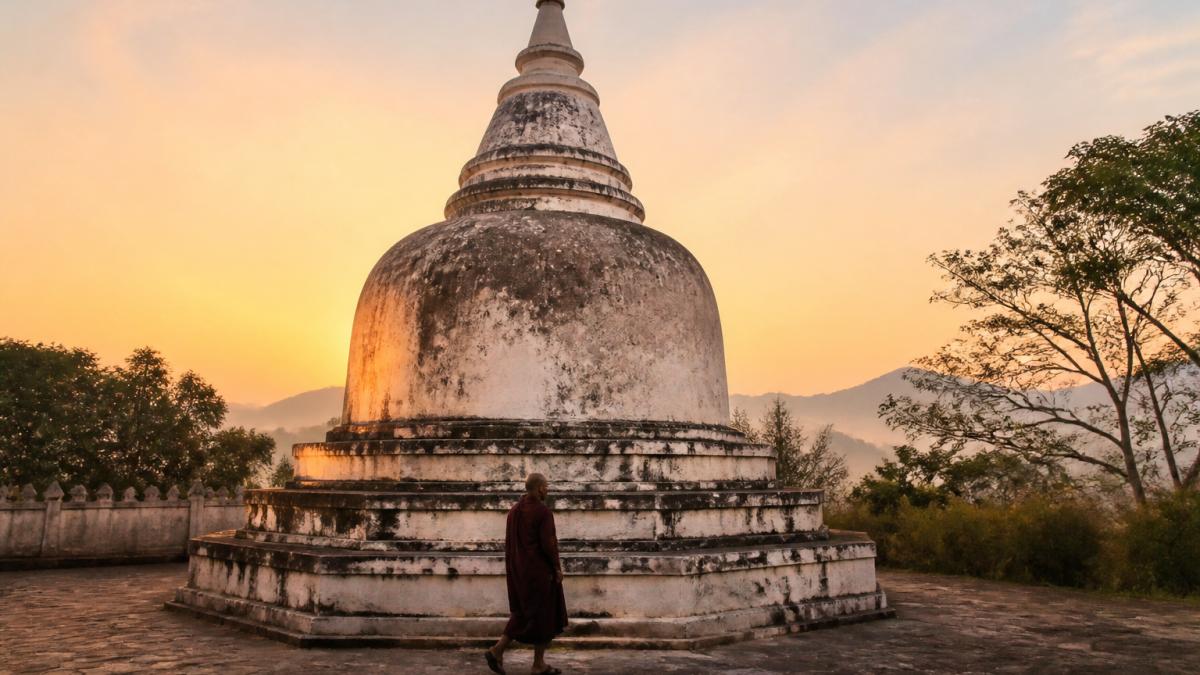
Walking clockwise around a stupa, a practice called circumambulation, mirrors the spiritual path itself: steady, repetitive, and oriented toward awakening. According to UNESCO's World Heritage documentation on Sanchi, the Great Stupa at Sanchi remains one of the best-preserved examples of early Buddhist architecture, with its hemispherical dome and carved gateways still intact.
For collectors, that context matters: a stupa is a reliquary, an architectural form, and a meditation support at once.
Parts of a Buddhist Stupa: A Component-by-Component Guide
A stupa's design breaks into distinct parts, each mapping to a stage on the path to enlightenment. Understanding these components is the fastest way to read any stupa, because proportions and sequence carry as much meaning as ornament.
Read from the ground up, the standard vertical program runs: square base, stepped terraces, drum, dome (anda), harmika, spire (yasti), and crowning finial. Regional traditions rename or reweight these parts, but the upward sequence is consistent.
The Square Base and Stepped Terraces
The square base grounds the structure and represents earth and stability, its four sides facing the cardinal directions. Above it rise stepped terraces, usually three or four, symbolizing the graduated stages of spiritual development, read in many traditions as the four foundations of mindfulness, the four immeasurables, or the progressive stages of the path.
On antique models, the terraces are the most reliable place to read tool marks and wear. Hand-carved stone terraces show slight irregularities in step height and corner alignment that a cast piece rarely reproduces: a hand-cut corner tends to have a subtle chamfer, while a molded corner is uniform to the millimeter.
The Drum and the Dome (Anda)
Above the terraces sits the drum, a short cylindrical or square section that lifts the dome off the base. The dome, or anda (Sanskrit for "egg"), is the egg-shaped or hemispherical mass at the heart of the stupa, traditionally enclosing a reliquary chamber. In Buddhist art the anda represents the cosmos and the vessel of enlightenment; the egg shape also evokes gestation and awakening.
The curvature of the anda is one of the clearest signals of age and craftsmanship. A hand-formed dome has a slightly asymmetric profile against a straight edge; a perfectly symmetrical dome on a small model more often signals a later mold or modern reproduction.
The Harmika
Sitting directly on top of the anda is the harmika, a small square railing or box representing the dwelling place of the gods and, in some readings, the Buddha's seat under the bodhi tree. On Indian stupas it is often plain; on Nepalese stupas it is frequently painted with the eyes of the Buddha.
The Spire (Yasti) and Crowning Finial
The spire, or yasti, rises from the harmika, typically ringed by parasols or chhatras, flat, disc-like tiers representing the Buddha's sovereignty and the levels of the heavens. More rings generally mean a more elaborate monument.
At the top sits the finial, often a lotus bud, sun and moon, or flame. The sun-and-moon finial is especially common in Tibetan and Nepalese work, symbolizing the union of wisdom and method. On antique pieces the finial is frequently the first element lost, so a complete crown is worth noting.
Reading the Proportions
Proportion is where the symbolism becomes measurable. In the classical Indian canon, the anda's height roughly equals the base and terraces combined. Tibetan chortens are taller and narrower, with spire and finial taking a larger share of total height; Nepalese stupas compress the dome and emphasize the harmika and gilded spire. Knowing these ratios lets you place a piece regionally from its silhouette alone.
The Five Elements in Stupa Design
The five elements in stupa design correspond to earth, water, fire, air, and space, each assigned to a specific part of the structure. This is one of the most consistent symbolic systems across Buddhist traditions, giving the stupa its layered reading as a model of the universe.
Here is how the elements map onto the form:
| Element | Stupa Component | Meaning |
|---|---|---|
| Earth | Square base | Foundation and stability |
| Water | Dome (anda) | Fluidity and the cosmos |
| Fire | Conical spire | Transformation and energy |
| Air | Finial and parasol | Movement and liberation |
| Space | The whole form | Boundless awareness |
With this table, you can identify almost any stupa's symbolic program at a glance. The five elements framework also explains why the proportions feel deliberate: each part is sized to hold its place in the sequence.
Types of Buddhist Stupas Across Regions and Traditions
Types of Buddhist stupas vary by region, and the differences tell you where and when a piece was likely made. Comparing the major regional forms turns a vague impression of "old and Asian" into a specific read of proportions, materials, and terminology.
Indian Stupas
The Indian stupa is the ancestor form: a broad hemispherical dome on a low drum, ringed by a processional path and often enclosed by a railing with carved gateways (toranas). The Great Stupa at Sanchi is the canonical example, and its proportions, wide dome, low base, prominent gateways, set the template later traditions modified. In Indian work the dome is the anda and the railing the vedika. Antique Indian stupa models are most often carved in stone, preserving the broad, low silhouette.
Nepalese Stupas
The Nepalese stupa adds a square, painted harmika with the eyes of the Buddha and a prominent, often gilded spire. The dome is typically compressed and the spire tall and richly ornamented, sometimes with metal chhatras. Swayambhunath and Boudhanath are the best-known examples, and their design language, gilded spire, painted harmika, whitewashed dome, carries into portable models. Antique Nepalese pieces are frequently cast in gilt copper or repoussé sheet metal.
Tibetan Chortens
The Tibetan chorten stacks stepped tiers into a bell-shaped body with a tapering crown, the form most often encountered in portable antique models. Chortens fall into eight canonical types, each commemorating an event in the Buddha's life, the Enlightenment chorten, the Miracles chorten, the Parinirvana chorten, and so on. The eight share a basic silhouette but differ in dome shape and tier arrangement, so a knowledgeable eye can often identify which one a piece represents. Antique Tibetan chortens are commonly cast in bronze or gilt copper.
Southeast Asian Stupas
Southeast Asian stupas tend toward slender, bell-shaped silhouettes with elaborate finials, absorbing local architectural conventions. The Burmese form is often a tall bell-shaped stupa with a conical finial, while Thai forms (chedi) tend toward a bell-shaped body on a stepped base with a tall, tapering spire. Materials range from brick and stucco on monumental examples to bronze and silver on small votive models.
A Comparative Design Table
| Region | Dome Shape | Harmika | Spire | Common Antique Materials |
|---|---|---|---|---|
| India | Broad hemisphere | Plain | Low, with chhatras | Stone (schist, sandstone) |
| Nepal | Compressed dome | Square, painted with eyes | Tall, gilded | Gilt copper, repoussé |
| Tibet | Bell-shaped body | Small, tiered | Tapering, with sun-and-moon finial | Bronze, gilt copper |
| Southeast Asia | Slender bell | Often minimal | Tall, conical | Bronze, silver, stucco |
Why Regional Variation Matters for Dating
For collectors, regional variation is the single most useful dating clue. A model mixing, say, a Nepalese gilded spire with an Indian broad dome deserves a closer look, it may be a later composite, a regional hybrid, or a piece made for a cross-cultural market. Materials tell the same story: a bronze chorten with a Nepalese-style gilded spire but a Tibetan bell-shaped body points to the Nepal-Tibet trade routes.
Learn the silhouette first, the terminology second, and the materials third. A collector who can name the region from the silhouette alone is already ahead of most buyers in the room.
How Stupa Symbolism Changes by Tradition and Historical Period
Stupa symbolism shifts with tradition and period, and those shifts are visible in the objects themselves. Early stupas emphasized the relic and the dome. Over time, Mahayana and Vajrayana traditions layered in richer cosmological programs, adding tiered spires, painted surfaces, and elaborate finials.
The result is that two stupas built centuries apart can share a basic form while meaning quite different things. A collector reading a piece should ask which tradition it belongs to before assuming what its symbols represent. According to the Metropolitan Museum of Art's essay on Buddhist art, the stupa's form evolved alongside the spread of Buddhism across Asia, absorbing local architectural and devotional conventions along the way.
That evolution is what makes antique stupas rewarding to study: the form is stable enough to recognize and flexible enough to reward close attention.
Materials, Construction, and What Survives in Antique Pieces
Materials determine what survives, and that shapes the antique market. Stupas have been built and modeled in stone, brick, bronze, gilt copper, wood, and clay. Full-scale monuments were typically brick or stone, while portable stupa models were more often cast in metal or carved in stone.
What lasts is instructive: metal pieces survive with patina and casting detail intact but can lose gilding and finials; stone pieces hold their form but show wear at edges; wooden examples are rare precisely because they deteriorate.
According to the Smithsonian's conservation guidance on Asian art materials, material identification is the foundation of any responsible assessment of an antique object, since condition, stability, and appropriate care all follow from what the piece is made of.
Provenance and material honesty separate a serious piece from a decorative one. At HD Asian Art, we curate both antique and contemporary pieces and describe materials plainly so buyers know what they are acquiring.
Frequently Asked Questions
What does a Buddhist stupa symbolize?
A stupa represents the Buddha's enlightened mind and the path to awakening. Its dome recalls the Buddha's meditation posture, the square base suggests the lion throne, and the spire points toward liberation. In practice, stupa symbolism also marks sacred places and holds relics, making the structure a physical reminder of the Buddha's presence and teachings.
What are the main parts of a Buddhist stupa?
The main parts of a Buddhist stupa are the square base, the stepped terraces, the dome (anda), the square harmika, and the spire topped by a finial or umbrella. Each part carries meaning: the base grounds the structure, the terraces mark stages of the path, the dome holds the reliquary, and the spire rises toward enlightenment.
How does stupa design vary across Buddhist traditions?
Stupa design shifts by region and tradition. Early Indian stupas at Sanchi are hemispherical with stone railings; Nepali stupas feature painted eyes on the harmika; Tibetan examples are taller and bell-shaped with multiple umbrella rings. These variations reflect local materials, climate, and the emphasis each tradition places on stupa meaning and purpose.
What is the purpose of a stupa in Buddhism?
A stupa serves as a reliquary, a meditation focal point, and a site for circumambulation. Practitioners walk clockwise around it while reciting mantras, using the structure to focus the mind. For collectors, an antique stupa carries this same purpose in miniature, bringing a sense of sacred geometry and veneration into a home altar or meditation space.
