



7 Ancient Votive Stupa Discoveries That Rewrote Buddhist History
7 Ancient Votive Stupa Discoveries That Rewrote Buddhist History
Quick Summary
A votive stupa is a miniature stupa commissioned by an individual devotee as an act of merit and deposited at a sacred site rather than built to house a relic. Ancient votive stupa archaeological discoveries, such as two roughly 1,200-year-old miniature stupas reported near the Sarai Tila mound in 2023, reveal who funded these offerings and why.
- A missing umbrella finial is diagnostic evidence of how a votive stupa was assembled, not a disqualifying flaw.
- The Sanchi Museum holds a model based on a votive stupa dated to the 10th century CE, with three of four Buddha reliefs surviving.
- Stamped clay votive tablets and stupas let ordinary devotees sponsor sacred imagery at a scale stone carving never allowed.
- The Sarai Tila miniature stupas were chance finds during landscaping, which limits their stratigraphic context.
- Bandhavgarh researchers proposed a possible 6th- or 7th-century date for structural remains identified as a Buddha stupa.
Table of Contents
- What Ancient Votive Stupa Discoveries Reveal About Buddhist Devotion
- How Archaeologists Identify a Votive Stupa in the Field
- Miniature Votive Stupas: The Small Shrines That Anchor Dating and Provenance
- Clay Votive Tablets and Stupas: Stamped Images and Merit-Making
- Votive Stupa Materials and Construction, From Stone to Clay
- Find Context and Excavation: What the Ground Tells Researchers
- From Excavation to Collection: Provenance and Ethical Stewardship
- Browse Temple-Inspired Pieces for Your Own Meditation Space
- Frequently Asked Questions
What Ancient Votive Stupa Discoveries Reveal About Buddhist Devotion
Ancient votive stupa archaeological discoveries keep producing the same surprise: the smallest objects carry the largest stories. In 2023, the Archaeological Survey of India reported two miniature votive stupas found during landscaping near the Sarai Tila mound, each roughly 1,200 years old, according to NDTV's report on the Nalanda-area find.
A votive stupa is a small-scale stupa commissioned by an individual devotee as an act of merit, deposited at a sacred site rather than built to house a relic. For the full picture, see votive stupas and their religious purpose explained.
Below, we trace seven lines of evidence, from field identification to museum dating, that show what these objects reveal about donors, monasteries, and lay devotion.
How Archaeologists Identify a Votive Stupa in the Field
Identification starts with scale and setting, but the real work is typological. A votive stupa is a miniature stupa, usually compact enough to be carried and placed, and it almost always appears in numbers: rows, clusters, or courtyards around a larger monument. A systematic typology goes further, because shape, base, umbrella, material, and iconography each carry diagnostic weight.
Field criteria researchers apply:
- Size and portability: miniature scale, often with a separately modeled umbrella finial
- Find context: deposits near a main stupa, monastery courtyard, or enclosure wall
- Construction: molded clay, carved stone, or cast metal rather than monumental masonry
A Diagnostic Typology for Comparing Votive Stupas
Use these five axes to compare any two pieces side by side. The pattern of answers, not any single feature, is what separates a votive stupa from a miniature relic shrine or a later souvenir.
| Axis | Diagnostic question | What a votive answer looks like | What a non-votive answer looks like |
|---|---|---|---|
| Form | Is the profile a single molded mass or a stacked assembly? | Compact, often one-piece body with applied finial | Multi-part masonry with functional chambers |
| Base | Is the base stepped, plain, or absent? | Stepped plinth, frequently broken at the join | Deep foundation courses |
| Umbrella | Is the finial separate, integral, or missing? | Separate umbrella, often lost | Integral chatra carved in the round |
| Material | What does the fabric tell you about production? | Molded clay, soft stone, cast metal | Dressed masonry, brick |
| Iconography | Where do Buddha or Bodhisattva figures sit? | Incised or relief figures on the drum | Large freestanding sculpture in niches |
Two cautions follow from the table. First, a missing umbrella is diagnostic, not disqualifying: the join scar itself is evidence of how the object was assembled. Second, iconography placement matters more than iconography count.
Reading Inscriptions and Carved Decoration as Identification Evidence
Inscriptions are the strongest single identifier when present. A short dedicatory line naming a donor, a monastery, or a merit formula confirms votive function outright.
The study of votive stupas as bridges between monastic and non-monastic communities argues that the artwork on these pieces shows devotional stupas linking monastic and lay communities. That is the interpretive payoff: an object small enough to hold documents a religious network.
Field Identification in Practice
In the field, the sequence is consistent. Record the setting first, because a cluster tells you more than a single find. Photograph the base join and the finial scar before any handling. Note the material fabric and any mold seams. Only then read the decoration. This order keeps context ahead of interpretation, which is the difference between an object that supports a chronology and one that supports only a guess.
Miniature Votive Stupas: The Small Shrines That Anchor Dating and Provenance
Miniature votive stupas are the workhorses of stupa chronology. Because they were produced in quantity and often deposited in datable layers, they give researchers a comparative sequence that monumental architecture rarely provides.
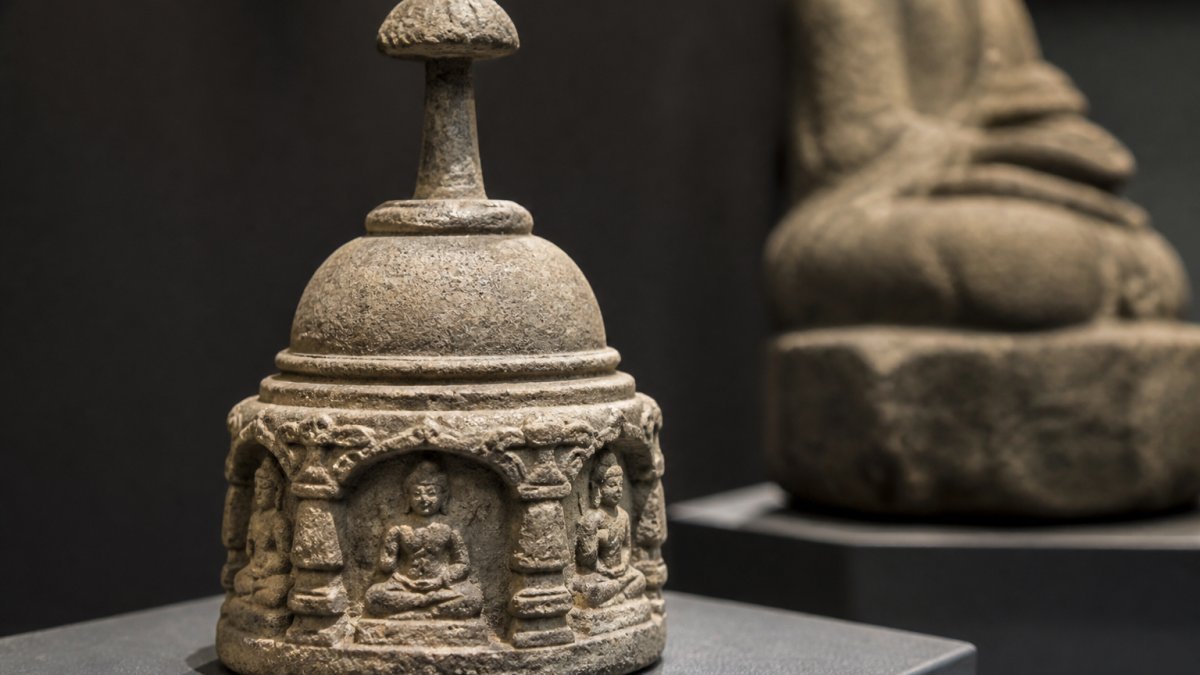
The Sanchi Museum holds a model based on a votive stupa dated to the 10th century CE, originally bearing four Buddha relief images of which three remain, as described in a Sanchi Museum feature on the 3-D stupa model. Note what that single object tells you: a date, a decorative program, and a survival rate. Three of four figures. That is provenance evidence, not decoration.
For collectors, the lesson is blunt. A miniature stupa with intact iconography and documented find context is a different class of object from one with the same silhouette and no history.
Clay Votive Tablets and Stupas: Stamped Images and Merit-Making
Clay votive tablets and stupas are the mass-produced end of Buddhist devotion, and that is precisely why they matter.
The mechanics are simple. A devotee commissions or purchases a molded tablet bearing a Buddha image or a stupa silhouette, deposits it at a shrine, and accrues merit.
What most guides miss is the diagnostic value of the mold itself. Mold families, clay composition, and finishing marks let researchers group tablets by workshop and region, which is how regional variation gets mapped.
Votive Stupa Materials and Construction, From Stone to Clay
Materials follow function. A stupa meant to endure in a monastery courtyard gets carved stone. One meant to be deposited in quantity gets clay.
| Material | Typical Use | What It Signals |
|---|---|---|
| Carved stone | Courtyard and shrine settings | Higher-status donor, durable memorial |
| Molded clay | Mass deposition, merit-making | Lay participation, workshop production |
| Cast metal | Portable shrines, small altars | Wealth, personal devotional use |
| Mixed construction | Base plus separate finial | Repair history, later reassembly |
Construction details carry diagnostic weight. A separately fitted umbrella, a stepped base, and pilaster reliefs on the drum all point to specific regional workshops.
If you want to read stupa form more closely, our guide to stupa symbolism and design walks through the components and what each one represents.
Find Context and Excavation: What the Ground Tells Researchers
Context converts an object into evidence. A stupa pulled from a datable deposit supports a chronology. The same stupa without a find record supports nothing but a guess. Most guides stop at that principle. The useful version separates two dates that are routinely confused: when an object was excavated, and when the object was made.
A Comparative Timeline: Excavation Dates vs. Object Dates
The table below organizes well-documented finds by excavation or discovery date, then places the object's estimated date beside it. The gap between the columns is the point.
| Site or find | Excavation or discovery date | Object's estimated date | Context quality |
|---|---|---|---|
| Sanchi, votive stupa model now in the Sanchi Museum | Museum documentation, 20th century | 10th century CE | Museum accession with published description |
| Sarai Tila mound, Nalanda area | 2023, during landscaping | Roughly 1,200 years old | Chance find, limited stratigraphic control |
| Bandhavgarh structural remains | Documented in published study | Proposed 6th or 7th century CE | Structural identification, date proposed not confirmed |
Read the table as a warning about precision. A 2023 discovery date says nothing about age. A 10th-century attribution says nothing about when the object entered a collection. Only the context column tells you how much weight the date can bear.
A Gazetteer of Discovery Settings
Finds cluster in a small number of setting types, and the setting predicts what researchers can learn.
- Monastic courtyards and enclosure walls: rows and clusters of deposited offerings, the richest context for studying lay participation
- Around a main stupa: circumambulation deposits that show devotional practice in sequence
- Chance finds during landscaping or construction: confirm a site's extent but rarely preserve stratigraphy
Two recent examples show the range. The Sarai Tila miniature stupas came to light during landscaping, not a planned excavation, which limits their contextual value even as it confirms the site's extent. At Bandhavgarh, researchers documented structural remains identified as a Buddha stupa and proposed a possible 6th- or 7th-century date, per the published study of the Bandhavgarh stupa remains.
Excavation Methods and What Surrounding Deposits Reveal
How a stupa is documented determines what it can prove. The standard sequence is surface survey, then controlled excavation in measured units, then stratigraphic recording of each layer, then photography and drawing of the object in place before removal.
Surrounding deposits carry much of the interpretive weight. Ash layers, broken offerings, and repeated deposition episodes show use over time. A cluster of identical molded pieces points to workshop production and organized donation.
From Excavation to Collection: Provenance and Ethical Stewardship
Provenance is the chain of custody, and for Buddhist antiquities it is the single most important document an object can carry. Our guide on how to verify provenance for Buddhist antiquities walks through the practical steps. A find report, an excavation record, a museum accession, a published catalogue entry: each link strengthens the case.
What a serious buyer should ask for:
- A documented find location or site name
- Publication history, even a brief catalogue mention
- Prior ownership records with dates
Conservation matters too: cleaning and restoration decisions should preserve evidence, not erase it.
Browse Temple-Inspired Pieces for Your Own Meditation Space
Not every reader is excavating a site. Many want the same quality of form in their own practice space.
HD Asian Art curates Buddhist and Hindu statues alongside Khmer and Southeast Asian sculpture, with handpicked antique and contemporary pieces suited to altars, meditation corners, and refined interiors.
If you are building that space from scratch, our complete guide to setting up a Buddhist altar at home covers placement and proportion.
Frequently Asked Questions
What is an ancient votive stupa?
An ancient votive stupa is a small devotional structure built by lay donors to earn merit, rather than to house relics. They range from miniature stone models to clay tablets stamped with Buddha images. Recent reporting describes two miniature votive stupas found near the Sarai Tila mound as approximately 1,200 years old, while a Bandhavgarh study proposes a 6th- or 7th-century date for structural remains identified as a Buddha stupa.
What materials were ancient votive stupas made from?
Most surviving examples are stone, carved with relief panels and pilasters, or fired clay formed as tablets and miniature models. Votive stupa materials and construction vary by region and period: stone examples often show incised Buddha figures and an umbrella finial, while clay versions were stamped from molds and produced in quantity. The Sanchi Museum model dated to the 10th century CE is stone and originally carried four Buddha relief images, of which three remain.
How do archaeologists identify a votive stupa?
Researchers look at scale, placement, and decoration. A votive stupa is usually small, built near a monastery courtyard or enclosure, and marked by carved Buddha figures, inscriptions naming donors, or stamped clay tablets. The Bandhavgarh study identified structural remains as a Buddha stupa through architectural form and associated sculpture. Find context matters too: devotional stupas placed outside monastic compounds suggest use by non-monastic communities.
Where have miniature votive stupas been discovered?
Miniature votive stupas have been reported from monastic and pilgrimage sites across South Asia. The Archaeological Survey of India found two during landscaping near the Sarai Tila mound, and researchers documented structural remains at Bandhavgarh. Museum collections, including a Sanchi Museum model dated to the 10th century CE, preserve further examples. Excavation records and find context remain the strongest evidence for dating and attribution.
The gap between a museum plinth and your meditation corner is smaller than it looks. Both depend on knowing what you are looking at. Browse the HD Asian Art collection to find a stupa or Buddha figure with the form, material, and presence that fit your space, and bring a piece of that 1,200-year devotional tradition into daily practice.

