


What Is Asian Religious Art: A Complete Guide
What Is Asian Religious Art: A Complete Guide
Asian religious art is defined as the artistic expression of spiritual beliefs and practices across Asia’s major faith traditions, including Buddhism, Hinduism, Jainism, Islam, and Christianity. These works appear as sculptures, paintings, temple architecture, and ritual objects, each carrying precise symbolic meaning.
The category spans more than 2,500 years of continuous production across dozens of cultures. Understanding what is Asian religious art means recognizing that these objects were never purely decorative. They were made to teach, to focus the mind, and to connect the viewer with something beyond the visible world.
How did Asian religious art originate and develop?
Buddhist art originated in the northern Indian subcontinent shortly after Siddhartha Gautama’s death in the 6th to 5th century BCE. That starting point makes Buddhist sacred art one of the oldest continuously practiced visual traditions on earth.
The art spread rapidly along the Silk Road, adapting to each new culture it encountered. Greco-Roman sculptural conventions, absorbed through the Gandhara region of present-day Pakistan and Afghanistan, gave early Buddha images their draped robes and naturalistic facial features. Without that contact, the serene, classically proportioned Buddha face familiar today would look very different.
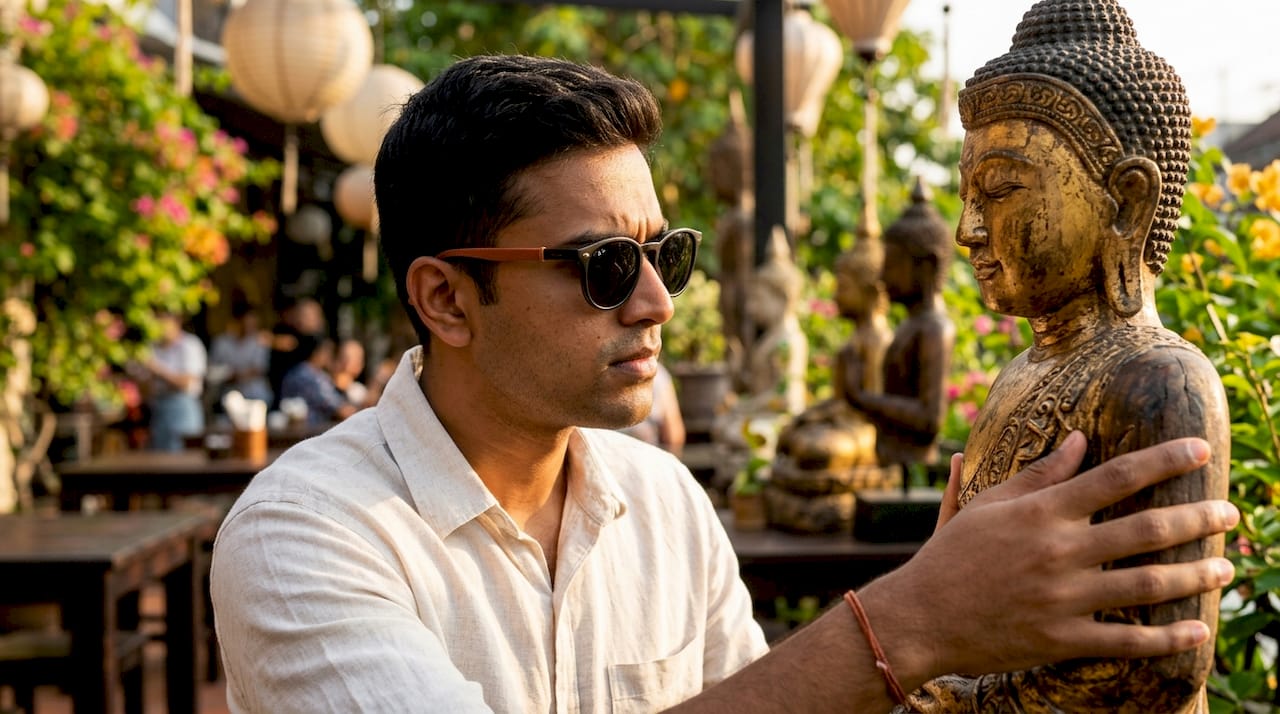
Hindu and Jain sacred art developed alongside Buddhist traditions, often within the same geography. Buddhist, Hindu, and Jain art co-developed in Indian cave temple complexes, producing stylistic cross-influences unique to each host region. Ajanta and Ellora in Maharashtra are the clearest examples: Buddhist, Hindu, and Jain shrines carved into the same cliff face, each borrowing compositional ideas from the others.
Two major branches of Buddhism shaped distinct artistic lineages. Theravada Buddhism, dominant in Sri Lanka, Thailand, Cambodia, and Myanmar, favored restrained, highly idealized Buddha figures. Mahayana and Vajrayana traditions, spreading into China, Japan, Korea, and Tibet, generated far more complex iconographic systems, including the bodhisattva pantheon and elaborate mandala compositions.
- 6th–5th century BCE: Buddhist art emerges in northern India after the death of the historical Buddha
- 3rd century BCE: Emperor Ashoka’s patronage spreads Buddhist imagery across the Indian subcontinent
- 1st–3rd century CE: Gandhara school absorbs Greco-Roman influence, producing the first anthropomorphic Buddha images
- 4th–7th century CE: Mahayana Buddhism carries new iconography into Central Asia, China, and Korea
- 7th–14th century CE: Vajrayana traditions develop in Tibet; Hindu temple sculpture reaches its classical peak in India and Southeast Asia
Pro Tip: When dating a piece of Asian sacred art, look at the treatment of the ushnisha (the cranial protuberance on Buddha figures). Its shape and size shifted significantly across periods and regions, making it one of the most reliable stylistic markers for attribution.
What are the key symbolic elements in Asian religious art?
Asian religious art operates as a visual language. Every gesture, color, and material choice carries meaning that a trained viewer can read as precisely as written text.
Buddhist iconography is the most codified system. Buddhist art includes depictions of the Buddha, bodhisattvas, and symbolic elements like mudras and mandalas representing core teachings such as the Noble Truths and the Eightfold Path. Each figure carries distinctive physical features, gestures, and attributes that identify it without any written label.
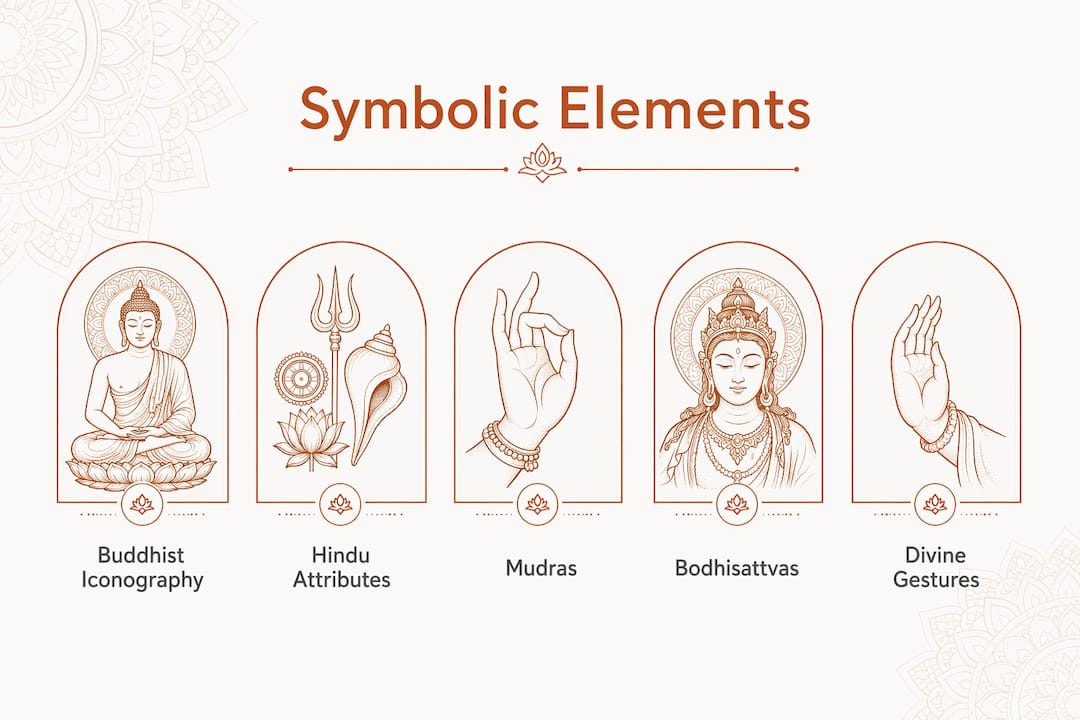
Mahayana Buddhism expanded this system dramatically. Mahayana traditions elevated bodhisattvas in art, and Vajrayana traditions introduced complex iconographies such as the five Dhyani Buddhas, each representing a different spiritual aspect, direction, color, and mudra. A single Tibetan thangka painting can contain dozens of identifiable figures, each placed in a precise cosmological position.
Hindu sacred art centers on the divine attributes of specific deities. Ganesha carries a broken tusk and a bowl of sweets, signaling his role as remover of obstacles and lord of beginnings. Shiva appears as Nataraja, dancing within a ring of fire that represents the cycle of creation and destruction. Temple carvings in the Hoysala and Chola styles depict entire episodes from the Ramayana and Mahabharata in stone, functioning as illustrated scripture for worshippers who could not read.
Islamic religious art in Asia takes a different path. Islamic calligraphy guidelines recommend the Naskh script for Quranic verses because of its clarity, while the Diwani script suits decorative or celebratory contexts. This distinction matters because the script itself is the sacred image. There are no figurative representations of the divine in orthodox Islamic art. The word carries the full spiritual weight.
The following elements appear most consistently across Asian sacred art traditions:
- Mudras: Hand gestures in Buddhist and Hindu art that communicate specific teachings or divine states. The Bhumisparsha mudra (earth-touching gesture) marks the moment of the Buddha’s enlightenment.
- Mandalas: Geometric diagrams representing the cosmos, used in Vajrayana Buddhism as meditation tools and ritual objects.
- Aureoles and halos: Radiating light forms behind sacred figures, indicating divine energy across Buddhist, Hindu, and Asian Christian art.
- Sacred animals: The lotus (purity), the naga serpent (protection and water), the Garuda bird (solar power), and the elephant (wisdom and royal authority) appear across multiple traditions.
- Color coding: In Vajrayana Buddhism, specific colors identify each Dhyani Buddha. Blue represents Akshobhya; yellow represents Ratnasambhava. Color is never arbitrary.
Pro Tip: Learning to read mudras takes about an hour with a reference guide. Once you recognize the five most common gestures, you can identify the primary teaching or narrative moment depicted in almost any Buddhist sculpture without reading a label.
How does Asian religious art vary by region and tradition?
Geography shapes sacred art as powerfully as theology does. The same Buddhist concept of compassion produces a slender, gilded bronze Avalokiteshvara in Thailand and a multi-armed, jewel-encrusted Guanyin in China. Both are correct. Both are complete.
The table below shows how major traditions express their sacred art across key regions.
| Tradition | Region | Characteristic style |
|---|---|---|
| Theravada Buddhism | Thailand, Sri Lanka, Cambodia | Idealized, gilded bronze Buddhas; restrained iconography |
| Mahayana Buddhism | China, Japan, Korea | Complex bodhisattva figures; lacquer, wood, and gilt bronze |
| Vajrayana Buddhism | Tibet, Nepal | Thangka paintings; multi-armed deities; rich symbolic color |
| Hindu temple art | India, Indonesia, Cambodia | Stone carvings; narrative friezes; deity sculpture in bronze and stone |
| Islamic calligraphy art | Central Asia, South Asia | Geometric patterns; Naskh and Kufic scripts; no figurative imagery |
| Asian Christian art | Philippines, South Korea, India | European imagery blended with local ethnic characteristics |
Sri Lankan Buddhist sculpture developed its own refined canon, with elongated figures and a distinctive flame-shaped ushnisha. Vietnamese Buddhist art absorbed both Chinese Mahayana and Theravada influences, producing a hybrid style found nowhere else. Cambodian Khmer art, centered on Angkor Wat, merged Hindu and Buddhist iconography within a single monument, reflecting the political and religious transitions of the Khmer Empire.
Japanese Buddhist art introduced the wabi-sabi aesthetic into sacred objects. The concept of wabi-sabi values imperfection and impermanence, treating weathered stone and worn finishes as spiritual testimony rather than damage. This directly contradicts Western conservation instincts, which favor restoration to original condition.
Why does Asian religious art still matter today?
Asian sacred art functions as a tool for meditation and devotion, not just a historical artifact. Asian religious art serves as a visual meditation portal, where each gesture, pose, and material choice conveys symbolism intended to facilitate spiritual experience. That function has not changed in 2,500 years.
Modern Buddhist art continues this living tradition. Modern Buddhist art emerged in the mid-20th century in countries like Japan, China, and Thailand, combining traditional iconography with contemporary artistic approaches to emphasize spiritual and meditative themes. The tradition adapts without losing its core purpose.
Gifting and display practices carry their own cultural weight. Respectful display of Asian religious art requires understanding cultural and spiritual norms, such as avoiding placement of sacred objects on floors and seeking specialist review for Quranic verse art to avoid errors in dots and spacing. These are not minor courtesies. They reflect the belief that the object itself holds sacred energy.
Collectors and spiritual seekers today engage with Asian sacred art through several distinct practices:
- Meditation focal points: A bronze Buddha or bodhisattva statue placed at eye level in a dedicated space supports consistent meditation practice by providing a stable visual anchor.
- Cultural identity: For diaspora communities across Southeast Asia and South Asia, owning traditional sacred art maintains a living connection to ancestral religious practice.
- Scholarly study: Art historians use iconographic analysis to trace trade routes, religious conversions, and political patronage across centuries.
- Gifting: Symbolic jewelry and sacred objects make meaningful gifts when the recipient understands the symbolism. Symbolic objects as gifts carry layered meaning that generic gifts cannot replicate.
- Spatial energy: The spiritual energy of Asian sculpture in a living or working space is a recognized concept in Buddhist and Hindu traditions, not a modern marketing idea.
Key Takeaways
Asian religious art is a living visual language, not a historical artifact, and understanding its symbols, origins, and regional variations is the foundation for genuine appreciation.
| Point | Details |
|---|---|
| Clear definition | Asian religious art covers Buddhist, Hindu, Jain, Islamic, and Christian traditions across Asia. |
| Historical depth | Buddhist sacred art began in the 6th–5th century BCE and spread via the Silk Road with regional adaptations. |
| Symbolic precision | Every mudra, color, and figure in Asian sacred art carries a specific, readable meaning. |
| Regional variation | The same tradition produces distinct styles in Thailand, Tibet, China, Japan, and Sri Lanka. |
| Living tradition | Modern Buddhist art and respectful gifting practices show that Asian sacred art remains active, not archival. |
What working with Asian religious art has taught me
People often approach Asian religious art the way they approach decorative objects: they ask whether it looks good in a room. That question misses the point entirely. These works were made to do something specific. A Cambodian Avalokiteshvara was not carved to fill a shelf. It was carved to embody compassion in a form the human eye could hold.
The most common mistake I see is treating iconographic complexity as a barrier. Readers assume they need years of study before they can engage meaningfully with a bodhisattva figure or a Hindu temple carving. They do not. Learning five mudras and the basic attributes of three or four major deities gives you enough to read most works you will encounter. The role of Avalokiteshvara in Buddhist art is a good starting point because that figure appears across nearly every Buddhist tradition in Asia.
The wabi-sabi principle is the insight that most surprises Western collectors. A worn bronze with a green patina is not a damaged object. It is an object that has been used, prayed over, and carried through time. That history is part of its meaning. Stripping it away in the name of restoration removes exactly what makes the piece worth owning.
My practical advice for anyone new to Asian sacred art: start with one tradition, learn its visual grammar, and then look at how neighboring traditions borrowed and adapted the same ideas. The cross-pollination between Buddhist, Hindu, and Jain art in Indian cave temples is one of the most fascinating stories in art history, and it becomes visible the moment you know what to look for.
— James, HDAsianArt.com
Authentic Asian religious sculptures at HDAsianArt
HDAsianArt specializes in antique and traditional Buddhist and Hindu sculptures sourced from Cambodia, Thailand, Indonesia, Sri Lanka, Vietnam, and beyond. Each piece is individually researched and described by experts, with worldwide insured DHL shipping.
The collection includes museum-quality bronze and stone works that embody the symbolic traditions covered in this article. The Javanese Avalokiteshvara bodhisattva statue and the seated Javanese preaching Buddha are two strong starting points for collectors seeking works with documented iconographic significance. Every sculpture in the HDAsianArt catalog is selected for craftsmanship, spiritual symbolism, and long-term collectability.
FAQ
What is Asian religious art in simple terms?
Asian religious art is any visual work created to express, teach, or support the spiritual practices of Asia’s major faiths, including Buddhism, Hinduism, Jainism, Islam, and Christianity. It includes sculptures, paintings, temple carvings, and ritual objects.
What are the main types of Asian religious art?
The main types include Buddhist sculpture and thangka painting, Hindu temple carvings and bronze deity figures, Islamic calligraphy, Jain manuscript illustration, and Asian Christian devotional painting. Each type uses a distinct visual language tied to its theological tradition.
How do mudras work in Buddhist and Hindu art?
Mudras are hand gestures that communicate specific teachings or divine states. In Buddhist art, the earth-touching mudra marks the Buddha’s enlightenment, while the teaching mudra indicates the first sermon. Each gesture has a fixed meaning readable across cultures.
Is Asian religious art still produced today?
Modern Buddhist art emerged in the mid-20th century in Japan, China, and Thailand, combining traditional iconography with contemporary techniques. The tradition remains active across Asia, with living artists producing works for temples, meditation centers, and private collectors.
How should Asian religious art be displayed respectfully?
Sacred objects should not be placed on the floor. Buddhist and Hindu figures are traditionally positioned at or above eye level. For Islamic calligraphy featuring Quranic verses, specialist review is advised to verify accuracy in script dots and spacing before display or gifting.
