



What Does a Serene Buddha Face Convey?
What Does a Serene Buddha Face Convey?
The serene Buddha face is defined as a visual symbol of stable, awakened consciousness expressed through precise artistic choices in Buddhist sculpture and painting. This expression, found across Cambodian bronze, Thai stone, and Tibetan gilded works, is not a casual smile or a look of relaxation.
The half-closed eyes and faint upward curve of the lips are deliberate. Together, they communicate meditation, compassion, and a mind fully awake to reality. Understanding what this expression conveys transforms how you see every Buddha statue, from museum collections to private altars.
What does a serene buddha face convey in buddhist art?
The serene Buddha face conveys awakened equilibrium, not ordinary human happiness. According to Tibetan artistic tradition, the face is not smiling socially. The expression is calibrated to signal one clear message: “Wake up,” not “Relax.” That distinction matters enormously for anyone studying Buddhist iconography.
The technical term for this quality in Buddhist art is mudita combined with upekkha, meaning compassionate joy held within equanimity. Artists working in the Tibetan, Theravada, and Mahayana traditions each interpret this balance differently, but the underlying intention is consistent. The face must hold two states at once: deep inward stillness and open outward awareness.
This is why the serene expression reads as serious rather than cheerful. A social smile engages one person with another. The Buddha’s expression engages every viewer with their own potential for awakening. That shift in direction is the core of Buddha face symbolism across all major traditions.
How do specific facial features carry symbolic meaning?
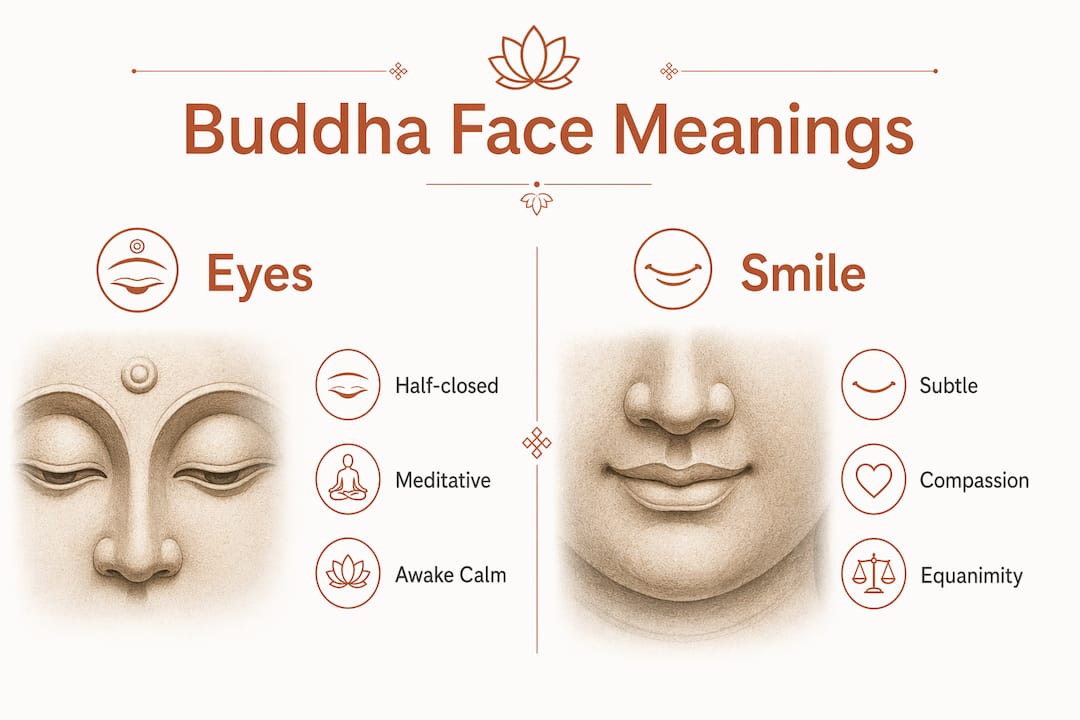
Each element of the serene Buddha face carries a specific, intentional meaning. Nothing is decorative for its own sake.
- The eyes. Half-closed eyes symbolize a meditative state that maintains awareness of the outer world without being pulled into it. The gaze is lowered, not shut. This communicates presence within the world alongside inward focus. A fully closed eye would suggest withdrawal. A fully open eye would suggest ordinary alertness. The half-lowered position holds both.
- The smile. The mouth carries a faint suggestion of a smile that expresses compassionate equilibrium rather than joy or indifference. This is not the broad smile of pleasure or the tight line of severity. It sits precisely between both, signaling a mind that sees clearly and responds with warmth.
- The gaze direction. The stable, non-dramatic downward gaze signals awakening, not passivity. It is an active state of awareness directed inward and outward simultaneously.
- The overall expression. The face as a whole avoids any single strong emotion. Surprise, grief, excitement, and contentment are all absent. What remains is a composed, steady presence that Buddhist teachers describe as the natural state of an unobstructed mind.
Pro Tip: When examining a Buddha statue, cover the lower half of the face and study the eyes alone, then cover the eyes and study the mouth alone. Each element should communicate the same quality of calm. If they conflict, the piece may lack the artistic precision that authentic works require.
The interpretation of Buddha expressions in this tradition is never accidental. Every millimeter of the sculpted or painted face carries weight.
How do artisans achieve this precise serenity?
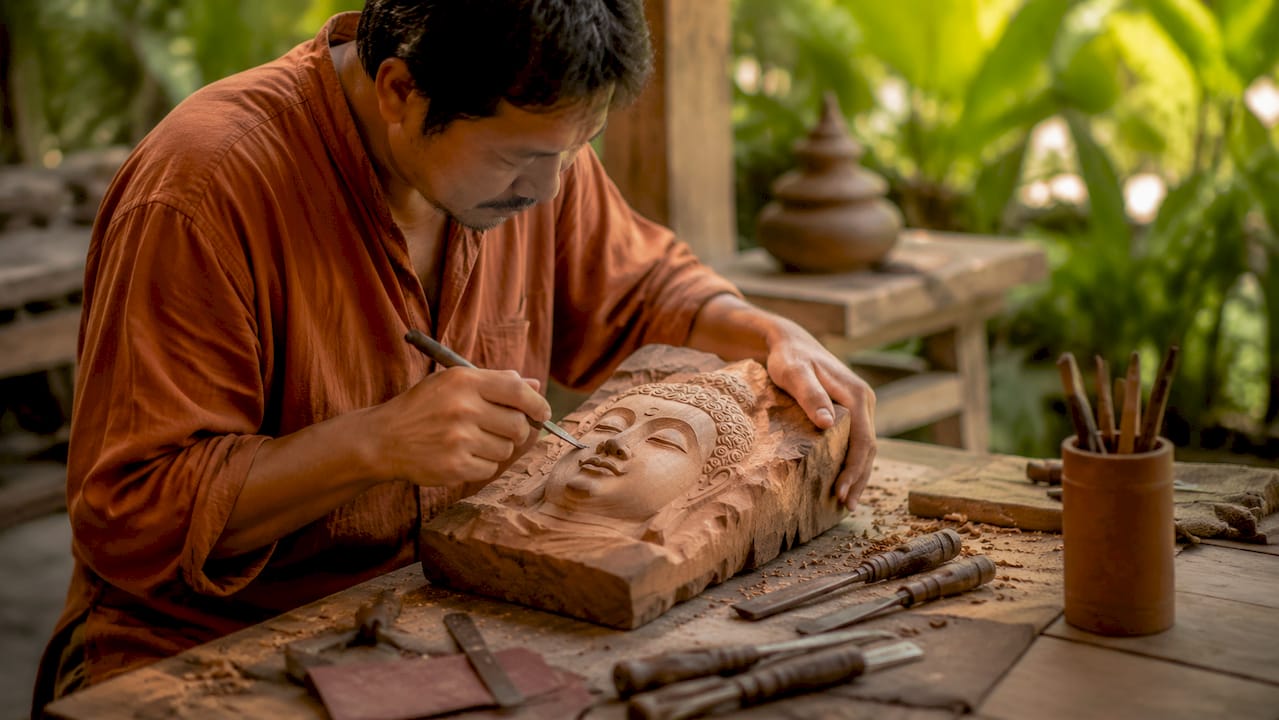
The serene expression in Buddhist art is the result of extraordinary technical discipline. Master painters repaint the lips up to four times during the creation of a single statue, because small changes in the curve or thickness of the lips shift the entire mood of the face. A slightly fuller lower lip reads as sentimental. A straighter line reads as severe. The correct position holds neither quality.
Sculptors working in stone, bronze, or wood follow a similar process of refinement:
- Establish proportions first. The Sarnath school, for example, uses mathematical ratios to set the distance between eyes, the width of the nose, and the height of the forehead before any expressive detail is added. These proportions create the structural foundation for serenity.
- Carve or model the neutral base. The face begins without expression. Artisans then add the subtle curves that define the eyes and mouth, working from the neutral state outward rather than trying to reduce an exaggerated expression.
- Test the expression under different light conditions. Candlelight, daylight, and shadow each reveal different aspects of the carved surface. A face that appears serene in bright light may look severe in low light if the proportions are slightly off.
- Refine the lips last. The mouth is the final element adjusted, because it is the most sensitive indicator of mood. This is why antique Thai Buddha images from different periods show subtle but meaningful differences in lip treatment.
Regional styles also shape the final result. Tibetan artisans work within strict iconometric grids derived from classical texts. Thai sculptors favor a slightly more elongated face with a more pronounced upward curve at the mouth corners. Khmer work from Cambodia tends toward a broader, more symmetrical face with a flatter smile. Each regional approach produces a distinct visual character while pursuing the same spiritual goal.
How does serenity differ across buddhist art traditions?
Serenity in Buddha art is a shared goal expressed through different visual languages. The Sarnath Buddha’s expression exemplifies perfect harmony between inward focus and outward presence, with eyes cast slightly downward and a face that holds the viewer without engaging them in ordinary social exchange.
The table below summarizes how key traditions approach the serene expression:
| Tradition / Region | Eye Treatment | Smile Quality | Overall Expression |
|---|---|---|---|
| Sarnath (India) | Slightly downward, half-closed | Minimal, inward | Inward serenity, mathematical harmony |
| Gandhara (Pakistan/Afghanistan) | More naturalistic, open | Subtle, classical | Naturalistic calm, Hellenistic influence |
| Mathura (India) | Direct, assertive | Stronger curve | Assertive presence, confident awakening |
| Amaravati (India) | Soft, devotional | Gentle, warm | Gentle devotional quality |
| Tibetan | Precisely lowered, iconometric | Calibrated equilibrium | Formal, spiritually precise |
| Thai (Sukhothai/Ayutthaya) | Elongated, downcast | Upturned corners | Graceful, idealized serenity |
| Khmer (Cambodia) | Broad, symmetrical | Flat, wide | Monumental, composed stillness |
Regional artistic nuances across Sri Lanka, Burma, and Java show similar patterns. Each culture adapts the visual vocabulary to its own aesthetic while preserving the core symbolic content. The Theravada sculptural tradition emphasizes restraint and precision. The Mahayana tradition often introduces more expressive warmth, particularly in bodhisattva figures. Both share the fundamental goal of depicting a mind free from agitation.
What does the serene expression invite you to cultivate?
The serene Buddha face functions as more than a subject of art history. It is a practical tool for contemplation. Buddha statues act as mirrors and supports for contemplation, reminding viewers of their own potential for awakening. The face does not demand worship. It offers a reference point.
Here is what the expression specifically invites:
- Mindfulness. The half-closed eyes model the quality of attention that meditation teachers describe as “present but not grasping.” You observe without being pulled into reaction.
- Compassion without sentimentality. The faint smile models warmth that does not collapse into pity or preference. This is the quality Buddhist practice calls karuna, compassion that remains stable under pressure.
- Equanimity. The overall expression models a mind that is not moved by pleasure or pain into exaggerated response. This is not indifference. It is stability.
- Self-recognition. A well-made Buddha head statue, even separated from the body, embodies awakening through its expression of wisdom and compassion. The face reflects back what is possible in any human mind.
Daily offerings to Buddha statues serve not as worship but as reminders to reset direction for the day. The gesture of pausing before the statue, noting its expression, and aligning your own state with what you see is a practical mindfulness exercise available to anyone.
Pro Tip: Place a Buddha statue at eye level rather than on the floor or on a very high shelf. Direct eye-level contact with the expression is what activates its function as a contemplative reference point. Too high and you look up in deference; too low and you look down in ownership. Eye level creates dialogue.
Understanding this transforms how you engage with Buddhist art. The serene face is not decoration. It is a communication.
Key takeaways
The serene Buddha face conveys stable, awakened consciousness through precise artistic choices in eye position, lip curve, and overall expression that together signal meditation, compassion, and equanimity.
| Point | Details |
|---|---|
| Not a social smile | The expression signals awakening, not relaxation, through a calibrated, non-dramatic gaze. |
| Eyes carry dual meaning | Half-closed eyes communicate simultaneous inward meditation and outward compassionate awareness. |
| Artisanal precision matters | Master painters repaint lips up to four times to hold the exact balance between sentimental and severe. |
| Regional styles share one goal | Sarnath, Gandhara, Tibetan, and Thai traditions each express serenity differently but pursue the same awakened quality. |
| A contemplative tool, not an idol | The serene face invites mindfulness and self-recognition, functioning as a daily reference point for inner practice. |
What i have learned from years with these faces
The first time I handled a masterpiece Khmer bronze Buddha head, I expected to feel the weight of the metal. What I did not expect was the weight of the expression. The face stopped me. Not because it was beautiful, though it was. Because it was serious in a way I had not encountered before in art.
Most art communicates emotion outward. This face communicated something inward, toward me, and also past me. I have spent years since then trying to articulate what that quality is. The research and the tradition give us the vocabulary: equanimity, compassion, awakening. But those words only become real when you sit with a well-made piece long enough to feel what the artisan was reaching for.
What I have found is that the quality of the expression depends almost entirely on the precision of the craftwork. A face that is slightly too cheerful reads as naive. A face that is slightly too stern reads as cold. The genuine article holds a tension between those poles that you feel before you can name it. That tension is the result of the repeated refinements described in Tibetan iconometric tradition, the four rounds of lip repainting, the mathematical proportions, the testing under different light.
My honest view is that most people who buy Buddha statues for their homes underestimate this. They focus on size, material, and provenance. Those matter. But the face is the piece. A statue with a mediocre expression is a missed opportunity, regardless of how old or rare it is. When you find a piece where the expression is exactly right, you know it immediately. You do not need to be a scholar. The face tells you.
— James, HDAsianArt.com
Authentic buddha statues at HDAsianArt
HDAsianArt offers a curated collection of antique and traditional Buddhist statues from Cambodia, Thailand, Sri Lanka, Indonesia, and beyond. Each piece is individually researched and photographed, with expert descriptions covering the artistic tradition, iconographic details, and condition.
If the symbolism explored in this article resonates with you, the collection at HDAsianArt is a direct way to engage with it at the level of physical objects. Every piece in the catalog reflects the craftsmanship standards discussed here, from the precision of the facial expression to the quality of the bronze or stone. Worldwide insured shipping is available through DHL, and the focus throughout is on museum-quality work with genuine spiritual and collectible value.
FAQ
What does the serene buddha face convey spiritually?
The serene Buddha face conveys stable awakened consciousness, communicating meditation, compassion, and equanimity through precise artistic choices in eye position and lip curve. It is not a social expression but a symbol of a mind fully awake and free from agitation.
What does the buddha’s subtle smile mean?
The Buddha’s faint smile signifies compassionate equilibrium rather than joy or indifference. It is calibrated to sit precisely between sentimentality and severity, expressing warmth without emotional excess.
Why are buddha’s eyes half-closed in statues?
Half-closed eyes in Buddha statues symbolize a meditative state that maintains awareness of the outer world without entanglement in it. The lowered gaze communicates simultaneous inward focus and outward compassionate presence.
Do buddha statues differ in expression across regions?
Yes. The Sarnath Buddha emphasizes inward serenity through mathematical proportions, while Gandhara Buddhas show naturalistic calm and Thai Sukhothai Buddhas display a more graceful, idealized expression. All traditions share the goal of depicting awakened equilibrium.
Is a buddha statue considered an idol for worship?
Buddhist tradition treats statues as contemplative tools rather than idols. Daily engagement with a Buddha statue serves as a reminder to realign the mind, not as an act of worship directed at the object itself.
