



The Role of Facial Expression in Buddhist Statues
Buddhist statues are often described as serene or peaceful, and that description is not wrong. But it barely scratches the surface. The role of facial expression in Buddhist statues, known more formally in art history as Buddhist iconography, goes far beyond a calm face. Each feature, from the position of the eyelids to the angle of the lips, carries a specific spiritual meaning that was carefully codified by artists and monks across centuries and cultures. What looks like simple stillness is, in practice, a visual doctrine. This article unpacks exactly what those expressions communicate and why they matter to anyone studying or collecting Buddhist art.
Table of Contents
- Key takeaways
- The role of facial expression in Buddhist statues: a historical view
- Symbolic meaning behind the Buddha’s facial features
- Differences between Buddha and Bodhisattva expressions
- Psychological and cultural impact of these expressions
- How to read and choose statues by facial expression
- My take: why these faces deserve more than a glance
- Explore authentic Buddhist statues at Hdasianart
- FAQ
Key takeaways
| Point | Details |
|---|---|
| Expressions carry doctrine | Every facial feature on a Buddhist statue follows established iconographic rules with specific spiritual meaning. |
| Eyes signal awareness | Half-closed eyes represent non-dual awareness, balancing inner meditation with outer presence. |
| Buddha vs. Bodhisattva differ | Buddhas show detached serenity; Bodhisattvas display warmer, more expressive compassion. |
| History shapes the face | Regional and period styles, from Northern Wei China to Khmer Cambodia, produced distinct facial conventions. |
| Expressions affect viewers | Subtle facial cues create measurable psychological effects including trust and calm in the viewer. |
The role of facial expression in Buddhist statues: a historical view
Buddhist art did not begin with faces at all. For the first several centuries after the Buddha’s death, around 500 BCE, artists at sites like Sanchi and Bharhut avoided depicting him in human form entirely. An empty throne, a pair of footprints, or a Bodhi tree stood in for his presence. These aniconic conventions reflected a theological position: the Buddha had passed beyond ordinary existence, so depicting him with a human face felt inappropriate, even limiting.
That changed gradually as Greek influence spread into the Indian subcontinent through the Gandharan region, in what is now Pakistan and Afghanistan. Hellenistic sculptors brought with them a tradition of idealized human portraiture. The result was the first anthropomorphic Buddha faces, combining Indian spiritual conventions with Greco-Roman facial naturalism. Expressions became a tool, not just a detail.
The technical complexity of early monumental statues is easy to overlook. The Bamiyan Buddhas in Afghanistan, carved into cliffsides in the 6th century CE, used composite construction methods: the stone base provided the body’s structure, while separate applied masks or painted plaster layers created the actual facial expression. When those surface layers eroded or were destroyed, the face appeared blank. What we see today as a featureless form was never meant to be viewed that way.
As Buddhism spread across Asia, regional traditions developed their own conventions:
- India (Gupta period, 4th to 6th century CE): Smooth, idealized faces with a faint inner smile, emphasizing spiritual perfection.
- China (Northern Wei dynasty, 386 to 534 CE): A “gentle smile” that conveyed human-like warmth and imperfection, distinct from the rigid solemnity of earlier styles. A 1,500-year-old fragment at the Luoyang Museum typifies this approach.
- Southeast Asia (Khmer, 9th to 13th century CE): Broad, full faces with strong brows and a subtle upward curve to the lips, projecting royal authority fused with spiritual calm.
- Japan (Nara and Heian periods): Highly refined, often elongated faces emphasizing ethereal refinement over earthy warmth.
| Region | Period | Defining facial trait |
|---|---|---|
| India (Gupta) | 4th to 6th century CE | Idealized, smooth, faint inner smile |
| China (Northern Wei) | 386 to 534 CE | Gentle human warmth, subtle imperfection |
| Cambodia (Khmer) | 9th to 13th century CE | Broad face, composed authority |
| Japan (Nara/Heian) | 8th to 12th century CE | Elongated, refined ethereal quality |
Understanding this timeline reframes what you see when examining any statue. The face is not just an aesthetic choice. It is the output of a specific culture, theology, and technical tradition.
Symbolic meaning behind the Buddha’s facial features
When you look at a typical Buddha statue, three facial elements demand attention: the eyes, the lips, and the overall expression. Each one functions as a symbol with a precise meaning.
The eyes
The eyes are the most theologically loaded feature on any Buddha face. Half-open eyes symbolize non-duality. They are neither fully closed in pure inward meditation nor fully open in ordinary outward attention. This in-between state represents the Buddha’s enlightened awareness: present to the world but not captured by it, turned inward but not withdrawn from compassion. It is a visual statement about the nature of enlightened mind itself.
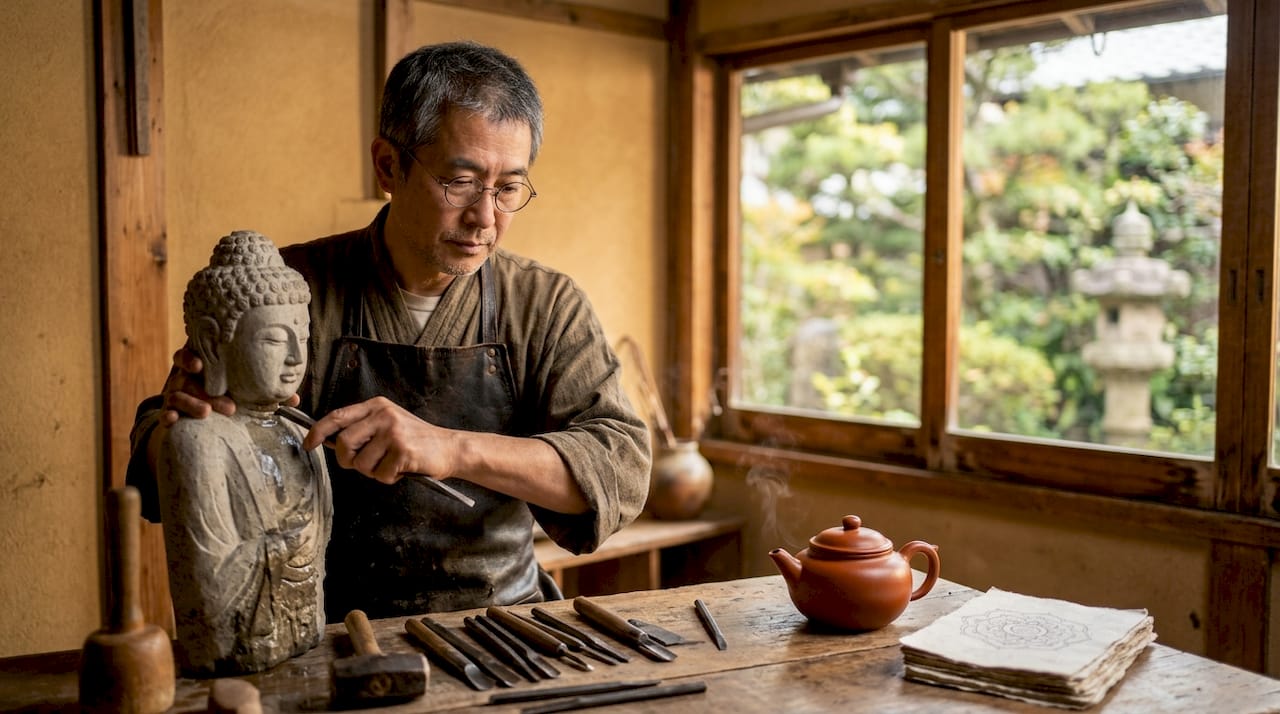
This detail is intentional, not conventional. Artists trained in iconographic traditions understood that fully closed eyes would signal sleep or death. Fully open eyes would suggest ordinary, distracted consciousness. The half-open position is the only one that communicates that specific state of balance.
The lips and smile
Buddha statues typically carry serene expressions with a gentle, barely perceptible smile and a lowered gaze. That smile does not represent happiness in the conventional sense. It represents equanimity: a state of inner stillness that does not depend on external circumstances. The smile says that compassion and peace coexist without contradiction.
“The gentle smile of the Northern Wei Buddha captures something modern portraiture rarely achieves: the appearance of a mind at rest that is simultaneously fully present.” — observation from Luoyang Museum catalog documentation
The lowered gaze directs the viewer’s attention inward. A statue whose eyes look down slightly is visually inviting reflection, not observation of the surrounding world.
Pro Tip: When examining a Buddha statue, cover the eyes and study the lips alone, then cover the lips and study the eyes. This isolates each feature’s contribution to the overall expression and trains your eye to read Buddhist iconography details more precisely.
Differences between Buddha and Bodhisattva expressions
This is one of the most underappreciated distinctions in Buddhist sculpture. The two types of figures are not interchangeable, and their facial expressions encode fundamentally different spiritual roles.
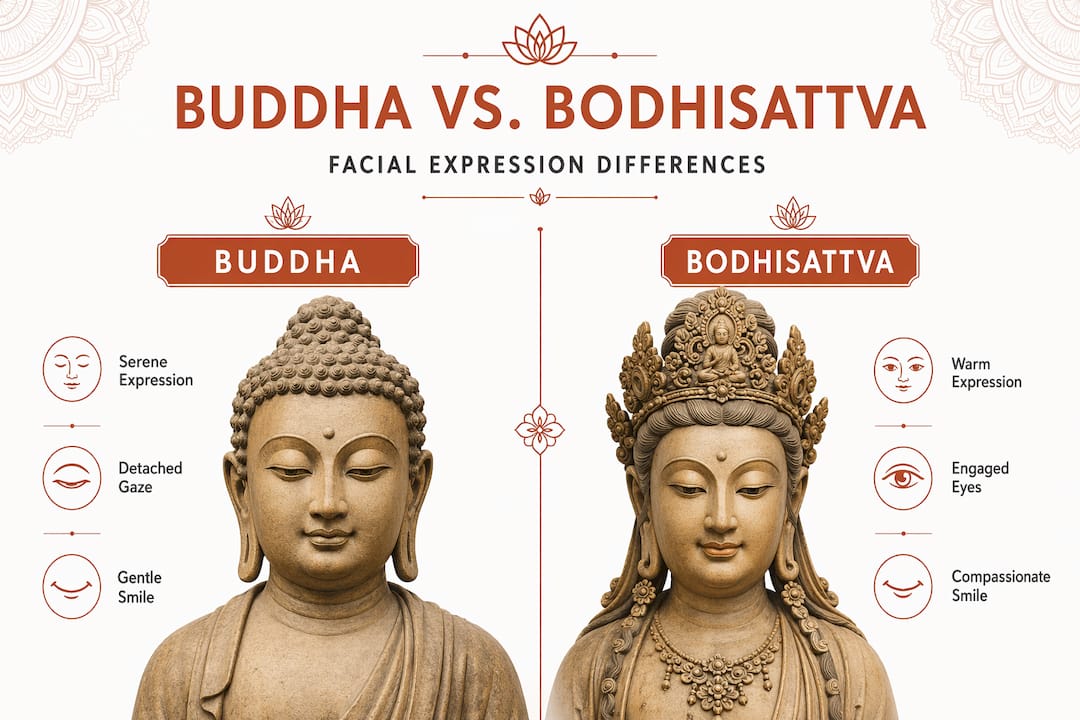
A Buddha, having achieved full enlightenment and passed beyond the cycle of rebirth, is depicted with a face that is passive, eternal, and indifferent to emotional fluctuation. The expression is timeless. It does not invite you to relate to it emotionally in the way a human face does. It represents a state that transcends ordinary feeling.
A Bodhisattva, by contrast, is a being who has chosen to remain accessible to the world out of compassion. Bodhisattva images show warmer, more expressive facial features, with attentive eyes, gently arched brows, and lips that carry a more visible expression of kindness. The face communicates active engagement, not transcendence. Avalokiteshvara (Guanyin in Chinese tradition) is a clear example: the face is approachable, soft, and emotionally readable.
| Feature | Buddha | Bodhisattva |
|---|---|---|
| Overall expression | Detached, timeless serenity | Warm, compassionate engagement |
| Eyes | Half-closed, inward focus | Often wider, more attentive |
| Smile | Subtle, equanimous | More visible, empathetic |
| Attire cues | Plain robes, minimal ornamentation | Jewelry, crowns, decorative detail |
| Emotional tone | Beyond emotion | Active compassion |
This distinction matters when you’re selecting a statue for a specific space or practice. A seated Amitabha Buddha with closed eyes suits a meditation context. An Avalokiteshvara with an open, compassionate expression suits a space dedicated to devotional practice or healing intention.
For more on Thai Buddha styles and how regional artistic conventions shape these distinctions in Southeast Asian statues specifically, the collector’s guide at HDAsianArt provides detailed regional breakdowns.
Psychological and cultural impact of these expressions
The effect of a Buddha’s face on a viewer is not merely aesthetic or spiritual. Research in psychology supports a mechanism behind it. Mimicry of facial expressions fosters trust and positive impressions, with smiling or serene faces more easily mirrored by observers and perceived as trustworthy. A Humboldt University study confirmed this effect: exposure to calm or gently smiling faces activates corresponding micro-expressions in the viewer, generating a feeling of safety and openness.
This is not incidental to Buddhist practice. Placing a statue in a meditation space and sitting with it is, from a neurological standpoint, a form of continuous low-level facial mimicry. The viewer’s nervous system responds to the calm face in front of them by shifting toward a calmer state. The statue’s expression becomes a tool for regulating the practitioner’s own internal experience.
Cultural transmission works through the same mechanism, scaled up. When the same iconographic conventions repeat across centuries and regions, the associated meanings become embedded in how communities respond to those images. The expressions do not need explanation for someone raised in that tradition. They communicate directly.
Four patterns emerge from documented observer responses to Buddhist statue expressions:
- Stillness: Viewers consistently report feeling less agitated in the presence of serene Buddha faces, regardless of their prior familiarity with Buddhism.
- Trust: The gentle downward gaze reads as non-threatening and is associated with perceived authority without aggression.
- Introspection: Half-closed eyes on a statue appear to turn the viewer’s attention inward rather than outward, functioning as a visual cue for reflection.
- Compassion activation: Bodhisattva expressions with warmer features elicit feelings of being acknowledged and cared for, which is consistent with their intended devotional function.
Understanding how Asian sculpture affects a space is directly relevant here. The face of a statue changes the atmosphere of a room in ways that go beyond decoration.
How to read and choose statues by facial expression
Applying this knowledge practically means training your eye to notice what most viewers skip over. Here is a structured approach for collectors and practitioners:
- Identify the figure type first. Before reading the expression, confirm whether you are looking at a Buddha or a Bodhisattva. The presence of jewelry, a crown, or elaborate ornamentation almost always signals a Bodhisattva. Plain robes point to a Buddha. The expression will mean different things depending on the figure’s identity.
- Read the eyes specifically. Check the degree of eyelid closure. Fully closed eyes typically appear on figures in deep meditation or nirvana states. Half-closed eyes signal active but detached awareness. Eyes cast downward signal compassion directed toward sentient beings.
- Note the smile’s intensity. A barely perceptible upturn of the lips is the classic Buddha expression: equanimity without sentiment. A more visible smile, especially on a Bodhisattva, communicates active warmth. A neutral or solemn expression can appear on wrathful protective figures, where the face signals power rather than peace.
- Consider the cultural context. A Thai Sukhothai-period Buddha face differs significantly from a Vietnamese Ly-dynasty face or a Cambodian Bayon-style face. Each tradition has its own conventions, and reading the expression accurately requires knowing the tradition’s visual grammar.
- Avoid the serenity trap. The most common misconception is equating any calm expression with enlightenment or spiritual quality. Mediocre reproductions often produce a bland, expressionless face that looks serene but communicates nothing. Authentic iconography has precision and subtlety. The features interact with each other. A genuine piece rewards close looking.
Pro Tip: When choosing a Buddha statue for a yoga studio or meditation room, look for a figure where the eyes and the lips work together. If one feature looks right but the other seems off, the piece likely lacks iconographic precision. The right statue for your practice space should feel complete, not assembled.
My take: why these faces deserve more than a glance
I’ve spent years studying Buddhist statues, and the observation that keeps proving true is this: most people treat the face of a Buddha statue the way they treat wallpaper. They register it as calm, find it pleasant, and move on. What they miss is that every one of those faces is making a specific argument about the nature of mind and compassion.
What strikes me is how often the face of a well-made statue changes on close inspection. A Guanyin that looks neutral from six feet away reveals a visible attentiveness when viewed from two feet. A Northern Wei Buddha that appears emotionless in a photograph carries an unmistakable quality of contained warmth when you sit with it. That gap between first impression and close reading is where the actual meaning lives.
The spiritual effectiveness of these objects is not accidental. It is the result of a tradition where artists, monks, and patrons worked together to encode doctrine into form. The face was the most powerful vehicle for that encoding because human beings are wired to read faces before anything else.
If you engage with a Buddhist statue contemplatively rather than decoratively, the face becomes the starting point. Sit with it. Let the eyes inform your own gaze. Notice how the expression settles into your awareness over time. That is not mysticism. It is the art doing exactly what it was designed to do.
— James. HDAsianArt.com
Explore authentic Buddhist statues at Hdasianart
HDAsianArt offers a curated selection of antique and traditional Buddhist statues sourced from Cambodia, Thailand, Indonesia, Sri Lanka, Vietnam, and across Asia. Each piece in the collection is individually researched and photographed, with detailed documentation covering iconographic features including facial expression, mudra, and regional style. For collectors and practitioners who want to engage seriously with Buddhist iconography, the difference between a reproduction and an authentic antique statue is visible in the face. Browse the full collection at HDAsianArt to find pieces where the craftsmanship and the doctrine meet at the highest level.
FAQ
What does a Buddhist statue’s facial expression communicate?
Buddhist statue expressions communicate specific spiritual states including meditation, compassion, and enlightenment through the precise positioning of the eyes, lips, and gaze.
Why are Buddha’s eyes half-closed?
Half-open eyes represent non-dual awareness, a state of balanced consciousness that is neither lost in internal meditation nor absorbed in external distraction.
How do Buddha and Bodhisattva expressions differ?
Buddhas carry detached, timeless expressions reflecting transcendence, while Bodhisattvas display warmer and more emotionally readable faces that communicate active compassion and accessibility.
Does a Buddhist statue’s expression affect the viewer?
Research on facial mimicry and trust shows that calm, gently smiling faces activate corresponding states in viewers, making the statue’s expression a functional tool in meditation and devotional settings.
How do regional styles change Buddhist facial expressions?
Regional traditions produced distinct conventions, from the gentle human warmth of Northern Wei Chinese statues to the composed authority of Khmer faces in Cambodia, each reflecting local theology and aesthetic values.
