



Spiritual Significance of Hindu Temple Art: A Complete Guide
The spiritual significance of hindu temple art extends far beyond aesthetic beauty. Every carved stone, painted wall, and architectural element carries layers of meaning rooted in ancient Hindu philosophy, cosmology, and spiritual practice.
This guide explores how temple art functions as a visual language for spiritual transcendence, examining the symbolism embedded in architecture, sculpture, and sacred geometry.
Table of Contents
How Temple Art Connects the Material and Spiritual Realms
Temple art transforms physical structures into portals for divine encounter. The temple functions as a three-dimensional mandala, mapping the relationship between the material world and the transcendent realm. When devotees enter, they embark on a symbolic journey from the external plane inward toward the sanctum sanctorum, where the divine resides, a progression mirroring the spiritual path from ignorance to enlightenment.
Hindu philosophy teaches that divinity permeates all existence, yet most people experience only the material surface. Temple art makes the invisible visible. Sculptural narratives carved into temple walls depict stories from the Puranas, functioning as teaching tools that communicate spiritual truths to all devotees.
The Garbhagriha and Sanctum Sanctorum: Heart of Divine Presence
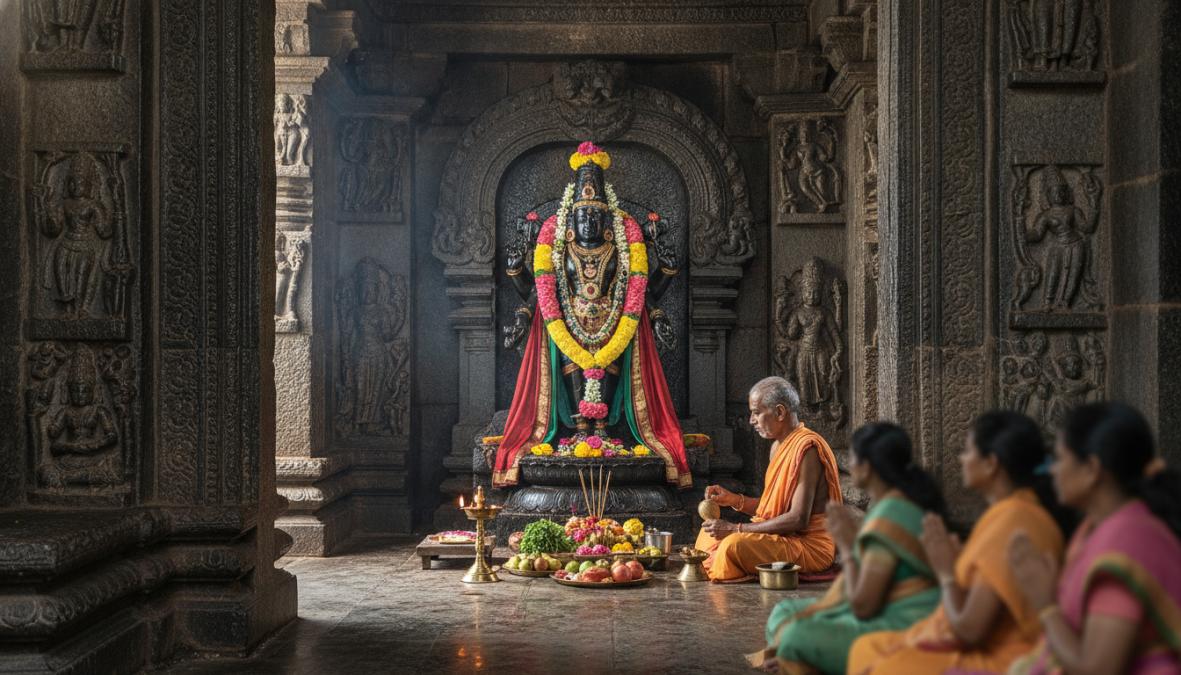
The garbhagriha, or sanctum sanctorum, represents the innermost chamber of a Hindu temple and the spiritual heart of the entire structure. The term literally means "womb chamber," emphasizing its role as the source of divine manifestation. This sacred space houses the primary deity idol and serves as the focal point where devotees experience darśana, the auspicious viewing of the divine.
The garbhagriha's enclosed darkness contrasts sharply with open outer courtyards, teaching that divinity is found in inner depths rather than external spectacle. Architecturally, it maintains precise proportions derived from Vastu Shastra, the ancient science of sacred geometry. The chamber is typically cubic, representing stability and the four cardinal directions. The deity typically faces east, the direction of sunrise and new beginnings, symbolizing eternal renewal of divine consciousness. Oil lamps create flickering shadows that seem to bring the stone sculpture to life, suggesting that divinity transcends static materiality.
Sacred Geometry and the Inner Sanctum
The sacred geometry of the garbhagriha reflects principles found throughout Hindu cosmology. The cube represents the material world and its four cardinal directions. By housing the deity within a cubic chamber, temples assert that divinity manifests within material reality. The threshold of the garbhagriha functions as a boundary between the ordinary and sacred. When devotees stand in the mandapa and gaze toward the garbhagriha, they participate in darśana across this sacred boundary.
Light treatment in the sanctum reveals sophisticated understanding of how environment shapes spiritual experience. Minimal natural light creates an atmosphere of mystery and interiority. When priests light oil lamps during rituals, flickering flames create movement and warmth, suggesting that the seemingly static idol embodies living divine presence.
Mount Meru, Cosmic Axis, and Temple Architecture
Mount Meru, the mythical cosmic mountain at the center of the universe according to Hindu cosmology, serves as the primary architectural metaphor for temple design. Every temple aspires to represent Mount Meru, the axis mundi connecting earth and heaven.
Hindu cosmology envisions Mount Meru surrounded by concentric rings of mountains and oceans. The temple replicates this cosmic geography through spatial organization. The garbhagriha represents the peak of Mount Meru, where divinity concentrates most intensely. Surrounding mandapas, courtyards, and outer walls represent progressively lower elevations, moving from the sacred center toward the material periphery.
This vertical cosmology reflects the Hindu understanding that consciousness operates in layers. Moving inward through the temple's spaces, one progresses through increasingly subtle levels of awareness, finally reaching the innermost sanctum where pure consciousness resides. Most Hindu temples face east, aligning with the path of the sun and the direction of illumination.
The Shikhara as Cosmic Mountain
The shikhara, the tower rising above the garbhagriha, represents the most visible manifestation of Mount Meru symbolism. This soaring structure dominates the temple's silhouette and serves as a beacon drawing devotees toward the sacred center.
The shikhara's conical or pyramidal shape echoes Mount Meru itself. As it rises skyward, it tapers progressively, suggesting ascent toward increasingly subtle and transcendent realms. The vertical thrust creates a visual pathway from earth to heaven, materializing the Hindu belief in a cosmic axis connecting different planes of reality. The shikhara's surface decoration amplifies its spiritual significance through intricate patterns and sculptural elements that become a microcosm of the entire temple.
Symbolism in Hindu Temple Architecture: Gopurams and Thresholds
Gopurams, the monumental gateway towers found in South Indian temples, represent crucial elements of temple symbolism. These towering structures often exceed the height of the main temple itself, creating dramatic entrances that announce the sacred space's presence.
The gopuram functions as a threshold between the secular and sacred worlds. Its massive size and elaborate decoration communicate that one is about to enter a fundamentally different space. The sculptural program covering gopuram surfaces tells stories of deities and cosmic events, serving a pedagogical function as devotees move through the gateway.
Gopurams typically feature multiple tiers, each diminishing slightly in size as it rises. This stepped progression creates visual movement upward, reinforcing the spiritual ascent theme central to temple symbolism. The threshold concept extends throughout temple architecture, with every gateway, doorway, and architectural boundary marking a transition between different levels of spiritual intensity.
| Architectural Element | Spiritual Function | Symbolic Meaning |
|---|---|---|
| Gopuram | Gateway marking entry to sacred space | Transition from material to spiritual realm |
| Garbhagriha | Chamber housing deity | Peak of Mount Meru; center of divine presence |
| Shikhara | Tower above sanctum | Cosmic mountain connecting earth and heaven |
| Mandapa | Pillared hall | Intermediate space for ritual and gathering |
| Threshold | Boundary between spaces | Progression toward increasing spiritual intensity |
Hindu Temple Iconography Explained: Deities and Divine Narratives
Temple sculpture communicates theological concepts through visual language accessible to all devotees. Each deity carries specific symbolic associations and attributes that teach spiritual truths. Shiva typically appears with a third eye, symbolizing transcendent vision. Vishnu carries a conch and discus, representing cosmic sound and the wheel of time. Devi appears in multiple forms, fierce Durga, nurturing Parvati, or compassionate Lakshmi.
Hand gestures, or mudras, carry specific meanings. The abhaya mudra, with palm raised in blessing, communicates fearlessness and divine protection. The varada mudra, with palm downward in offering, suggests generosity and fulfillment of wishes.
Puranic Stories Carved in Stone
The walls of Hindu temples become open-air libraries where the Puranas, ancient sacred narratives, are carved into stone. These sculptural narratives educate devotees about sacred stories and create a visual atmosphere supporting spiritual practice. The story of Krishna's divine childhood frequently appears in temple sculpture, communicating theological truths about divine play and grace. The Ramayana provides extensive material for sculptural programs, with scenes illustrating principles of dharma, devotion, and the ultimate victory of good over evil.
Sculptural Language and Spiritual Meaning
Temple sculpture develops a sophisticated visual language through which abstract spiritual concepts become tangible. A deity depicted with multiple arms isn't anatomically realistic but spiritually significant, the additional limbs suggest supernatural power and the ability to act simultaneously in multiple dimensions of reality.
Sculptural proportion follows principles derived from ancient texts like the Shilpa Shastras, which establish ideal proportions for depicting different deities. Facial expressions convey the emotional and spiritual quality of different deities. Shiva's serene expression suggests transcendent detachment, while Durga's fierce expression communicates divine wrath directed against ignorance and evil.
Vastu Shastra and Temple Architecture: Sacred Geometry Principles
Vastu Shastra, the ancient Hindu science of architecture and spatial arrangement, provides the theoretical foundation underlying temple design. Rather than being merely decorative or practical, every architectural decision reflects cosmological principles and beliefs about how physical space affects consciousness.
The cardinal directions hold primary importance in Vastu Shastra. East represents illumination and wisdom. South represents strength. West represents completion. North represents prosperity. Temple orientation and the placement of functional spaces reflect these directional associations. Proportional relationships in Vastu Shastra derive from numerical sequences found throughout nature and mathematics, including the golden ratio and Fibonacci sequence.
Cosmic Order in Architectural Design
The principle of cosmic order, or rita in Sanskrit, underlies all Vastu Shastra applications. By designing temples according to cosmic principles, architects attempt to create microcosms that reflect and support the larger cosmic order.
This principle appears most clearly in the mandala-like floor plans of many temples. The square, representing the material world and its four cardinal directions, forms the basic unit of temple planning. Concentric squares, circles, and other geometric forms create complex patterns that map cosmic relationships. Bilateral symmetry creates a sense of balance and completeness. The relationship between interior and exterior spaces reflects the Hindu philosophical principle that divinity permeates both material and subtle dimensions of reality.
Darśana: The Sacred Act of Seeing and Spiritual Experience
Darśana, the Sanskrit term for "viewing," represents one of the most fundamental spiritual practices within Hindu temple worship. It refers to a sacred encounter with divinity in which both the deity and devotee are transformed through mutual recognition and blessing.
The architectural design of temples facilitates darśana by creating sightlines that guide the devotee's gaze toward the deity. The progression through gopurams, courtyards, and mandapas progressively narrows the field of vision, focusing attention on the garbhagriha. The moment of darśana, when the devotee's eyes meet the idol's, represents the climax of the temple visit. Priests perform ceremonies involving light, sound, and fragrance. Oil lamps illuminate the deity. Bells ring, creating vibrations believed to attune consciousness to spiritual frequencies.
How Temple Art Facilitates Divine Encounter
Temple art functions as more than decoration; it actively facilitates the spiritual experience of darśana. Sculptural representations of deities surrounding the garbhagriha create an atmosphere saturated with divine presence. The artistic depiction of divine narratives creates psychological preparation for darśana. A devotee moved to tears by carved beauty experiences a softening of ego-boundaries that normally separate individual consciousness from universal awareness.
Regional Variations in Temple Symbolism: Nagara, Dravidian, and Vesara
The spiritual significance of hindu temple art manifests differently across India's diverse regional traditions. The three primary architectural styles, Nagara, Dravidian, and Vesara, each developed distinct approaches to expressing spiritual concepts through architecture and art.
Nagara architecture, dominant in North India, emphasizes the shikhara's upward thrust and curvilinear form. The Nagara shikhara appears to ascend toward infinity, its curved profile suggesting the eternal upward movement of consciousness toward transcendence. Dravidian architecture, characteristic of South India, features gopurams that dominate the temple's visual presence. Vesara architecture, found in Central and Western India, represents a synthesis of Nagara and Dravidian principles.
Despite these regional variations, all three traditions share fundamental commitments to expressing spiritual concepts through architecture and art. All create vertical emphasis suggesting ascent toward transcendence. All incorporate sculptural programs communicating sacred narratives. All employ proportional systems derived from Vastu Shastra principles.
| Architectural Style | Primary Region | Key Features | Spiritual Emphasis |
|---|---|---|---|
| Nagara | North India | Curvilinear shikhara, integrated sculpture | Upward ascent toward transcendence |
| Dravidian | South India | Gopurams, narrative reliefs, multiple towers | Graduated progression toward sacred center |
| Vesara | Central/Western India | Hybrid forms, synthesis of traditions | Integration of multiple spiritual approaches |
The spiritual significance of hindu temple art reveals itself as a comprehensive system for facilitating spiritual experience and communicating sacred knowledge. Every architectural element, sculptural detail, and spatial arrangement serves this fundamental purpose. Whether you're seeking antique temple sculptures or contemporary pieces, carefully curated collections honor the spiritual traditions embedded in Hindu temple art, bringing refined spiritual energy into contemporary spaces.
Frequently Asked Questions
What is the spiritual significance of Hindu temple art and symbolism?
Hindu temple art embodies spiritual principles that connect the material world to the divine realm. Every element, from the Garbhagriha (sanctum sanctorum) to sculptural narratives, serves a sacred purpose. The spiritual significance of Hindu temple art lies in its role as a visual pathway to moksha (liberation), using sacred geometry, iconography, and architectural design to facilitate Darśana (divine vision) and help devotees transcend the material world through aesthetic and spiritual experience.
How does Vastu Shastra influence the spiritual meaning of temple design?
Vastu Shastra, the ancient Hindu science of architecture, governs temple layout to align with cosmic order and natural energies. This system determines the placement of the Garbhagriha at the temple's center, the orientation toward cardinal directions, and proportional relationships between structures. By following Vastu principles, temples create a microcosm of the universe, ensuring that the architectural design itself becomes a spiritual tool that channels divine energy and promotes meditation and transcendence within the sacred space.
What do the different deities and sculptures in Hindu temples represent?
Hindu temple iconography uses deity representations and sculptural narratives to teach spiritual philosophy and Puranic stories. Each carved figure, whether Brahma, Vishnu, Shiva, or their manifestations, embodies specific spiritual qualities and cosmic functions. The iconography serves as visual scripture, allowing illiterate and literate devotees alike to understand Hindu philosophy through sacred imagery. Sculptural narratives on temple walls depict mythological stories that illustrate dharma (cosmic order) and the path to spiritual enlightenment.
How does temple architecture create a psychological and spiritual experience for devotees?
Temple architecture uses sacred geometry and spatial design to profoundly influence the devotee's psychological and spiritual state. The progression from outer gopurams through mandapas to the inner Garbhagriha creates an inward journey mirroring spiritual ascent. The shikhara's upward thrust symbolizes Mount Meru and cosmic ascension. Intricate carvings, proportional relationships based on Vastu Shastra, and carefully orchestrated thresholds work together to calm the mind, focus intention, and facilitate Darśana, the transformative experience of encountering the divine through seeing and being seen by the deity
